Exorbitantly Bold! Liang Wenfeng Invests 20 Billion Yuan of His Own Funds and Imposes 'Dictatorial Terms'
 06/22 2026
 547
547
In recent times, China's AI sector has been set abuzz by a groundbreaking announcement.
According to Tianyancha, on June 15th, DeepSeek's parent company, Hangzhou DeepSeek, announced a new Series A financing round valued at approximately 51 billion yuan, catapulting its post-money valuation to a staggering 400 billion yuan.
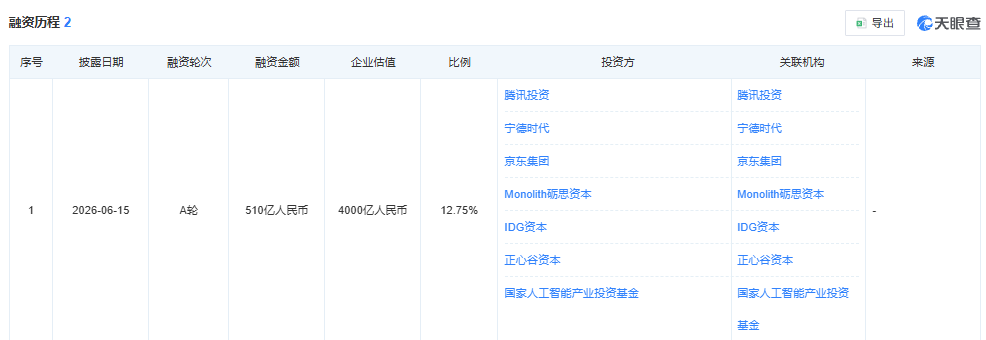
This scale of funding has directly shattered China's AI industry's single-funding record. While outsiders initially speculated that Wall Street investment banks or state-backed funds were 'splashing the cash,' a closer examination revealed that the largest investor was none other than the company's founder, Liang Wenfeng.
As reported by the 21st Century Business Herald, of the more than 50 billion yuan raised, Liang Wenfeng personally contributed 20 billion yuan directly, accounting for a substantial 40%.
As is widely recognized, Liang Wenfeng amassed his initial fortune through quantitative investment, transforming an 80,000 yuan initial stake into a personal contribution of 20 billion yuan to DeepSeek. In his perspective, perhaps this money is merely 'fuel to propel his ambitions.'
By investing his own cash, he is making a clear statement: 'DeepSeek needs funding, but I must retain control.'
It appears that the outside world has still underestimated Liang Wenfeng's financial prowess. Even more remarkable is that he orchestrated 'unconventional tactics' in this financing round to further cement his control.
1. Betting 20 Billion Yuan in One Fell Swoop: Just How Deep Are Liang Wenfeng's Pockets?
Liang Wenfeng's wealth primarily stems from his original domain—High-Flyer Quantitative, one of China's 'Four Heavenly Kings' in the quantitative private equity sector.
As early as 2008, he embarked on his quantitative investment journey with an 80,000 yuan principal. By the time High-Flyer Quantitative was established in 2015, he had already ascended to the ranks of billionaires, boasting a compound annual return rate exceeding 100%.
According to Red Star Capital Bureau, High-Flyer Quantitative now manages over 70 billion yuan and has been closed to new investments for three years, refusing additional capital inflows and opting for a controlled growth strategy. Staff members explain, 'We aim to maintain a manageable scale.'
Just how lucrative is this business?
In 2025, High-Flyer Quantitative achieved a full-year return rate of 56.6%, aiding clients in earning nearly 39.6 billion yuan in China's A-share market.
Private Equity Ranking reveals that among High-Flyer Quantitative's products disclosing relevant data, all achieved returns exceeding 50% in 2025, with multiple products boasting returns surpassing 300% since inception. For instance, 'Jiuzhang High-Flyer CSI 500 Quantitative Aggressive No. 1' has delivered a 564.76% return since inception and a 60.42% return in the past year.
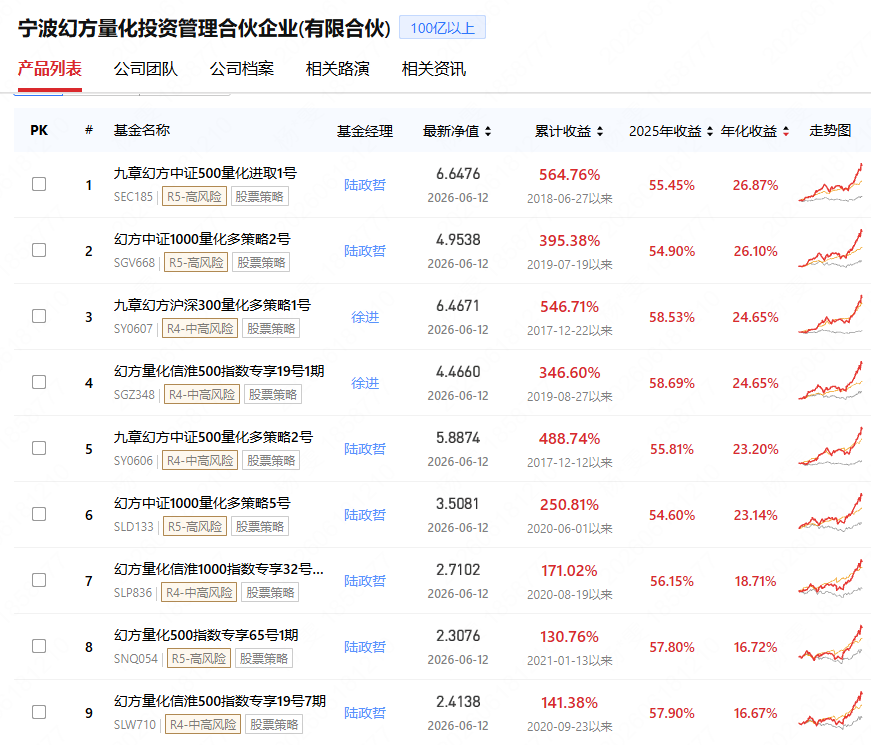
Beyond high return rates, what truly makes the market envious is High-Flyer's near-'money-printing' profitability.
Based on the prevalent private equity model of '1% management fee + 20% performance fee,' High-Flyer's annual revenue exceeds 8 billion yuan. With Liang Wenfeng holding an 85% stake, dividends and equity returns over a decade render his 20 billion yuan contribution a mere drop in the bucket.
Had Liang Wenfeng personally invested in High-Flyer's products, his earnings would have been even higher.
In essence, he is utilizing the steady income from quantitative trading to finance AI's long-term expenditures. This 'cross-subsidization' approach grants him a serenity rooted in financial stability, unlike AI founders who are constantly pursued by capital.
2. Why Does Cash-Rich DeepSeek Require Financing?
If they are not short on cash, why raise additional funds?
In fact, this marks a pivotal shift in Liang Wenfeng's strategy from 'technological idealism' to 'commercial pragmatism.'
Firstly, computing power is a significant expense. DeepSeek needs to construct its own intelligent computing center and adapt to domestic chips. Relying solely on High-Flyer's profits, while sufficient, does not provide complete peace of mind.
Secondly, talent acquisition is costly. DeepSeek's R1 core author, Guo Daya, was poached by ByteDance, while V3 architect Luo Fuli joined Xiaomi, lured by salaries 2-3 times higher. Liang's financing provides employees with an 'valuation anchor'—their stock options are now highly valuable, offering reassurance and stability.
Thirdly, upgrading the strategic positioning. Previously positioned as a 'research laboratory,' DeepSeek now aspires to become a 'national-level AI infrastructure.' It requires collaboration with Tencent's cloud services, CATL's new energy scenarios, JD's logistics data, etc. Financing is about enlisting industrial capital as ecological allies, not as controllers.
3. Liang Wenfeng's 'Dictatorial Terms'
Besides Liang Wenfeng, other major investors include Tencent (10 billion yuan), CATL (5 billion yuan), NetEase, JD, and IDG Capital (3 billion yuan each), with the National Large Fund contributing 1 billion yuan.
The most intriguing aspect? While ordinary entrepreneurs bow to investors' demands, Liang Wenfeng dares to set his own 'rules.'
Except for the National Large Fund, other investors' funds cannot directly enter DeepSeek's main entity but instead flow into a limited partnership managed by Liang Wenfeng. They possess no voting rights and cannot interfere in decision-making; equity is locked for five years, prohibiting short-term cash-outs; even 'LP identity checks' are conducted to prevent tainted money from entering.
Only the National Large Fund enjoys direct investment and voting rights.
This highly unconventional financing arrangement preserves Liang Wenfeng's absolute control while securing industrial resources and national strategic support.
Consider that today's OpenAI and Anthropic are heavily influenced by capital and commercialization pressures—something Liang Wenfeng is determined to avoid. By self-investing 20 billion yuan, he has earned the right to remain 'unyielding,' ignoring capital's demands and refusing to sacrifice technical routes for financial gain.
After this financing round, DeepSeek's valuation has soared to 400 billion yuan, solidifying its position in China's AI large model first tier.
For the general public, understanding quantitative models or MoE architectures is not essential. Just recognize that in an era where everyone rushes for trends and quick profits, Liang Wenfeng has charted a counterintuitive path.
With 20 billion yuan in actual cash and nearly dictatorial terms, he declares to capital: On the AGI (Artificial General Intelligence) stage, money is merely an entry ticket. The true throne belongs only to 'visionaries' who relentlessly pursue technology and never relinquish control.
Deep Blue Finance New Media Cluster originated from the Deep Blue Finance Journalist Community, boasting a 15-year history. As a renowned domestic financial new media outlet, its accounts focus on China's most valuable companies, cutting-edge industry developments, and emerging regional economies, providing valuable content for investors, corporate executives, and the middle class. Welcome to follow.
-
![]()
Dreame Technology Implements Major Strategic Retrenchment Amid Controversy: Retains Four Core Sectors, Continues Pursuit of Car Manufacturing
-
![]()
AI Phones Haven't Gone Mainstream Yet, and Now Agent Phones Are Taking Off? A Deep Dive into the AI Strategies of Eight Mobile Giants
-
![]()
AI Smartphones Haven't Gone Mainstream Yet, But Agent Smartphones Are Already Taking Off? Breaking Down the AI Strategies of Eight Smartphone Giants
-
![]()
Mega Review of 2026 Mid-Range Smartphones: Post Price Hikes, Which Model Reigns Supreme Among vivo, OPPO, Honor, and Xiaomi in the 3000 Yuan Bracket?
-
![]()
Without the Support of These Companies, SpaceX Would Struggle to Launch Rockets!
-
![]()
Enflame Technology Clears IPO Hurdle: A Daring Venture into CUDA-Incompatible Realm
-
![]()
Significant Shifts in Home Appliance Market Trends During This Year’s 618 Shopping Festival
-
![]()
Insta360 Fights Back! Standing Up to Black PR Operations", "Insta360 Innovation, Black PR Operations, Patent Litigation, Market Competition, Financial Performance", "Insta360 Innovation, targeted by b