Without the Support of These Companies, SpaceX Would Struggle to Launch Rockets!
 06/22 2026
 571
571
The Untold Stories of the Gold Rush Pioneers!
Produced by | Meigang Detective
When gold was first discovered at Sutter's Mill in 1848, the individual who reaped the greatest rewards from the gold rush never actually panned for gold himself.
Samuel Brannan, a Mormon with a knack for theatrics, discreetly acquired every pickaxe, gold pan, and shovel available in San Francisco. He then paraded through the streets, brandishing a vial of gold dust and declaring that he had cornered the market on gold-mining equipment.
A metal gold pan that cost him a mere 20 cents was sold for $15.
Years later, a Bavarian merchant named Levi Strauss, the inventor of jeans, observed that miners were constantly tearing their pants. In response, he reinforced the seams with rivets.
Brannan became California's first millionaire, while the company founded by Levi Strauss has outlasted every mine in the state.
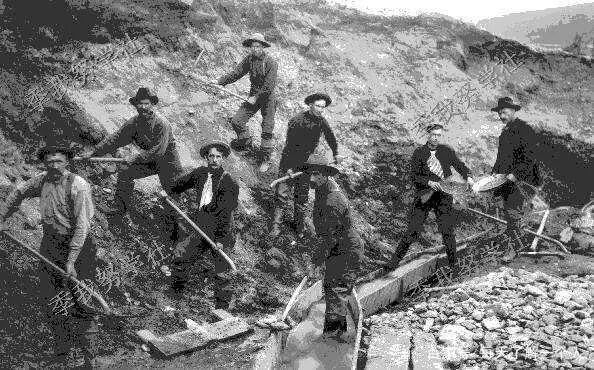
However, most gold prospectors returned home empty-handed, burdened only with sunburns and debt.
History has repeatedly shouted this lesson, yet it seems we never heed it.
From a financial perspective, the gold rush was essentially a mechanism for transferring wealth from the masses, who were chasing after metal, to the few who provided the necessary tools.
This brings us to today's most captivating scenario: SpaceX has just executed the largest initial public offering (IPO) in history, with a stock price valued at approximately 94 times its annual revenue.
Purchasing SpaceX shares at this price is akin to paying for nearly a century's worth of sales—and joining forces with millions of retail investors who are flocking to the party at its peak. The vast potential of space may indeed hold immense fortunes.
The question worth pondering is whether the most astute way to tap into that wealth is by buying the most expensive ticket.
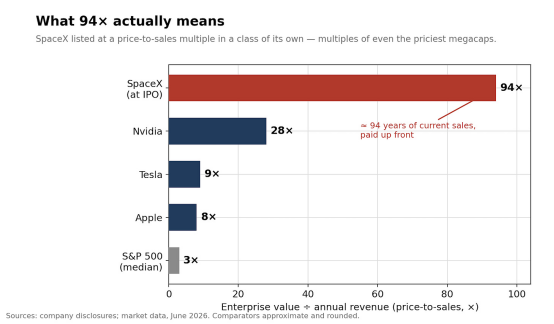
Source: Company disclosures; market data as of June 2026. Figures are approximate. Claude Glunder
Instead, consider the unassuming yet indispensable companies that support SpaceX—modern-day equivalents of Brannan's shovels, operating behind the scenes.
Lightweight Structures – Hexcel (HXL)
Every kilogram saved can be utilized to carry additional fuel or payload. Therefore, lightweighting is crucial for space exploration.
Hexcel manufactures lightweight carbon fiber composites and structures for satellites, solar arrays, launch vehicles, and other space systems, aiding companies in reducing weight. It already supplies SpaceX and boasts decades of experience in deep space.
Think of Hexcel as the foundational materials science layer that supports the entire space infrastructure.
Power Generation and Thermal Management – Redwire (RDW)
Recall the two primary features of SpaceX's AI1 satellite design: solar panels and radiators.
Power generation and thermal management are key architectural elements for space-based data center satellites, and Redwire provides both. Its deployable solar array technology already powers the International Space Station and dominates the deployable structure market. The company also manufactures deployable radiators, docking hardware, and on-orbit assembly equipment.
It acts as a cargo supplier to SpaceX and secured a contract to provide solar panels for Axiom's commercial space station. Redwire even published a white paper on power and thermal management for scalable orbital data center architectures.
This represents one of the cleaner, more direct avenues to potentially profit from space-based AI.
Power Delivery – Vicor (VICR)
Once electricity is generated, a device must efficiently convert and deliver it to AI chips inside satellites, even in the harsh environment of space.
This is Vicor's area of expertise. It produces radiation-hardened modular power solutions specifically designed for LEO (Low Earth Orbit) and MEO (Medium Earth Orbit) satellites: efficient, high-density voltage conversion tailored for advanced processors in space.
As AI chips become increasingly power-dense, Vicor emerges as one of the most concrete solutions on this list.
Radiation-Hardened Electronics and Memory – Mercury Systems (MRCY) and Teledyne (TDY)
While AI chips may dominate the headlines, every AI data center satellite requires reliable supporting hardware—memory, storage, and data processing systems capable of withstanding radiation interference. Mercury Systems specializes in this field, with extensive experience on the International Space Station and U.S. Space Development Agency projects.
Teledyne complements this role with its expertise in sensors, having participated in more than 260 space missions.
Ground Support – Kratos Defense & Security Solutions (KTOS) and Viasat (VSAT)
Most satellites in orbit cannot perform any useful tasks without instructions from—and data received by—ground crews. Kratos builds precisely these ground systems: antennas, command software, tracking networks, and more.
Kratos' ground technology already supports over 85% of U.S. space missions and roughly 75% of commercial satellite operations.
Viasat handles the connectivity and secure relay aspects, providing it, like Kratos, with recurring revenue within the same underlying infrastructure.
With thousands of new satellites flooding into orbit, both companies are poised to benefit, as every satellite requires a ground station to communicate with Earth.
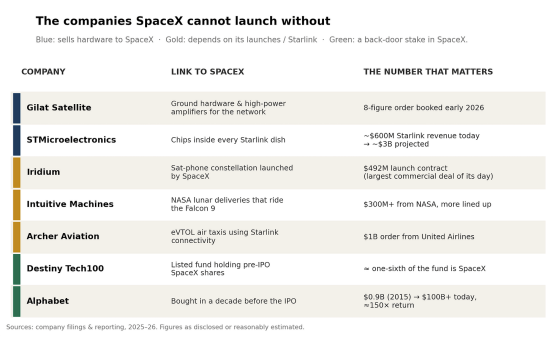
Source: Company filings and reports, 2025–2026; figures are disclosed or estimated. Claude Glunder | PTT Research
This pattern extends far beyond rockets. Every infrastructure boom gives rise to a multitude of anonymous suppliers: companies that sold rails and rolling stock to railroad magnates, manufacturers that provided cables and switches for telecom networks, and chip designers who once marketed gaming hardware but now supply critical chips for AI development.
The glamorous operators bear the media spotlight and endure stomach-churning market fluctuations; the suppliers, on the other hand, profit from the activity itself.
Investors tend to obsessively remember the shining stars but overlook the names on the invoices—which is often precisely why the invoices ultimately prove to be the wiser investment.
Prospectors bet that a particular claim holds gold. Mining companies bet that people will keep digging—a safer wager that pays off whether or not gold is ever found.
Levi Strauss & Co. still trades on the New York Stock Exchange, 170 years after its founder realized that the real business opportunity in the gold rush lay in producing sturdier jeans.
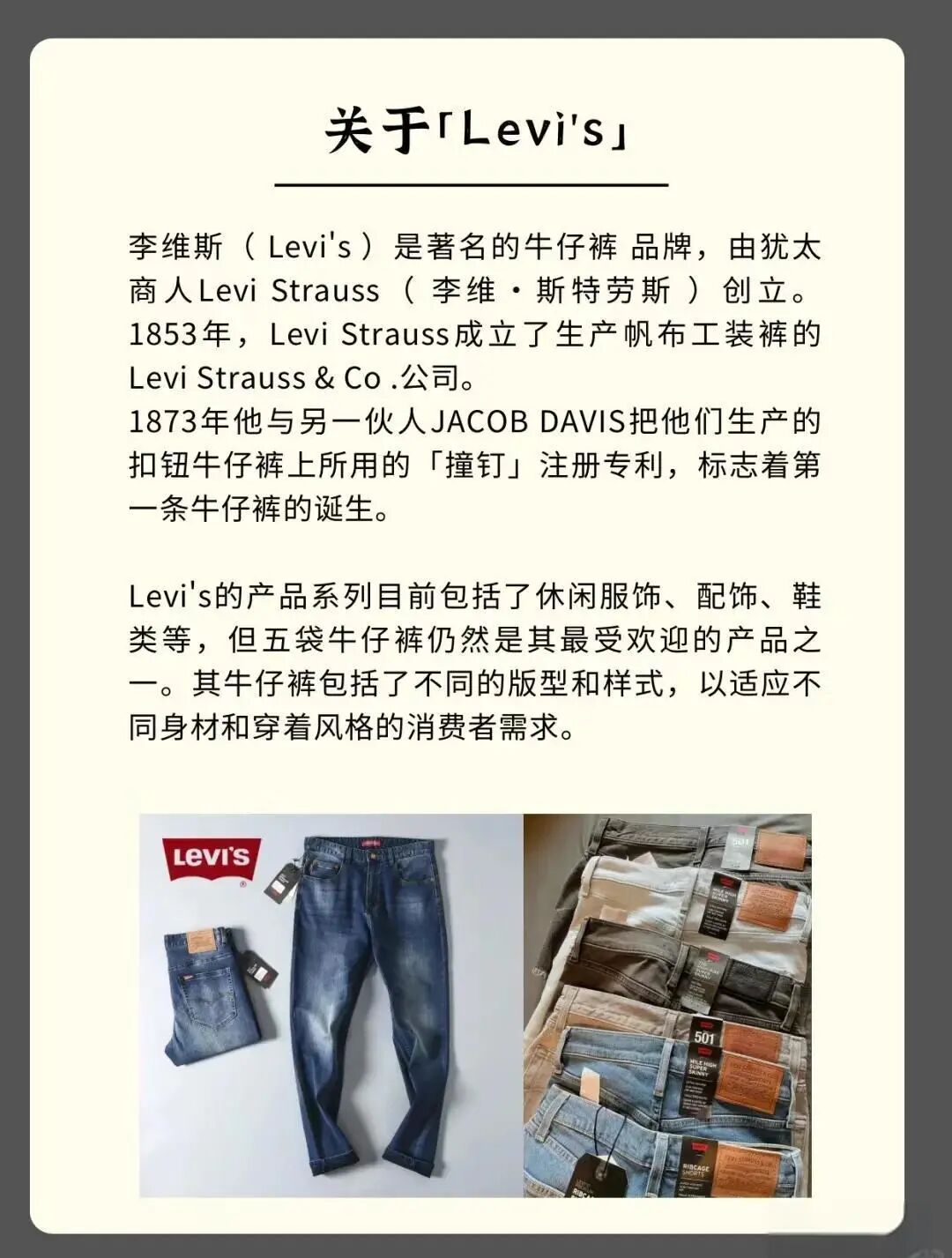
The miners of 1849 have long since turned to dust. The company that sold them jeans is still in business.
As millions prepare to pay top dollar for history's most famous rocket, it's worth recalling who ultimately made money in that ancient tale.

Disclaimer: This article is based on the public company attributes of listed companies. Meigang Detective strives to ensure that the content and viewpoints presented are objective and fair, but does not guarantee their accuracy, completeness, or timeliness. The information or opinions expressed in this article do not constitute any investment advice, and Meigang Detective assumes no responsibility for any actions taken based on the use of this article.
-
![]()
Proposed to Raise 955 Million Yuan through Private Placement! Huicheng Vacuum Boosts Localization of Ultra-Precision Optical Coating Equipment
-
![]()
Cash Flow Soars 13-Fold! What Major Strategic Move is Wuhan Five Square Optoelectronics Planning?
-
![]()
Leaked Design of vivo X500: Reverts to Circular Camera Module in Top-Left Corner, Pays Homage to Classic X90 Aesthetic
-
![]()
DeepSeek Shows Signs of Foraying into Code Agents, Launches WeChat Official Account Focused on Harness
-
![]()
Auto Companies Deny Claims That ‘Cooperation with Huawei Is Non-Essential’, as Huawei Transforms into a ‘Public Platform’
-
![]()
Starship to Independently 'Return to the Launch Tower': SpaceX's Ambitions Extend Beyond Rocket Building to Dominating Space Transportation
-
![]()
Starship Set to Independently 'Return to the Launch Tower': SpaceX is Revolutionizing Space Transportation, Not Just Building Rockets
-
![]()
Anthropic and OpenAI Face Off Against Deepseek