Alibaba and Zhou Jingren: A Mutual Need or a Parting of Ways?
 06/24 2026
 418
418
By Wang Huiying
Edited by Ziye
At the 2017 Apsara Conference, Jack Ma announced the establishment of the DAMO Academy, pledging to invest over 100 billion yuan in technological R&D within the next three years.
In the ensuing two years, the DAMO Academy brought on board 13 eminent scientists to spearhead key domains such as machine intelligence, data computing, robotics, fintech, and quantum computing. Dubbed the "Thirteen Guardians of DAMO Academy" by outsiders, they quickly made their mark.
In Jin Yong's martial arts novels, the Guardian is a hidden master in the Scripture Depository, quietly sweeping fallen leaves in the corner yet capable of taking on multiple foes and turning the tide when he strikes. Jack Ma, with a passion for martial arts, envisioned the DAMO Academy as an enduring legacy, outlasting Alibaba itself.
Nearly nine years have elapsed, and while the DAMO Academy continues to shine, most of the original thirteen have moved on. Some have sought new challenges, while others have faded from the core spotlight. Among them, only Li Feifei, who joined Alibaba in 2018, and Zhou Jingren have remained steadfast.

Image source: DAMO Academy WeChat Official Account
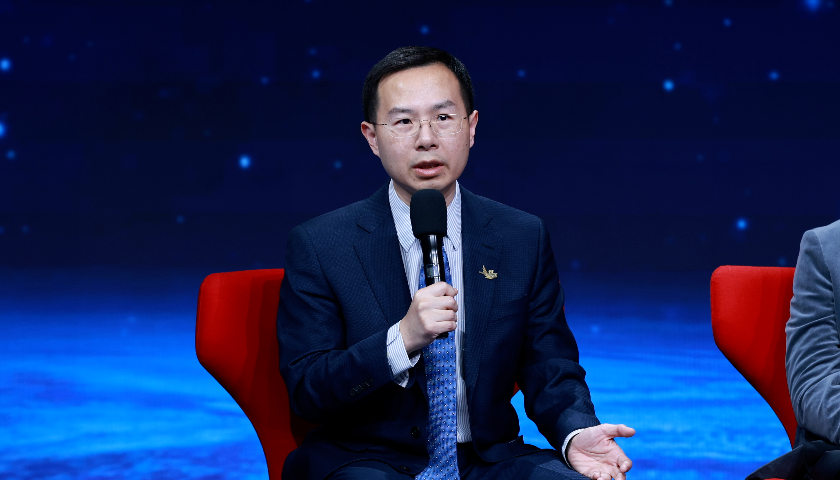
Like a steadfast guardian of a city, Zhou Jingren has witnessed the departure of batch after batch of colleagues, standing alone at the forefront of technological waves.
From the foundational era of cloud computing to the data intelligence era of e-commerce and finance, and then to the era of large models, he has accurately anticipated and navigated each technological shift, withstanding immense pressure. His appointment as an Alibaba partner in 2025 was a testament to this perseverance.
However, in 2026, Alibaba AI underwent a dramatic restructuring. In April, Lin Junyang, the technical mastermind behind Tongyi Qianwen, departed. In June, after three consecutive role adjustments within three months, rumors surfaced that Zhou Jingren was also on his way out.
Although Alibaba subsequently denied these rumors, a deeper question lingered: As Alibaba AI's strategic focus shifts from technological breakthroughs to commercialization, and as its decentralized R&D system moves toward a centralized governance structure, does Alibaba still need Zhou Jingren? Or, is Zhou Jingren willing to adapt to the organization's evolving needs?
To understand this, we must delve into the past decade of Zhou Jingren's journey with Alibaba AI.

Three Adjustments in Three Months: Is Zhou Jingren Being Sidelined?
In just seven days, the fate of Alibaba's Chief Scientist Zhou Jingren became the most talked-about "rumor" in China's AI circle.
The timeline traces back to early June.
On June 8, Alibaba announced that Zhou Jingren, head of the Tongyi Large Model Business Unit, would assume the role of Alibaba's Chief Scientist.
However, within Alibaba, Zhou Jingren did not find himself in the expected position. On the same day, Alibaba announced another major move: merging the Tongyi Large Model Business Unit and the Future Living Lab to establish the Token Foundry Business Unit, directly overseen by Group CEO Wu Yongming.
In essence, the core model R&D team previously under Zhou Jingren's purview was entirely transferred to this new AI business unit, now directly managed by the CEO. Meanwhile, Zhou Jingren was tasked with exploring cutting-edge technologies.
From overseeing the core R&D of the Tongyi Large Model Business Unit to focusing on cutting-edge exploration at the AI Future Research Institute, many industry insiders interpreted this as a sign that he no longer held concrete operational power.
Speculation about being sidelined reached a fever pitch on June 12. Just four days after assuming his new role, rumors swirled that "Zhou Jingren was leaving."
Interestingly, Alibaba did not respond immediately. Instead, its reply came two days later, stating that "Zhou Jingren's resignation" was purely a rumor: "We have noticed that someone has been organizing the spread of this rumor online in recent days and call on everyone not to disseminate false information."
Even with Alibaba's denial, the dramatic events continued to unsettle the outside world.
The first domino in this personnel shakeup fell quietly three months earlier.
In early March, Lin Junyang, the core architecture leader of Tongyi Qianwen and the key operator of the Qwen model, confirmed his departure. Along with him, core members from multiple teams, including post-training and code models, also left. This technical team, which had propelled Tongyi to the pinnacle of global open-source models, lost nearly half its members overnight, leaving Alibaba's large model R&D frontline leaderless.
Image source: Alibaba Cloud Official Website
Zhou Jingren was called upon in this crisis. At the time, he was still Alibaba Cloud's CTO and Vice President of the DAMO Academy. As the overall technical leader, he urgently took over the Qwen core technical team, stabilizing the R&D situation. This was his first role adjustment in 2026, more akin to a firefighting substitution than an expansion of power.
A month later, on April 8, Wu Yongming issued an internal letter to all employees, initiating the second round of AI organizational restructuring: A Technology Committee was established at the group level, with Wu Yongming personally serving as its leader, and Zhou Jingren appointed as Chief AI Architect. Simultaneously, the Tongyi Lab was upgraded to an independent Tongyi Large Model Business Unit, fully overseen by Zhou Jingren.
This time, he officially stepped down as Alibaba Cloud's CTO, shifting from the cloud business's technical leadership to AI technology top-level design at the group level. His role transformed from the technical leader of the cloud business to Alibaba's top AI figure, marking a significant promotion.
Independent from Alibaba Cloud and elevated to group strategic importance, Tongyi's restructuring signified Alibaba's commitment to concentrating resources on AI. Zhou Jingren, as the technical core, was pushed to an even more central position.
However, few realized that this was merely an intermediate step in the centralized adjustment. Eventually, the Token Foundry was established, completing Alibaba's three-step centralization of AI at the group level. As AI reporting lines shortened, power further consolidated under Wu Yongming.

This determined that while Zhou Jingren's titles continued to rise, his actual power clearly contracted. The rapid pace of adjustments and the obvious shifts in power boundaries left Zhou Jingren virtually sidelined from the core battlefield.
From start to finish, unlike Lin Junyang's highly personal response, Zhou Jingren himself rarely responded. Perhaps he had long grown accustomed to such twists and turns.
Last April, as Alibaba launched its AI offensive, Zhou Jingren remarked in a conversation with LatePost, "It's come full circle in a decade."
Zhou Jingren said his multiple role transitions at Alibaba had broadened his horizons and exposure. Involvement in such diverse business scenarios helped him see clearly and make better technical judgments.
Regarding technical judgments, Zhou Jingren early on proposed the classic concept of "Model as a Service." He also keenly pointed out that the core paradigm of large models lies in their integration into enterprises.
As someone so forward-thinking, he could not have been unaware of his awkward position or the trend of group R&D priorities giving way to commercialization.
Zhou Jingren likely understood better than anyone that this was a turning point of the era.

Zhou Jingren's Decade at Alibaba AI
Those caught in the midst of change are often the most perceptive of shifting winds.
But what truly defines Zhou Jingren is not his sensitivity to the winds but his ability to stand firm in his own way with each shift.
This ability stems from a contradictory yet unified aspect of his character: the prudence and rule-following nature of a foreign corporate professional on one hand, and the directness and stubbornness of a technologist on the other.
Within Alibaba, there have been many versions of who Zhou Jingren is.
Some say he carries a hint of Microsoft's office culture, is well-versed in workplace rules, possesses a certain ability to manage upwards, and is typically unsmiling and inscrutable—a classic foreign corporate professional.
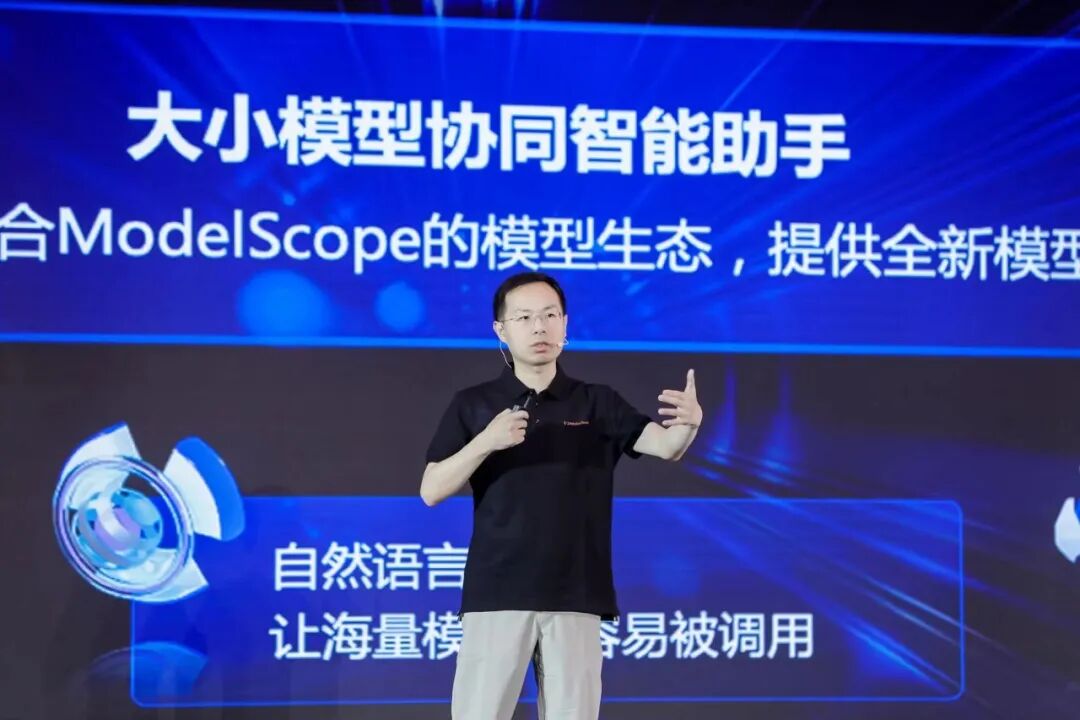
Image source: Alibaba Cloud WeChat Official Account
Regarding downward management, several former Alibaba employees commented that Zhou Jingren was not only capable of research and product development but also of leading teams. He was willing to boldly empower young people and delegate authority. Both Zhou Chang and Lin Junyang, the two successive leaders of the Qianwen model team, were post-90s campus recruits.
Yet some have witnessed an entirely different side of Zhou Jingren. A colleague who worked with him for years lamented, "Jingren can be quite straightforward and blunt at times."
During a conference, Alibaba's CPO, Tong Wenhong, encouraged everyone to share their opinions on the company's current issues. After a moment of silence, Zhou Jingren spoke up, saying something that instantly quieted the room: "To be honest, the code written by Taobao in the past was terrible."
A scientist daring to directly criticize code quality embodies a technical idealism. However, this aspect does not fully define Zhou Jingren. If he were merely a technical purist, he could not have navigated Alibaba's system for a decade, undergone multiple role transitions, and remained at the table.
What truly makes Zhou Jingren unique is his rare dual nature: he understands underlying computing architectures and can also delve into the messy business of e-commerce search and recommendations.
How was this "dual" capability forged? We must return to the autumn of 2016 when he joined Alibaba Cloud from Microsoft.
That year, Zhou Jingren was 42.
His previous resume was a standard answer: a prodigy from the University of Science and Technology of China's youth class, a Ph.D. in computer science from Columbia University, and a research partner at Microsoft. Upon joining Alibaba, Zhou Jingren's first major task was to lead the establishment of iDST, the precursor to the DAMO Academy.
It was Alibaba's most challenging technological climb. Zhou Jingren built Alibaba Cloud's AI computing foundation from scratch, leading teams to iterate the Feitian operating system, implement the Shenlong computing architecture, and establish the underlying infrastructure for Alibaba Cloud's AI computing power.

What truly transformed him from a technical expert into a rare breed was a seemingly off-course turn. After laying the foundation at Alibaba Cloud, he ventured into the heart of the business, transferring to the Taobao Search and Recommendation Business Unit to oversee data intelligence for Taobao, Tmall, and advertising.
There, he mastered the full commercial logic of search ranking, personalized recommendations, and ad bidding. Later, he moved to Ant Group to lead the Intelligent Engine and Data Middle Platform, further refining his technical vision in fintech scenarios.
This experience marked a crucial identity shift for Zhou Jingren. He was no longer just a technologist versed in distributed systems but a multifaceted figure who understood both underlying computing power and how algorithms translated into GMV.
This rarity made Zhou Jingren indispensable when the AI era arrived.
By late 2022, with the emergence of ChatGPT, Zhou Jingren was entrusted with leading the R&D and iteration of the Tongyi Qianwen large model. Under his dual technical and business mindset, the Tongyi series rose rapidly. By the 2025 Apsara Conference, Tongyi had released over 300 open-source models, with downloads exceeding 600 million.
In September of that year, Qwen3-Max ranked among the top three globally in performance. By year-end, Zhou Jingren was selected as an Alibaba partner, the sole new addition as the partnership shrank from 26 to 17. Alibaba's management described Zhou Jingren in just five words: "Extremely not easy."

Image source: Alibaba Cloud Official Website
During this process, Zhou Jingren also insisted on one thing: open-sourcing. While the industry chose closed-source monetization, he advocated for open-sourcing the Tongyi models and led the development of the ModelScope community. This strategy earned Tongyi widespread recognition in the global developer community, making Qwen one of the world's largest open-source model families.
From joining Alibaba Cloud in 2016 to becoming a partner in 2025, Zhou Jingren spent nearly a decade transforming himself into an indispensable piece in Alibaba's AI puzzle.
However, as Alibaba's AI strategic balance rapidly tilts, whether his decade-long technical reputation and irreplaceable dual capabilities are assets or burdens may not be for Zhou Jingren to decide.

Between Advancement and Retreat: Does Alibaba Still Need Zhou Jingren?
In his decade at Alibaba, Zhou Jingren has rarely appeared in public.
Unlike some technical executives who frequently attend industry forums and media events or post on social media, his name mostly appears on product launch PPTs at Alibaba Cloud Summits or technical speech agendas at Apsara Conferences.
Even during his high-profile selection as an Alibaba partner in 2025, all the outside world saw was an internal letter and a few formulaic evaluations.
He operates more like a puppeteer working behind the technical scenes. Whenever systems face instability, Zhou Jingren takes charge, personally leading teams to revamp technical modules, showcasing his unwavering commitment to technical excellence.
This unwavering technical idealism placed him in a precarious position during the March 2026 controversy surrounding Lin Junyang's departure, leaving him torn between Alibaba's AI strategy and its core technical framework, and making him the most troubled intermediary.
Zhou Jingren and Lin Junyang share a common ethos, both favoring a pure and unrestricted academic environment within the laboratory. They also recognize that the vertically integrated model is the linchpin behind Qwen's meteoric rise. However, as an Alibaba partner and the linchpin of the group's technology, Zhou Jingren cannot afford a singular viewpoint. When the call for a strategic pivot echoes and the organization's will must prevail, Zhou ultimately aligns with maintaining Alibaba's strategic coherence.
This is the inevitable trade-off a technical manager must navigate within a corporate power structure. Zhou Jingren understands that the longevity of his role as a 'ballast stone' hinges not on him but on the trajectory of Alibaba's AI strategy.
Image source: Alibaba's official website
Over the past three years, Alibaba AI's primary focus has been on technological catch-up and establishing its own large-scale model foundation. Commencing in 2026, Alibaba's AI strategy has crystallized: prioritizing the rollout of scalable products and full-spectrum commercialization.
At this juncture, the drawbacks of fragmented AI R&D resources and inadequate business collaboration across Alibaba Cloud, Damo Academy, Taotian, and Local Life have become increasingly apparent. Consequently, management is taking proactive measures to consolidate AI capabilities.
In March, the ATH Business Group was established to integrate multiple AI business lines. In April, a unified Group Technology Committee was formed to harmonize technical roadmaps. In June, the Token Foundry Business Unit was established under the direct supervision of the CEO to streamline the entire chain of model R&D, product iteration, and full-group scenario monetization.
This rationale is not hard to fathom. Large models demand substantial resource investment, including computing power, data, and talent. If each business unit operates in isolation and reinvents the wheel, it will not only be inefficient but also lead to significant resource wastage.
Commercialization endeavors require not just technical prowess but also group-wide resource coordination, cross-business collaboration, budget allocation, and the opening up of business scenarios—tasks that can only be effectively driven at the CEO level.
From this vantage point, reassigning Zhou Jingren to the Frontier Research Institute appears more like a return to specialized division of labor. Entrusting mature business lines to a CEO adept at coordination to spearhead the commercialization battle, while liberating top technical talent from daily management and short-term KPIs to tackle the formidable challenges of next-generation technology.
This is also a prevalent organizational strategy among leading AI companies. Google has DeepMind dedicated to frontier research, OpenAI has a Superalignment team exploring long-term directions, and global tech giants generally follow the conventional path of gradually freeing top technical talent from daily operations to invest in longer-term technological reserves.
This also aligns more closely with Zhou Jingren's own technological philosophy. During a group interview following the 2025 Alibaba Cloud Computing Conference, when queried about the core elements of achieving ASI, he stated, 'The upper limits of AI models remain uncharted territory. To truly progress toward ASI, we must continually innovate in technical pathways and address a series of fundamental challenges at the architectural, system, and algorithmic levels.'
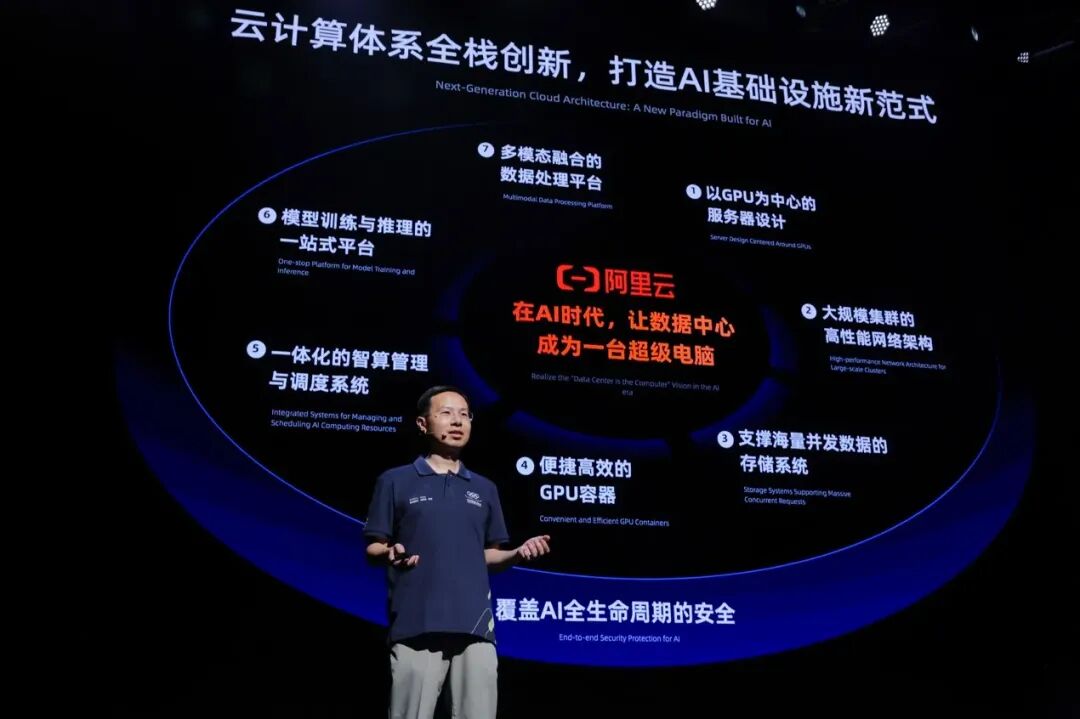
Image source: Alibaba Cloud's official website
Since 2026, major domestic companies have also been transitioning from laboratory-based models to industrialized models. Key members of ByteDance's Seed team have been reassigned, multiple major companies have streamlined their AI labs to focus on business implementation, and startups have shifted from competing on leaderboards to competing on commercialization.
This brings us back to the fundamental question. Alibaba undoubtedly values Zhou Jingren, but the nature of its reliance on him has fundamentally evolved.
Alibaba needs Zhou Jingren's technical acumen more than ever to uphold its stature in the AI arena, but it no longer requires the specific capabilities that once defined his reputation. In a company like Alibaba, which has transitioned from a technology-first to a business-first approach, there has never been a place for a technical idealist at the helm.
For Alibaba and Zhou Jingren, whether their decade-long partnership will extend into another decade is merely the tip of the iceberg to the outside world. What truly dictates the outcome has always been the underlying direction.
(The header image for this article is sourced from the Alibaba Cloud WeChat official account.)
-
![]()
Can the ‘New Energy Vehicles to the Countryside’ Campaign Revive the Sluggish Auto Market?
-
![]()
The Covert Battle for AI Ride-Hailing Entry Points Among Didi, Qianwen, and Doubao
-
![]()
Momenta Lays Out Its Books: A Strong Report, and a Pricier Story
-
![]()
US New Car Manufacturer Faces Major Crisis: Layoffs Hit 18%, COO Position Eliminated, with Each Vehicle Sold Incurring a Loss of $1.83 Million
-
![]()
Say Goodbye to Wasteful Spending! Innovative Policies to Boost Auto Consumption
-
![]()
With 370 Million Vehicles on the Road, the Auto Industry Reevaluates Its Post-Sale Business Strategy
-
Doubao Learns to Hail Taxis, but Profitability Remains Elusive
-
Fuji Intelligence Clears BSE Listing Hurdle: A Dual-Track Leap for the Precision Manufacturing 'Little Giant' | A-Share Financing Brief