Dialogue with Trooly.AI: AI is Just the Pathway to Connect Authentic User Voices Directly to Brands
 06/25 2026
 499
499
Author|Vivi, Whisper
We are currently in an era of diverse and complex consumption, where the traditional notion of 'I think, therefore I am' is evolving into 'I consume, therefore I am.' This is also a time of rapid technological iteration, where AI continues to reshape people's lives and consumption patterns. Authentic user needs have become an increasingly central factor in business competition.
However, for a long time, the needs and voices of target users have struggled to be effectively communicated to brands in a timely manner. More often than not, founders release their products into the vast market only to see no ripples of response. Can the product truly fit the market? What are the consumption habits and cultural preferences of target users? How should brands adapt and iterate accordingly? All these questions require authentic user feedback to guide brands in systematically refining and calibrating their direction.
Founded in 2025, Trooly.AI, an AI-native user research platform, uses intelligent technology as a bridge to break down communication barriers between brands and consumers. Platform founders Whisper and Sun Hao previously collaborated to create the hit AI companion product Museland, accumulating deep technical and industry experience in immersive intelligent dialogue.
Leveraging mature human-computer interaction capabilities, the duo founded Trooly.AI, focusing on providing in-depth qualitative interview services for enterprises. The platform is simple to operate and highly efficient, allowing research projects to be set up and launched in just ten minutes, with complete interview data and professional insight reports generated on the same day, thoroughly eliminating the pain point of lengthy traditional user research cycles.
Through Trooly.AI, brands can precisely grasp what labor-intensive tasks pet-owning households most want machines to handle; what kind of overbearing CEO (overbearing CEO) stories North American middle-aged female audiences are willing to pay for; how the sense of ritual in Valentine's Day gift exchanges differs among couples at various stages of intimacy; and whether American fortune-telling enthusiasts are truly willing to pay for AI-based fortune-telling.
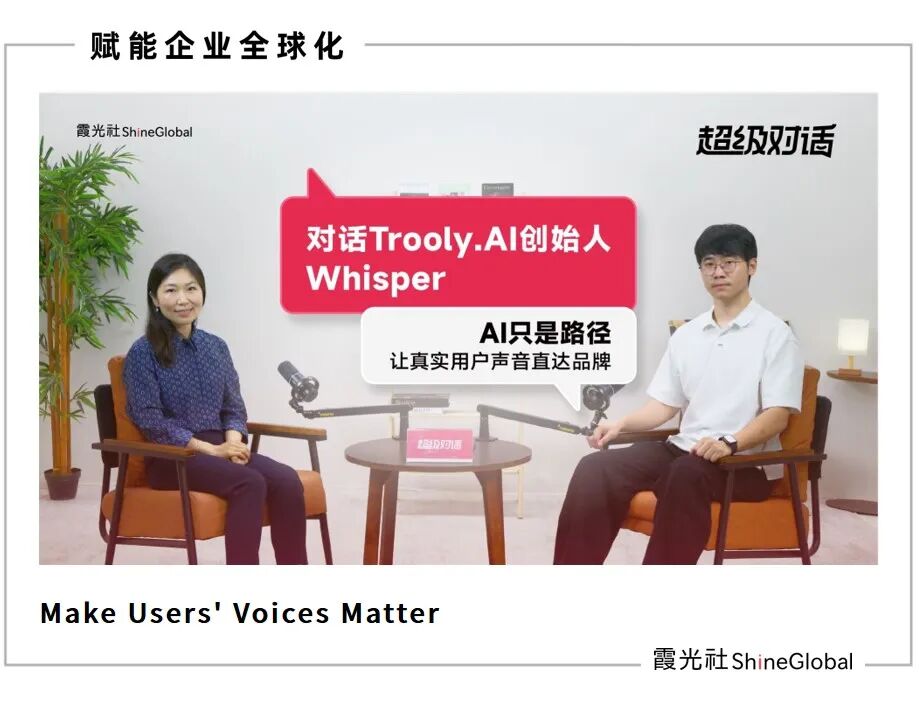
The guest on this episode of Xiaguang Society's 'Super Dialogue' is Whisper, founder of Trooly.AI. In his view, genuinely hearing user voices is undoubtedly crucial for brands. However, in the past, due to inefficient and slow connections, these voices were largely drowned out and silenced. But now, Trooly.AI, established for less than a year, aims to become the key link between products and users in the surging AI era, ensuring that every user voice is clearly heard and fully valued in the business world.

From C-End AI Companionship to B-End In-Depth Interviews: A Entrepreneurial Shift Based on Authentic User Needs
Vivi: I know you previously worked on the AI companion product Museland, and now you've created a B2B AI in-depth interview platform. Why did you make this shift instead of creating another C-end product?
Whisper: When I was working on large C-end products, I could see roughly 3,000 user feedback entries per day on external networks. I had interns collect these 3,000 pieces of feedback, organize, filter, adjust, and output the information, quickly turning feedback into features. Over time, a phenomenon emerged: super users were helping iterate the product.
Later, when starting my entrepreneurial journey, I reached out to product managers and market research experts on Xiaohongshu for interviews. After interviewing many of them, the common feedback I received was: 'Dude, unlike you with 100,000 DAU, I don't even have users at this early stage. Can you at least let me hear some user voices first?'
That made sense! My partner Sun Hao and I discussed it and realized that while transforming feedback into features had long-term value, perhaps we should first set that aside and help product managers solve the problem of accessing user feedback.
After all, when it comes to human-AI interaction, there aren't many people in the country who understand it better than we do. Since the GPT moment in 2023, we've been researching how to make people willing to share their innermost thoughts and stories with AI.
Additionally, we had solid user interview skills, having conducted many user interviews ourselves. Furthermore, we could connect with numerous expert resources in user interviews.
We decided to launch this project focused on AI user research. Around September last year, we officially completed company registration, and the rest is history.
Vivi: In this process, do you prioritize the user's interview experience or the results your clients receive? How do you balance these two ends?
Whisper: It's indeed a balance. We position our platform as B2B2C, acting as the intermediary link.
Our core value has two layers: first, understanding authentic users; second, assisting our client partners in understanding users.
From our perspective, users are the primary service recipients. Only by providing users with a good interview experience can they openly share their true thoughts, enabling us to deliver meaningful research conclusions to our clients.
To date, we've conducted around 13,000 interviews, with 8,000 pieces of respondent feedback accumulated in our backend. You'd be hard-pressed to find another platform with such a high proportion of respondent feedback, and there are many interesting anecdotes.
Our platform uses a 1-to-5-star rating system, with emojis like smiling faces and frowning faces to indicate experience quality. We often receive one-star ratings accompanied by lengthy explanations: 'I gave one star because it corresponds to the crying face emoji.' Respondents sometimes get emotional during interviews and can't help but shed tears.
Because our research questions delve deeper into inner expressions, guiding respondents to share personal stories. For example, someone might mention a gift from their late father. We always uncover the deeper life contexts behind objective consumption behaviors—perhaps childhood imprints or unforgettable past experiences. These hidden emotions and past events directly influence subsequent consumption choices. For instance, whether a user is willing to pay for luxury goods is closely tied to their upbringing.

Effective User Interviews: Cave-Like Exploration, Not Mechanical Q&A
Vivi: You've completed over 10,000 interviews since last September, not even a full year yet. How did you achieve this?
Whisper: Our research demands mainly fall into three categories: First, pre-product audience screening. We recruit different groups in multiple batches, gradually narrowing the scope to precisely target clients' core users.
Second, investment institution project due diligence. Investors need to understand a project's true audience profile, making this a very common research demand.
Third, pre-ad placement testing. Clients plan to invest heavily in advertising but are unsure if their copy will resonate with users. Through interviews, we help them validate messaging and optimize expressions from a consumer perspective.
Vivi: Especially in global expansion scenarios, brands have a stronger need to understand and gain insights into overseas users.
Whisper: Yes, about 70% of our clients operate in cross-border global markets, spanning consumer electronics, fast fashion, fast-moving consumer goods, gaming, and other sectors. These brands rely on our tools to quickly locate overseas target audiences and gain deep user insights. This insight isn't limited to users' opinions on single products but aims to fully reconstruct users' real living environments and daily routines.
For example, clothing merchants don't just want to understand current purchasing preferences but hope to visually see the complete wardrobe contents of their target users. Beauty brands need more than just monthly makeup consumption data; they want to fully reconstruct users' morning makeup routines.
In the past, such deep scenario research was nearly impossible to implement. Traditional research models struggled to send researchers to users' homes at 6 or 7 AM for full-day tracking. We leverage users' own smartphones and devices as the brand's 'eyes and ears' to observe them. The entire process resembles self-shot Vlogs, eliminating user resistance and defensiveness.
The essence of this research approach stems from users' trust in our interview process. They're willing to share more heartfelt thoughts. Often, our designed interview duration is 45 minutes, but users end up chatting for over an hour and a half.
Vivi: This surprises me. How do you transform user research interviews into open, engaging conversations?
Whisper: There's no major secret. The core dividing line is this: When conducting research, are you interrogating users with a scripted outline, or are you exploring the deeper contexts behind behaviors to support commercial judgments by following their expressions?
The former is like joining a fixed-itinerary tour group in Yunnan, visiting scenic spots on a strict schedule with limited time at each location. In gaming terms, it's like being trapped in a 'box garden' world, constantly hitting invisible walls—an unfree experience.
Our approach is to maintain an open mindset, avoiding Preset answer (preconceived answers) and giving users control over expression. Many high-value commercial insights hide in spontaneous follow-up questions during conversations. This resembles cave exploration: before diving in, you don't know the cave's full layout. You must follow users' emotions and narrative threads to gradually uncover their truest motivations, then use this raw information to support clients' commercial decisions.
Meanwhile, users deepen their self-awareness through these dialogues. Our backend shows many users describing the experience as 'inspiring,' with some even asking to chat again.
Vivi: For Trooly.AI now, which requires more continuous iteration: identifying brands' target users, or optimizing interview mechanisms and result analysis?
Whisper: For us, the two most critical challenges are: first, identifying target users faster and more accurately—this capability must keep improving; second, conducting deeper interview follow-ups.
Regarding the first point, the core technology lies in identifying and blocking Professional interviewees (professional respondents), a persistent issue. Professional respondents participate in interviews solely for incentive commissions, attracting many ' Wool Party ' (opportunity seekers) who make a living by joining various platforms' interviews. We must employ various strategies to block them.
We've invested significant resources and manpower to build a model that assesses recruitment difficulty when receiving client requests, considering factors like target groups' market share and reachable channel diversity. We determine appropriate recruitment timelines based on difficulty, increasing commissions if a hard-to-recruit group is urgently needed.
On the interview execution side, the core is professional questioning and deep follow-up capabilities. While we have an interview outline agreed upon with clients, merely following it step-by-step would be like finding a goldmine but only digging a shallow hole. We must uncover authentic, insightful viewpoints within 45 minutes to feed back to clients. This requires identifying good questions and deciding when to pursue follow-ups or return to the original interview framework.

Why AI Excels at Interviews Compared to Humans
Vivi: Many people 'put on a facade' when facing real humans, unconsciously activating self-protection mechanisms. Can AI dialogue dissolve this defensive posture?
Whisper: Face-to-face human interaction often carries social psychological pressure. As social beings, people instinctively worry about whether blunt expressions might damage their public image. That's why skilled psychological counselor (psychological counselors) always start by saying, 'Please rest assured, our conversation will remain confidential. You can trust me completely.' They aim to create a safe environment for honesty. Many people prefer talking to tree holes, writing messages in bottles, or confiding in strangers to reduce psychological pressure and social impact after speaking truthfully.
AI inherently fulfills this need: first, it's not human, eliminating social relationships and image judgments; second, it cedes the stage to users, encouraging them to share more about themselves. We observed this phenomenon when developing AI companion products—people revealed their true selves more openly with AI, sharing extensively and for extended periods.
Vivi: But in common perception, AI lacks 'liveliness' and struggles to capture users' emotional fluctuations in real time. How do you use AI to precisely capture emotions and pursue better follow-ups?
Whisper: This has never been difficult for us. Previously, we made people enjoy chatting with AI using only text-based information without facial expressions. Now, with Trooly's system, we've added complete multimodal capabilities: cameras capture users' facial expressions and environmental changes; ASR speech recognition accurately transcribes users' spoken content, even handling various dialects and accents.
The reasoning power of language models and advancements in multimodal technology provide strong support. Long-term, as long as AI maintains complete dialogue context, its capabilities in deep interviews will eventually surpass human researchers.
In fact, after combing through and studying a significant amount of theories from in-depth interviews with industry experts, I've identified a core criterion: How can you confirm that you've extracted sufficient, authentic, and valid information from the interviewee? The most prominent indicator is that after your conversation, you feel as though your relationship has deepened, becoming more akin to friendship. To reach this point, you must delve deeply enough to ensure that the user is sharing their innermost thoughts with you without reservation.
Many traditional in-depth interviews merely aim to obtain superficial standard answers. However, such information is rarely directly applicable to final business and product decisions. In contrast, AI is more adept at evoking emotions from users, fostering closer relationships, and thereby obtaining more authentic responses.
vivi: This is quite counterintuitive. So, in your opinion, what information might be missed or overlooked when conducting interviews with users in person?
Whisper: During initial communication, it's challenging to get strangers to lower their guard and share their true thoughts. For instance, if the interviewer is a female and particularly attractive, when facing a male interviewee, the latter may easily be influenced by social psychological factors, deliberately concealing their true thoughts and making insincere statements.
That's why we didn't give our AI a face; instead, we created a serene, sound-wave meditation-like environment. Currently, we've developed only two voice tones: a male and a female one. In most scenarios, the female voice is used by default, but special scenarios also allow interviewees to switch and choose independently.
Our core design intent is to fully focus the user's attention on their inner selves, eliminating the need to be distracted by the interviewer's expressions or demeanor, transforming the entire conversation into a profound dialogue with oneself.

AI is the Path, Humans are the Purpose
vivi: I find it quite intriguing that while many people oppose AI due to its lack of authenticity and human-like qualities, we're discussing a contrary perspective: AI's unbiased, non-judgmental, and even non-gaze-based approach has become a more precious mode of communication. Do you see any conflict in this?
Whisper: Firstly, we also oppose AI in its current form; we acknowledge its lack of human-like qualities. Internally, we've taken many actions against over-reliance on AI, such as prohibiting the use of AI for writing documents or PPTs.
Although Trooly is an AI product, its core carries a distinct anti-AI attribute. From day one, we've treated AI as a means to more authentically understand user feedback. Our ultimate goal is to present the user's voice; our mission is to make users' voices matter. AI is merely the path to achieving this goal.
During our project's progression, numerous investors and friends have asked why we still conduct interviews with real people instead of directly interviewing AI. However, we rejected this approach from the outset. We aim to serve real people ultimately, placing the stage in the hands of genuine humans to understand their authentic voices.
When I first entered the internet industry, a phrase was etched in my mind and has since become the core tenet for all products I create: Everything revolves around user value. The underlying logic of business competition remains unchanged: whoever serves their users better will achieve greater success in the commercial world.
vivi: I think that's pretty cool; you're addressing a genuine issue. As Drucker said, a valuable company must solve a problem, even if it's not a massive one. Solving it is the commercial value itself, and when you do, the company will grow significantly. Globalization should have an even greater demand for this, as they face cross-cultural barriers.
Whisper: That's precisely why we've chosen the global market as our core business scenario from the start. Most of our projects fall under the category of 'China for Global' – assisting Chinese brands in expanding into global markets, helping domestic businesses and entrepreneurs understand their target overseas markets thoroughly, and grasping the true consumption habits and preferences of local users.
For example, during a specific survey we conducted for the French market, results emerged within two days that directly influenced whether the project would adopt online or offline sales for local promotion. According to our findings, some users frequently mentioned the need to touch and feel the product's material before making a purchase decision; otherwise, they wouldn't proceed.
vivi: Trooly.AI has been in existence for less than a year but has already reached its third round of funding. Why do you think your product has garnered favor from investors?
Whisper: I believe it's because we're addressing a genuine issue, and we truly believe in it. Plus, we have a competent team with fast response times and strong execution capabilities.
During internal sharing sessions, I've also mentioned that we firmly believe in the irreplaceable unique value of users themselves. I stand on the side of carbon-based humans. While I don't deny that AGI will eventually arrive, the ultimate destination of all AI technologies must be to serve humanity. Therefore, in commercial scenarios, users' authentic emotions and experiences should always be valued. From the inception of our company, we've set this core direction: to better serve real humans through new technologies.
User insights should be integrated into the ecosystem of the entire business world. It provides more real-time business insights, allowing you to establish profound empathy and understanding of users during the process. It enables you to know who your target users are, what kind of waters your ship is sailing in, what competitors lie ahead, and what mental space those competitors occupy. And if you aim to sail into the blue ocean, it helps you identify the right direction.
-
![]()
Can Computers, Despite Daily Price Hikes, Still Be a Viable Purchase?
-
![]()
January-June Auto Stocks' 'Resilience Ranking': Geely Alone Posts Gains, Six Plummet Over 40%, One Tumbles 54.5% | Mirror Pro
-
![]()
China’s Public Charging Market: Didi Charging, Teld, and Yunkuai Take the Lead
-
![]()
The First Year of AI-Native Mid-Year Shopping Festival: Technology Reconstructs Human-Product Matching for 618
-
![]()
Micron has released its financial report, showing revenues of $41.5 billion, a 74% increase quarter-over-quarter, with a gross margin of 84.6%. The company provided both short-term and long-term guida
-
![]()
Expert Interpretation of New Policy Combination: Activating the Trillion-Dollar Automotive Aftermarket
-
![]()
Doubao Goes 'Professional', Volcano Rolls the Snowball
-
AI: No Sign of a Bubble!