Zhipu VS Minimax: A Chinese Reflection of Anthropic PK OpenAI
 06/25 2026
 489
489
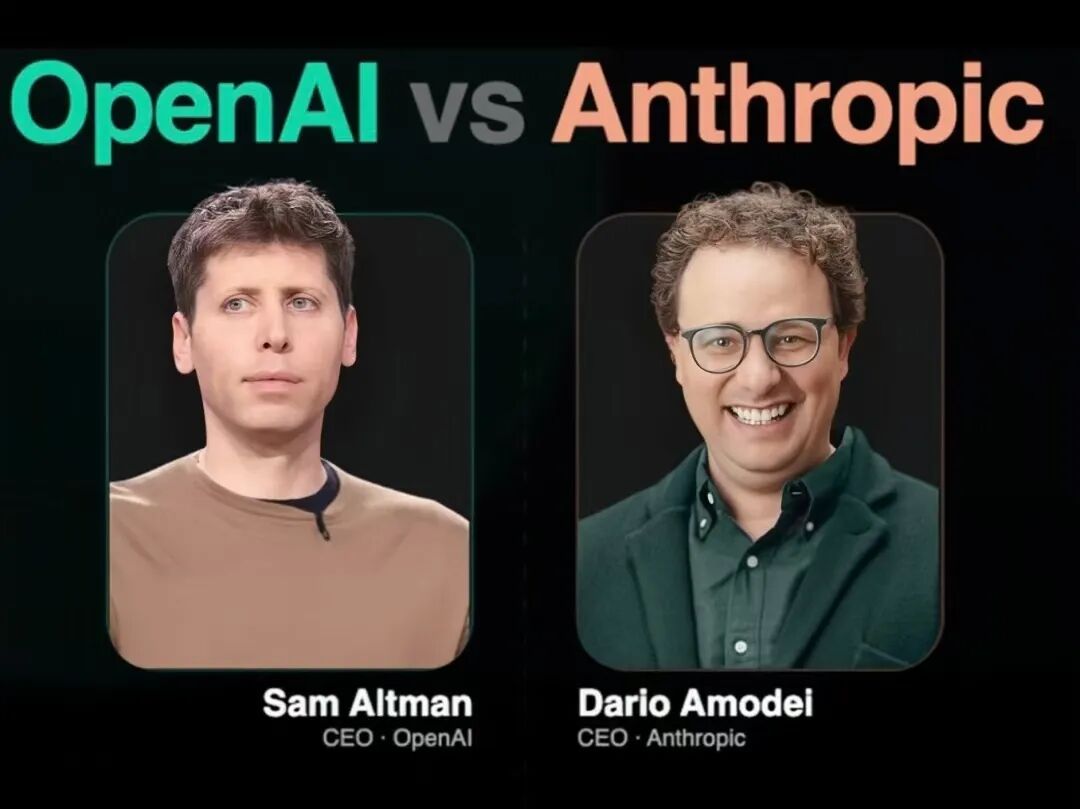 The valuation reversal of Anthropic and OpenAI appears to be a prelude to the Zhipu VS Minimax narrative.

Written by | She Zongming
History does not repeat itself, but it often rhymes. Reality may not be identical, yet it is always interconnected.
Zhipu VS Minimax exemplifies this point—it resembles an Eastern mirror image of Anthropic PK OpenAI, albeit not as an exact replica but as an exaggerated portrayal.
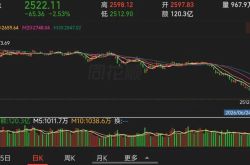
As the two leading large model companies in the Hong Kong stock market, Zhipu and Minimax have shown a K-shaped divergence: as of the market close on June 24, Zhipu's market capitalization stood at approximately HK$975 billion, while Minimax's was around HK$150 billion, less than one-sixth of Zhipu's.
Upon seeing this, many might recall Shen Teng's line from *Only Fools Rush In*: “Who could have seen this coming?”
Back in January when they both listed on the Hong Kong stock market, Zhipu was taught a lesson by the capital market on its debut day, suffering a break below the issue price, while Minimax doubled in value, with a market capitalization nearly twice that of Zhipu.
Who could have anticipated that, over five months later, Zhipu's stock price would have surged by approximately 2000% year-to-date, while Minimax's would have retreated by more than half from its peak, transforming their competitive dynamic from “the wild one wins in a narrow encounter” to “Minimax cannot even keep Zhipu's taillights in sight”?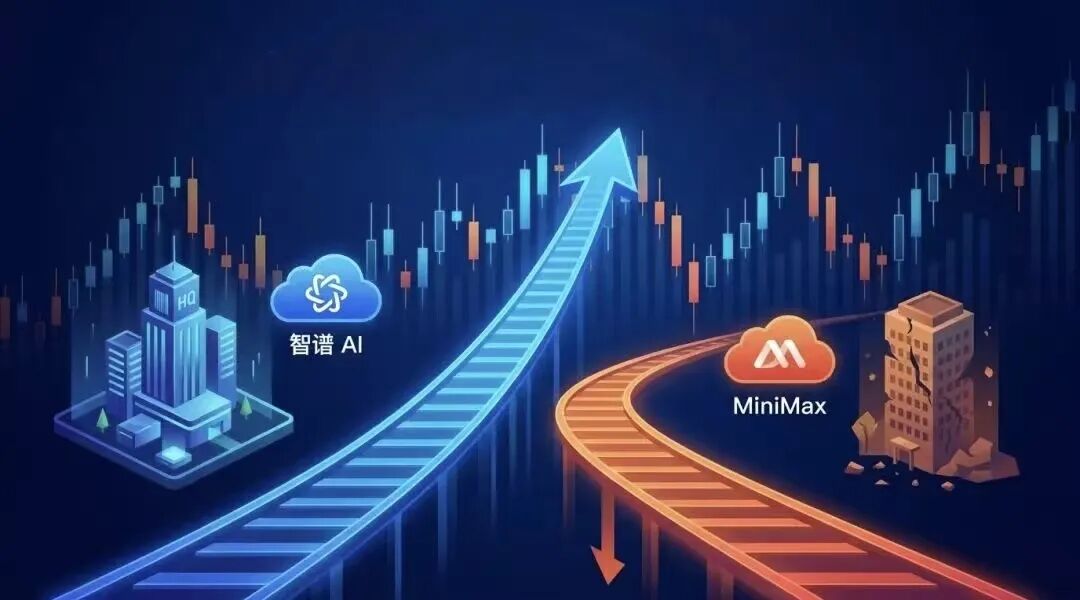
▲Zhipu and Minimax are showing signs of diverging market capitalization performance.
In contrast, across the ocean, the AI twin stars OpenAI and Anthropic have also experienced a valuation reversal.
Earlier, OpenAI, with its ambitious “Stargate” plan and backed by the Silicon Valley version of “ironclad alliances,” firmly occupied the center stage of Silicon Valley's AI new elite club, regardless of “surname stroke order determining name placement”; Anthropic, on the other hand, seemed to lament, “Since O exists, why does A?”
However, by May of this year, the situation had reversed: Anthropic, with its annualized revenue surpassing that of its rival, achieved a valuation of $965 billion after its Series H funding, directly overtaking OpenAI's valuation of approximately $850 billion.
Now, it appears that the valuation reversal of Anthropic and OpenAI is a prelude to the Zhipu VS Minimax narrative. This is not surprising: after all, Zhipu and Minimax are following the scripts of Anthropic and OpenAI, respectively.
01/
Three months ago, MiniMax founder Yan Junjie proposed the formula: “AI platform value = intelligence density × Token throughput.”
Upon hearing this, Sam Altman might snap his fingers in agreement: I can't agree more.
OpenAI's typical approach is: consumer-side traffic first, full-modal products, and application-driven models.
Distilling its essence, it pursues higher model efficiency, greater Token throughput, and broader user coverage.
Since ChatGPT's explosive popularity in late 2022, OpenAI has aggressively expanded globally, rapidly advancing its consumer product matrix, covering dialogue, images, videos, voice, and coding tools, offering everything under the sun. Its business model adopts a dual-wheel drive of consumer-side subscriptions and enterprise-scale API services, adhering to the principle of “adult AI wants it all.”
As the top student in the class, OpenAI's homework is too good not to copy, so domestic AI startups initially paid “remote tribute,” with Minimax among them.
From its inception, Minimax has pursued a “global layout + consumer-focused + native multimodal products” route: Hailuo AI competes with Sora, targeting AI video generation; Talkie/Xingye competes with ChatGPT in dialogue interaction, positioning itself as an AI virtual emotional companion; Minimax Voice competes with OpenAI's voice model, covering self-media and audio content sectors... All are “Born Global.” Monetization also relies on a three-dimensional model of “traffic—subscriptions—API.”
Today, Minimax has approximately 300 million global users, covering over 200 countries and regions, with over 70% of its revenue coming from overseas markets. It is the only large model company in China that relies on overseas consumer subscriptions to achieve scalable revenue.
Disregarding technological generation gaps, it is fair to say that Minimax is OpenAI's “worldly doppelgänger.”
Earlier, during the release of its 2025 financial report, Zhipu CEO Zhang Peng also proposed a formula: AGI commercial value = upper bound of intelligence × Token consumption scale.
If the “upper bound of intelligence” refers to foundation model capabilities and the Token consumption scale hinges on high-value productivity scenarios, then Anthropic might nod in agreement.
From its inception, Anthropic has targeted enterprise foundations + safety and controllability alignment + deep capabilities in long-text and programming, abandoning the mass consumer market and delving deep into the government-enterprise developer ecosystem, embracing the enterprise side with controllable, stable, and highly reliable model foundations.
To date, Anthropic has built barriers with million-level context, low hallucination, Vibe Coding, and a constitutional AI safety framework, securing orders from most Fortune 500 companies, with 80% of its revenue coming from large enterprise clients. From Claude Code to Cowork to industry plugins, Anthropic has taken over developers' terminals with programming tools, directly disrupting the business of many traditional SaaS companies.
Zhipu's route of “foundation capabilities first, enterprise services dominant, safety alignment, and infrastructure for trustworthy AI” is similar.
A few days ago, Zhipu founder Tang Jie engaged in a virtual dialogue with Elon Musk, drawing widespread attention—when asked by netizens on X platform, “When will China's large models catch up to Anthropic Fable's level?” Musk replied, “Q1 2027,” while Tang Jie stated, “It won't take that long.”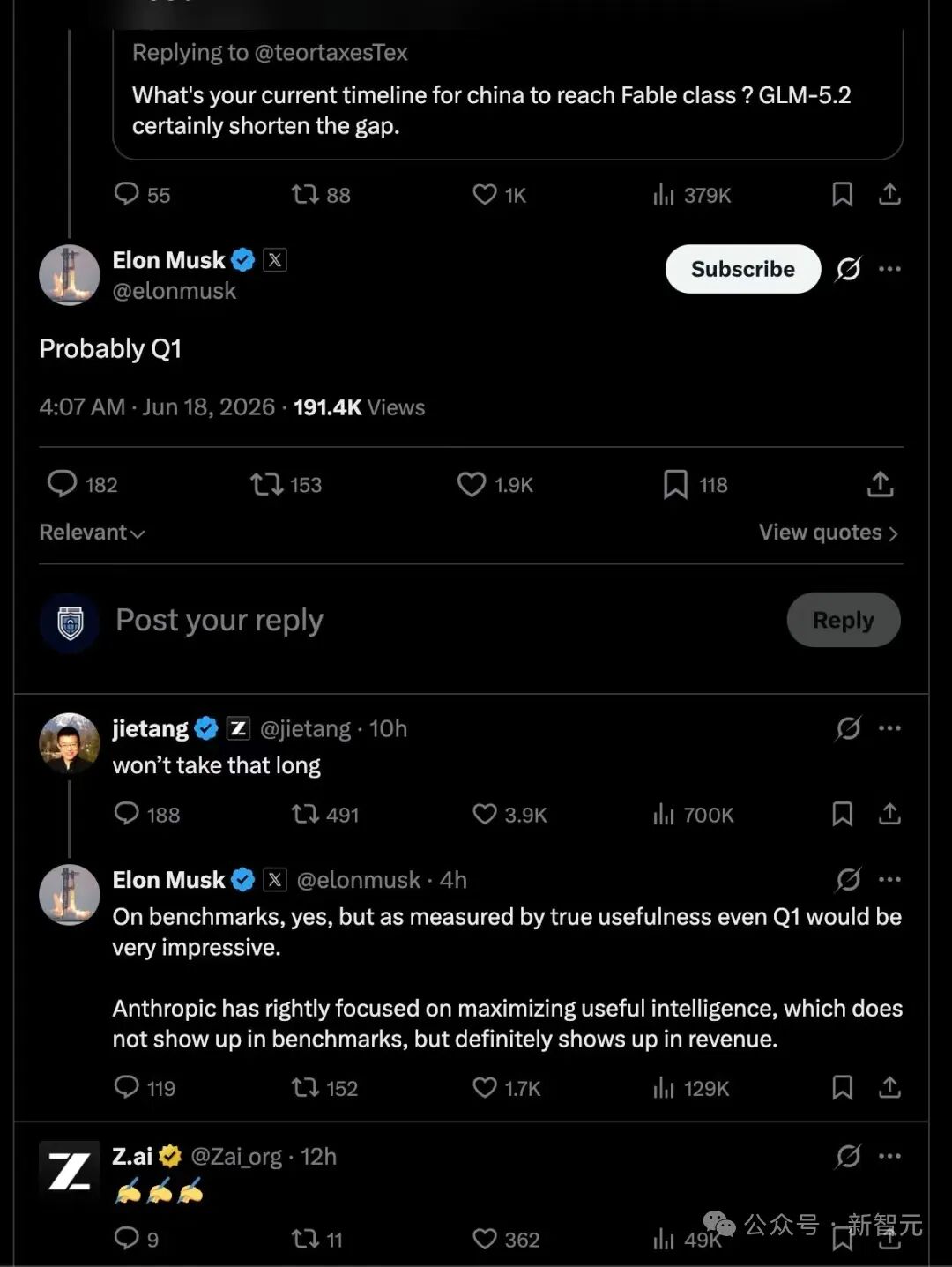
▲Tang Jie engages in a virtual dialogue with Elon Musk.
Tang Jie's confidence may stem from foundation model performance: GLM-5.2, the open-source model SOTA, ranks first globally in coding capabilities, second only to the “too powerful to display” Fable.
As one of the few model vendors in China capable of providing a full-stack, self-controllable, hundred-billion-parameter foundation, Zhipu's core revenue comes from MaaS platform API calls, private foundation deployments, and industry-customized models. The vast enterprise side is its love.
OpenAI and Anthropic have vastly different “enterprise personas”: the former is an AI product company for everyone, while the latter is an AI foundation company for industries. Minimax and Zhipu also have similar mental anchors.
02/
Once Zhipu and Minimax are placed within the “twin stars” framework, they cannot avoid being compared side by side: which has a brighter (monetary) future?
Five months ago, anyone hesitating on this question for even a second would have been disrespecting Minimax.
For the past three-plus years, the market has favored the traffic narrative. The consensus was that whoever had more users, more products, and broader coverage was more valuable.
Why did BAT companies issue AI red envelopes early this year? To compete for super AI entry points, because the AI industry's valuation logic was directly tied to consumer-side user scale—under the “internet-like valuation model,” factors like user scale, monthly active growth, and overseas penetration became the most heavily weighted metrics.
OpenAI was the biggest beneficiary of this logic, with its global layout, consumer-market offensive, and multimodal products all aimed at expanding user scale.
Minimax was initially valued as “China's OpenAI × overseas Character.AI,” with high growth (159% YoY revenue in 2025), a globalization story, and multimodal technology superposition (stacked), making it highly favored.
Anthropic and Zhipu, however, were less favored due to their lack of consumer-side hit products and long enterprise-side delivery cycles.
However, as the “diseconomies of scale” effect of AI large models gradually emerged, many began to realize that the AI industry could not simply replicate the internet's playbook of “larger user scale → lower marginal costs → higher platform value.”
More consumer-side users do not necessarily mean higher subscription revenue; they may also mean greater inefficiencies in computational power usage. If you charge, ordinary users might complain, “You're using my data and still trying to fleece me?” If you don't charge, more users mean greater losses—this is how ByteDance's 2025 net profit was “eaten away.”
To squeeze “a few more bushels” from users, Sam Altman even considered allowing ChatGPT to engage in adult content, not to mention various ads, but consumer-side price sensitivity and fickleness prevailed.
Not only is the paid conversion rate low, but consumer-side product lifespans are short—today's hit AI video generation tool might be replaced by a low-cost version from a big tech company tomorrow; today's popular AI emotional companion app might be shut down by regulators tomorrow. Low returns and high risks—can you stomach this?
“Burning money for scale, but scale doesn't translate to money,” led to a clear shift in the AI industry's valuation anchors after January this year.
Have you noticed? Since February, from lobster crazes to Vibe Coding's popularity, Agents have become the main theme, signaling: AI companies, go to the enterprise side!
The reason is simple: the story of “seeking future imagination from the consumer side” is no longer sexy. “Diseconomies of scale” have shaken the core valuation supports of OpenAI and others. Correspondingly, the capital market no longer cares only about “how many users” but also “how many problems can be solved.” The core pricing criteria for AI companies have also become threefold: whether they possess industrial infrastructure attributes, whether they have stable enterprise-side cash flow, and whether they comply with long-term global AI safety regulatory trends.
At this point, market tastes naturally changed: Anthropic is an AI infrastructure company— reference ( reference , referring to) Oracle or Salesforce in their heyday—deserving a Pro-level premium based on P/ARR (market cap/annual recurring revenue), right?
As for OpenAI, with frequent changes in the large model leaderboard, low individual user migration costs, and low ARPU, the scissors gap (scissor gap) between capital expenditures (CAPEX) and operating income (OPEX) is evident, compounded by continuous large-scale financing dilution, so valuation (valuation) should err on the low side, right?
Applied to the Hong Kong stock market, the same logic holds: Zhipu is seen as the underlying operating system of the AI era, priced based on high-stickiness enterprise MaaS + domestic substitution scarcity, while Minimax is viewed as an application-layer tool in the AI era, priced like an AI app company... The magnitude gap in their industrial value weights makes them incomparable.
▲The capital market's valuation logic for Zhipu and Minimax is bound to differ greatly.
If we also consider that the full-link safety alignment system complies with domestic trustworthy AI regulatory requirements, and GLM-5.2 has completed adaptation to domestic computational power platforms like Huawei Ascend, Cambrian, Moore Threads, and Kunlun Core, then Zhipu, holding an “Anthropic experience card” and superposition (stacked with) a “self-controllable” buff, being hit by market dream rates is only natural.
In contrast, Minimax cannot play this hand—its aggressive overseas expansion, while good for expanding its user base, carries significant risks amid great power rivalries and frequent geopolitical conflicts, vulnerable to being hit by “a speck of dust from the era.”
Timing, world affairs, trends—they all matter.
03/
In *Bird by Bird*, author Anne Lamott says: “You don't need to know where you're going or see your destination or everything along the way. You just need to see the next one or two hundred meters ahead.”
However, often, the road conditions or directions at one or two hundred meters differ completely from those at three or four hundred meters. Seeing one or two hundred meters does not guarantee you can go further at three or four hundred meters or beyond.
The routes of OpenAI and Anthropic, which seemed clearly differentiated a year ago, have now reversed, surprising many. This proves: in the AI era, it is indeed hard to see several years ahead.
Zhipu VS Minimax is nothing less than a Chinese projection of Anthropic PK OpenAI. Their sharp divergence in market capitalization is a synchronous validation of global AI industry logic in the Chinese market.
Considering that both AI stars will face restricted stock unlocking in July—Zhipu's unlocking ratio is approximately 15% to 25%, with weak reduce holdings (share reduction) intentions from state-owned and industrial cornerstone shareholders, superposition (stacked with) expectations of a return to the STAR Market locking up shares; MiniMax's unlocking ratio exceeds 40%, with a higher proportion of financial VCs facing significant selling pressure—differences in liquidity supply are likely to further exacerbate divergence.
Same “model,” different fates—this is already the settled outcome of Zhipu VS Minimax, their destinies having been “spoiled” in advance by the ranking flip of Anthropic and OpenAI.
From how Zhipu VS Minimax replicates the Anthropic PK OpenAI script, the implications can perhaps be summed up as follows:
1. Consumer-side traffic is no longer the ultimate valuation passport for AI companies.
ChatGPT's traffic growth myth, while seemingly an early-stage boon for the industry, may actually be a late-stage bane. When computational costs are rigid, user competition intensifies, and the Paid ceiling (payment ceiling) becomes apparent, the growth logic of pure consumer internet playbooks will gradually failure (fail).
Those replicating OpenAI's consumer-focused route may face long-term pressure of declining valuation centers.
2. A usable and controllable industrial-level foundation model is a long-term core asset of AI.
The core driving force behind Anthropic's surpassing of OpenAI can be summed up in one term: Agentic Workflow Monetization. As high-value productivity scenarios become a rich source of AI opportunities, model vendors capable of addressing real enterprise production needs and aligning with global safety regulatory trends will secure a larger share of the market.
3. The underlying logic of business models determines the potential of AI companies.
While OpenAI and Anthropic each have their strengths and weaknesses in model performance, the same can be said for Minimax and Zhipu. However, the fundamental differences in their business models ultimately result in a tenfold valuation gap.
In general, the fate of a model vendor depends not only on its own path selection but also on the trajectory of historical progress.
At least after AI competition turns to Page 2, the 'Anthropic-style' mass spectrometer has secured a premium for its rarity and uniqueness, while the 'OpenAI-style' Minimax will need time to prove that it is no ordinary contender.
-
![]()
Can Computers, Despite Daily Price Hikes, Still Be a Viable Purchase?
-
![]()
January-June Auto Stocks' 'Resilience Ranking': Geely Alone Posts Gains, Six Plummet Over 40%, One Tumbles 54.5% | Mirror Pro
-
![]()
China’s Public Charging Market: Didi Charging, Teld, and Yunkuai Take the Lead
-
![]()
The First Year of AI-Native Mid-Year Shopping Festival: Technology Reconstructs Human-Product Matching for 618
-
![]()
Micron has released its financial report, showing revenues of $41.5 billion, a 74% increase quarter-over-quarter, with a gross margin of 84.6%. The company provided both short-term and long-term guida
-
![]()
Expert Interpretation of New Policy Combination: Activating the Trillion-Dollar Automotive Aftermarket
-
![]()
Doubao Goes 'Professional', Volcano Rolls the Snowball
-
AI: No Sign of a Bubble!