Upgraded Wenxin and Paid Doubao: AI Bids Farewell to the 'Traffic-Only' Era
 06/26 2026
 518
518
On June 24, ByteDance's Doubao unveiled three tiers of subscription plans: Standard at 68 RMB/month, Enhanced at 200 RMB/month, and Premium at 500 RMB/month, all seamlessly integrated with the Doubao 2.1 model series.
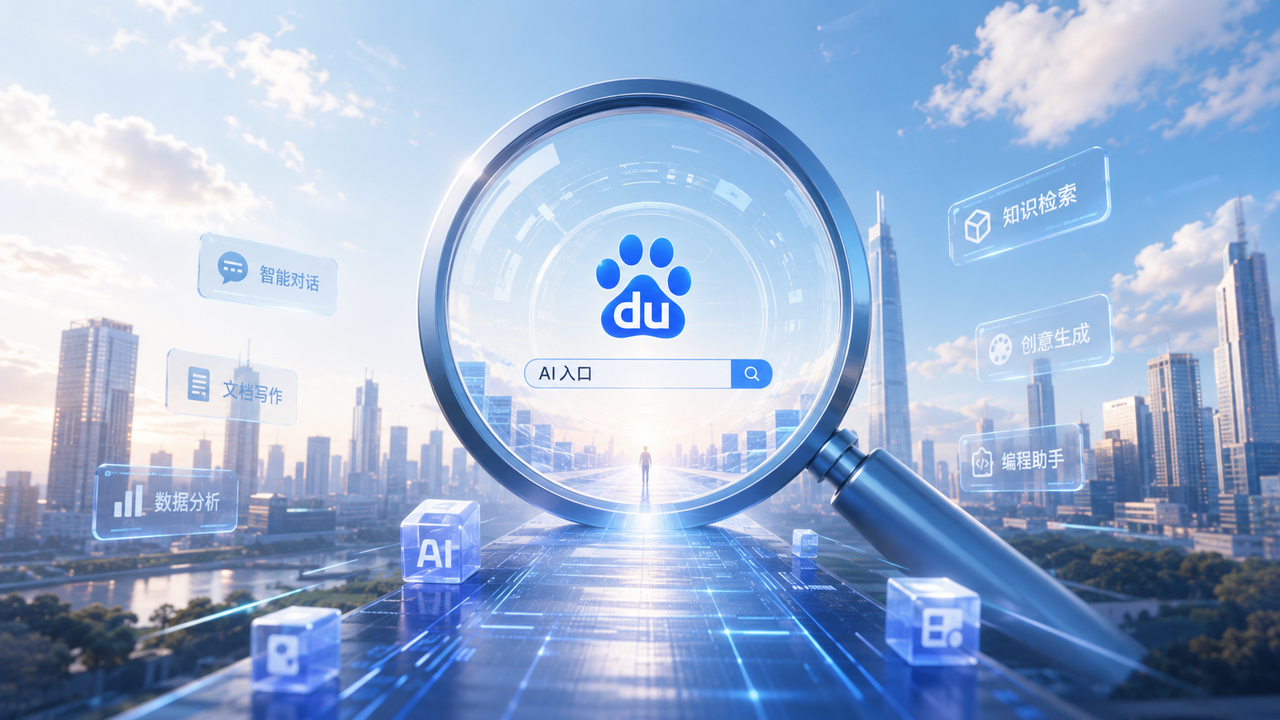
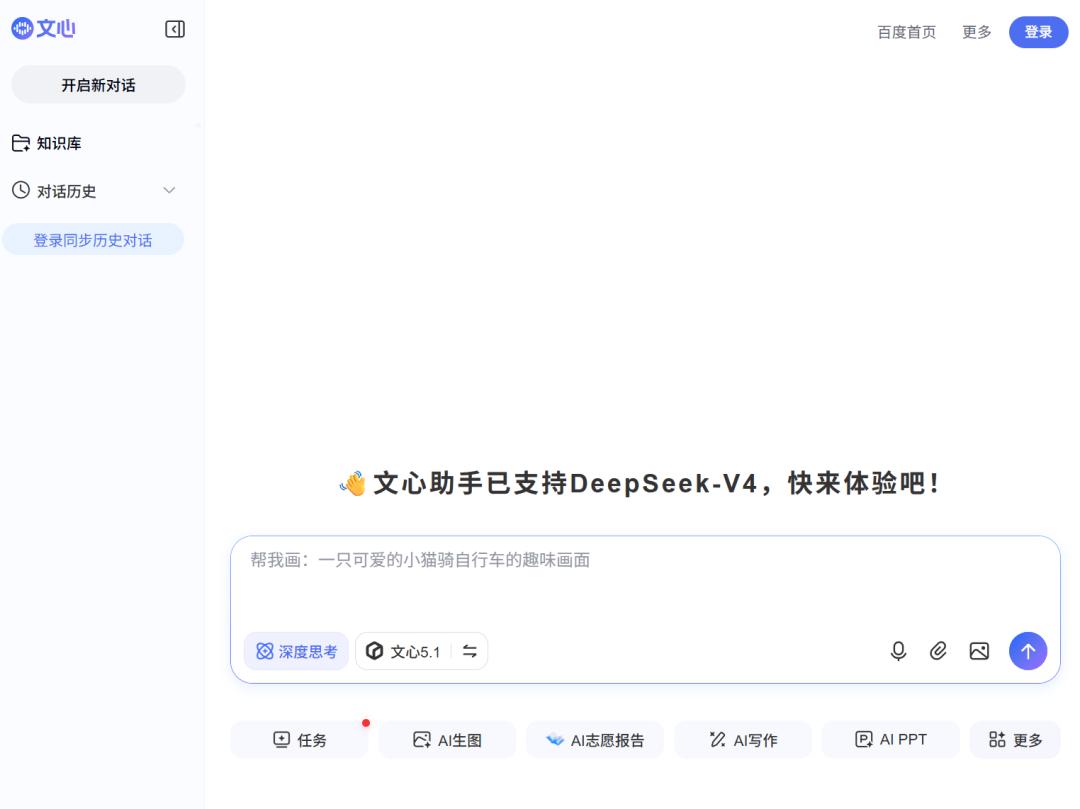
Around the same time, Baidu announced the consolidation of multiple platforms, including Wenxin Yiyan Web, Wenxin, and Wenxin Assistant, into a unified Wenxin Assistant interface. Its pricing model remains unchanged: free of charge.
On one hand, AI applications are beginning to monetize their services; on the other, they are streamlining access points and enhancing features without additional cost. Both companies have provided their answers to a pressing industry question.
The question is whether the tried-and-true rule of the mobile internet era—more entry points equal greater traffic and stronger bargaining power—still applies in the AI age. Over the past decade, nearly all internet companies have built their strategies around this assumption, expanding entry points, capturing user attention, and fortifying their market positions through scale.
However, the cost dynamics of AI products are fundamentally different from those of the internet era. Every query-response interaction incurs tangible computational expenses. More users can sometimes translate to higher operational costs.
Doubao and Wenxin represent two divergent approaches to this challenge.
Doubao has opted to monetize 'task completion,' while Wenxin has expanded its free offerings to turn more capabilities into essential infrastructure. These two strategies may seem at odds, but they both respond to a common shift: AI competition has transitioned from a focus on entry points and traffic volume to a focus on actual task execution and user satisfaction.
The convergence of these two approaches at a similar time offers an excellent vantage point to observe the commercialization trajectory of domestic large language models.

Entry point redundancy is a 'midlife crisis' that almost every AI product company faces.
The initial logic of securing a foothold first and refining the experience later is understandable. Gaining and retaining users early on provides a competitive edge. While this approach has its merits, the downside is that users often struggle to remember where to pose their queries.
Microsoft's situation is a prime example. Open Word, and there's a Copilot; switch to Teams, and there's another; jump to GitHub, and Copilot is still there; Edge has Copilot, and even Windows itself has a built-in Copilot. Users must navigate five separate entry points, none of which share conversation states or historical context. The AI assistant thus becomes an additional memory burden for the user.

This redundancy was manageable in the product's early stages when Copilot served more as a feature demonstration: summarizing meetings, drafting emails, or completing code snippets. Users did not heavily rely on it, and the cost of starting over was minimal.
However, as the industry shifts from chatbots to intelligent agents, AI needs more than just a conversational interface. It requires a system capable of planning, executing, reviewing, and transitioning tasks across different scenarios. Relying on multiple uncoordinated assistants under the same brand is no longer sufficient. When user expectations for AI evolve from 'Can we chat?' to 'Can you get this done?' too many entry points hinder efficiency.
Hence, industry giants are almost simultaneously consolidating their entry points.
Google's strategy involves integrating Gemini into Chrome, a major traffic gateway. Initially introduced as a permanent sidebar, Gemini now offers 'auto-browsing' capabilities, enabling users to delegate tasks like price comparisons, form filling, and ticket booking to Gemini, with users retaining control only for sensitive operations like login or final payment. Google's objective is clear: to make Gemini a unified AI entry point across search, browsers, and office suites, ensuring that search remains a core revenue stream unaffected by chat-based interactions.
Microsoft is pursuing a similar path. In late May, Fortune reported, citing internal sources, that the company is developing an unnamed 'super app' to unify Copilot Chat, GitHub Copilot, Copilot Cowork, and the workflow engine codenamed Autopilot under a single interface. Led by Copilot business head Jacob Andreou, the internal project aims to 'create a single Copilot,' with a launch targeted for late summer.
While the specifics of these two companies' solutions differ, they address the same core issue: users should not waste time determining 'which AI assistant to consult' before solving their problem.
Baidu's 'three-site consolidation' is its response to the same challenge in the Chinese market.
Closing several websites and unifying them under one domain is the visible change; the invisible transformation is that search, document library, office, and intelligent agent capabilities are now integrated into a single dispatch system. The system itself decides which sub-capability to activate, rather than leaving the choice to the user.
For instance, previously, a user wanting to write a report with AI had to decide whether to seek ideas from Wenxin Yiyan or search the document library for templates. Historical records and style preferences were fragmented. Now, the user simply states the requirement, and the system handles the rest.
This change is not merely a user experience enhancement but reflects a broader shift in the focus of AI competition: the company that enables users to accomplish tasks in one place will truly retain them.

Doubao's pricing strategy has been in the making for longer than outsiders might suspect.
A month earlier, in early May, Doubao subtly hinted at paid options in its App Store version notes. After nearly two months of deliberation, the paid plans were finally announced. The three pricing tiers—Standard at 68 RMB, Enhanced at 200 RMB, and Premium at 500 RMB—focus on high-computing-power productivity scenarios such as software development, data analysis, professional design, and ultra-long document parsing, precisely the areas where the free model struggled to cover costs.
Compared to global counterparts, 68 RMB is lower than the ~100+ RMB starting price of ChatGPT Plus and Claude Pro; while 500 RMB is Doubao's highest tier, it remains significantly cheaper than the $200-300 monthly pricing of ChatGPT Pro and Claude Max.
This marks the first instance of a domestic large language model directly pricing 'complexity' in a consumer-facing application. Simple Q&A remains free, while tasks that genuinely consume computing power and reasoning time are assigned a price.
The rationale behind this decision is pressing. As of March this year, Doubao's large model had surpassed 120 trillion daily Token calls, doubling in three months and reaching 1,000 times the volume since its May 2024 launch.
In the mobile internet era, the adage 'more users, more profit' does not hold true for large models. Every free conversation incurs hardware depreciation and electricity costs. A larger user base means higher operational expenses, and scale does not necessarily equate to stronger bargaining power.
From this perspective, Doubao's pricing is understandable. However, Wenxin has chosen a different path, guided by Baidu's 'long-termism,' a term often mentioned but seldom dissected.
Beyond the 'three-site consolidation,' Wenxin Large Model 5.1 has also been launched, maintaining its free pricing strategy while further expanding its feature set. New capabilities include Office document online editing, scheduled tasks, AI volunteer reports, AI PPTs, in-depth research, and AI music, extending coverage from single-point Q&A to specific learning, office, and life scenarios.
Wenxin's ability to remain free stems from its cost curve being flattened by technological advancements.
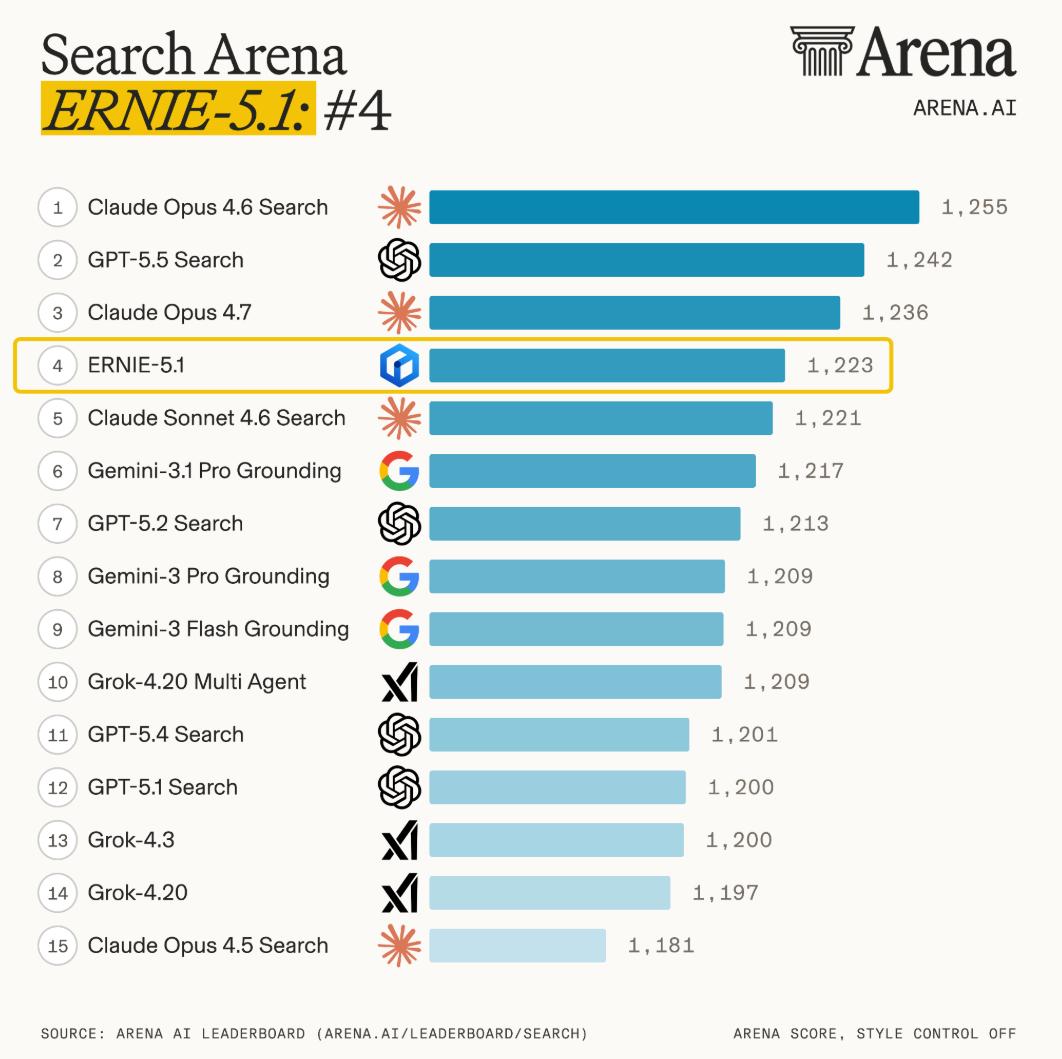
Wenxin Large Model 5.1 scored 1223 on the internationally recognized Search Arena benchmark, ranking fourth globally and first domestically. It is the only domestic model on this list. In the AIME26 benchmark (with tool invocation), dubbed the 'math competition level,' it scored 99.6, second only to Gemini 3.1 Pro.
More critically, in terms of cost, Wenxin 5.1 employs a 'multi-dimensional elastic pre-training' method, extracting an optimal subnet directly from the Wenxin 5.0 sub-model matrix. This fully inherits the knowledge learned by 5.0, eliminating the need for training from scratch. Total parameters are compressed to about one-third of the previous generation, activated parameters to about half, and pre-training costs are just 6% of models of the same scale.
However, cost control alone does not justify 'long-termism.'
Notably, domestic large models have already experienced a wave of pricing adjustments this year. Wenxin's decision to maintain free foundational capabilities runs counter to this trend.
On February 12, Zhipu raised prices for its GLM Coding Plan and eliminated first-purchase discounts, with the Lite tier rising to 49 RMB and the Max tier to 469 RMB. On March 23, Jieyue Xingchen introduced its first paid Step Plan, starting at 49 RMB per month. MiniMax's move was more dramatic: on June 1, with the launch of its new M3 model, it switched from per-use billing to Token-based pricing without prior notice, jumping the 29 RMB entry tier to 49 RMB, causing an uproar in the developer community.
As a company with practical experience in AI pricing, Baidu's decision to keep foundational capabilities free amid industry-wide tiered pricing requires not only robust cost control but also confidence in its long-term vision.
Market posturing alone cannot sustain this choice. Over the past decade, Baidu has maintained high R&D investment in AI, covering chip-level Kunlunxin, framework-level PaddlePaddle, model-level Wenxin Large Model, and application-level intelligent agents. All four technology layers are fully operational.
Ultimately, the viability of a free strategy depends on whether this full-stack pipeline is truly interconnected.

The two paths chosen by Doubao and Wenxin are shaped by their distinct resource endowments.
Baidu follows an 'ecosystem flywheel' model: technological advancements attract user scale, which solidifies into ecological barriers. These barriers then indirectly monetize AI capabilities through existing engines like search and intelligent cloud. This approach keeps monetization distant from users but closely aligned with Baidu's legacy businesses, such as search and cloud, which are already financially stable. Embedding AI capabilities essentially adds a new engine to established businesses.
Doubao follows a 'product flywheel' model: product capabilities lead to user payments, which fund model R&D, creating a faster-acting cycle. This path is closest to users and offers quick returns but requires continuous proof of product value—users' monthly renewal decisions are the most direct product ratings.

Breaking it down, these two approaches extend into different real-world choices across four dimensions.
The most obvious is monetization paths, as mentioned earlier. Baidu can indirectly monetize AI value through existing engines, a longer but more recession-resistant route; Doubao relies more on C-end subscriptions and API calls, a shorter path that requires continuous validation of user payment willingness.
In terms of user strategy, Wenxin employs low barriers to grow daily active users and retains them through feature breadth, a 'broad coverage' logic. Doubao uses tiered operations, using a free version to attract users and a paid version to monetize, a 'user segmentation' logic. Both address the same problem—matching users with value—but from different angles: Wenxin first expands the pool, then screens for value; Doubao first prices value, letting users self-select tiers.
Naturally, the two convey technological confidence differently. Wenxin's confidence stems from its ability to keep top-tier capabilities free, supported by engineering prowess in continuous model iteration. Doubao places high-tier capabilities in paid tiers, using pricing itself to anchor product value. How much users are willing to pay for a capability defines its worth.
Wenxin uses 'free' as a trust gateway, while Doubao uses 'pricing' as a value yardstick. Though logically opposite, their goals align—convincing users that the company's technological capabilities are worth the price.
While these two flywheels have different starting points and radii, they are not mutually exclusive.
In the short term, both choices are realistically justified. Baidu has an ecological foundation to support free offerings, while ByteDance needs to quickly close the commercial loop. This does not prove one is superior but reflects two resource structures matching different rhythms.
In the medium to long term, three evolving factors will determine the outcome: how much further computing costs can be reduced, how mature user willingness to pay for AI becomes, and whether AI can truly become an irreplaceable productivity tool. All three are still in flux and far from conclusive.
Globally, these two paths are becoming a shared product philosophy.
Even Google and Microsoft, which have already 'folded' their entry points, have left themselves with dual options when it comes to charging fees: Microsoft 365 Copilot offers a $30-per-month subscription for enterprise customers, while retaining free access to basic functions for consumers. Gemini also has multiple tiers—after its I/O conference in May this year, Google reduced the top-tier Ultra subscription from $249.99 to $199.99 per month, inserted a transitional plan at $99.99, and kept the free version in its product lineup without removing it.
First, integrate the entry points, then decide the pacing of charging based on scenarios and user segmentation. This is becoming an unspoken consensus among global AI products.
From this perspective, free and paid models are not mutually exclusive but rather two capabilities that the same company needs to master simultaneously at different stages of development and for different user groups.

Whether it's Doubao's tiered pricing strategy or Wenxin's move towards free expansion, the key insight from these nearly simultaneous market differentiations is that entry points themselves are evolving into a scarce resource.
Over the past two years, the AI industry had previously “presumed” that entry points were abundant. A product might be launched across three websites, a function could be shoehorned into five assistants, and users were left to navigate their own way. However, the reality is that ordinary people's daily usage habits are highly inertial; most individuals will only allocate a fixed amount of time to one or two AI applications. Once a particular entry point becomes the preferred choice for completing tasks, other similar products may not even be opened.
More significantly, the switching costs associated with AI products are much higher than anticipated. A user's reliance on an entry point is built upon the accumulation of usage habits, historical records, file storage, task context, and, most crucially, trust in the tool. The higher the switching cost, the greater the value of securing the entry point early on.
Therefore, when Wenxin consolidates three entry points into one and expands its capabilities from question-and-answer to office and learning scenarios, what it's actually doing is leveraging a lower barrier to entry and a smoother user experience to occupy the entry point first. By integrating AI into users' workflows and establishing a presence through sustained use, it is laying the groundwork for greater future commercial opportunities.
The ultimate competition in the AI landscape may not necessarily hinge on who converts users into paying customers first. Rather, the company that can meet more needs at lower costs and establish a strong foothold in users' workflows and habits will have a better chance of building an irreplaceable platform advantage in the future.
Entry point integration is merely the starting point, and tiered pricing is just one option among many in the commercialization process. The real race that will determine the outcome has only just begun.
*The featured image and illustrations in the text are sourced from the internet.
-
![]()
Discounts Now on Offer: Is Xiaomi No Longer Grappling with Vehicle Shortages?
-
![]()
Samsung Doesn't Make Money the Hard Way
-
![]()
Japanese Media Acknowledges: China's Engine Technology Outstrips That of Japanese Firms
-
![]()
Japanese Media Concedes: China’s Engine Technology Outpaces Japanese Firms
-
![]()
Doubao Professional Version Unveiled! China Now Boasts Its Own National-Level Professional AI Agent
-
![]()
ByteDance and Alibaba Both Step Back from the Gaming Arena
-
Xiangeo International Clears BSE Review: Setting a Global Standard for the ‘Chinese Sound’ | A-Share Financing Brief
-
![]()
86% Gross Margin, Revenue Hits 48-Year High: Micron Warns of Prolonged Supply Tightness Beyond 2027