"Whether People Like It or Not, the Robotic Revolution's Pivotal Moment Has Seemingly Arrived"
 07/01 2026
 489
489
This article is crafted based on publicly accessible information and serves purely as a platform for informational exchange, not as any sort of investment guidance.
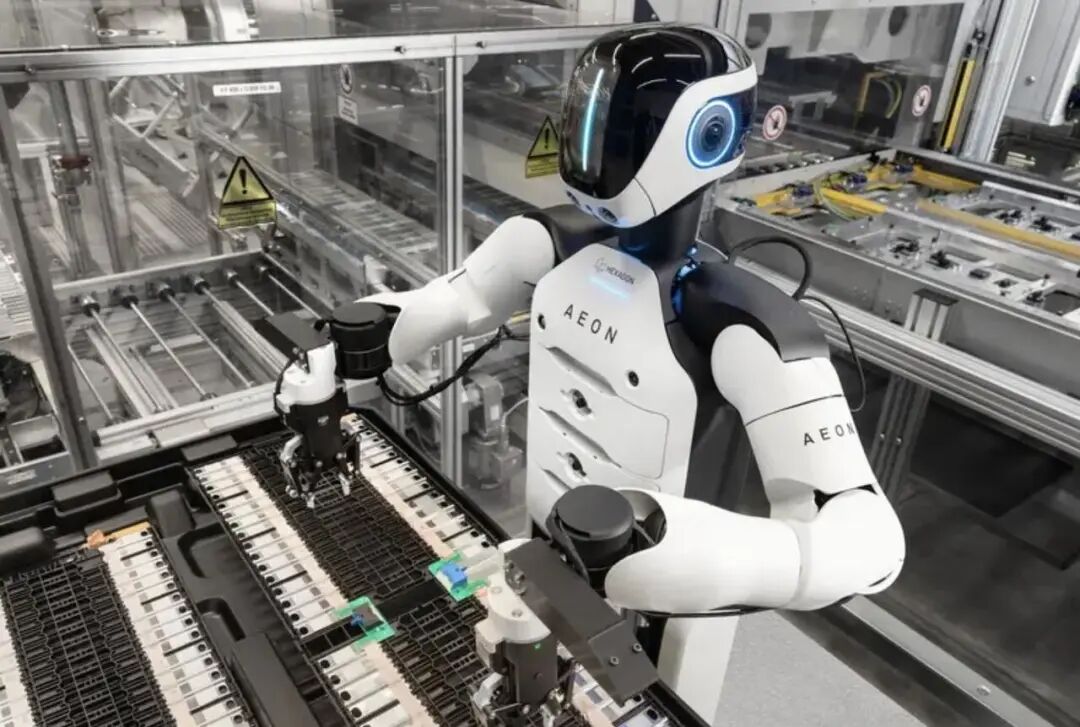
In June 2026, General Motors made a strategic move: 50 collaborative robots were deployed at its Detroit Factory Zero, resulting in the reduction of over 1,000 human jobs.
This facility, which manufactures the GMC Hummer EV and Chevrolet Silverado EV, was once the symbol of GM's electric vehicle aspirations. Now, the banners adorning the exterior convey a different narrative. The company asserts that these robots are merely auxiliary tools aimed at minimizing repetitive tasks and bolstering safety, rather than displacing workers. Nevertheless, the factory workers perceive the situation differently. Local 22 of the United Auto Workers union has officially lodged a complaint.
When an event is interpreted in two contrasting ways, it often implies that one of the interpretations is misleading.
This isn't General Motors' first brush with controversy. In 2018, the same company announced the closure of its Lordstown plant in Ohio, leading to the layoff of 14,000 employees. At that juncture, the rationale provided was "structural adjustment." In 2023, following the UAW's successful negotiation of a new contract through strikes, GM estimated that the agreement would escalate the cost per vehicle by approximately $500. In the same year, GM inked a collaboration deal with NVIDIA to co-develop an AI-powered factory system. CEO Mary Barra has repeatedly underscored that cutting-edge technology is pivotal for enhancing production efficiency and sustaining competitiveness.
Layoffs, strikes, and AI collaboration. When these three events are viewed in tandem, the underlying logic becomes apparent. It's not that robots have suddenly mastered the art of car manufacturing; rather, labor costs have soared, while machine costs have plummeted. The convergence of these trends is exemplified by the 50 Fanuc robots at Factory Zero.
Over a century ago, Ford revolutionized manufacturing by replacing craftsmen with assembly lines, slashing the time required to assemble a Model T from 12.5 hours to just 93 minutes. Back then, the narrative was also centered around "assistance," not "replacement." Yet, the outcome was the disappearance of craftsmen, replaced by assembly line workers. Today, robots are touted as colleagues, but who will recall their initial designation in tomorrow's factories?
GM is currently facing challenges. Fluctuating demand for electric vehicles has necessitated production adjustments and frequent line shutdowns. Factory Zero, once envisioned as the flagship factory for an all-electric future, has now become a significant source of underutilized capacity.
However, this isn't the core issue. GM is caught in a dual bind. On one hand, profits from gasoline-powered vehicles are dwindling, and capital markets offer little reprieve to traditional automakers, with price-to-earnings ratios languishing in the single digits, akin to a sunset industry. On the other hand, the transition to electric vehicles is consuming vast amounts of cash, with losses incurred from the outset of production and higher depreciation costs per vehicle compared to gasoline-powered cars. To preserve profit margins, the most straightforward approach is to slash costs.
Among all expenses, labor is the most straightforward to quantify. Equipment depreciation can be spread out over time, and raw material prices can be locked in. Only labor represents a recurring fixed expense every quarter. Fifty robots represent a one-time capital outlay with depreciation over five years. One thousand workers necessitate annual payments for salaries, healthcare, and pensions. Any CFO would reach the same conclusion when presented with these figures.
Toyota is ramping up automation, and BMW is following suit. German and Japanese automakers, who once equipped their workers with lean production techniques to transform them into precision machines, are now replacing them with actual machines. The entire industry is moving in the same direction, not by mutual agreement, but driven by the same underlying force.
The UAW's next round of negotiations is slated for 2028, less than two years from now. From this point onward, every robot that goes online and every job that is cut will serve as ammunition for the negotiating table.
But this battle may already be devoid of suspense.
A century ago, workers still held an ace: while the assembly line supplanted manual labor, machines still required human operators. A worker might transition from craftsman to assembly line worker, experiencing a devaluation of skills but still retaining employment. Today's collaborative robots do not require operators; they only need programmers who, from an office outside the factory, write code, upload it to the cloud, and let the robots handle the rest. Technology is redefining those thousand laid-off workers into assets that can be amortized and depreciated.
The ultimate irony lies in the fact that the work output of collaborative robots—pass rates, production rhythms, energy consumption data—is transmitted in real-time to the cloud, becoming data to train the next AI model. The displaced workers may not even realize that they are inadvertently providing training samples for the next wave of automation that will replace them.
The 50 robots at Factory Zero are quietly assembling electric Hummers. Outside the factory, a job posting from last month still lingers on the bulletin board. Between these two scenes lies the past and future of the entire automotive manufacturing industry.
-
![]()
Big Company HR Departments Are Overwhelmed: Young Job Seekers Harness Agents, AI-Assisted Interviews Spark Controversy
-
![]()
SAIC MG General Manager Overwhelmed by Online Backlash, Ends Livestream Prematurely: A Blend of Unfairness and Fairness
-
![]()
Hong Kong Stock IPO丨Recon Technology: The First Embodied Visual Intelligence Stock in Hong Kong Stock Market Launches Offering Without Cornerstones or Green Shoe Option
-
![]()
Avita Reapplies for Listing: Reports 25.6 Billion Yuan in Revenue and 3.49 Billion Yuan in Net Loss for the Previous Year, with 182 Million Yuan in Dividends from Yinwang | MIRROR Pro
-
![]()
DataStory's Controversial Hong Kong IPO: 5 Billion Valuation Hangs in the Balance Amid 866 Million Debt Pressure
-
![]()
Apple’s Prices Skyrocket Up to 3,500 Yuan! Who Empowered Cook to Hike Prices?
-
![]()
ByteDance Executives Go Viral!
-
![]()
ByteDance Executives Dominate Headlines!