ByteDance Executives Go Viral!
 07/01 2026
 526
526

On the evening of June 29, ByteDance CEO Liang Rubo sent a company-wide email to employees globally, sparking widespread discussion and heated debate across the internet.
This time, it didn’t follow the conventional script of internet giants—no flashy rhetoric or emotional slogans. The entire letter focused on one thing: taking aim at management.
The core of this letter can be summed up in three words: serious action.

Why did the company-wide letter go viral?
Liang Rubo’s email contained a wealth of information and openly addressed the challenges ByteDance currently faces.
First, he reiterated the unchanging mission: 'Inspire creativity, enrich lives.' However, the key takeaway was his added statement: 'From the era of recommendations to the AI era, ByteDance’s approach to fulfilling its mission remains consistent—using computation to enhance intelligence and using intelligence to boost creativity and experience.'
This statement effectively sets the tone for ByteDance’s AI strategy, positioning it not as a departure but as a natural extension of its mission.
Even more impactful is the updated '10 Leadership Principles.' The last time Liang Rubo revised these principles was in 2022. Four years later, this adjustment is sharp and direct:
First Cut: Eliminating 'passive management.' New additions include 'pursuing ambitious goals' and 'daring to set high standards,' explicitly requiring managers not to focus solely on short-term revenue or monthly metrics but to look beyond daily operations and anchor in long-term, high-value areas. Simply put, managers who rely on past successes to coast along will no longer survive.
Second Cut: Managers must 'go to the frontlines.' 'Maintain a sense of crisis, keep an external perspective,' and 'dive deep into the frontlines' are now listed as separate items. Henceforth, middle and senior management cannot simply sit in offices reviewing reports and listening to briefings—they must regularly immerse themselves in business, product, and user frontlines.
The email also explicitly states that middle management layers detached from the business frontlines and serving only as information relays will see their organizational value continuously diminished. This is a core signal of ByteDance’s push for organizational flattening.
Third Cut: Eliminating formalism. The 'Context over Control' philosophy is emphasized, requiring managers to reduce multi-level approvals, repetitive meetings, and ineffective reporting. Many teams previously suffered from 'busywork with no substantive output,' which is now directly listed as a negative management example.
The toughest part is the implementation mechanism: the updated 10 Leadership Principles will be directly incorporated into the core criteria for all managers’ promotions and annual evaluations. Those unable to deliver results or detached from the business frontlines will face simultaneous adjustments to their roles and responsibilities.
The reason this company-wide letter has drawn widespread attention boils down to one core factor: ByteDance is actively taking on 'big company syndrome.'
When a supergiant with over 100,000 employees and trillions in revenue openly admits in an internal letter to issues like 'idle operations,' 'formality,' and 'inertial coasting,' and introduces strict evaluations to correct course, it is news in itself.
What’s happening at ByteDance?
Liang Rubo’s letter didn’t come out of nowhere. ByteDance is at a crossroads of 'fire and ice.'
First, the 'fire.' In 2025, ByteDance’s annual revenue is expected to reach approximately $186 billion (RMB 1.31 trillion), up about 20% year-over-year, surpassing Tencent and Alibaba to rank first among Chinese internet companies.
Douyin E-commerce’s 2025 annual GMV exceeded RMB 4 trillion, growing over 30% and closing in on Pinduoduo. Overseas revenue grew nearly 50% year-over-year, with the share of overseas business revenue rising from 25% in 2024 to over 30%.
But the 'ice' is equally biting.
According to multiple media reports, ByteDance’s net profit in 2025 shrank sharply from $33 billion in 2024 to just over $9 billion, a year-over-year decline exceeding 70%. The profit margin dropped from 25% to single digits.
Revenue rose 20%, but profits fell 70%. Where did the money go?
The answer is two words: AI.
Insiders reveal that the significant decline in net profit margin came as ByteDance substantially increased AI business investments in the third and fourth quarters of 2025. In 2026, ByteDance raised its AI capital expenditure plan to RMB 200 billion (approximately $30 billion), an increase of at least 25% from the initial plan.
What does RMB 200 billion mean? It’s equivalent to 60% of 2025’s profits.
This is ByteDance’s current reality: revenue scale tops China’s internet sector, but profits are being rapidly consumed in the AI 'arms race.'
Revenue surges while profits plummet—this disconnect is the true backdrop to Liang Rubo’s company-wide letter.

Is ByteDance set to fully monetize its AI tools?
Facing the dilemma of 'rising revenue but falling profits,' ByteDance’s strategy is clear: focus strategically on AI while making AI 'self-sufficient.'
In June of this year, Liang Rubo made a rare appearance at the Volcano Engine FORCE Conference, officially clarifying ByteDance’s strategic focus on AI and setting the 2026 annual keyword as 'scaling new heights,' with the core goal of truly mastering large model technology capabilities. In recent years, ByteDance has continuously narrowed its business scope, focusing resources on AI.
But spending alone isn’t enough—revenue must follow.
Doubao’s commercialization has accelerated. On June 24, 2026, Doubao officially launched a professional paid subscription with three pricing tiers. Some media calculations show: with 345 million monthly active users, even if just 1% subscribe, monthly revenue could exceed RMB 228 million.
Will Doubao fully monetize? Probably not.
Free basic features for consumers and paid premium features are already an industry consensus. ByteDance’s likely strategy is 'capturing consumers for free, earning profits from businesses,' with Volcano Engine’s MaaS business serving as the true profit engine.
In 2025, Volcano Engine’s full-category MaaS actual revenue reached approximately RMB 1.5 billion, while the 2026 revenue target has been raised to RMB 15 billion—ten times last year’s figure. The video large model Seedance 2.0 alone generates over RMB 1 billion in monthly revenue.
ByteDance’s plan is clear: use Doubao’s 345 million monthly active users to capture consumers and use Volcano Engine’s MaaS services to earn from businesses.
Capturing market share for free and monetizing later—this classic internet business logic is being replicated in the AI era.
ByteDance’s 'Spear' and 'Shield'
When viewed within the industry landscape, ByteDance’s strengths and weaknesses are equally apparent.
Unmatched traffic moat. Doubao’s MAU reached 345 million, surpassing the combined monthly active users of second-place QianWen and third-place DeepSeek. Leveraging ecosystems like Douyin, Toutiao, and Xigua Video, ByteDance has established a formidable traffic barrier.

Revenue scale tops the charts. With RMB 1.31 trillion in revenue, it surpasses Tencent (RMB 751.7 billion) and Alibaba (RMB 996.3 billion), firmly sitting atop China’s internet sector.
Largest AI investment. The RMB 200 billion capital expenditure in 2026 exceeds the annual CapEx of any listed cloud provider.
But the weaknesses are equally critical:
Profits devoured by AI. While Tencent’s 2025 net profit reached RMB 224.8 billion (up 16% year-over-year) and Alibaba’s 2025 fiscal year net profit hit RMB 126 billion (up 77% year-over-year), ByteDance’s profit fell from $33 billion to $9 billion.
Late start in B2B business. Tencent Cloud and Alibaba Cloud have already achieved Large scale profitability (scalable profitability), while Volcano Engine’s MaaS business generated just RMB 1.5 billion in 2025—a significant gap.
The 'double-edged sword' of going public. Not being listed spares ByteDance from quarterly earnings pressure, allowing unrestricted AI investment—but also removes capital market financing channels and equity incentive tools.
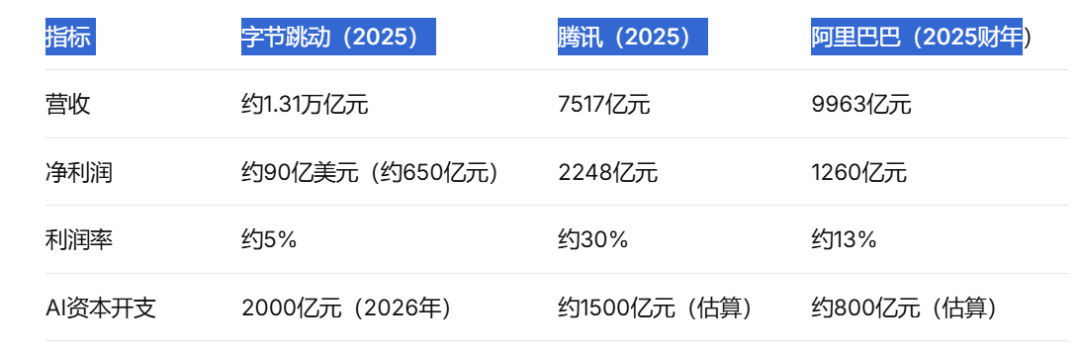
Note: As ByteDance is not publicly listed, some data comes from public reports or media estimates.
This table reveals a harsh reality: ByteDance has the highest revenue but the thinnest profits. In the AI battle, ByteDance is trading profits for the future.
What’s the takeaway?
Returning to Liang Rubo’s company-wide letter.
Some might dismiss this as just another 'management rectification.' Based on years of observing ByteDance, this letter carries far more weight than a typical internal adjustment.
First, ByteDance is voluntarily 'operating on itself.' When a company reaches China’s top revenue spot and serves billions of users, 'big company syndrome'—cumbersome processes, bloated hierarchies, slow decision-making, and detachment from frontlines—becomes inevitable.
ByteDance’s choice to proactively expose and rectify these issues at its peak requires courage.

Second, ByteDance is redefining 'management.' The harshest part of Liang Rubo’s letter is transforming 'management' from a position into a verb. Managers are not just 'overseers' in offices but must 'dive into frontlines, deliver results, and drive growth.' Generals who can’t fight aren’t fit to lead.
Third, ByteDance is betting on a bigger future. The RMB 200 billion AI investment, plunging profits, and tightened management—all these short-term pains are paving the way for long-term competitiveness in the AI era.
Liang Rubo put it bluntly: 'Scaling the AI peak is ByteDance’s top priority right now.'
From recommendation algorithms to AI large models, ByteDance is undergoing a difficult but necessary transformation. This letter isn’t a sign of crisis but of clarity.
A company’s most dangerous moment isn’t when it faces difficulties but when it believes nothing needs to change. ByteDance clearly isn’t on that path.
Liang Rubo concluded the letter by saying: 'Updating the words is just the beginning—what matters is implementation.'
Let’s see how many managers truly 'dive into the frontlines' in the 2026 performance reviews.
That’s when this letter will truly take effect.
-
![]()
Alibaba's AI 'Crucible': Navigating Overseas Blockades, Organizational Upheaval, and the Lag in Commercialization
-
![]()
Global Electric Vehicles Enter the '23 Million Unit Era': China Maintains Edge, Emerging Markets as New Growth Pole
-
Meituan Triumphs with Domestic Computing Power: Running a Trillion-Parameter Model, Exploration Initiated in 2023
-
![]()
Embodied Intelligence and Mobile Robots: Why the Intensified Focus on Factories This Year
-
"Chip" Radiance Persists: Is the Semiconductor Sector Still a Magnet for Investors?
-
![]()
Robots Embark on 200-Hour Factory Trials: Is AI Truly Ready for Industrial Deployment?
-
![]()
Another Bionic Robot Company Secures $7 Million in Funding
-
![]()
UBTECH U1 Launch: Pre-sale Excitement Creates Unrealistic Hopes, Resulting in Disappointment at the Event