Market Share Dilemma: DJI vs. Insta360 – A '40-40 Split' or '60-30 Split'?
 07/01 2026
 525
525

In 1950, the renowned director Akira Kurosawa crafted the film Rashomon. In this masterpiece, a woodcutter, a bandit, and the spirit of the victim, speaking through a medium, all recount their versions of the same murder, each narrative contradicting the others.
For the consumer electronics sector, market share can occasionally resemble a Rashomon scenario—various reports present vastly different accounts of the same market segment within the same timeframe.
This year, both DJI and Insta360 have witnessed robust sales for their latest offerings. In April, the DJI Pocket 4 sold out online within moments and faced month-long backorders at physical stores. In June, the Insta360 Luna Ultra and DJI Pocket 4P both sold out shortly after their launch, boasting impressive sales figures during the 618 shopping festival.
However, when discussions turn to 'who is leading the market,' the answers vary widely.
IDC's most recent global tracking report reveals that in the first quarter of 2026, DJI and Insta360 achieved a '40-40 split' in the action camera market, while Insta360 maintained over a 68% share of global shipments in the 360-degree camera market.
Yet, over the past month, another widely referenced industry dataset presents a starkly different narrative: Insta360's market share in the 360-degree camera market has plummeted to 49% or even 33%, with DJI clearly taking the lead.
Same market, same quarter, two reports—yet nearly diametrically opposed conclusions.
Did someone make a calculation error, or are they even assessing the same market?
The answer may lie in the seldom-scrutinized 'statistical criteria.'

The handheld smart camera category has undergone significant transformations in recent years. DJI's Pocket series, Insta360's X series, and the much-discussed Luna Ultra have all taken turns dominating the market.
Features such as AI editing and one-click video generation have matured, enabling ordinary users to effortlessly create polished short films. The user base has expanded from early 'creators' to 'recorders.'
Clearly, this is a market driven by growth, and DJI and Insta360 are undoubtedly the two most closely watched companies in this space.
Founded nearly a decade apart—DJI in 2006 (with 2025 revenue reportedly expected to surpass 100 billion yuan) and Insta360 in 2015 by a startup team from Nanjing University (with 2025 revenue around 9.7 billion yuan)—the two companies differ significantly in scale. However, Insta360 holds a trump card: 360-degree cameras. Since the days when Ricoh and Samsung failed to establish a foothold, Insta360 has dominated this niche, consistently holding a 60-80% global market share.
For an extended period, the two companies coexisted peacefully in their respective niches, with minimal direct competition. Outsiders were content to label them simply: 'drones for DJI, 360 for Insta360.'
But that label no longer seems adequate.
Their recent clashes have centered on gimbal cameras. This category traces its origins to GoPro's 2016 Karma Grip, with the 2017 REMOVU K1 integrating the gimbal, screen, and handle into a single device.
DJI succeeded in popularizing gimbal cameras among consumers. Since then, the category has largely been DJI's domain, with the market awaiting a significant challenger.
In June 2026, the Insta360 Luna Ultra emerged as the first true competitor to DJI's Pocket series, selling out in five minutes and confirming market expectations.
But in reality, the rivalry between the two companies began nearly a year earlier.
In July 2025, Insta360 announced its 'Yingling Antigravity' drone brand. Just three days later, DJI released its first 360-degree camera, the Osmo 360. That September, DJI launched the Osmo Nano, directly competing with Insta360's GO Ultra in the thumb camera category that Insta360 had pioneered.
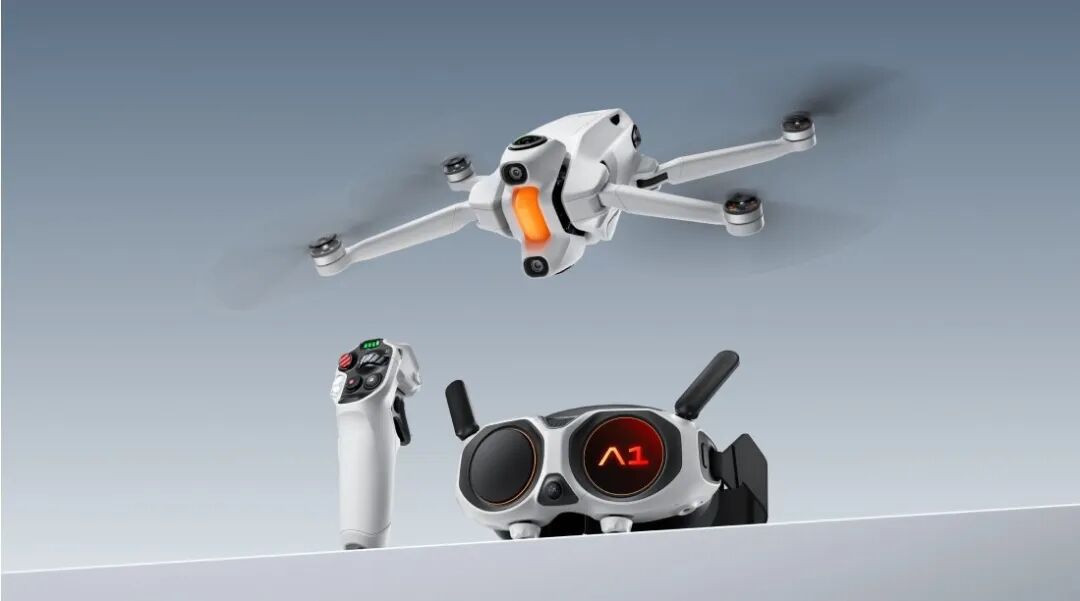
According to Liu Jingkang, Insta360's decision to enter the drone market was made five years prior, with a 360-degree camera compatible with drones even released in 2022. With the technical groundwork already laid, Insta360 expanded from its niche 360-degree camera market into larger markets like drones and gimbal cameras. DJI, meanwhile, moved from the large drone and gimbal camera market into Insta360's smaller niches of 360-degree and thumb cameras—the two companies expanded in opposite directions yet found themselves facing off.
But now, the field is becoming crowded. OPPO and Vivo have announced gimbal camera lines, directly competing with DJI's long-dominated Pocket series, while Honor has launched a 'robot phone,' attempting to enter the same scene with a different product logic.
The influx of new players is actually a positive signal: it shows this market is far from a zero-sum competition.
Yet as the market grows busier, discrepancies in statistical criteria become increasingly glaring.

The same market, two contradictory narratives.
A report by Jiuqian Zhongtai shows that in the first quarter of 2026, DJI held 61% of the global handheld smart imaging device market, with Insta360 at 28%. These figures have been repeatedly cited over the past month as the 'default truth' in the industry, used in countless industry articles and even some investment analyses.
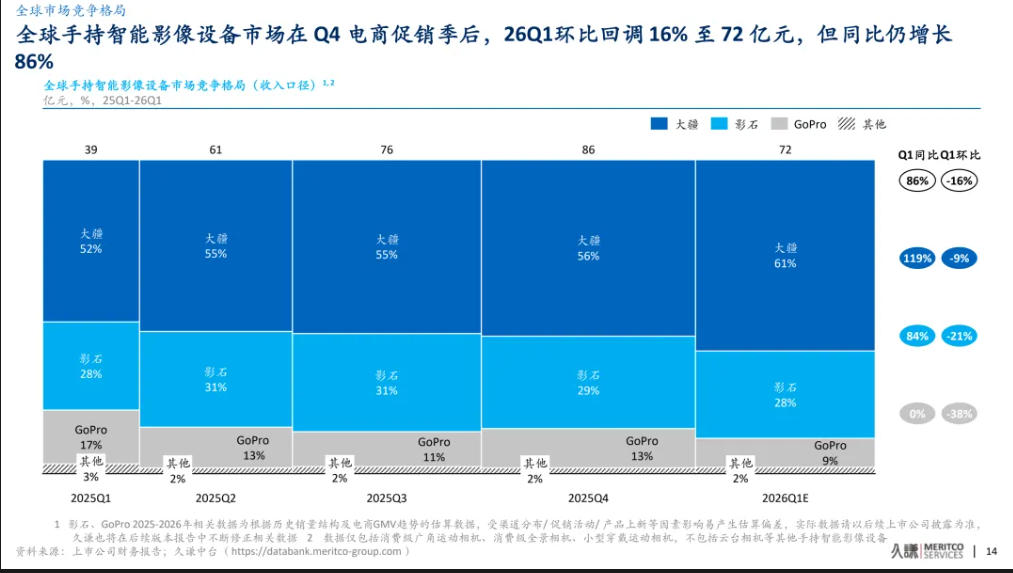
However, IDC's latest global market tracking report paints a different picture. In the same broad category, DJI holds 65% and Insta360 22%. At first glance, the numbers seem similar, but they don't actually align.
Jiuqian's data covers action cameras, 360-degree cameras, and wearable cameras, excluding gimbal cameras. IDC's 'handheld smart camera' definition includes gimbal cameras. The issue is that Insta360's Luna Ultra only officially launched in June, so Q1 shipments didn't include it.
In other words, nearly all gimbal cameras available online in Q1 were DJI's. This 1.63 million-unit category was entirely rolled into the total, yet DJI's share only rose slightly from 61% to 65%—just a 4-point increase, which seems statistically questionable.
If we standardize the criteria to exclude gimbal cameras, the two companies remain in a '40-40 split.'
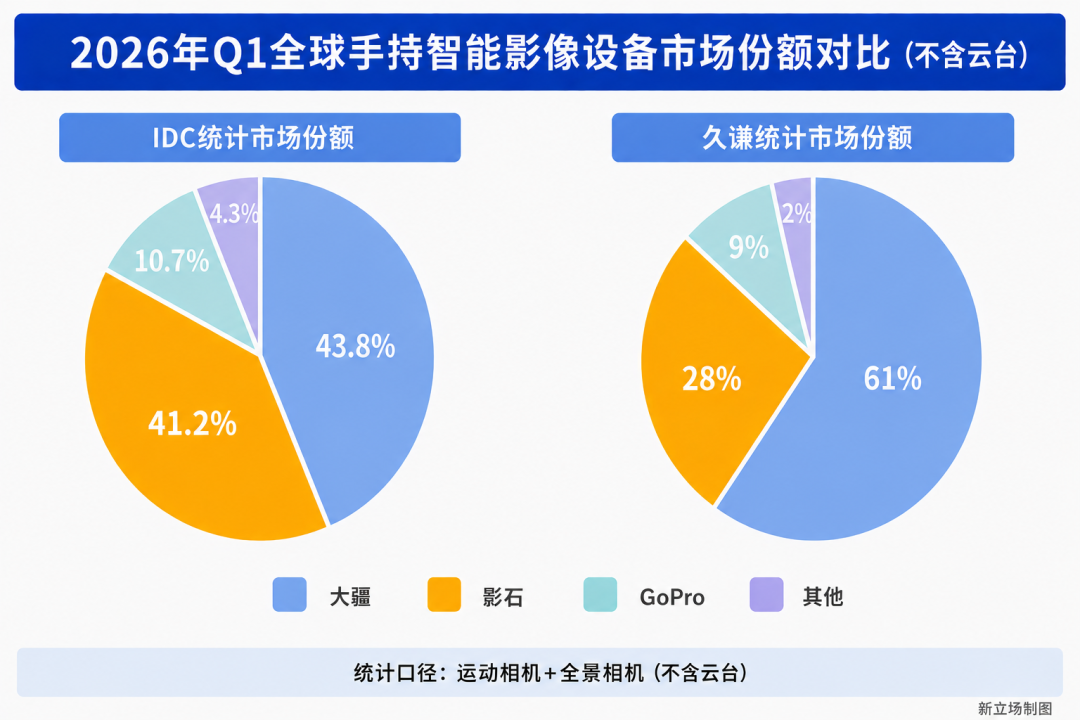
Narrowing to the 360-degree camera market, IDC data shows Insta360 with over a 68% shipment share and 71% revenue share, firmly the global leader. This sharply contrasts with Jiuqian's figures—widely cited by media—showing Insta360's market share plummeting to 49% or even 33%, with DJI rising to 57%.
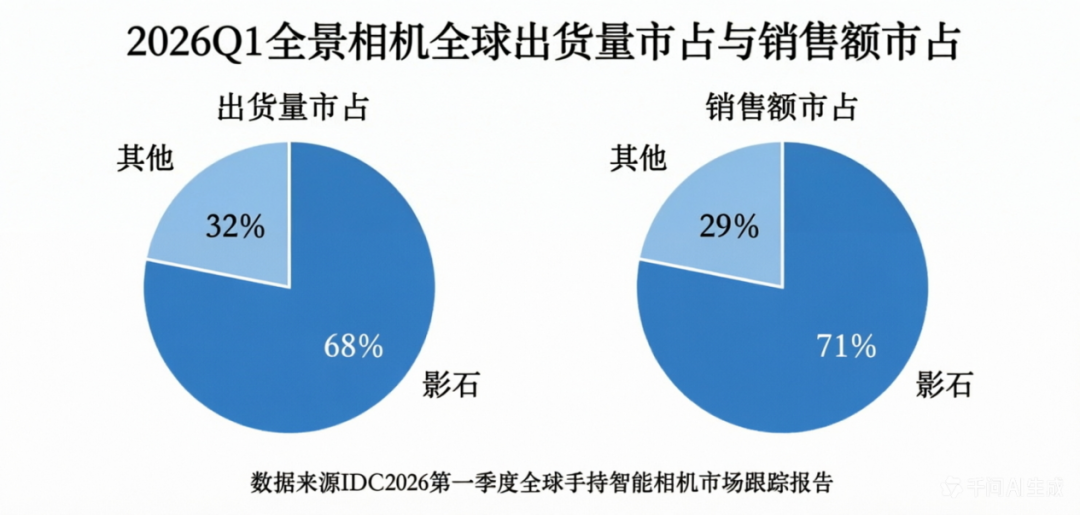
When both reports are placed side by side, the disconnect is striking—it's as if they describe two different markets. Where does the discrepancy lie?
Currently, the gap stems from two main differences in statistical criteria.
Jiuqian Zhongtai primarily monitors e-commerce platform data, using 'estimates based on historical sales structure and e-commerce GMV trends.' In other words, these are global estimates extrapolated from e-commerce trends using models.
Using online retail share to infer global competitive standing is like judging national traffic conditions by looking at one city's car flow—somewhat one-sided.
Second is the difference in statistical methods. E-commerce sales capture real-time retail enthusiasm but are easily skewed by pulse-like spikes during shopping festivals like 618 or Double 11. Shipment and revenue data better reflect manufacturers' actual global operations, with smoother fluctuations.
Early last year, an agency cited Jiuqian's offline store survey data to conclude that Pop Mart's domestic store growth was slowing. Yet Pop Mart's 2025 annual report and Q1 2026 operating data showed 75-80% YoY growth in domestic offline channels—completely contradicting the initial judgment.
The same estimation-dependent method, when applied to the smart camera market with its wider price ranges and more intertwined online/offline channels, has no reason to be more reliable than in the toy sector.
IDC's situation differs slightly. As one of the most cited data agencies in consumer electronics, IDC's global shipment statistics for smartphones, PCs, and tablets are standard industry references.
For more mature categories like smartphones and home appliances, IDC's shipment data and e-commerce retail figures have long shown similar discrepancies, but with smart imaging devices still small, even slight percentage differences appear glaring.
One easily overlooked point: Insta360 is a publicly traded company, with every financial report and announcement subject to audit and regulatory scrutiny. Information disclosure follows clear rules, making data fabrication extremely costly. DJI, still private, relies solely on media reports for its data, with no audited financial statements for cross-verification.
The clash between these two statistical approaches is partly tied to this asymmetry—one side can be verified, the other cannot.
Of course, statistical discrepancies themselves are understandable. The problem is that these 'estimates,' repeatedly cited over the past month, have evolved from one perspective into industry consensus, potentially influencing investors and consumers—this is what warrants caution.

Discrepancies in data criteria are just one facet of this comprehensive competition.
Supply chain conflicts emerged earliest. Before Insta360's first 360-degree drone launch, key suppliers faced exclusivity pressure, with one supplier stating they could dine together but not do business. Around the same time, an Insta360 store in Changsha was required to remove its signage due to exclusivity agreements.
On pricing, DJI's first 360-degree camera, the Osmo 360, was priced nearly 800 yuan lower than Insta360's flagship X5, directly entering Insta360's long-dominated market. The price war escalated from there, with DJI offering steep discounts on multiple products during Double 11, sparking consumer backlash over price protection guarantees and trending on social media.
At this stage, competition inevitably deepened.
In 2026, patent litigation became the new front. DJI first sued Insta360 in China, followed by cross-lawsuits in the U.S. Subsequently, Insta360 executives publicly accused organized attacks by 'blackwater' online troops during litigation, stating that 'organized public opinion attacks on cases still in judicial proceedings are a red line that cannot be crossed,' sharing evidence and filing police reports.
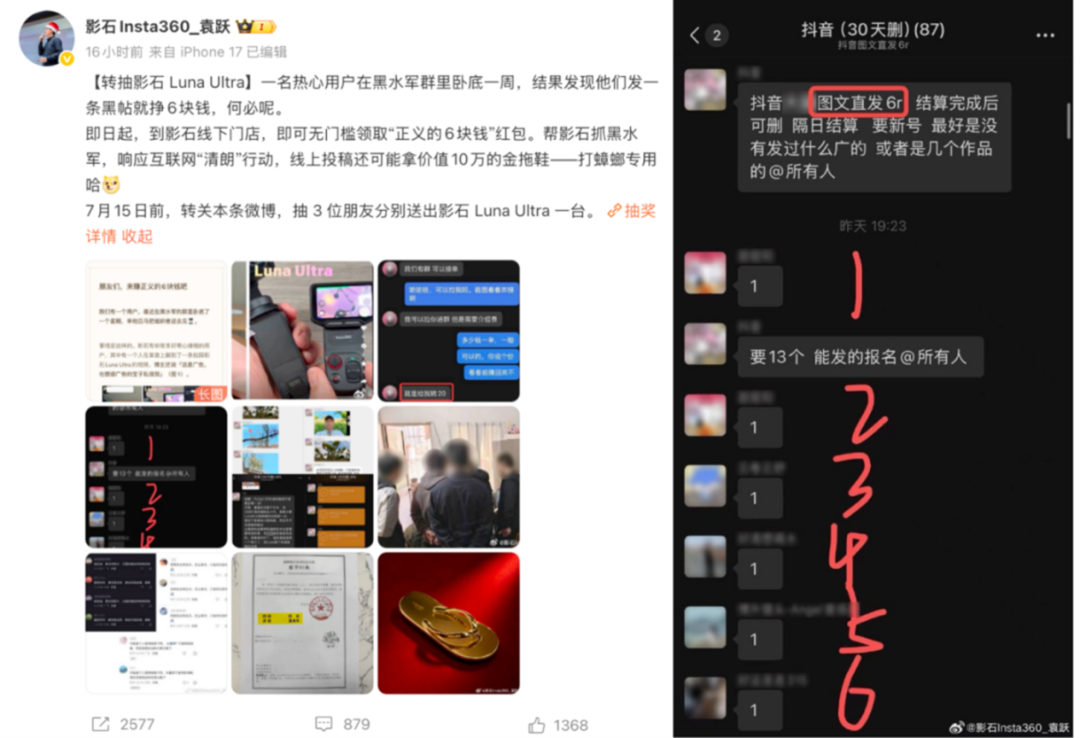
Objectively speaking, 'taking disputes to court' is hardly a blemish in the broader consumer tech and internet industry.
Temu and Shein have been suing and countersuing each other since late 2022. Didi and Meituan's Brazilian brands have also faced off in court over trademarks and unfair competition.
Only competitors with scale and influence have the confidence to bring disputes into the legal arena.
Viewed through this lens, it represents a necessary phase as China's smart imaging industry transitions from 'product competition' to 'rule-based competition.'
Ultimately, while these two companies clash fiercely, their core strengths differ. DJI's foundation lies in gimbal stabilization and flight control systems, while Insta360's edge is in 360-degree stitching and AI imaging algorithms. These technical DNAs point to different product logics and user scenarios.
Competition is fierce, but the market is still growing—far from a zero-sum game.
*The featured image and illustrations are sourced from the internet.
-
![]()
Market Share Dilemma: DJI vs. Insta360—Is It '40-40' or '60-30'?
-
![]()
Market Share Dilemma: DJI vs. Insta360 – A '40-40 Split' or '60-30 Split'?
-
![]()
It's Kunlunxin's Turn to Play
-
![]()
Is the New Performance Peak Just the Starting Point? What Will Be Crystal-Optech's Next Destination?
-
![]()
Goertek Pours 69 Million Yuan into Elite Precision: Ramping Up Optical Precision Manufacturing and R&D Capabilities
-
![]()
Avatr Attempts HKEX Listing Again, With 20,000 Vehicles Sold in First Five Months
-
![]()
NVIDIA Announces 10-Fold Production Capacity Increase in 2 Years, Disrupting the Energy Storage Industry
-
![]()
AI Enters the Second Half: Models Are No Longer Scarce, What’s Truly Scarce Are Computing Power, Scenarios, and Trust