MathWorks: Generative AI Holds Great Potential, Yet a Trusted Toolchain is Essential for Flawless Operation
 07/02 2026
 474
474
Authored by Zhineng Technology
At the MathWorks 2026 China Automotive Conference, Tom Erkkinen, the Embedded Software and Certification Product Manager, took part in a group interview that lasted nearly an hour.
With the rise of generative AI, how should automotive software engineers keep leveraging MATLAB® and Simulink®? Will MBD (Model-Based Design), a methodology honed over decades, face disruption? How can one trust the code produced by large models?
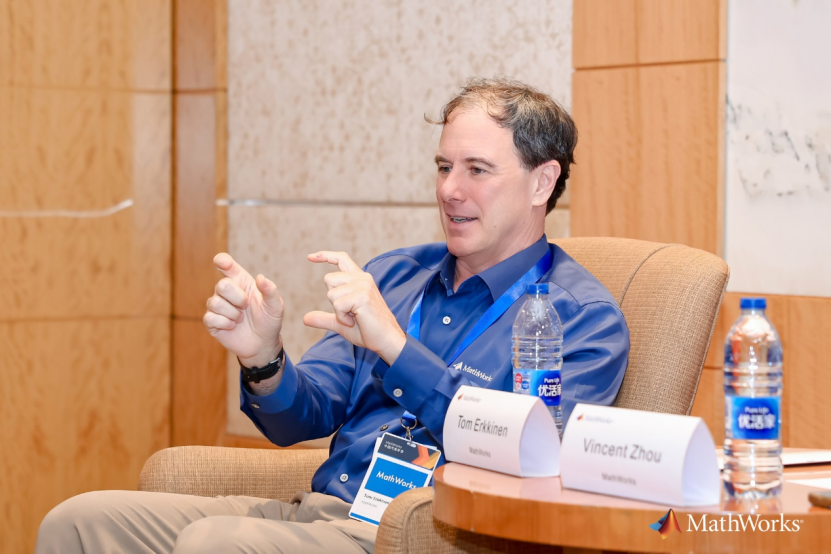
Tom Erkkinen, MathWorks' Embedded Software and Certification Product Manager
Tom provided a well-defined framework in his response, characterizing the relationship between generative AI, engineers, and MBD as a 'collaborative partnership'.
01 Generative AI Takes on Task Allocation
● The Function of Generative AI in Engineering Software Development
The MathWorks' MATLAB MCP Core Server, launched in October of the previous year, serves as a universal protocol enabling any large language model (LLM) to call upon MATLAB and Simulink via this server.
In April of this year, the Agentic Toolkit was unveiled, infusing MATLAB and Simulink expert knowledge into large models, empowering them to generate code and models that adhere to modeling standards.
Two pivotal capabilities were introduced to large models, which they initially lacked: firstly, interfaces to access real engineering tools, and secondly, best practices for utilizing these tools.
If a large language model directly generates MATLAB code, it might write numerous lines to execute a function already present in a MATLAB toolbox. With Skills, the large model recognizes that the proper approach is to invoke that toolbox, resolving the issue in a single line. This significantly reduces token consumption, and the generated code is faster and less prone to errors.
Achieving optimal results with minimal token consumption often hinges on these skills.
What MathWorks does is 'prevent AI from directly writing code and instead have AI identify verified tools to accomplish the task.' Generative AI functions as a dispatcher, aware of which tool resolves which issue, rather than as a manual laborer.
● Generative AI Offers Varied Responses
How can one trust the code produced by large models? A succinct summary of users' primary concern: 'If provided with the same input, it may yield different results.' This statement encapsulates the automotive industry's profound apprehension regarding generative AI.
Functional safety engineers are accustomed to determinism: the same input into the same toolchain should yield unique, traceable, and verifiable code. The probabilistic nature of large language models inherently clashes with this requirement.
Large models cannot directly produce production-level code. When combined with the Agentic Toolkit, they correctly utilize and execute corresponding tools in MATLAB and Simulink for design and verification, then call upon Embedded Coder to generate deployable embedded code. MBD tools themselves are ISO 26262-certified, guaranteeing deterministic outputs.
MathWorks' solution ensures that large language models correctly utilize and execute verified MATLAB and Simulink tools, yielding deterministic results.
While large language models excel at innovation, the true value of the MBD (Model-Based Design) workflow and toolchain lies in transforming their outputs into deterministic, engineering-ready, and production-ready outcomes.
The ingenuity of this solution resides in confining the uncertainty of generative AI within a manageable range. The boundaries are as follows: generative AI comprehends requirements, invokes tools, and designs tasks. Tools manage execution.
Execution results are deterministic, traceable, and certified. Generative AI does not directly access the product code layer.
For users manually writing code, Tom believes that directly generating code with large models is acceptable, as long as it is not employed in safety-critical systems. Your objectives and requirements vary.
For engineering and safety-critical systems, code quality must meet certain thresholds and adhere to functional safety standards. Manual coders can develop without Simulink if they do not take engineering or productization into account.
02 Engineers Will Gain Greater Value Than Coding
● Pace of Product Development
When questioned about how AI Agents will alter automotive engineers' daily tasks in the next three to five years, Tom initially joked, 'Are you referring to Simulink Copilot?' He then offered a perspective that may require many coders to ponder.
With Simulink Copilot, engineers will concentrate less on implementing software themselves and more on having AI Agents execute tasks. Agents will generate standardized requirements, test cases, and models.
The engineer's role transitions from 'coder' to 'definer of goals and system architecture' and 'reviewer of AI outputs.' Shifting from software implementation to result review, system decision-making, and framework definition becomes more valuable.
Viewed within the context of the automotive software industry's evolution, this indicates a profound shift. For decades, automotive software engineers' core competitiveness lay in comprehending tools, writing code, and operating toolchains.
As AI assumes implementation, competitiveness will shift upward (defining system architecture and goals) and downward (auditing and verifying AI outputs for safety and standards compliance).
MathWorks R2026a introduced Simulink Copilot and the Agentic Toolkit, enabling generative AI to manage implementation, while the Polyspace tool suite, including Polyspace as You Code, integrates code analysis and safety vulnerability detection into the development process. One expands, one contracts.
● Standards Remain in Draft Stage
Concerning the certification of code generated by generative AI, ISO 22440 is still in draft form, with ongoing debates about sections on AI tool certification. ISO 26262 currently lacks mature practical guidance for AI-generated code.
Code generated through MBD (Model-Based Design) software development does not suffer from traceability gaps or uncertainty, as Embedded Coder is 26262-certified, ensuring deterministic outputs for each input.
However, code directly generated by large language models faces significant challenges in passing functional safety certification. A minor alteration in prompts can modify the code, posing a major risk. For manual coding, Tom believes certification is theoretically feasible, as numerous historically certified manual codes exist.
Logically, code generated by large language models can undergo the same certification process, but the output discretization caused by each fine-tuning makes the certification workload increase not just twofold but by orders of magnitude.
Summary
Generative AI is potent yet not yet capable of independently assuming safety responsibilities. Having generative AI schedule verified MBD (Model-Based Design) toolchains, rather than writing code itself, is the path forward. Engineers' roles transition from implementers to architects and reviewers.
Standards and certification remain subjects of debate, with no mature solution for directly certifying large model-generated code for functional safety in the near term. This accurately mirrors the engineering realities the automotive industry confronts when introducing generative AI. When software failures in a vehicle can compromise human safety, any uncertain output source is intolerable.
The value of toolchains lies in confining large language model uncertainty within controllable limits. MathWorks' focus is ensuring its biannual releases maintain high quality and reliability, especially in the AI era, providing engineers with a trustworthy foundation.
-
![]()
Behind the Release of Its First Self-Developed Chip, Is OpenAI's Full-Stack Ambition on Display?
-
![]()
Has Anthropic Targeted Chinese Users? Is a New Era of AI-Driven Racial Discrimination Emerging?
-
![]()
MathWorks: Generative AI Holds Great Potential, Yet a Trusted Toolchain is Essential for Flawless Operation
-
![]()
Small Earphones, Big Business
-
![]()
Volkswagen Slashes 100,000 Jobs, Mercedes-Benz Axes Year-End Bonuses: What’s Ailing German Auto Titans?
-
![]()
Doubao Can No Longer Offer Free Services to 345 Million Users: China's Era of Free AI Is Drawing to a Close
-
![]()
How Can Chinese Small Home Appliances Conquer Southeast Asia Through 'Dimensional Competition'?
-
![]()
Why are top intelligent driving players betting on reinforcement learning?