Small Earphones, Big Business
 07/02 2026
 352
352
Let's kick things off with a question: When it comes to wearable AI hardware, which category do you think will take the lead first—AI earphones or AI glasses?
Here's a hint: There's a poll at the end of this article, and I'm eager to hear your thoughts.
Big Business in Small Earphones
Despite their small size, earphones pack a huge punch, representing a business opportunity worth trillions of dollars.
The earphone market has emerged as one of the largest and most consistently growing segments in the consumer electronics industry. According to data from Canalys:
By 2025, global smart earphone shipments are projected to reach around 485 million units, marking a 6.5% year-over-year increase. By 2031, the global smart earphone market size is expected to hit 644 million units.
In 2025, the global earphone market size is estimated at approximately $127.5 billion, with projections indicating it will grow to $167.6 billion by 2026, firmly establishing it as a trillion-yuan market in China.
Currently, leading companies in the global smart earphone industry include Apple, Samsung, Sony, Xiaomi, Huawei, Bose, and others.
Do you think these companies have a monopoly on the earphone market? Not quite. In fact, many niche brands are thriving.
Take Shokz, for instance, a brand synonymous with bone conduction and open-ear headphones. It sets the standard for sports earphones, leveraging proprietary technology to secure a strong foothold in outdoor communities like marathons and cycling. Its 2024 annual sales are reportedly nearing $1 billion (approximately 7.1 billion yuan).
Then there's Edifier, a seasoned player with a 30-year history, listed on the Shenzhen Stock Exchange in 2010. Edifier started in audio but now derives its largest revenue from earphones. In 2025, earphone revenue reached 1.5 billion yuan, accounting for 53% of total revenue.
1MORE Sound Technology adopts a unique dual-track strategy of 'ODM manufacturing + proprietary branding.' It was once the 'first enterprise' in Xiaomi's ecosystem. By 2025, 1MORE's revenue approached 1.7 billion yuan. Its proprietary brand, '1MORE,' targets the mid-to-high-end market, with global sales surpassing 300 million units.
Other notable players include Cleer and Anker's Soundcore, both of which are performing exceptionally well.
There are also brands specializing in gaming earphones, such as Corsair, Razer, and Logitech.
Despite fierce competition from industry giants, many niche brands have carved out their own niches, proving that this is indeed a highly profitable business.
The Previous Era's Earphone Champion: TWS Earphones and AirPods
What are TWS earphones? TWS stands for True Wireless Stereo, meaning truly wireless stereo sound.
In 2016, Apple released the world's first TWS Bluetooth earphones, AirPods, which were initially met with ridicule.
AirPods, with their cable-free design, were unfamiliar to consumers. Their unique appearance drew criticism, with some comparing them to 'bean sprouts.' The primary concern was their small size, which increased the risk of loss.
Online, many mocked AirPods, such as the AirPods earrings shown below—quite stylish, aren't they?

Or the AirPods ear cleaner, which looks surprisingly fitting.
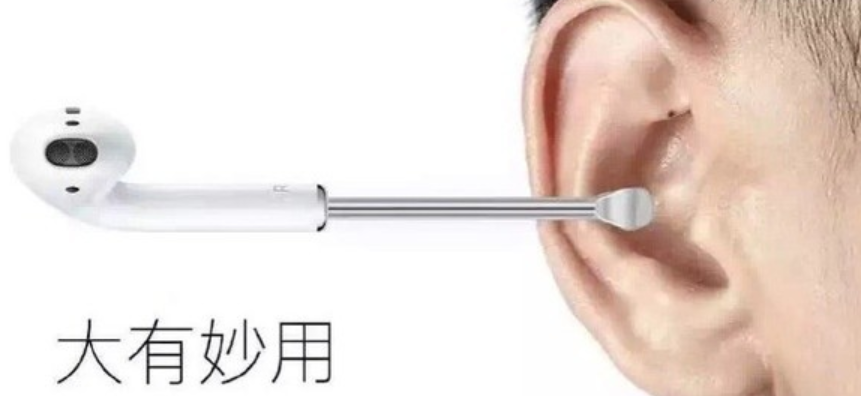
In their first two years, while many bought AirPods, they didn't become a cultural phenomenon until 2018, when they exploded in popularity, becoming a symbol of modern culture and cementing Apple's dominance in the market.
Since then, AirPods have evolved from a mere accessory into an independent commercial empire.
In fiscal 2024, Apple's wearables business, including AirPods, generated $37.005 billion in revenue. In the fourth quarter of fiscal 2025 alone, this segment reached $9.013 billion.
Even more impressive is its cumulative revenue. Counterpoint Research predicts that by 2026, AirPods' cumulative revenue will exceed $100 billion. If AirPods were an independent company, this annual revenue would place it among the Fortune 500.
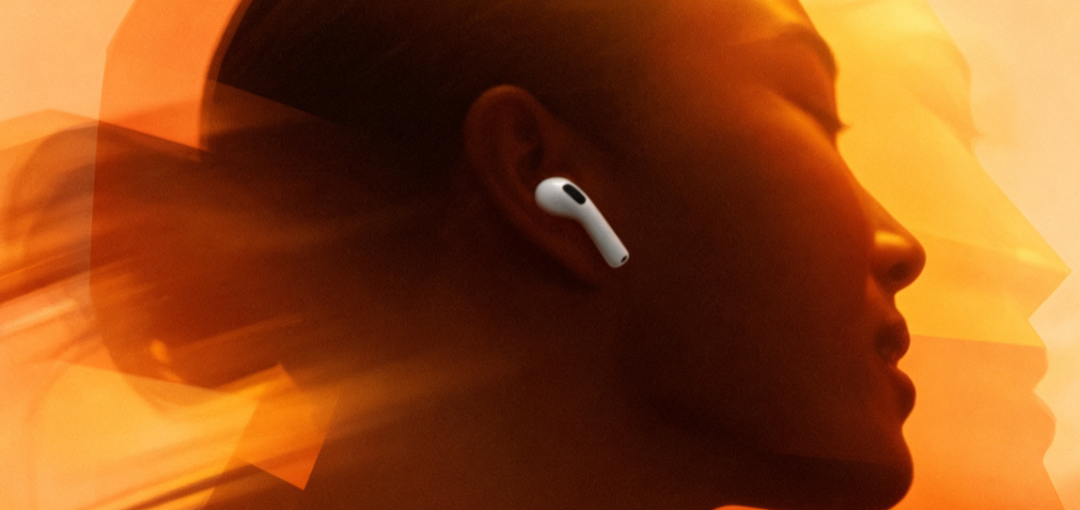
Apple single-handedly created the TWS earphone category, holding a 23.3% market share, firmly ranking first globally. Android players like Samsung, Huawei, and Xiaomi quickly followed suit, making TWS one of the fastest-growing consumer electronics segments in recent years.
Can AI Earphones Become the New Champions of This Era?
Unlike traditional earphones, whether TWS or sports earphones, which focus on 'listening' as an audio device, emphasizing sound quality, noise cancellation, and comfort, AI earphones are fundamentally smart terminals and personal AI assistants. Positioned as 'productivity tools,' they address practical work and life challenges, offering features like real-time translation, meeting transcription, smart reminders, AI chat, and health monitoring.
1. Real-time translation and voice transcription: These are the most mature and core applications of AI earphones, turning ears into portable 'interpreters' and 'stenographers.'
2. Smart noise cancellation and clear calls: AI technology precisely extracts human voices, ensuring clear communication.
3. AI assistant and proactive services: Through natural language interaction, they complete information queries, schedule reminders, etc. Some products can integrate recordings and documents over multiple days around a single theme, enabling cross-time project management and contextual understanding.
4. Health monitoring and lifestyle assistance: Leveraging the earphones' close contact with the body, sensors and AI algorithms monitor physiological states, such as real-time fatigue analysis, heart rate, blood oxygen, and even posture reminders.
AI is the biggest cyclical opportunity of this era, and AI earphones are a compelling choice. While they may not be as hyped as AI glasses, major players are already making their moves, along with innovative startups.
iFlytek pioneered the AI conference earphone segment. Its subsidiary, iFLYTEK Future Intelligence, upgraded earphones from tools to office AI agents with 'long-term memory' via the viaim AI brain. In May this year, it secured a hundred-million-yuan A+ round of financing, with participation from Transsion, the 'King of African Phones.'
ByteDance's Ola Friend earphones focus on integration with content ecosystems like Douyin. Positioned as 'AI agent earphones,' they emphasize companionship in lifestyle scenarios like 'English practice partners' and 'travel guides,' rather than competing in the intense office efficiency track (market). However, market performance has been mediocre.
Anker's Soundcore has focused on the audio segment for years, achieving strong overseas performance. Anker even developed its own AI chip for earphones, aiming to differentiate itself from competitors through underlying architecture.
Ambitious newcomer LightSail Technology seeks to redefine earphones as a new category—an independently existing AI-native device. It's the industry's first earphone equipped with an 88° wide-angle, 2-megapixel camera. The camera enables AI to 'see' the user's real world, identifying restaurants, products, etc., and providing proactive services without user description.
Veteran earphone manufacturers like Edifier and 1MORE have also entered the AI earphone arena, embracing AI technology.
Epilogue: Will AI Earphones or AI Glasses Emerge First?
Nearly all major companies are investing in the AI glasses track (market), believing it to be the sole gateway to future spatial computing. I agree with this assessment, though the timing remains uncertain.
Thus, AI glasses face an awkward situation: the industry is abuzz with excitement, but the market is lukewarm, and users are confused.
In 2025, global AI glasses shipments reached 8.7 million units, expected to surpass 23 million in 2026. However, most of these 'AI glasses' lack display functionality, being merely smart glasses. AR/AI glasses with displays and spatial computing capabilities have negligible shipments.
The glasses industry has traditionally been a blend of medical and commercial sectors, perhaps more akin to the hearing aid market within earphones.
Traditional earphones address the need for clearer, better listening, a consumer electronics track (market) where user habits are already well-established, and education costs are nearly zero. AI earphones simply add AI functionality to 'devices users already accept,' incurring almost zero education costs.
Moreover, AI earphones address genuine rigid-demand scenarios, notably improving office efficiency. In contrast, many current AI glasses features seem like 'gimmicks,' with truly essential scenarios yet to be discovered.
My argument: In the short term, AI earphones may emerge first; in the long term, AI glasses will hold greater value.
What's your opinion? Cast your vote.
-
![]()
Behind the Release of Its First Self-Developed Chip, Is OpenAI's Full-Stack Ambition on Display?
-
![]()
Has Anthropic Targeted Chinese Users? Is a New Era of AI-Driven Racial Discrimination Emerging?
-
![]()
MathWorks: Generative AI Holds Great Potential, Yet a Trusted Toolchain is Essential for Flawless Operation
-
![]()
Small Earphones, Big Business
-
![]()
Volkswagen Slashes 100,000 Jobs, Mercedes-Benz Axes Year-End Bonuses: What’s Ailing German Auto Titans?
-
![]()
Doubao Can No Longer Offer Free Services to 345 Million Users: China's Era of Free AI Is Drawing to a Close
-
![]()
How Can Chinese Small Home Appliances Conquer Southeast Asia Through 'Dimensional Competition'?
-
![]()
Why are top intelligent driving players betting on reinforcement learning?