Is It More Profitable to Build 'Hands' for Robots Than 'Humans'?
 07/02 2026
 477
477
Capital Floods In: Has the 'Dexterous Hand' Sector Reached a Turning Point?
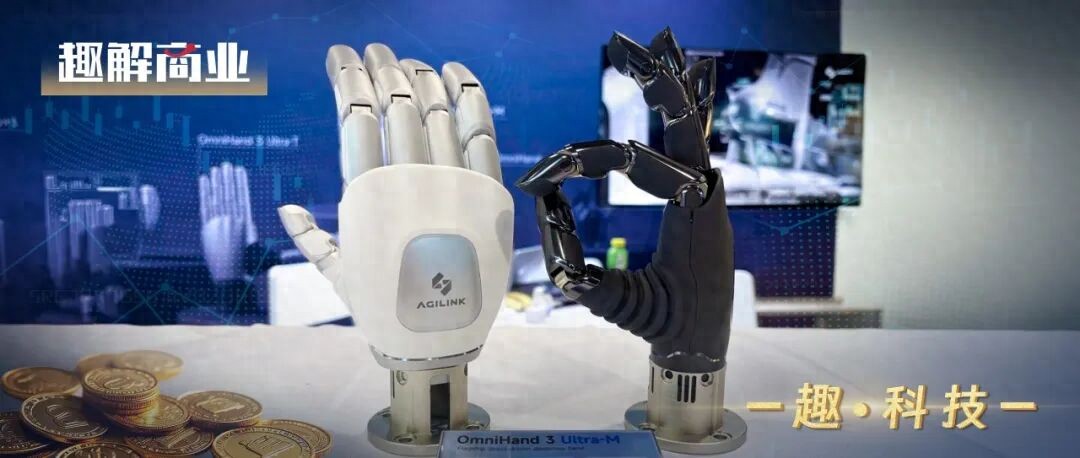
Recently, AGILINK, a dexterous hand company under the 'Zhiyuan Group,' announced the completion of a new round of financing totaling nearly 1 billion yuan, with a post-investment valuation exceeding 1 billion US dollars. From its establishment in January 2026 to joining the unicorn ranks, AGILINK took only 5 months, completing 4 rounds of financing and gaining favor from top-tier capital firms such as Baidu, BlueRun Ventures, and Hillhouse Capital, setting the fastest financing speed in the dexterous hand sector.
As the first half of 2026 concludes, several leading dexterous hand and tactile sensing companies have successively secured large-scale financing, with financing volumes and valuations continuing to rise. Dexterous hands have become one of the hottest segments for capital inflow.
According to (incomplete) data from 'IT Juzi,' in the first half of this year, the domestic dexterous hand sector raised over 25 billion yuan in financing, compared to 16.877 billion yuan in total investment for the entire year of 2025, reflecting the sector's heated status this year.
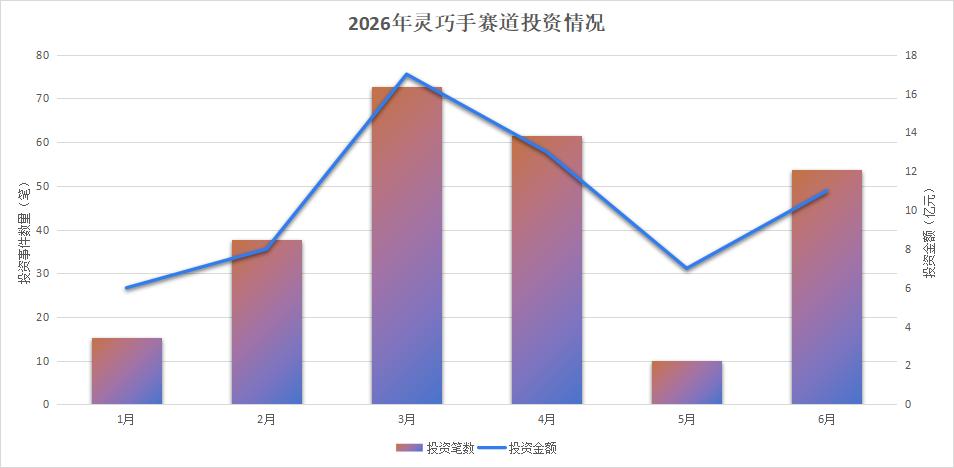
Data Source: IT Juzi, Graphic by Qujie Business
Notably, another star company in the dexterous hand sector, 'Lingxin Dexterous Hands,' was recently reported to be seeking a 6 billion US dollar valuation (approximately 41 billion yuan) in its next funding round, doubling its previous valuation and approaching Unitree Technology. Behind this, a signal has emerged: companies building 'hands' for robots and those making robot bodies have similar valuations.
From the perspective of valuations and financing enthusiasm, is capital's rush into the dexterous hand sector driven by FOMO (fear of missing out), or do they truly see potential in the sector?
01. Are Dexterous Hands the Bottleneck for Robots?
Han Xiaoxuan, Marketing Director at AGILINK, stated to the media that the rising heat (popularity) of dexterous hands is essentially an inevitable result of the evolutionary stage of humanoid robot development. 'Early on, the industry focused more on robots' motion control capabilities, such as walking, running, jumping, and balance. However, as these capabilities mature, for robots to truly enter real-world scenarios, complete specific tasks, and generate practical work value, they must possess stronger operational capabilities. The 'hand' is the core component for robots to interact with the real world and complete tasks.'
As a competitor in the same sector, Lingxin Dexterous Hands shares the same view.
From an industry practitioner's perspective, Lingxin Dexterous Hands told 'Qujie Business' that compared to the same period last year, changes in the capital market are evident. 'A couple of years ago, capital may have placed more emphasis on technological barriers and team backgrounds. This year, they are clearly more pragmatic, focusing primarily on mass production and deployment capabilities: Do you have stable mass production capabilities? Are there verifiable commercial scenarios? Can you consistently deliver stable and reliable products?'
Investors' questions have also become more specific: 'What is your monthly production capacity?' 'Do you have real-world deployment scenarios that have been operational for more than six months?'
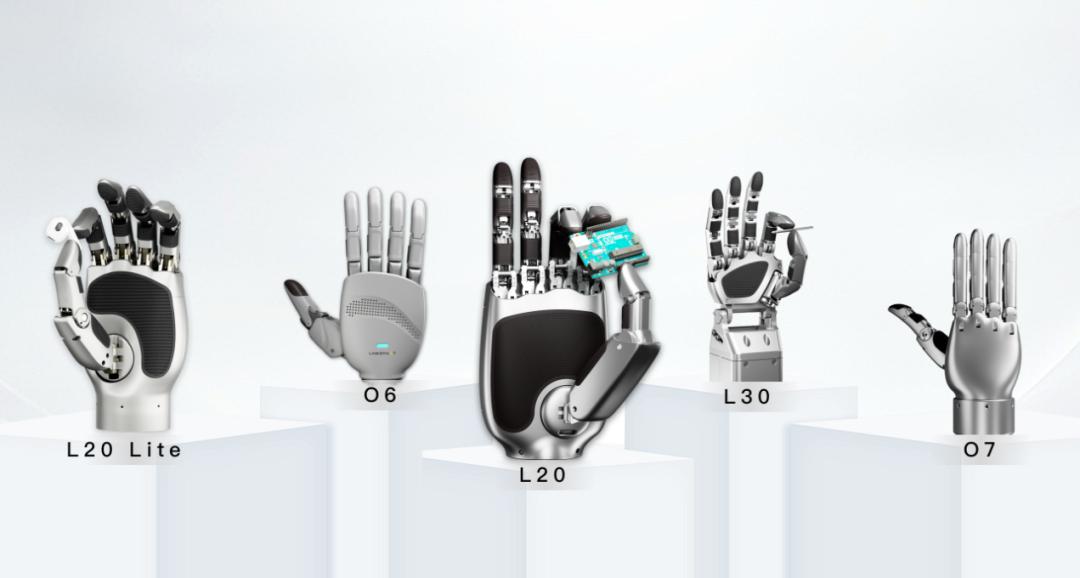
Source: Screenshot from Lingxin Dexterous Hands' official website
However, capital's investment logic is also evolving with industry trends.
A couple of years ago, the entire industry was focused on developing the 'brain' of large models, only to later discover a practical issue: 90% of robots' interactions with the physical world rely on 'hands.' No matter how intelligent the brain is, without agile hands, deployment is impossible.
Even on industrial production lines, where traditional grippers and suction cups are already in use, a single line often requires dozens of different models and specifications of grippers for various workpieces and stations, leading to high changeover costs—a persistent headache.
From Lingxin Dexterous Hands' perspective, the core value of dexterous hands lies in their ability to adapt to multi-category, flexible production demands with a single pair of hands, which is why they are increasingly valued by both industry and capital.
Another core reason for the concentrated outbreak of financing events in the dexterous hand sector in the first half of this year is that the industry has reached a turning point, transitioning from 'lab storytelling' to 'industrialization and deployment.'
'Two or three years ago, dexterous hands across the industry were basically custom-made in labs, with high prices, short lifespans, and poor consistency, only suitable for demonstrations. Now, products are moving towards stable mass production, and the entire industry is at the critical point of transitioning from lab prototypes to scalable mass production,' said Lingxin Dexterous Hands.
02. The Other Side of Prosperity
According to Qichacha data, as of June 2026, nearly 510 dexterous hand-related companies exist nationwide. Based on their products and businesses, the sector can be divided into three main types:
The first category consists of companies specializing in dexterous hands, pursuing extreme breakthroughs in hand performance, such as AGILINK, Lingxin Dexterous Hands, Inspire Robotics, BrainCo, and Ouyi Technology.
The second category includes manufacturers providing dexterous hand modules, expanding from core components (motors, reducers, etc.) to downstream module production, such as Zhaowi Mechanical & Electrical, Leishai Intelligence, Dahuan Robotics, and PaXini.
The third category encompasses full-stack, self-developed humanoid robot companies that emphasize overall integration, including dexterous hand components, deeply adaptation with their own robot bodies and not for external sale, such as Unitree, Zhiyuan, and Galaxy Generals.
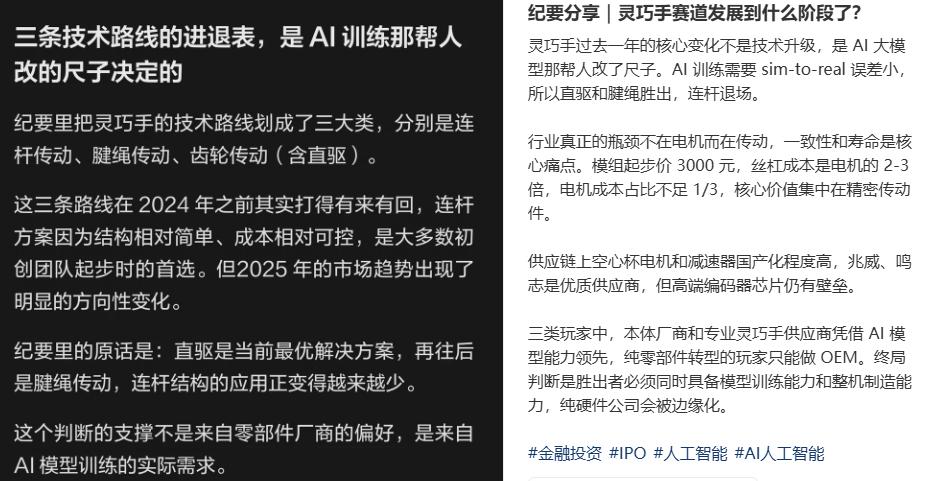
Some netizens also classify them by technical route. Source: Screenshot from Xiaohongshu
As a critical component of embodied intelligent humanoid robots in the past two years, the market holds extremely optimistic expectations for dexterous hands. According to 'GGII,' China's dexterous hand sales are expected to grow from approximately 19,200 units in 2025 to around 70,200 units in 2026, potentially surpassing 430,000 units by 2030.
However, behind the capital market's excitement and market optimism, no player in the industry dares to guarantee that the dexterous hand business model can sustainably generate large-scale profits.
Industry reports indicate that no major orders have been publicly disclosed in the dexterous hand sector, with the 'hardware → data' link currently operational, 'data → model' in its early stages, 'model → skills' still conceptual, and 'skills → commercialization' yet to be verified.
Although some companies, such as Inspire Robotics, have announced achieving break-even, and AGILINK claims to have achieved operational net profitability in Q1 2026, the reality is that most dexterous hand companies are still operating at a loss.
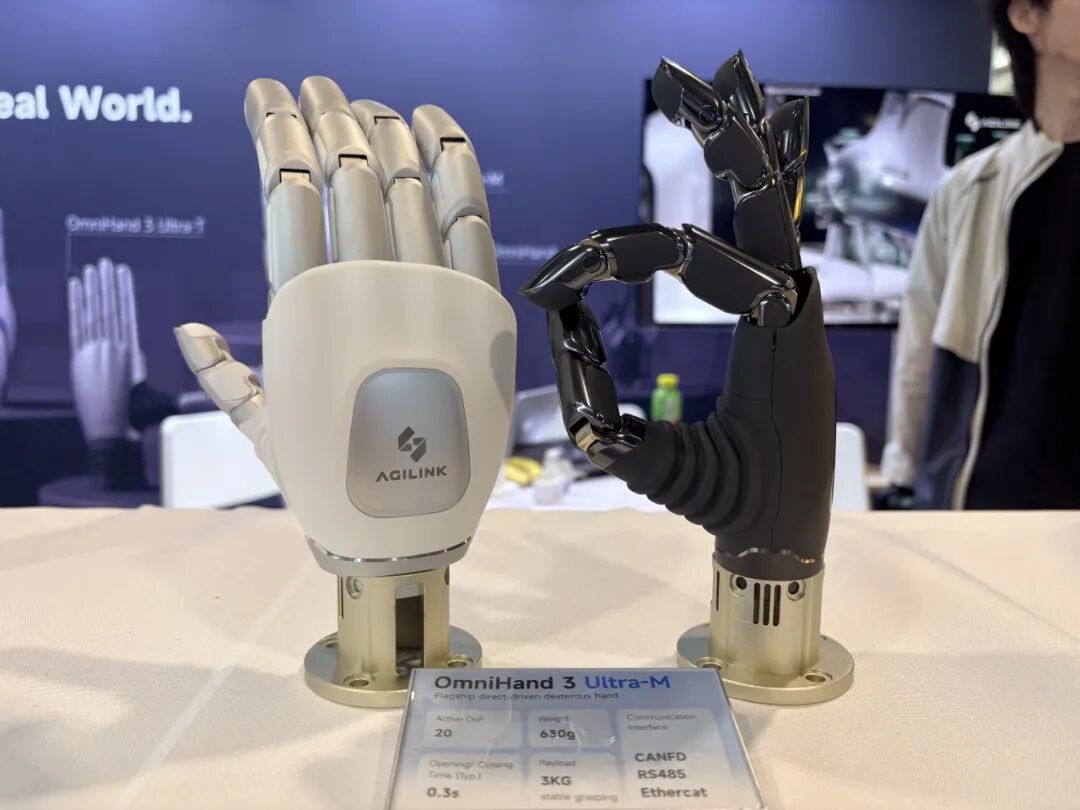
Source: AGILINK
Moreover, the dexterous hand sector requires continuous capital investment, with each stage—expanding mass production capabilities, building data flywheels for dexterous operations, and advancing research on contact intelligence models—demanding substantial financial input. This means most companies must still contend with high R&D and market promotion costs.
More critically, amid the immature and unverified profitable business model for dexterous hands, product prices have already begun to decline.
According to 'Qujie Business,' some dexterous hand products have dropped to the ten-thousand-yuan level. For example, a high-degree-of-freedom dexterous hand from UK-based Shadow Robot costs over 1 million yuan, while Lingxin Dexterous Hands offers a similarly performing product for around 50,000 yuan. Zhiyuan's OmniHand 2025 series, launched in August last year, is priced below 20,000 yuan. Inspire Robotics' latest FTP series humanoid five-finger dexterous hand retails for just 10,000-20,000 yuan, almost unimaginable in the micro-servo electric gripper market, where prices typically ranged from 50,000-100,000 yuan two years ago.
The same trend applies to manufacturers directly providing dexterous hand modules. Dahuan Robotics leverages its mass production expertise and supply chain advantages to reduce the unit price of some modular fingers to the thousand-yuan level. Zhaowi Mechanical & Electrical's motor-embedded single-finger joint module, with its self-produced micro-transmission box, has a BOM cost far lower than solutions requiring externally purchased motors, forcing the entire upstream drive module price range downward.
Dexterous hand prices are nearly in freefall, making product commercialization and widespread adoption possible while also squeezing profit margins for players in the sector.
03. Still in the Early Stages of Industrialization
Even Lingxin Dexterous Hands admits that, as far as the dexterous hand sector is concerned, the overall industry is still in its early stages of industrialization, with significant challenges in hardware, data, models, and deployment scenarios.
In terms of hardware, the biggest challenges are reliability and consistency. Building a single prototype is not difficult, but producing 10,000 units with consistent performance that can withstand millions of operations tests Process Design (process design) and supply chain capabilities.
Regarding data, there is a scarcity of real-world dexterous operation data. Unlike large models with vast amounts of internet text, the complexity of human hand fine operations makes efficient data collection and standardized labeling a common challenge across the industry.
Lingxin Dexterous Hands told 'Qujie Business' that many teams in the industry use video motion capture and simulation generation to supplement data, but when deployed on real machines, the success rate and generalization ability of such data cannot be guaranteed.
In terms of models, the main issue is poor generalization. Many current demonstrations are limited to 'specific objects, specific lighting, and specific workstations,' failing to adapt to changes in objects or environments, falling far short of true universal dexterous operation.
Even Wang Xingxing, founder of Unitree, who brought robots onto the CCTV Spring Festival Gala stage twice, mentioned in a February 2026 podcast with 'Wei Shijie Man Tan' that 'while Unitree's dexterous hands can handle general grasping actions, highly refined movements pose significant challenges.'
Wang believes the fundamental issue lies in AI models. Using a relatable analogy, he noted that some disabled individuals, despite lacking hands, can still perform exceptionally well, even engaging in fine art activities like sculpture. In his view, as long as AI large models are powerful enough, even with inferior hardware, dexterous hands can still function effectively.
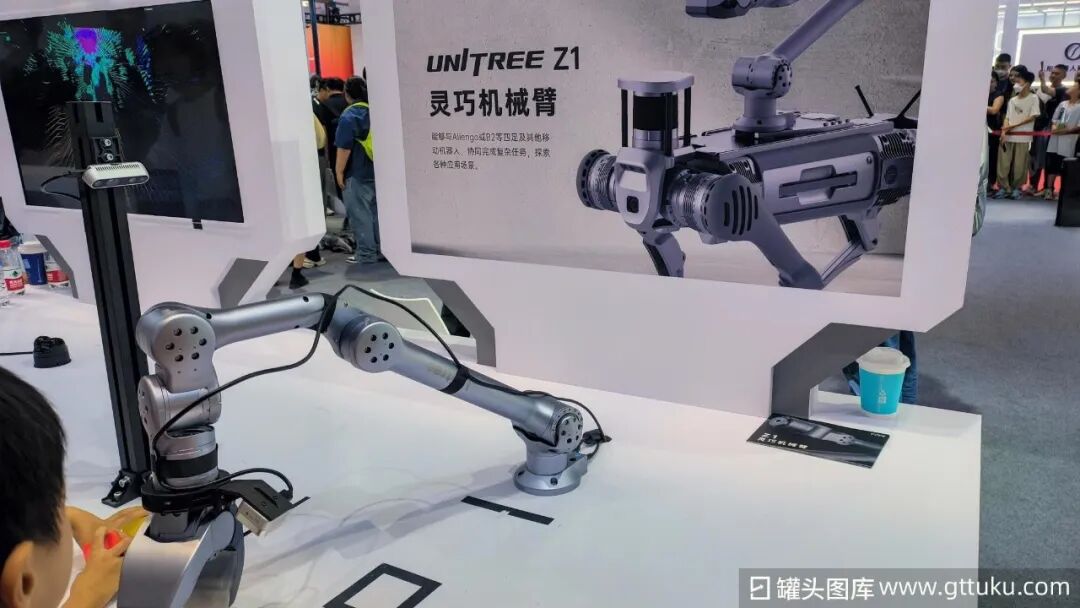
Source: Canstock Photo Library
In terms of scenarios, current deployments are still sporadic, lacking standardized solutions. A Goldman Sachs research report pointed out that wheeled robots equipped with two- or three-finger grippers can already meet 70% to 90% of industrial scenarios. The problem is that demand varies greatly across industries, and making dexterous hands into universal end-effectors suitable for thousands of industries requires collective industry exploration.
Additionally, to increase penetration, dexterous hands must extend beyond industrial scenarios, but expanding into research or consumer scenarios is no easy feat.
While research scenarios offer stability, with universities and research institutes willing to pay a premium for new technologies, the overall market size is limited. In contrast, while the consumer scenario holds vast imagination, it remains far from becoming an affordable, accessible smart terminal for the general public.
Last year, Zhou Chen, CEO of Lingchuan Intelligence, discussed why dexterous hands have yet to achieve large-scale deployment in consumer scenarios, stating, 'Every industry faces an impossibility triangle of performance, cost, and reliability. Achieving the best possible balance among these three factors is a hurdle for dexterous hand robots to overcome in reaching consumers.'
These challenges represent real obstacles for every player in the dexterous hand sector.
In 2025, humanoid robot companies could secure financing based on stories and video demos, but this year, all complete machine manufacturers are undergoing the test of mass production and deployment. A similar script is unfolding in the dexterous hand sector, which is experiencing heated financing this year. Amid the capital frenzy, dexterous hand players must prove to the market their sustained profitability; otherwise, they risk becoming 'beautiful bubbles.'
-
![]()
A Humanoid Robot Becomes an Office Intern: The 'Reinforcement Learning' Journey of a Former NVIDIA Engineer
-
![]()
Meta Plans to Launch Cloud Infrastructure Business: Is Computing Power Really in Excess?
-
![]()
Giants Enter the Arena One After Another: The Embodied AI Battle Commences
-
![]()
Is It More Profitable to Build 'Hands' for Robots Than 'Humans'?
-
![]()
Yunling Optoelectronics Accelerates Its Listing on the Beijing Stock Exchange: Secures 989 Million Yuan to Bolster Production of Computing Optoelectronic Chips
-
![]()
From Drill Bits to Optical Coatings: A 200-Billion-Yuan Behemoth Quietly Unveils a New Business Front!
-
![]()
New Energy Vehicle Growth Slows: Are 370 Million Existing Cars the Next Lucrative Market?
-
![]()
Is Baidu Now Fostering Its Own 'Yao Shunyu'?