Meta Plans to Launch Cloud Infrastructure Business: Is Computing Power Really in Excess?
 07/02 2026
 523
523
Wall Street has sparked a heated debate over whether computing power is in excess.

On July 1, 2026, an unconfirmed message from Meta set off a "depth charge" in the U.S. stock market.
According to a report by Cailian Press citing Bloomberg, social media giant Meta is formulating plans to launch a cloud infrastructure business, selling AI computing power and model access rights to external clients. The news caused Meta's stock to surge 8.8% on the same day, marking its best single-day performance in over a year. Meanwhile, the Philadelphia Semiconductor Index plummeted by over 6%, Micron fell by over 10%, and SanDisk dropped by over 11%.
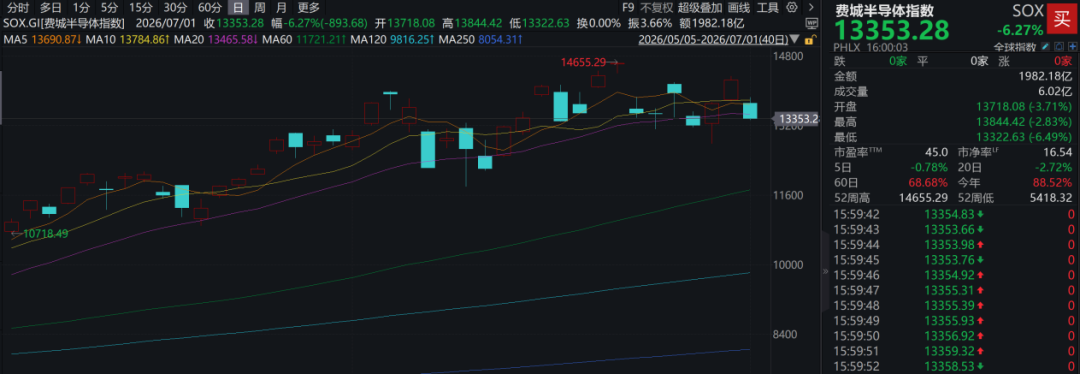
Image source: wind
Amid the surge and decline, the market is fiercely debating a core proposition: When the world's most aggressive buyer of AI computing power prepares to become a seller, has the inflection point of computing power oversupply arrived?

Meta's Two Paths to Monetization: Computing Power Leasing and Model Hosting
According to Bloomberg, citing insiders, Meta is discussing two schemes for monetizing computing power.
The first is hosted model/API access, similar to Amazon AWS's Bedrock service. Meta will open up various AI models deployed on its own AI infrastructure, including its self-developed Muse Spark model, to clients and charge developers for usage fees.
The second is directly selling "bare computing power," a model similar to emerging AI cloud computing companies like CoreWeave. Clients rent GPUs and supporting computing resources to train or run their chosen AI systems.
The former tests model competitiveness, while the latter tests cost control capabilities.
It is reported that the development of these new businesses is part of Meta's internal "Meta Compute" project, jointly led by Santosh Janardhan, head of Meta infrastructure; Daniel Gross, one of the heads of Meta Superintelligence Labs; and Dina Powell McCormick, president of Meta. Bloomberg pointed out that related plans are still being formulated, and the company's strategy may still be adjusted.

$140 Billion in Capital Expenditures, Yet Meta Lacks Cloud Service Revenue to Directly Hedge
Meta's move was not without warning signs.
At this year's annual shareholder meeting in May, when asked whether Meta would compete with Amazon and Microsoft in the cloud computing space, Zuckerberg responded definitively: "Absolutely under consideration." He also revealed: "Almost every week, external companies contact us, hoping we will launch an API service or asking if they can purchase our computing power, even willing to pay prices higher than our procurement costs."
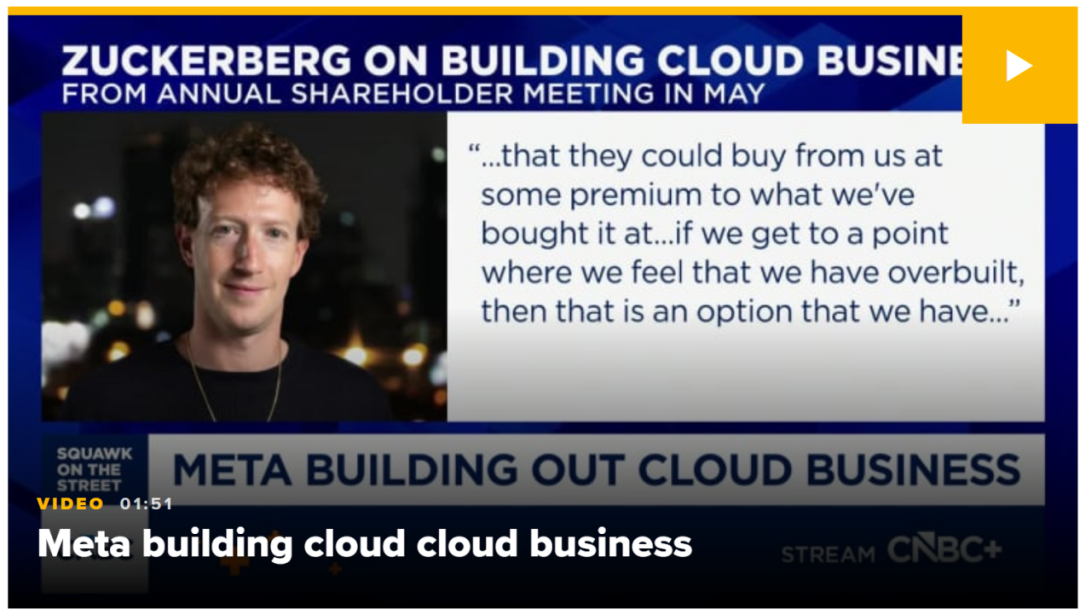
Image source: CNBC
From "under consideration" to "under construction," it took less than two months.
The pressure behind this is evident. According to Securities Times, Meta's spending on AI infrastructure this year is expected to reach as high as $145 billion. In April, Meta just raised its 2026 capital expenditure forecast from $115-135 billion to $125-145 billion. The combined capital expenditures of the world's four major tech giants (Meta, Microsoft, Google, Amazon) in 2026 are estimated to be around $725 billion.
However, Meta's investment situation fundamentally differs from the other three. Microsoft has Azure, Google has GCP, and Amazon has AWS—their massive capital expenditures are directly offset by cloud service revenue. Meta does not have this; every dollar of its infrastructure investment has been a pure cost item.
According to FactSet forecasts, Meta's free cash flow will remain negative for the next few years. This explains why the market rewarded Meta when news of "selling computing power" emerged.

Cloud Service Providers Face Direct Impact, Semiconductors Suffer Emotional Sell-Off
The market on July 1 presented a clear divergence.
The winner was Meta. Investors are optimistic about the company opening up new revenue streams by monetizing its massive infrastructure investments and improving its return on capital, causing Meta's stock price to surge 8.8% on the same day.
The losers were two chains.
First and foremost were emerging cloud computing power service providers. CoreWeave plunged by about 13% on the same day, while Nebius Group plummeted by over 15%. The market logic is simple: Meta is both one of their largest clients and is now set to become their most direct competitor.
Founded in 2017, CoreWeave was initially an Ethereum GPU mining company before transitioning to a GPU cloud service provider in 2021. It now operates 43 self-built data centers and deploys over 300,000 high-end GPUs. Meta is its most important client, with the two sides having signed cumulative computing power cooperation agreements worth up to $35.2 billion.
Bernstein analyst Madison Rezaei pointed out that Meta alone accounts for over one-third of CoreWeave's current orders. When combined with Microsoft's approximately $14 billion in orders, "nearly half of CoreWeave's current orders will come from clients that have become direct competitors when it comes time to renew contracts in the future."
Gil Luria, head of technical research at DA Davidson, put it more bluntly: "Companies like CoreWeave and Nebius rely on Meta's orders for growth, but Meta may not need them anymore." Client turning into competitor—this is the most direct negative narrative the market can imagine.
The other chain was semiconductors and storage. The Philadelphia Semiconductor Index plummeted by over 6%, Micron Technology fell by over 10%, and SanDisk dropped by over 11%. The core logic behind these companies' surge over the past year has been "exploding demand driven by the AI data center construction boom." Meta's news directly shook the underlying assumption of "build first, supply won't be enough." However, some Wall Street institutions believe that the semiconductor sell-off was more of an emotional stampede rather than a substantive deterioration in fundamentals.

Wall Street Divided: Strategic Retreat or Business Model Upgrade
After the news broke, Wall Street quickly split into two camps.
Pessimists believe this is a signal that Meta is the first to "retreat" in the cutting-edge AI arms race.
Gil Luria, analyst at D.A. Davidson, argues that this indicates the company is "abandoning frontier AI" and instead selling computing power. Baird analyst Colin Sebastian cautions that if Meta is moving forward with cloud platform construction, it may imply that the scaling speed of its internal AI products has not met initial expectations.
Rich Privorotsky, head of the 1-Delta trading desk at Goldman Sachs, issued an even more direct warning: The market's core premise until now has been that computing power is scarce, a scarcity that has maintained firm pricing and justified the tech giants' continuous capital expenditures. If computing power supply increases and leasing prices continue to decline, it will directly challenge the narrative of scarcity.
Optimists see another possibility.
Brent Thill, analyst at Jefferies, believes that concerns about overconstruction are "putting the cart before the horse," emphasizing that demand for computing power continues to outstrip supply. According to his research, Meta's current internal infrastructure utilization is about 65%, with the remaining 35% idle capacity providing Meta with additional monetization leverage. Thill stated that Meta is "not exiting the AI race but transforming its early aggressive capacity investments into a strategic value creation avenue."
Some Wall Street institutions believe the market has overinterpreted this news. Meta's sale of AI computing power is essentially more about finding a commercial outlet for its massive AI capital expenditures rather than implying a slowdown in its own AI investments.

Structural Idleness, Not Comprehensive Oversupply: Three Facts Reveal the Truth About Computing Power
In response to the market's biggest concern, multiple media outlets have pointed out that while Meta plans to rent out computing power, it has not halted its procurement efforts.
First, Meta continues to crazy (frenziedly) procure computing power. While preparing to rent out "older cards," it continues to purchase large-scale computing power from third-party cloud providers and build new proprietary AI data centers. If overall computing power were in excess, it would not continue to invest hundreds of billions more in infrastructure. Second, external companies are actively seeking to purchase computing power at a premium. Zuckerberg explicitly stated at the shareholder meeting that companies approach him every week, willing to rent computing power at prices higher than Meta's own costs. This indicates that the overall market for AI computing power remains tight, with no industry saturation.
There is also an important counterexample.
According to a report by the Financial Times, around the same time Meta was rumored to be selling computing power, Google restricted Meta's access to Gemini computing resources due to its own capacity limitations. This restriction directly disrupted the progress of some AI projects within Meta and has yet to be lifted. Meta is simultaneously being restricted by Google on computing power, continuing to purchase computing power externally, and preparing to sell some of its own computing power externally—this appears more like a reallocation of "different generations, different uses, and different time windows" rather than a simple case of "having more than needed."
As analysts have pointed out: This is not an "overall computing power oversupply" but "structural idleness."

From Capital Expenditures to Return on Investment: AI Enters the Second Half
The most intriguing aspect of this controversy is the change in Zuckerberg's attitude.
He has repeatedly stated that the industry's biggest bottleneck remains computing power supply. Just five weeks ago, he said, "Computing power still has its uses." Now, Meta is seriously planning to cede "its own uses" to external clients.
Launching a cloud business is like holding an option. If AI internal monetization succeeds and all computing power is used internally, the cloud business can be abandoned; if internal consumption falls short of expectations, excess computing power won't sit idle on the books depreciating but can generate revenue. It transforms "losing everything if the bet fails" into "collecting rent even if the bet fails."
But the market is also asking another question: Is Meta prematurely "throwing in the towel" in the race for frontier AI labs, or is it using this to propel its business empire toward a new round of upgrades?
The answer likely lies somewhere in between. As one analyst put it, Meta's move is more about transforming its early aggressive capacity commitments into a commercial option capable of creating strategic value.
This is not the end of AI but possibly a watershed moment in AI investment logic, shifting from a narrative of "who spends the most" to "who can make money back."
When the biggest buyer starts seriously considering the option of "what if we build too much," the entire narrative of supply and demand for AI infrastructure is being reexamined. Whether computing power is in excess may not lie in Meta's servers but in the revenue growth rate of AI applications over the next few quarters.
Data sources: Bloomberg, CNBC, wind, FactSet
Reporting sources:
Cailian Press, "Meta Reportedly Layouts AI Cloud Business, Plans to Sell Computing Power" (July 1, 2026)
Securities Times, "Meta Plans to Enter Cloud Computing Business, Intends to Sell Excess AI Computing Power" (July 2, 2026)
Jiemian News, "Meta Plans to Rent Out Excess Computing Power, Micron and SanDisk Plunge Over 10%" (July 2, 2026)",
Copyright and Disclaimer
1. Content Copyright: Except for publicly available data, policies, and cases cited, all content in this article is original. Professional data is sourced from authorized databases and official government websites, and cases are compiled from real events.
2. Image Authorization: Some of the images in this article are original materials or officially licensed, as well as AI-generated; for any online images with unclear copyright status, the copyright belongs to the original authors, and any infringement will be removed upon notification.
3. Reprint Guidelines: Reprinting is prohibited without permission; any reprints must retain the complete source and author information.
4. Liability Statement: This article represents the author's observations and industry commentary on business figures, compiled from publicly available information. The content is for reference only and does not constitute professional advice. Any risks arising from its use are to be borne by the user. The Industrial Association reserves the right of final interpretation of this article.
-
![]()
A Humanoid Robot Becomes an Office Intern: The 'Reinforcement Learning' Journey of a Former NVIDIA Engineer
-
![]()
Meta Plans to Launch Cloud Infrastructure Business: Is Computing Power Really in Excess?
-
![]()
Giants Enter the Arena One After Another: The Embodied AI Battle Commences
-
![]()
Is It More Profitable to Build 'Hands' for Robots Than 'Humans'?
-
![]()
Yunling Optoelectronics Accelerates Its Listing on the Beijing Stock Exchange: Secures 989 Million Yuan to Bolster Production of Computing Optoelectronic Chips
-
![]()
From Drill Bits to Optical Coatings: A 200-Billion-Yuan Behemoth Quietly Unveils a New Business Front!
-
![]()
New Energy Vehicle Growth Slows: Are 370 Million Existing Cars the Next Lucrative Market?
-
![]()
Is Baidu Now Fostering Its Own 'Yao Shunyu'?