Giants Enter the Arena One After Another: The Embodied AI Battle Commences
 07/02 2026
 351
351

High-Value Data Emerges as the Decisive Factor
Written by / Chen Dengxin
Edited by / Li Ji
Layout by / Annalee
The field of embodied AI is becoming increasingly vibrant.
While traditional smart vehicles have yet to fully saturate the market, Li Auto is already setting its sights on embodied AI vehicles. Alibaba has unveiled its Qwen-Robot series of embodied AI large models, further expanding its reach. ByteDance's AI core department, Seed, has undergone structural adjustments to incorporate embodied AI into its core business...
All these signs indicate that embodied AI has become a consensus within the industry.
With substantial investments and the entry of heavyweight players, competition in the embodied AI space has escalated to a new level, with giants from the automotive, mobile phone, and internet sectors taking center stage.
Thus, a major battle is inevitable.
Racing to Capture a Trillion-Yuan Blue Ocean Market
The physical world has emerged as the new frontier for AI competition.
On one hand, humanoid robots are performing dances, fights, martial arts, and other acts, winning widespread acclaim. On the other hand, they are being tested in industrial, commercial, logistics, and other scenarios, helping enterprises reduce costs, improve efficiency, and foster innovation.
In this context, embodied AI has become the new battleground in the AI industry.
According to Morgan Stanley, sales of humanoid robots in China are expected to reach 28,000 units in 2026, marking a year-on-year increase of 133%. By 2035, this figure could surge to 2.6 million units.
Roland Berger's data reveals that by 2035, the market size of robots deployed by automotive OEMs could reach USD 750 billion, expanding further to USD 4 trillion by 2050, approaching the scale of the automotive industry.
It is evident that embodied AI represents a vast blue ocean market.
More importantly, the capital market and industry are forming a synergistic force. Currently, around 20 embodied AI companies have clarified their plans to go public, including well-known enterprises such as Unitree Robotics, Zhiyuan Robotics, and Galaxy Robotics. They are seeking to address their shortcomings with the help of the capital market.
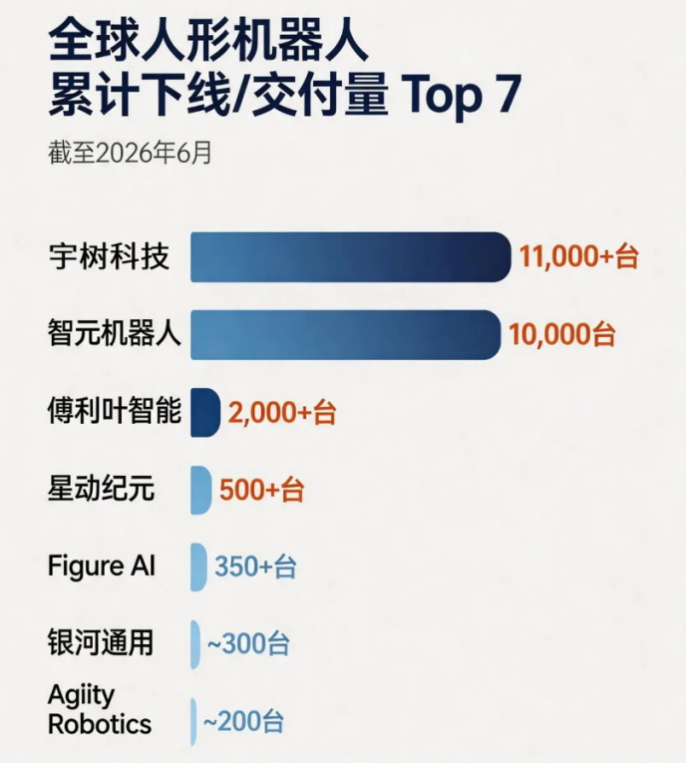
Source: 51 Robo Selection
Beyond IPOs, financing activities are also in full swing.
According to IT Juzi, from July 2025 to June 2026, there were 503 financing rounds in the embodied AI sector in the domestic primary market (excluding IPOs and mergers and acquisitions), with total financing exceeding RMB 96 billion.
On June 3, 2026 alone, three embodied AI startups—Astribot, Qianxun Intelligence, and Xingyuan Intelligence—each secured financing of RMB 1 billion or more, showcasing the sector's intense heat.
Behind these substantial investments lies uncertainty in the sector's competitive landscape.
Take Unitree Robotics as an example: it currently holds 262 patents, but only 20 are core invention patents. This indicates that its patent wall and ecological barriers are not yet fully formed, leaving opportunities for latecomers.
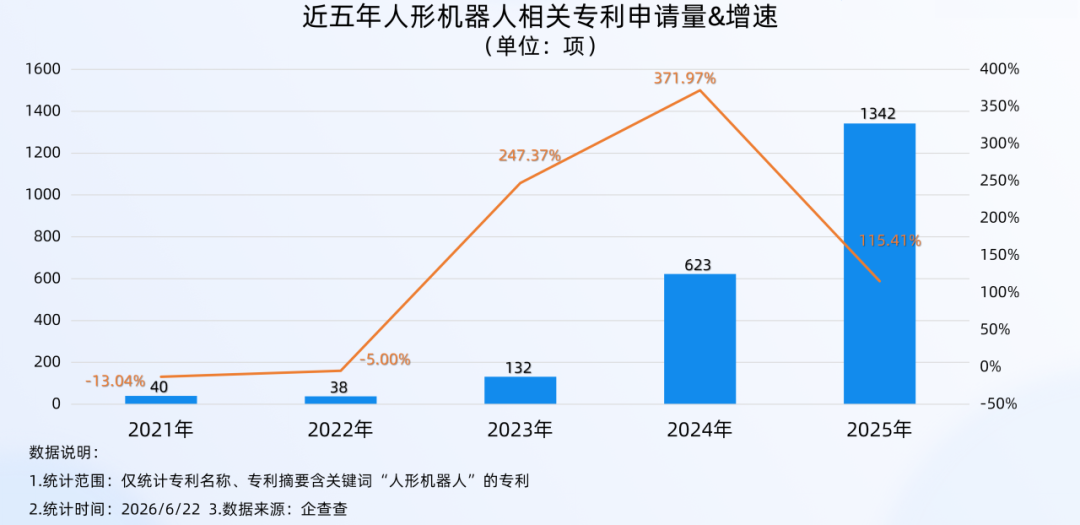
Source: Qichacha
This is evident from Honor's dramatic overtaking.
At the 2026 Humanoid Robot Half Marathon, Honor Robotics outperformed popular contenders like Unitree Robotics and Songyan Dynamics to win the championship, becoming the biggest dark horse.
"Ruicaijing" stated: "Mobile phone manufacturers have a mature supply chain system, enabling them to quickly integrate core hardware such as motors, vision, motion controllers, cooling, and batteries. This is an advantage that traditional robot manufacturers lack and one of the main reasons why Honor Robotics was able to 'come from behind' in the competition."
Like mobile phones, automotive intelligent hardware also shares similarities with embodied AI.
As a result, sensing, decision-making, execution, and data can be reused, enabling the extension of technology and products and potentially giving rise to new species.
Embodied AI vehicles are the best proof of this.
Li Xiang stated: "An embodied AI vehicle should be 'four-in-one': it is an electric vehicle, a professional driver, an AI computer, and a life assistant. Here, the electric vehicle and AI computer are the 'embodied' aspects, while the professional driver and life assistant represent the 'intelligent' aspects."
Internet Giants Compete to Be the 'Shovel Sellers'
The future winner remains unknown, but one thing is certain: the 'shovel sellers' will benefit significantly.
On one hand, they provide foundational support.
Training embodied AI models requires substantial computing power; the higher the computing power, the greater the efficiency, accelerating model iteration.
Compared to computing power, data poses an even greater challenge.
Deng Zhidong, director of the Visual Intelligence Research Center at Tsinghua University's Institute for AI, said: "One of the main challenges in implementing embodied AI is transitioning from one-dimensional text language models to four-dimensional spatiotemporal world models. This requires more training for large models on tasks and dynamic driving scenarios, which in turn demands higher-quality pre-training and fine-tuning data. However, unlike language models that rely on text corpora and multimodal training data, world model agents also require action and interaction training data from both the real and virtual worlds. Collecting interaction data is costly and more difficult."
Simply put, the industry faces a "data shortage," with issues such as insufficient data, high costs, and inconsistent quality.
In this context, Volcano Engine, Baidu Intelligent Cloud, and others have become ideal partners for embodied AI companies, providing support in computing power, data, and scenarios.
For example, Baidu Intelligent Cloud's AI Infra technology platform, combined with its large model training and inference acceleration suite, can improve model training and inference efficiency by 30% and 60%, respectively.
More critically, it has launched an embodied AI data supermarket.
The data supermarket provides embodied AI companies with data hosting and display capabilities, assisting them in compliant display and traffic matching without interfering with data content or usage methods. It also makes data features easily identifiable through standardized definitions of atomic tags and structured combinations of composite tags.
In short, embodied AI companies can obtain high-value data at a low cost.
On the other hand, they compete for model entry points.
Tencent, Xiaomi, Alibaba, and others are more inclined towards embodied AI models, facilitating their use by embodied AI companies and aiming to secure super entry points in the embodied AI era.
For instance, Alibaba released the Qwen-Robot large model, comprising three sub-models: the VLA operation model Qwen-RobotManip, the VLN mobility model Qwen-RobotNav, and the world model Qwen-RobotWorld.
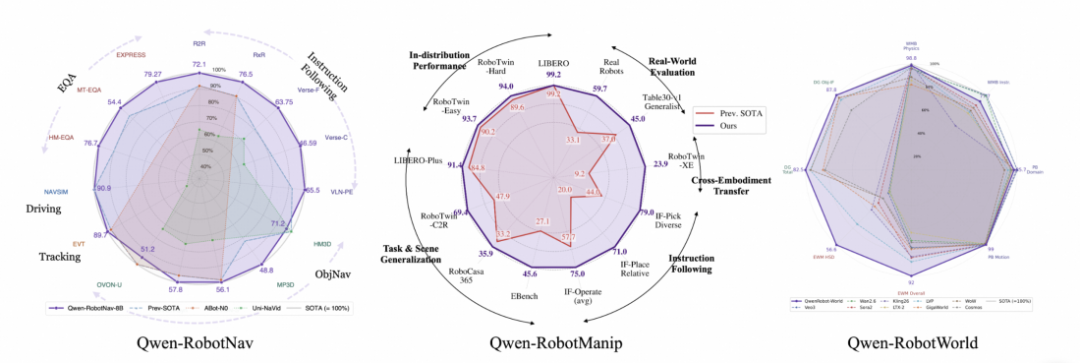
Source: Tongyi Lab
Qwen-RobotManip handles manipulation, using a unified 80-dimensional action representation and absolute coordinate-independent calculations to address performance degradation when switching robots or scenarios. Qwen-RobotNav handles navigation, introducing a task-adaptive observation mechanism to solve the issues of getting lost with little memory and confusion with too much memory. Qwen-RobotWorld handles reasoning, predicting reasonable actions and states for the robot at the next time point to enable precise actions in the real world.
Another example is Tencent's release of the HY-Embodied-0.5-X large model, which includes two versions: MoT-2B, designed for edge deployment with an emphasis on real-time responsiveness, and MoE-32B, with a larger parameter scale for handling more complex tasks.
HY-Embodied-0.5-X excels in spatial understanding, long-term planning, embodied interaction, and risk assessment, enabling robots to understand their environment more accurately and complete complex tasks.
It is important to note that if embodied AI is to go further, safety cannot be overlooked.
At the 2025 GeekCon security conference, two white-hat hackers demonstrated how to remotely hijack a humanoid robot and command it to knock down a dummy at the center of the stage.
The issue is that safety is not currently a focus of embodied AI.
The "Embodied AI Safety Technology White Paper: Robotics" states: "The embodied AI industry is currently in a rapid expansion phase similar to the early days of smart terminals and IoT. Manufacturers generally focus on algorithm accuracy, hardware performance, task completion, and cost optimization. Safety protection is often seen as a non-core requirement that affects user experience or increases costs."
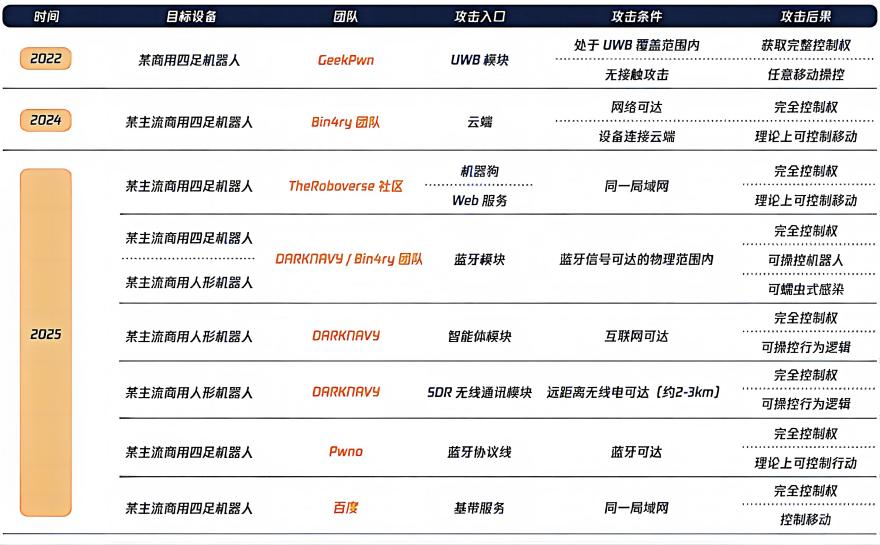
Source: "Embodied AI Safety Technology White Paper: Robotics"
In summary, the field of embodied AI is red-hot, having captured the attention of the capital market and tech giants, offering great promise. However, embodied AI still needs to strengthen its fundamentals in reducing costs, enhancing safety, and deepening scenario integration. Only by doing so can it truly reshape industries and become a companion in people's daily lives.
Thus, embodied AI still has much work to do.
-
![]()
A Humanoid Robot Becomes an Office Intern: The 'Reinforcement Learning' Journey of a Former NVIDIA Engineer
-
![]()
Meta Plans to Launch Cloud Infrastructure Business: Is Computing Power Really in Excess?
-
![]()
Giants Enter the Arena One After Another: The Embodied AI Battle Commences
-
![]()
Is It More Profitable to Build 'Hands' for Robots Than 'Humans'?
-
![]()
Yunling Optoelectronics Accelerates Its Listing on the Beijing Stock Exchange: Secures 989 Million Yuan to Bolster Production of Computing Optoelectronic Chips
-
![]()
From Drill Bits to Optical Coatings: A 200-Billion-Yuan Behemoth Quietly Unveils a New Business Front!
-
![]()
New Energy Vehicle Growth Slows: Are 370 Million Existing Cars the Next Lucrative Market?
-
![]()
Is Baidu Now Fostering Its Own 'Yao Shunyu'?