Market Value Exceeds Trillion, 'Pouring Cold Water' on Itself: Cambricon Loses Over 140 Billion Yuan in Two Days
 07/03 2026
 572
572

Produced by Leida Finance. Text by Ding Yu. Edited by Meng Shuai
On the last day of June, the STAR Market witnessed a historic moment. During trading, Cambricon, crowned as the "first AI chip stock," saw its stock price surge to RMB 1,620 per share, becoming the first listed company on the STAR Market to exceed a trillion yuan in market value.
By the close of trading that day, Cambricon's stock price had risen by 7.66% to RMB 1,595.55 per share, with a total market value of RMB 1,002.5 billion. Over a longer timeframe, after hitting a yearly low in March, Cambricon's stock price surged nearly 150% in just three months.
However, just as the market celebrated the birth of a trillion-yuan computing power leader, Cambricon issued a "Stock Trading Risk Warning Announcement" on the evening of June 30, proactively warning the market of risks such as its high valuation and relatively limited market resilience, thereby "cooling down" the heated market sentiment.
After the announcement, Cambricon's stock price fell by 6.91% and 7.93% on July 1 and 2, respectively. By the close of trading on July 2, Cambricon closed at RMB 1,372 per share, with its latest market value falling below the trillion-yuan mark to RMB 862 billion, a drop of over RMB 140 billion from the close on June 30.
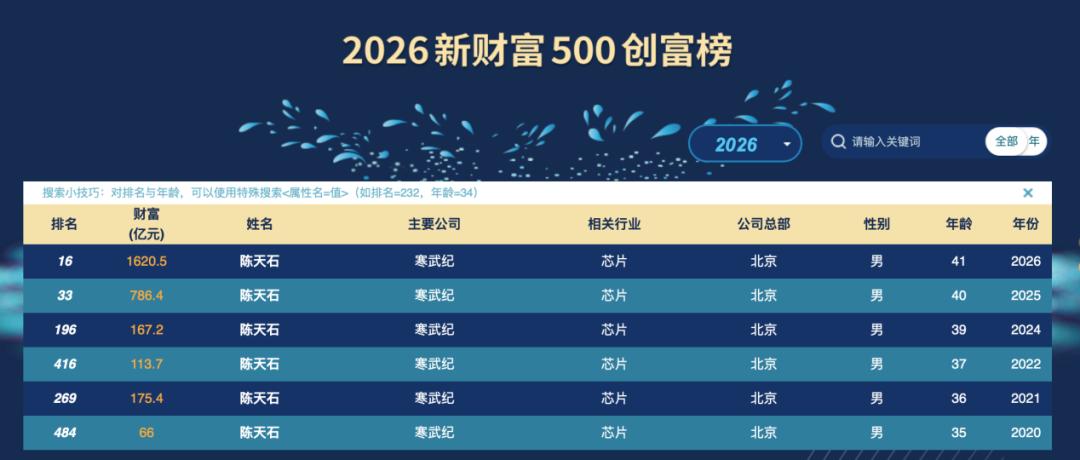
Notably, in the "2026 New Fortune 500 Richest List" released in June, Chen Tianshi, the founder of Cambricon, ranked 16th with a net worth of RMB 162.05 billion, an increase of over RMB 80 billion from last year.
Experiencing a Trillion-Yuan Market Value 'Trial Card,' Cambricon Proactively 'Cools Down'
In the announcement released on June 30, Cambricon pointed out that its stock price had recently experienced a significant cumulative increase, surpassing the gains of relevant indices such as the STAR Composite Index and the Shanghai Composite Index, potentially indicating a risk of decline due to short-term rapid growth.
According to the announcement, as of June 30, Cambricon's closing price was RMB 1,595.55 per share. Data released by China Securities Index Co., Ltd. showed that the company's latest trailing price-to-earnings ratio was 368.97 times, and the price-to-book ratio was 77.88 times.
In contrast, the latest trailing price-to-earnings ratio for the computer, communication, and other electronic equipment manufacturing industries was 74.86 times, with a price-to-book ratio of 8.06 times. For the software and information technology services industries, the latest trailing price-to-earnings ratio was 74.13 times, with a price-to-book ratio of 5.67 times.
Cambricon admitted that its trailing price-to-earnings and price-to-book ratios were significantly higher than industry levels, posing a risk of high valuation.
Cambricon also stated that the company is still in a stage of continuous development and has relatively limited ability to withstand market fluctuations and industry changes. At the same time, the company's operating performance is influenced by various factors such as the macroeconomic environment, market competition, and policy environment, introducing uncertainties.
In fact, as more and more manufacturers launch AI chip products, Cambricon faces increasingly fierce market competition.
Although the AI industry has received growing attention in recent years, overall, AI chip technology is still in its developmental stage, with rapid technological iteration and exploration of technological development paths. No architecture or system ecosystem with absolute advantages has yet emerged.
Additionally, Cambricon highlighted the challenges it faces in terms of supply chain stability. According to the company, it operates under a Fabless model, with suppliers including IP licensing vendors, server manufacturers, wafer foundries, and packaging and testing factories.
Fabless refers to fabless chip design enterprises (also referring to the business model of such enterprises). Cambricon only engages in the design and sales of chips, while entrusting wafer manufacturing, packaging, and testing to specialized manufacturers. The company primarily generates revenue by providing customers with intelligent chips and boards, intelligent complete machines, and other products.
Given the specialized division of labor and high technical barriers in the entire integrated circuit industry chain, coupled with the fact that the company and some of its subsidiaries have been included in the "Entity List," there is a certain risk to the stability of the company's supply chain.
At the same time, the cost pressures faced by Cambricon are also not to be underestimated. In recent years, the demand for raw materials in the domestic semiconductor industry has sustained growth (continued to grow), with upstream supply shortages and overall rising procurement prices.
Cambricon's comprehensive gross profit margin is influenced by various factors, including product mix, the company's expansion into new businesses, product selling prices, raw material and packaging and testing costs, and production process levels. On the other hand, it is also affected by industry conditions, with the comprehensive gross profit margin of the chip industry being highly correlated with national policy adjustments, the degree of market competition, and the stability of the global supply chain.
Changes in the aforementioned factors may cause fluctuations in Cambricon's gross profit margin, thereby affecting the company's operating results.
However, Cambricon also emphasized that as of the disclosure of the announcement, the company's daily operations were normal, and there was no other material information that should have been disclosed but was not.
Performance Reaches New Highs, Revenue and Net Profit Soar
According to Tianyancha, Chinese Academy of Sciences Cambricon Technology Corporation was registered in March 2016 and listed on the STAR Market in July 2020.
As a listed company specializing in AI chip research and development, Cambricon's main business is the research, development, design, and sales of AI core chips applied in various cloud servers, edge computing devices, and terminal devices.
In recent years, the increasing maturity of AIGC technology has spurred rapid growth in demand for intelligent computing power, while emerging industries such as cloud computing, big data, and IoT continue to drive demand for intelligent chips. Benefiting from this, Cambricon's performance has continued to climb.
In 2025, Cambricon achieved revenue of RMB 6.497 billion, a year-on-year surge of 453.21%; net profit attributable to shareholders reached RMB 2.059 billion, successfully reversing the previous year's loss of RMB 452 million and achieving its first-ever annual profit.
In the first quarter of this year, Cambricon continued to build on its momentum, achieving quarterly revenue of RMB 2.885 billion, a year-on-year increase of 159.56%; net profit attributable to shareholders reached RMB 1.013 billion, a year-on-year increase of 185.04%, achieving approximately half of last year's profit in just one quarter.
In response, Cambricon stated that in the first quarter, benefiting from the sustained increase in computing power demand in the AI industry, the company continued to expand its market with its excellent product competitiveness and actively promoted the implementation of AI application scenarios. Revenue during the reporting period increased significantly year-on-year, further driving substantial growth in net profit attributable to shareholders.
Notably, although R&D expenses in the first quarter increased by 18.88% year-on-year to RMB 324 million, due to a larger increase in revenue, the company's R&D expense ratio decreased from 24.53% in the same period last year to 11.23%.
As of the end of the first quarter, Cambricon's current assets were RMB 13.953 billion, an increase of 15.5% from the beginning of the period.
The growth in the company's current assets was partly due to the surge in accounts receivable and prepayments, which increased by 81.79% and 154.72% from the beginning of the period to RMB 1.219 billion and RMB 1.897 billion, respectively.
Western Securities' research report believes that the company aims to actively place orders to meet potential downstream demand.
Morgan Stanley pointed out that Cambricon's revenue growth in the first quarter exceeded the bank's and the market's general expectations, primarily driven by strong shipments of the SiYuan 590 chip; the company's prepayments in the first quarter surged quarter-on-quarter, mainly supported by newly obtained chip production orders. Shipments are expected to see significant growth starting from the second quarter of 2026.
Additionally, as of the end of the first quarter, Cambricon's inventory scale had decreased by approximately 9% from the beginning of the period to RMB 4.497 billion, but it remained at a relatively high level compared to the company's revenue.
According to Cambricon's announcement on provisioning for asset impairment in the first quarter, after testing, the company provisioned approximately RMB 246 million for inventory write-downs in the first quarter, mainly due to strategic stockpiling of raw materials in the previous period. As the age of some raw materials increased this quarter, the corresponding provision for inventory write-downs also increased.
The announcement showed that the total provision for credit impairment losses and asset impairment losses this time was approximately RMB 245 million, which would correspondingly reduce the company's total consolidated profit for the first quarter of 2026 by RMB 245 million.
Cambricon stated that the company's management attaches great importance to and strictly controls inventory management. It will further increase market development efforts, deeply explore industry customer needs, accelerate inventory turnover, and reduce inventory risks.
'First AI Chip Stock' Faces 'Hunting' by Major Players
Leida Finance learned from the annual report that since its establishment in 2016, Cambricon has rapidly achieved industrialization of its technologies, successively launching the Cambricon series of intelligent processors for terminal scenarios; cloud-based intelligent acceleration card products based on the SiYuan series; and edge intelligent acceleration cards based on the SiYuan 220 chip.
As of the end of 2025, Cambricon's intelligent processor IP products had been integrated into over 100 million smartphones and other intelligent terminal devices, while the SiYuan series products had also been applied in products from multiple server manufacturers. Since its release, cumulative sales of the SiYuan 220 have exceeded one million units.
Financial reports showed that in 2025, Cambricon produced a total of 127,700 intelligent chips and boards, a year-on-year increase of 409.84%; it sold 117,400 units, a year-on-year increase of 201.57%; and had an ending inventory of 857,100 units, a slight year-on-year increase of 0.63%.
Cambricon believes that the year-on-year increase in production and sales volume of the aforementioned products was mainly due to the sustained increase in computing power demand in the AI industry during the reporting period, as the company continued to expand its market with its excellent product competitiveness.
However, the phenomenon of customer concentration remains significant for Cambricon: in 2025, the combined sales amount from the company's top five customers accounted for as high as 88.66% of total operating revenue. Over the past three years, this proportion has consistently hovered around 90%.
Moreover, as domestic tech giants step up their efforts to develop self-researched computing power chips, Cambricon's "scarcity" advantage in the domestic computing power sector is continuously being eroded.
Previously, after being sanctioned, Huawei independently developed the Ascend chip to lay out its AI strategy. Later, Alibaba and ByteDance invested heavily in self-researched chips.
According to a report by the STAR Market Daily, earlier this year, a source close to Alibaba revealed that Alibaba's Pingtouge Zhenwu PPU chip shipments had reached hundreds of thousands of units, surpassing Cambricon and leading among domestic GPU manufacturers.
In February, there were reports that ByteDance's chip R&D team would begin large-scale recruitment, with specific recruitment cities including Beijing, Shanghai, and Shenzhen. Required positions included chip architecture and SoC design.
The source revealed that ByteDance's chip R&D team is currently focused on the chip design phase, conducting custom hardware optimization for the company's own business and developing multiple complex chips using advanced semiconductor processes for cloud scenarios to improve performance and reduce computing power costs.
"Currently, ByteDance's chip team has achieved multiple successful first-pass silicon runs, with several early projects entering the mass production deployment phase, covering multiple mainstream advanced process nodes. The overall R&D and implementation pace is steadily advancing," the source said.
Faced with the aggressive pursuit of many major players, Chen Tianshi, the founder of Cambricon, stated at the 2025 annual performance briefing that internet companies' R&D of AI chips is primarily focused on completing complete or relatively complete industry solutions around their main businesses or for specific application scenarios.
"Cambricon's products are general-purpose intelligent chips designed and developed for diverse application scenarios within the AI field. They have good versatility for various AI technologies such as vision, speech, natural language processing, and traditional machine learning techniques. They can provide customers in multiple industry sectors with differentiated products of different sizes and for multiple scenarios to meet their diverse needs," Chen Tianshi further explained.
Whether Cambricon, whose market value once surpassed the trillion-yuan mark, can achieve sustained growth in its performance in the future remains to be seen. Leida Finance will continue to monitor the situation.
-
![]()
Laifen Seeks to Escape 'Budget Dyson' Label but Falls Short of Dyson's Prestige
-
![]()
Who is Holding Back the Development of Dexterous Hands?
-
![]()
How do Autonomous Driving Physical AI and End-to-End Systems Work Together?
-
![]()
June's New Energy Vehicle Sales Rankings Unveiled! Leapmotor Surpasses Tesla in a Stunning Comeback, Marking the Start of the Automakers' Knockout Phase
-
![]()
Global Agents Embrace 'Loop Engineering': AI's Self-Sufficient Work, Supervision, and Revision
-
Post-90s Straight-A CEO Propels Jihao Technology Toward IPO, Despite Over 90% Revenue Reliance on Smartphones
-
AI 'Dissolves' Visual China's Copyright Moat—What Story Can It Tell to List in Hong Kong?
-
![]()
The AI Industry Chain: A Tale of Fire and Ice - Upstream Thrives, Downstream Struggles