DeepSeek’s Liang Wenfeng Becomes World’s Wealthiest in AI, Net Worth Skyrockets to $36 Billion
 07/15 2026
 545
545
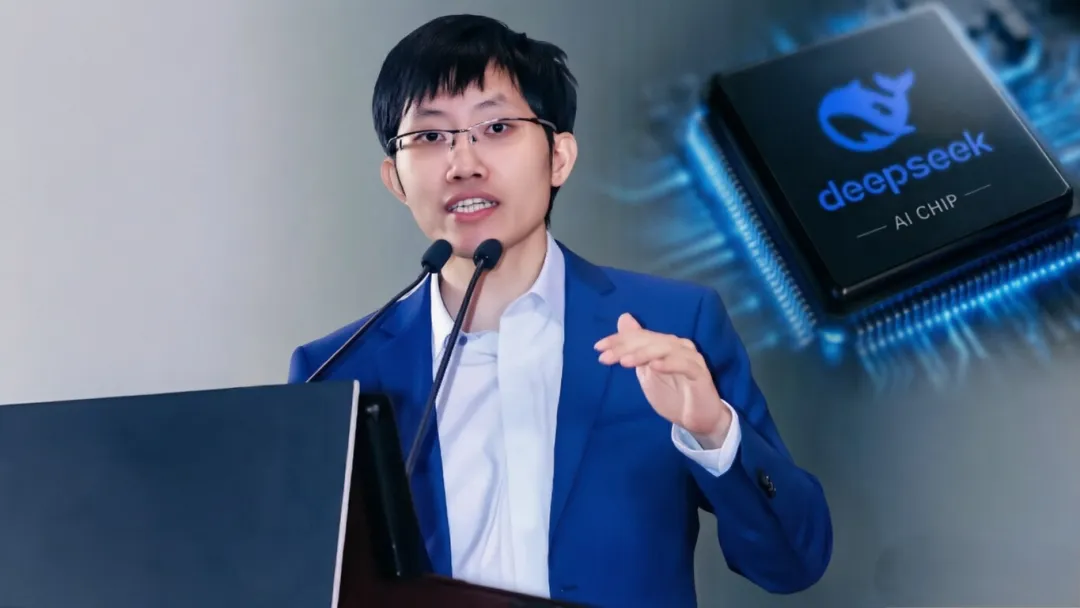 Image Source: AI Synthetic Schematic
Introduction
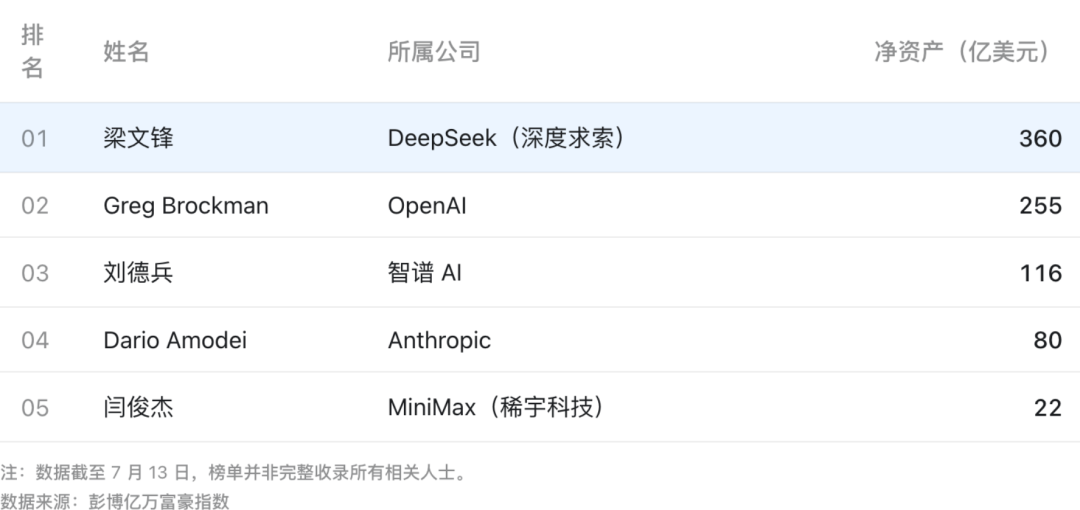
On July 14, the Bloomberg Billionaires Index update ignited a buzz in the tech and finance sectors, revealing that DeepSeek founder Liang Wenfeng’s net worth had doubled from $16.7 billion to $36 billion (RMB 244 billion). This milestone not only propelled him past AI leaders from Silicon Valley like those at OpenAI and Anthropic, but also established him as the world’s richest individual in the field of pure AI large models and China’s eighth-wealthiest person, shattering previous wealth records for domestic large model entrepreneurs.
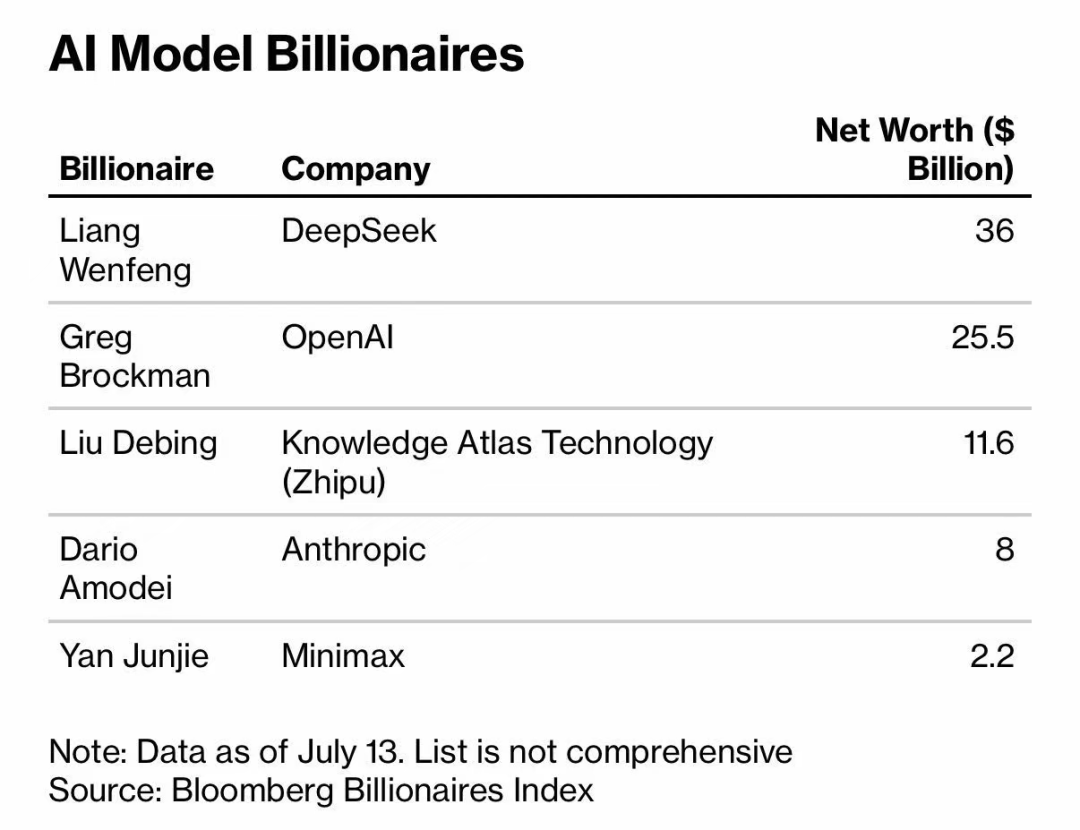
Unlike the common Silicon Valley practice of equity dilution and limited capital control for AI founders, Liang Wenfeng retains nearly 78% absolute control of DeepSeek. This has paved a uniquely Chinese path in AI entrepreneurship, characterized by financial sustainability through quantitative trading, self-developed technological breakthroughs, strict capital control, and autonomous decision-making. Behind this striking wealth surge lies a new entrepreneurial logic that is reshaping global venture capital norms.
I. $36 Billion Net Worth: Leading the Global Pure AI Race
The Bloomberg Billionaires Index employs rigorous criteria, focusing solely on founders of pure AI large model R&D and operations firms, excluding internet conglomerates, AI chipmakers, and computing service providers. Within this niche, Liang Wenfeng’s wealth signifies comprehensive dominance.
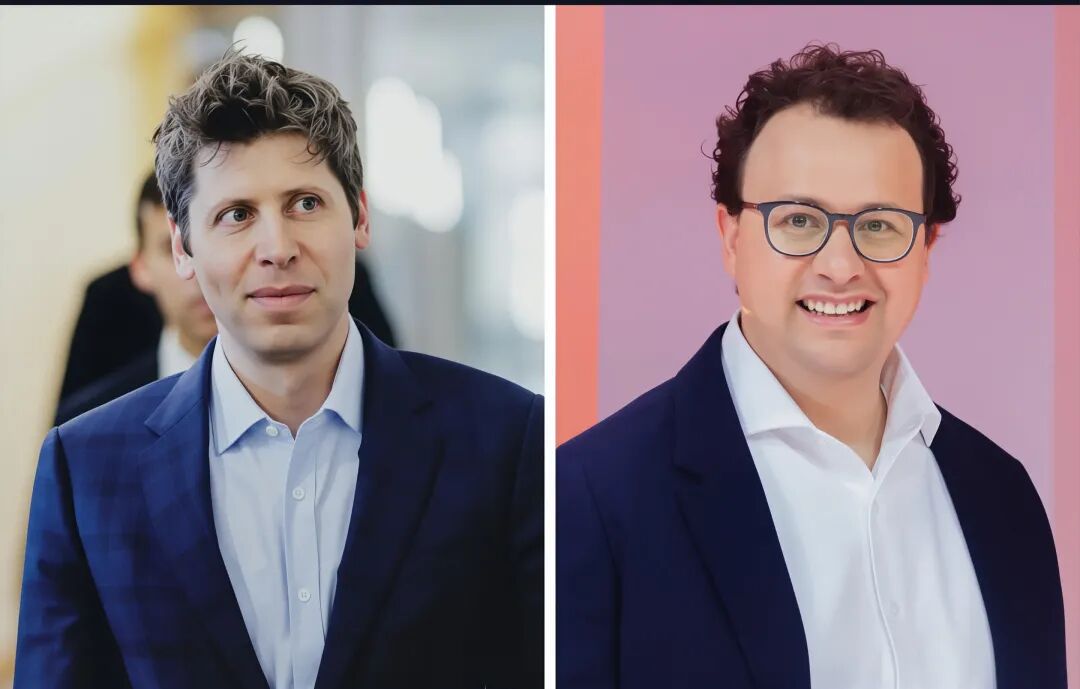
Caption: OpenAI CEO Sam Altman (left) and Anthropic Co-Founder/CEO Dario Amodei (right)
Comparisons on a global scale reveal significant gaps: Liang’s $36 billion far surpasses Anthropic’s Dario Amodei and OpenAI’s Greg Brockman. Domestically, Zhipu AI’s Liu Debing ($11.6 billion) and MiniMax’s Yan Junjie ($2.2 billion) lag far behind.
Many wonder why founders of OpenAI and Anthropic, with valuations nearing a trillion dollars, are far less wealthy than Liang. The key lies in their equity structures. Silicon Valley AI firms typically have highly dispersed ownership among numerous investors and co-founders, significantly reducing the founders’ realizable assets. Liang’s absolute control creates an impenetrable wealth barrier.
Among Chinese billionaires, Liang ranks eighth and stands out as the only entrepreneur whose wealth is derived from general-purpose large models. DeepSeek’s valuation has exceeded $50 billion (RMB 330 billion), quintupling from $10 billion in April, strongly validating the industrial value of domestic hardcore AI models.
II. $7.4 Billion Landmark Funding: Anti-Conventional Structure Safeguards Control
In June 2026, DeepSeek completed its first external funding round, raising $7.4 billion (RMB 50 billion)—a domestic record—that triggered Liang’s wealth surge. The investor lineup included elite domestic industrial capital: Liang himself invested $20 billion as the largest contributor, followed by Tencent ($10 billion), CATL ($5 billion), JD.com, NetEase, and IDG Capital ($3 billion each), with the National AI Industry Investment Fund contributing $1 billion.
More groundbreaking than the funding scale was its equity structure design, which defied conventional venture capital norms and secured Liang’s 78% stake. Firstly, market investors’ funds were channeled into a limited partnership fully managed by Liang, granting them only dividend rights without board seats or voting power, leaving technical and commercial strategies untouched. Secondly, all external capital faced a mandatory five-year lockup period, barring transfers or sales to eliminate short-term speculators and protect long-term R&D.
The control over equity dilution reached industry extremes: Liang’s direct and indirect holding dipped from 89.5% to just 78% post-funding. In Silicon Valley, AI startups at similar valuations typically surrender over half their equity for resources. Liang uniquely achieved “funding growth without relinquishing power,” an unparalleled feat in global AI entrepreneurship. DeepSeek has not officially commented on these calculations.
III. 18-Year Deep Commitment: From Quantitative Trading Prodigy to Domestic AI Leader
Born in 1985 to a primary school teacher in Zhanjiang, Guangdong, Liang’s rational and focused character was shaped early. He earned undergraduate and master’s degrees in electrical engineering from Zhejiang University, laying the foundation for his crossover into quantitative trading and AI.
During the 2008 global financial crisis, graduate student Liang first recognized the commercial potential of machine learning. In 2015, he co-founded High-Flyer Quantitative with Zhejiang University classmates, applying AI algorithms to quantitative trading. By 2017, High-Flyer achieved fully AI-driven autonomous trading, managing over RMB 100 billion at its peak. The stable cash flow from quantitative operations allowed Liang to preemptively stockpile high-end GPUs before overseas chip restrictions tightened, securing computational power for DeepSeek.
In 2023, Liang spun off High-Flyer’s AI team to establish DeepSeek, setting three ironclad rules: no external financing, no rush to commercialize, and no IPO plans. What appeared idealistic was actually a long-term technical strategy. As competition in large models intensified, mounting training costs and talent wars forced him to break his no-funding pledge for strategic upgrades.
The new V4 model fully supports Huawei Ascend domestic chips, with completely rewritten low-level code, costing over $500 million per training round. Simultaneously, the global AI talent war drove salaries skyward, necessitating capital for iterations. Released in early 2025, DeepSeek’s first-generation model matched overseas top-tier performance while drastically cutting training and inference costs, breaking overseas monopolies. The upgraded V4 now fully supports domestic chips and has launched a self-developed inference chip project, achieving complete independence from overseas computational supply chains.
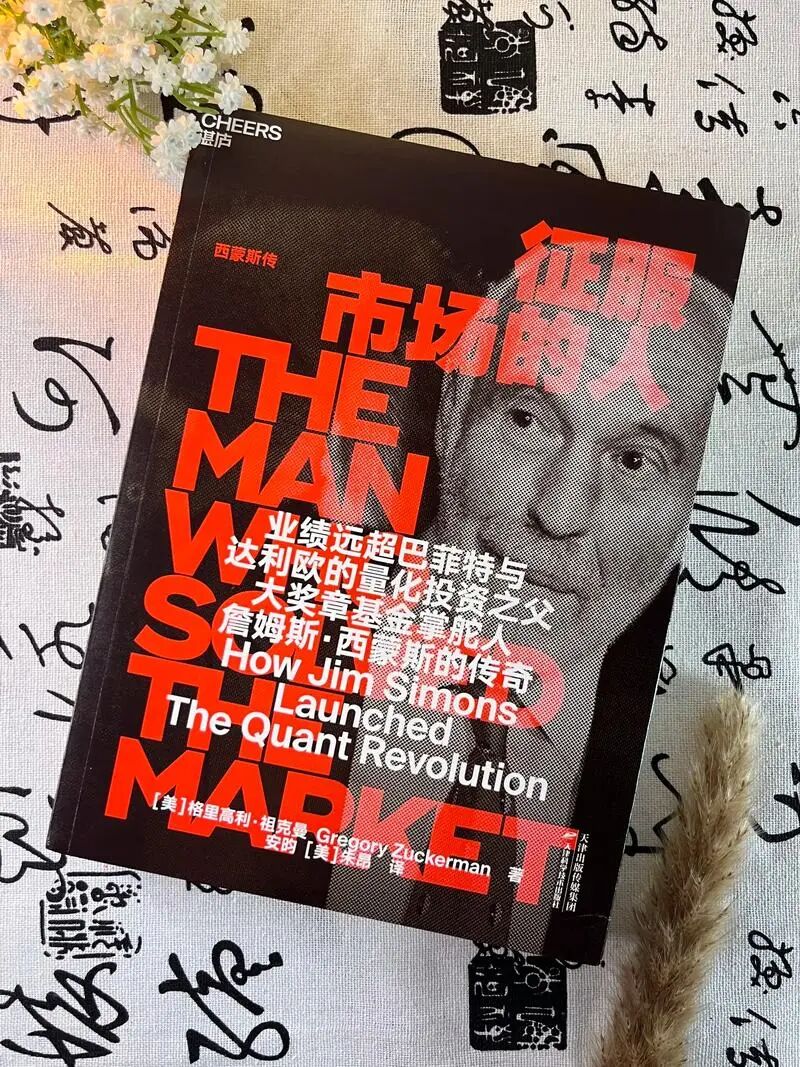 Image Source: Mufeng Yuedu @ Douyin
Extremely reclusive, Liang rarely appears publicly, but his preface to "The Man Who Conquered Markets: The Simon Story" reveals his core business philosophy. Quantitative trading pioneer James Simons created legendary returns through mathematical models, while Liang firmly believes: algorithms can dissect all commercial complexities, and long-term iteration will build core barriers. This philosophy has guided his decade-plus tech entrepreneurship.
IV. Key Takeaways: Wealth Myth Hard to Replicate, Entrepreneurial Logic Worth Emulating
Liang’s success seems unrepeatable: billion-dollar quantitative operations providing continuous cash flow, heavy personal investment in funding rounds, and nearly 80% company control are all rare advantages. Yet beyond the wealth halo, his three entrepreneurial principles offer high value to all founders:
First, build a stable foundation before pursuing technical ideals. Liang didn’t blindly burn cash; he first established a profitable core business through quantitative trading to sustain AI R&D, using independent cash flow to resist short-term capital pressures and focus on long-term tracks.
Second, compromise flexibly on details but defend core principles. He broke his “no financing” vow to introduce industrial capital for technical growth, but maintained control through unique equity structures and long lockup periods. Entrepreneurship requires neither stubbornness nor total surrender—compromise on details, never on essentials.
Third, reject quick fixes; build barriers through time. From machine learning in 2008 to becoming the world’s wealthiest in AI in 2026, Liang deeply cultivated the same technical domain for 18 years. In an era of rapid financing and exits, true technical moats come only from sustained long-term iteration and accumulation.
While Simons conquered capital markets with algorithms, Liang’s long-termist tech faith is reshaping China’s AI landscape, setting a new paradigm for domestic hardcore tech entrepreneurship.
End Discussion: Silicon Valley AI founders often dilute equity for rapid capital growth, while Liang Wenfeng insists on autonomous control and self-developed depth. Which long-term value model do you favor? Share your thoughts in the comments.
Disclaimer: This article provides financial commentary only and does not constitute investment advice. All corporate data and regulatory events cited are from public information, for reference only, and subject to official confirmation. Images sourced from networks; copyright holders may contact for removal.
-
![]()
A Trillion Dollars Poured into AI: Only These Three Types of Companies Are Truly Profiting
-
![]()
Differentiation and Acceleration in Banking AI Implementation
-
![]()
Year’s First Half Sees Nearly 1.81 Million Vehicles Sold, with Exports Contributing Over 40%: How Will BYD Steer Through the Second Half Amidst a Price War?
-
![]()
Chuenergy’s Maiden ET Vehicle Rolls Off Line at SAIC-GM Wuhan South Plant, Poised to Rival AITO M5
-
![]()
StepOn’s AI Terminal: A Tale of Unveiled Potential
-
![]()
StepOn’s AI Terminal: Only Part of the Picture Unveiled
-
![]()
The Tale of Rapid Iteration: Even Elite Students in the Auto Industry Struggle to Keep Pace
-
![]()
Seventy Years On: From China’s First Car to a Pivotal Moment in Automotive Excellence