A Trillion Dollars Poured into AI: Only These Three Types of Companies Are Truly Profiting
 07/15 2026
 498
498
A trillion dollars is pouring into AI infrastructure at an unprecedented pace.
Let’s look at the numbers: Based on 2026 capital expenditure guidance, the upper limits for Microsoft, Amazon, Alphabet, and Meta—the four leading cloud providers—have been pushed to a staggering $725 billion, up 77% from 2025.
Factoring in Oracle, CoreWeave, the Stargate project, sovereign AI initiatives from various countries, and countless enterprise-built computing infrastructures, the total annual investment in AI infrastructure has easily surpassed the $1 trillion mark.
In business, there’s an immutable truth: Money flows where profits flow.
But is this trillion dollars being evenly distributed across every company in the supply chain?
The answer is a resounding no.
In July, Chris Zeoli, an early-stage tech investor in the U.S., did something fascinating. He dissected the entire AI infrastructure supply chain like an onion, layer by layer, and crunched the numbers.
The results are sobering: In this trillion-dollar frenzy, some are feasting while others scrape by. Some reap massive profits with minimal effort, while others toil relentlessly for crumbs. Some gamble their futures on mountains of debt.
Let’s examine this chart of “AI stratification”:
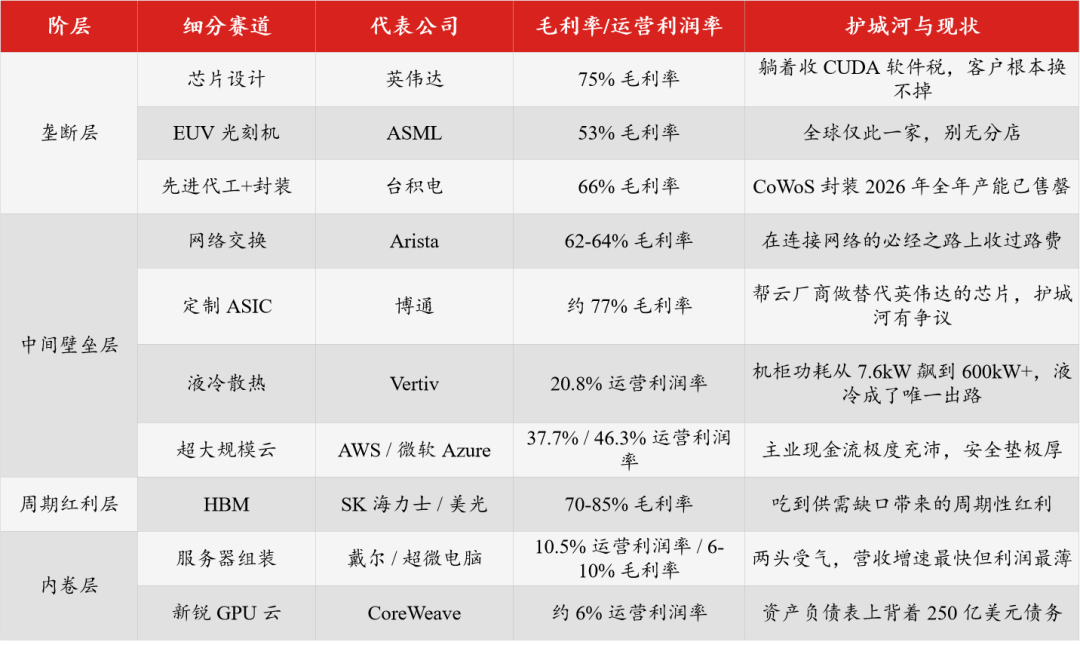
Why, in this historic, supercharged AI infrastructure boom, do fortunes diverge so wildly?
In this article, we’ll follow the trillion-dollar trail from the top of the pyramid downward, dissecting the underlying business logic of this profit chain. We’ll see who the real winners are—and who’s swimming naked before the tide goes out.
/ 01 / The Monopoly Tier: Scarcity Is the Ultimate Money Printer
Before analyzing profit distribution across the supply chain, we must agree on one principle: In business, profits always concentrate where scarcity is greatest.
At the pinnacle of this pyramid stand three companies—NVIDIA, TSMC, and ASML—reaping the fattest profits for one reason: No one else can do what they do. They hold pricing power firmly in their grasp.
Take NVIDIA as the prime example.
Do you know the manufacturing cost of a Blackwell B200 GPU? About $6,400. What’s its selling price? Between $30,000 and $40,000.
What does that mean? It means a 500–600% markup is captured entirely by the “design” phase, propelling NVIDIA’s gross margin to a staggering 75%.
You might ask: Can hardware really generate such massive profits? Of course not. NVIDIA’s windfall doesn’t come from hardware alone—it comes from something called CUDA.
What is CUDA? It’s a programming platform NVIDIA spent over a decade building. Developers use it to harness GPU computing power for model training, inference, and deployment. Over the past 15 years, millions of developers worldwide have accumulated countless toolkits, algorithm frameworks, and industry solutions on this system.
Today’s mainstream AI frameworks like PyTorch and TensorFlow are built from the ground up for CUDA.
Think of it as the Windows operating system for AI. AMD has its ROCm platform, but it’s orders of magnitude smaller and less mature. Would any major company’s developers rewrite millions of lines of code on a “good enough but not great” platform just to save a little on chips?
So, do you see it now? NVIDIA isn’t selling chips—it’s collecting an “AI operating system tax” on hundreds of billions in annual global computing spend.
A naive argument once circulated: If model training efficiency improves, won’t demand for computing power peak?
In January 2025, DeepSeek released its V3 model, claiming to have trained it for just $5.6 million—a tenth of Meta’s cost for Llama 3.
Panic ensued. “Computing demand has peaked!” cried the market. NVIDIA’s stock plummeted 16.97% in a single day, wiping $589 billion off its market cap—the largest one-day loss in human history.
But what happened next?
Eighteen months later, NVIDIA’s market cap had octupled, peaking at $4.85 trillion. Meanwhile, the four major cloud providers’ capital expenditures soared from $410 billion to $725 billion—a 77% jump in one year.
Why did spending increase despite efficiency gains?
Economics offers a famous concept: Jevons’ Paradox. When steam engines became more efficient, coal consumption skyrocketed. Why? Cheaper energy enabled previously unimaginable applications.
The same logic applies to AI computing power. Every order-of-magnitude reduction in training costs unlocks tenfold new use cases that dare to, can afford to, and must adopt AI.
Remember: Efficiency doesn’t kill demand—it feeds it.
If NVIDIA’s moat is its unfathomably deep software ecosystem, TSMC and ASML’s moats lie in manufacturing irreplaceability.
TSMC commands a 66% gross margin. Its core barrier (Chinese term for “competitive barrier”) is CoWoS advanced packaging—essentially, integrating GPU compute cores with HBM memory.
This might sound mundane, but the reality is brutal: Only TSMC can mass-produce AI-grade chips with perfect yield rates at scale. Samsung has I-Cube4, Intel has EMIB—each with unique technical approaches—but they lag generations behind TSMC in volume and yield.
Even as TSMC Crazy expansion of production (Chinese term for “aggressively expands production”), with capacity surging from 35,000 wafers per month in late 2024 to 128,000 by late 2026 (nearly quadrupling), demand still outstrips supply year-round.
Upstream, ASML is the world’s sole EUV lithography machine manufacturer. Without EUV, chip production below 7nm grinds to a halt. Every AI accelerator, flagship smartphone chip, and high-performance processor you know depends on this technology.
ASML spent two decades and over €20 billion in R&D to master EUV. This barrier (barrier) can’t be replicated with money alone—time can’t be compressed, and experience can’t be bought.
Companies at this tier profit from structural scarcity. They feast while others starve—and rightly so.
/ 02 / The Middle-Barrier Tier: Stuck Customers Mean Steady Profits
Just below absolute monopolies lie “middle-barrier” firms that secure pricing power through high switching costs.
Their barriers aren’t absolute, but once customers adopt their solutions, they dare not switch. As long as customers stay, stable pricing follows.
This tier includes network switching (locking customers through reliability), custom ASICs (binding customers via “NVIDIA fear”), and liquid cooling (trapping customers through physical limits). Three sectors, three reasons customers “can’t switch.”
First, network switching.
An AI cluster means tens of thousands of GPUs working in tandem. They constantly exchange data: parameter synchronization, gradient transfers, intermediate result aggregation—all dependent on the network.
When selecting network suppliers, customers care about one thing: stability. Price is secondary because a network failure halting training costs far more than equipment price differences.
Arista dominates this niche with its EOS switch operating system.
EOS does two things: (1) Intelligently routes data traffic to ensure seamless exchange across tens of thousands of GPUs, and (2) automatically switches to backup paths in milliseconds during failures, safeguarding training tasks.
Arista maintains 62–64% gross margins through this ultra-stable system. Essentially, it collects “tolls” on all data flowing through AI clusters.
Next, custom ASICs.
Google, Amazon, and Microsoft pay NVIDIA tens of billions annually in “computing taxes.” As trillion-dollar giants, none wants permanent dependency. Thus, self-designed chips become the only path.
But chip design isn’t something money can solve overnight, and demand is too vast for any single company to handle alone. Enter Broadcom: “You provide the design vision; we build your chips.”
This collaboration creates deep binding. Customers don’t buy off-the-shelf chips—they co-define architectures, develop in phases, and secure long-term supply. Once deployed, the entire software stack must optimize around these chips.
Switching suppliers means redesigning, revalidating, and re-adapting—a two-to-three-year ordeal. All the while, computing costs pile up.
So what does Broadcom earn? It collects “insurance premiums” as cloud providers race to “de-NVIDIA-ize.” This business is growing rapidly, with margins nearing 77%—almost matching NVIDIA’s.
But Broadcom’s moat is debatable. Cloud providers build chip teams in parallel. As their engineers mature, Broadcom’s replaceability risk rises.
Finally, liquid cooling—a often-overlooked sector.
This market remained niche until AI arrived. Why? Traditional data center racks drew just 7.6kW. A few large fans sufficed.
But AI changed everything. A single GB200 rack now consumes 120–140kW—16–18x traditional levels. Air cooling hit its physical limits. Now, it’s not a “should we switch” question but a “can’t operate without switching” reality.
Liquid cooling differs from air cooling: It’s not standalone but deeply integrated with data center construction, piping, and electromechanical systems. Once deployed, maintenance and expansion practically require the original vendor.
This is why Vertiv dominates. Its 20% operating margin seems modest, but its $15+ billion order backlog covers 12–18 months of revenue.
It’s a slow business, but it wins through certainty—customers board the ship and can’t disembark.
Companies at this tier profit from “customers unwilling to switch.” Their barriers are lower than monopolies, but stability and sustainability reign.
/ 03 / The Cyclical-Bonus Tier: HBM Won’t Produce a Second NVIDIA
If 2026 had an AI superstar, it’s HBM (High-Bandwidth Memory)—no contest.
SK Hynix, Samsung, and Micron monopolize the HBM market. Their results border on the absurd:
● SK Hynix: Q2 revenue projected at KRW 80.9 trillion (~$59B), +264% YoY; operating profit KRW 60.4 trillion (~$44B), +556% YoY. Operating margin: 74.6% (all-time high).
● Micron: FQ3 revenue $41.46B, +346% YoY; gross margin 84.9%; GAAP profit $33.32B, +1,400% YoY.
● Samsung: Q2 revenue KRW 171 trillion (~$111.8B), operating profit KRW 89.4 trillion (~$58.4B), +1,810% YoY—briefly surpassing NVIDIA’s $53.5B.
With 75–85% gross margins, many shout: “HBM is the next NVIDIA!”
But are these profits the same? Absolutely not.
NVIDIA’s scarcity stems from a 15-year ecosystem moat—customers can’t switch. HBM’s scarcity is purely short-term supply-demand mismatch.
All three manufacturers are now aggressively expanding capacity. But storage follows a 40-year iron law: Price hikes → Capacity expansions → Gluts → Price crashes. Every four years, without fail.
This cycle’s amplitude is unprecedented. DRAM contract prices surged 820% YoY—the steepest climb in three cycles.
But warning signs flash: NAND flash spot prices just fell below contract prices. Historically, this “spot < contract” inversion signals cyclical turning points.
When new capacity floods in, HBM’s fat margins will compress. HBM won’t produce a second NVIDIA—it’s a cyclical bonus. Trade the waves for thick profits, but hold it as faith at your own risk.
/ 04 / The Hyper-Competitive Tier: The Dangerous “Hard Business” of High Revenue
If the cyclical tier’s risk is “unknown turning points,” the hyper-competitive tier’s cruelty lies in knowing it’s a tough gig—but doing it anyway because the wind’s blowing.
The prime example: AI server assembly.
Dell’s financials show AI server revenue up 292% YoY—tripling NVIDIA’s 85% growth. But its infrastructure division’s operating margin? A pitiful 10.5%. Full-year AI orders hit $64.1B, with backlog at $43–51B.
The larger the scale, the harder it works for upstream suppliers.
Dell buys NVIDIA GPUs, SK Hynix HBM, Broadcom NICs—powerful upstream vendors capture most profits. What does Dell do? It screws parts together, adds a chassis, runs cables, signs support contracts, and marks up prices by single digits.
Supermicro fares worse, with margins stuck at 6.3–10.1%.
Server assembly lacks proprietary IP. Upstream chipmakers dominate, downstream cloud providers diversify suppliers, leaving assemblers as middlemen squeezed on both ends.
Equally alarming are the emerging GPU cloud providers, with CoreWeave as a typical example.
In 2026, CoreWeave’s revenue guidance stands at $12 to $13 billion, with a backlog of orders totaling $99.4 billion. Looks impressive, right? But its operating profit margin is only around 6%. More outrageously, its capital expenditures are 250% of its annual revenue, and it carries $25 billion in debt on its balance sheet.
Similarly, when it comes to renting out computing power, established cloud providers like AWS, Azure, and Google Cloud use cash flow generated from their main businesses to expand capacity; CoreWeave, on the other hand, borrows money to buy GPUs and then rents them out.
What’s even more concerning is that while legacy cloud providers serve millions of enterprises worldwide, spreading risk extremely thin, CoreWeave’s customer base is highly concentrated among a handful of major players like Microsoft and OpenAI.
Once demand growth slows or a price war breaks out, high leverage will instantly transform from an accelerator into a noose. As of now, CoreWeave’s stock price has dropped by 55.45% from its peak of $187 in June last year, with the market voting with its feet.
This business model of borrowing money to rent out computing power closely resembles the fiber-optic bubble of the late 1990s.
From 1996 to 2001, North American telecom operators invested approximately $500 billion in laying fiber-optic backbone networks. Back then, everyone knew the internet needed bandwidth and was desperately borrowing money to lay cables.
What was the outcome? Equipment sellers like Cisco, Nortel, and Lucent made a fortune. But the operators who borrowed money to lay cables suffered terribly: Global Crossing went bankrupt with $12.4 billion in debt, WorldCom collapsed due to $11 billion in accounting fraud, and Qwest was forced to sell itself to a century-old company. Hundreds of billions of dollars in infrastructure investment ultimately turned into a pile of scrap metal taken over by creditors.
History does not simply repeat itself, but the laws of value distribution remain unchanged.
/05/ Summary
After dissecting the industrial chain of this trillion-dollar AI infrastructure boom, we uncover a harsh truth:
Changes on the supply side of an industry largely determine how much profit companies can make.
When the tide is surging, everyone feels like a winner and rushes forward desperately. But only when the tide recedes will we see who has been swimming naked.
The trillion-dollar party continues, but the shuffle at the base has already quietly begun.
Written by Yuanyuan
-
Why Can''t AutoNavi Maps Excel in Local Services?
-
![]()
Cameras: A New Frontier in Smart Hardware at More Affordable Prices
-
Raising Nearly US$400 Million in Intensive Financing Over Six Months: Can This New Heavy Truck Player Pioneer a New Model for Autonomous Heavy Trucks?
-
![]()
Memory Chip Price Surge Imposes Heavy Burden on Smartphone Market, with Q2 Global Shipments Slumping to 13-Year Low
-
![]()
Tencent’s Acquisition of Manus: No Less Anxious Than Meta
-
![]()
Collective Failure of BBA, Only '56E' Holding On
-
![]()
Step's Apple Dream
-
![]()
The value of AI Coding is quietly shifting from 'whose model is stronger' to 'whose toolchain is denser'.