iFLYTEK Anticipates RMB 200 Million Loss, Embracing 'Subtraction' and 'Addition': Abandoning Low-Margin Businesses and Betting on AI's Future
 07/15 2026
 435
435
On July 14, iFLYTEK released its performance forecast for the first half of 2026, stirring the market with a set of eye-catching figures:
- Anticipated net loss attributable to the parent company: RMB 180 million to RMB 228 million, representing a 5% to 25% year-on-year reduction in losses;
- Year-on-year growth in revenue and gross profit: 5% to 10%;
- Sales collections: RMB 11.8 billion, up RMB 1.5 billion year-on-year;
- Contract value: Surged 27%, with a robust pipeline of orders on hand.
Many jump to conclusions about iFLYTEK's viability upon seeing the word 'loss.' However, to truly understand this financial report, the focus should not be on 'how much was lost' but rather on two critical questions: Where was the money spent? What business decisions were made?
The answer is clear: This is not a sign of operational distress but a deliberate strategy by China's leading AI company—employing 'subtraction' to shed inefficient businesses and 'addition' to double down on core markets, building resilience for long-term growth.
01 It's Not About Inability to Earn, But About Voluntarily Abandoning 'Inefficient Profits'
Panicking at the sight of 'loss' is unnecessary. The core operational data for iFLYTEK in the first half of the year are all positive signals:
- Double-digit growth in both revenue and gross profit indicates strong product sales and stable profit margins;
- Collections surpassing RMB 10 billion, up RMB 1.5 billion from last year, reflect healthy cash flow;
- Contract value growth far outpacing revenue, with a backlog of orders to be fulfilled, ensures future revenue stability.
Simply put, it's not about an inability to earn but a choice not to focus on 'quick money.'
So, where does the loss come from? There are two core reasons:
- Proactive Shedding: Voluntarily contracting low-margin, long-payment-term traditional project-based businesses to optimize the business structure.
- Unwavering Investment: Heavy investment in foundational technologies such as computing power and models to lay a solid foundation for long-term development.
Let's first discuss 'proactive shedding.' The announcement noted a 2.13% decline in G-end business revenue, but this is not due to lost orders but rather a deliberate decision to cut unprofitable projects.
In the past, G-end customized projects were iFLYTEK's bread and butter, but they came with three major pain points:
- High customization: Each project required a research and development team of dozens and took over six months to complete;
- Low gross margins: Generally below 20%;
- Slow collections: Waiting periods of 1-2 years tied up significant cash flow.
In contrast, the current focus on standardized products allows for one-time R&D with mass replication, achieving gross margins exceeding 40% and shortening the collection cycle to 3-6 months. This 'shedding' is not about abandoning revenue but about discarding low-quality growth and allocating resources to more valuable businesses—a hallmark of a maturing enterprise.
A straightforward example illustrates the value of this trade-off: A traditional G-end customized project required a team of dozens and over six months, ultimately yielding a gross margin below 20% and collections delayed by 1-2 years. Today's standardized products, developed once and replicated en masse, achieve gross margins exceeding 40% and collections within 3-6 months. This 'shedding' is not about sacrificing revenue but about eliminating low-quality growth and focusing limited resources on more promising businesses—a sign of corporate maturity.
Now, let's talk about 'unwavering investment.' First-half R&D spending exceeded RMB 2.8 billion, accounting for over 20% of revenue, all directed toward foundational technologies such as computing power and models.
For AI companies, foundational technologies are the 'lifeblood'—without robust computing power and model capabilities, even the best scenarios cannot be realized.
Globally, short-term losses are already the norm in the AI industry. International giants like OpenAI and Meta, along with leading domestic AI companies, are all pouring money into foundational technologies. The AI race hinges on capital, technology, and talent; without significant upfront investment, there is no chance of securing industry leadership later. This R&D spending is essentially paving the way for the future.
Another positive sign: The loss is narrowing!
- Q1 net loss: RMB 170 million;
- H1 overall loss: RMB 180 million to RMB 228 million, implying a Q2 loss of just RMB 10 million to RMB 58 million.
This indicates that the business structure optimization is taking effect, and earlier R&D investments are gradually translating into tangible growth drivers.
02 The Confidence Behind 'Addition': Two Core Sectors Driving Explosive Growth
The confidence to proactively cut inefficient businesses and invest RMB 2.8 billion in R&D comes from the explosive growth in two core sectors, with data exceeding expectations: 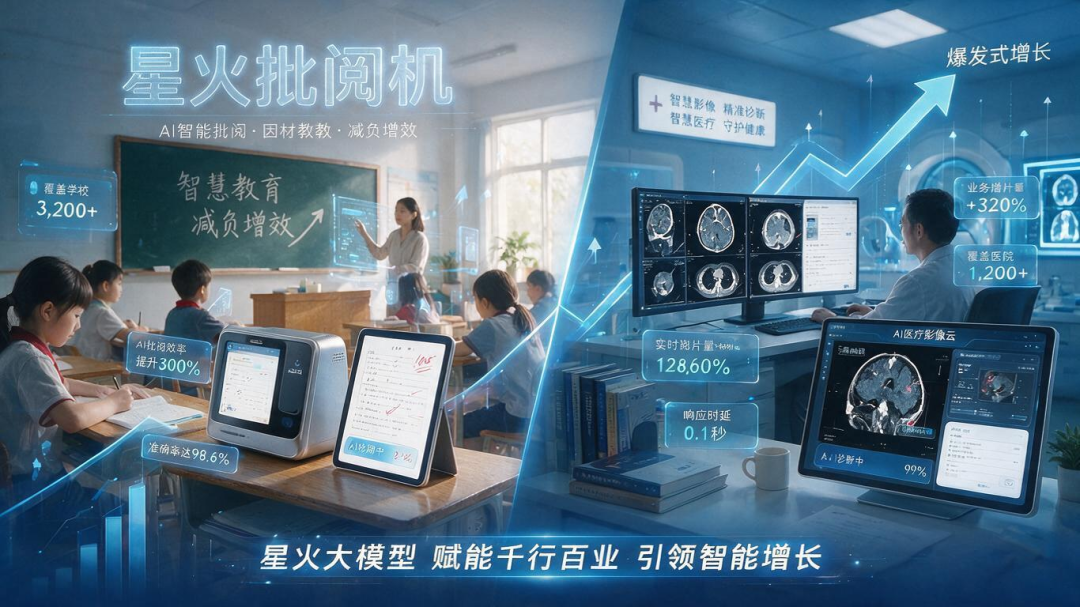
- Education: Sales of the Spark Grading System surged 1,471% year-on-year;
- Healthcare: Spark Medical Imaging Cloud revenue exceeded RMB 100 million in the first half, up 158% year-on-year.
Let's first examine the education sector. As iFLYTEK's foundational market for over a decade, smart education has consistently been its highest-margin and most competitive business segment. Previously, the company's education products focused on hardware like smart classrooms and AI blackboards. The explosive growth of the Spark Grading System marks a qualitative breakthrough, as it officially enters the core teaching process of 'subjective question grading' from merely 'assisting teaching.'
The Spark Grading System is iFLYTEK's 'ace product' in education AI, leveraging its proprietary Spark large model to solve teachers' most vexing problems:
- Step-by-step grading of subjective questions with standardized scoring;
- Precise diagnosis of error causes, generating personalized error analysis and learning recommendations for students;
- A single machine replaces dozens of hours of manual labor, significantly reducing teachers' workloads.
For schools, it enhances teaching efficiency while aligning with education digitalization policies, making it a willing purchase.
The 1,471% sales surge, though striking, is a natural outcome:
- After years of piloting, schools and teachers have shifted from 'experimenting' with AI education products to 'relying' on them;
- High product standardization enables rapid, large-scale deployment, breaking free from traditional project-based limitations.
In the future, such standardized AI education products will become iFLYTEK's core profit driver.
Medical AI is widely regarded as a 'tough nut to crack': high technical barriers, strict regulatory oversight, and difficult commercialization have left many companies investing for years with little to show. However, iFLYTEK has finally cracked this code through years of technical accumulation and scenario deep cultivation (shēn gēng, deep cultivation), achieving a breakthrough in medical AI profitability.
In the first half, Spark Medical Imaging Cloud revenue exceeded RMB 100 million, up 158% year-on-year, marking a transition from 'technical piloting' to 'sustainable paid operations.'
Spark Medical Imaging Cloud addresses pain points in primary healthcare institutions: doctor shortages, equipment deficits, and weak diagnostic capabilities. Leveraging the Spark Medical large model, it enables:
- Intelligent image reading for rapid lesion identification;
- Remote diagnostics, bringing quality healthcare resources to primary patients;
- Inter-hospital result recognition to reduce redundant examinations.
The platform now serves nearly 2,000 medical institutions, accumulating over 100 million medical imaging records, creating a virtuous cycle of 'data-model-scenario.' Critically, the healthcare sector features strong policy barriers and long-term repurchase attributes, making it difficult to dislodge once advantages are established.
The explosive growth in these two sectors reflects iFLYTEK's clear core logic: avoiding the 'parameter race' of general-purpose large models and instead focusing on vertical scenarios like education and healthcare, using proprietary technologies to solve real industry pain points.
This 'technology + scenario' dual-drive model avoids wasted R&D investments and differentiates iFLYTEK from other AI companies.
03 A Technological Development Perspective: Not a 'Follower' but a 'Trendsetter'
From a technological development standpoint, iFLYTEK's choices align perfectly with the transformation trend in China's AI industry—shifting from 'following trends' to 'deepening core technologies and focusing on scenario-based implementation.'
China's AI industry is at a critical reshuffling phase. Many companies are obsessed with the 'hype race' around general-purpose large models, blindly chasing parameters and attention while neglecting technology implementation and commercialization. This leads to a vicious cycle of 'burning money-losing money-burning more money,' making sustainable development elusive.
iFLYTEK's approach is more pragmatic:
- Strengthening foundational capabilities by launching the Spark X2-Flash large model based on domestic chips, reducing reliance on overseas computing power;
- Adhering to 'full-stack self-research,' which, in the context of AI supply chain localization, is both a core competitive edge and key to China's AI autonomy.
More importantly, iFLYTEK avoids 'ivory tower' R&D; all technologies are grounded in real scenarios:
- Education: Solving teachers' grading challenges to enhance teaching quality;
- Healthcare: Addressing primary healthcare gaps to benefit more patients.
This closed-loop model of 'technology serving scenarios and scenarios feeding back into technology' ensures that every yuan of R&D investment translates into tangible business growth—the core path for tech companies to achieve long-term development.
The industry's endgame is clear: AI will not be monopolized by a single general-purpose model; vertical industry-specific AI will dominate.
Vertical sectors like education, healthcare, and government services represent multi-trillion-yuan markets with strong demand. iFLYTEK's early Layout (bù jú, Layout , strategic Layout ) and deep cultivation position it to capture exclusive (dú jiā, exclusive) advantages in these markets.
04 Objectively Assessing Challenges: Short-Term Investments Come at a Cost, Long-Term Implementation Delivers Value
Of course, we must also recognize that iFLYTEK faces significant challenges beyond mere 'growing pains,' with risks already evident and likely to persist in the short term. Both the positives and negatives must be thoroughly examined: 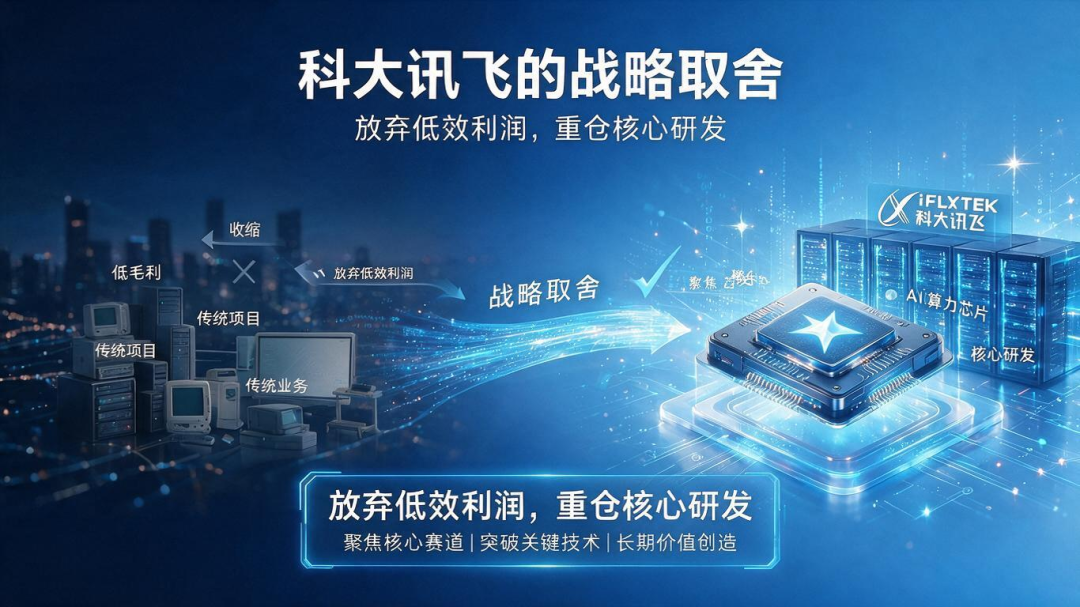
- High R&D spending and uncertain profitability inflection: First-half R&D exceeded RMB 2.8 billion, accounting for over 20% of revenue, a level unlikely to change soon. The AI industry's rapid technological iteration and high costs for computing power and top talent mean that if core sectors like education and healthcare do not scale as expected, R&D investments may not quickly convert to revenue and profits, delaying the profitability inflection point or even widening losses.
- Intensifying competition and margin pressure: Education and healthcare, iFLYTEK's two core sectors, have become battlegrounds for internet giants and AI startups. Internet giants leverage their traffic and capital to offer low-cost or even free AI products, while niche startups target specific scenarios with precision products, diverting customers. Meanwhile, the price war among general-purpose large models directly compresses margins for iFLYTEK's cloud services and model subscriptions, with significant downward pressure on future gross margins.
- G-end business adjustment pains and Transformation (zhuǎn xíng, transformation) uncertainty: Despite proactively contracting low-margin, long-payment-term G-end projects, these remain a significant revenue component, and core benchmark projects are vulnerable to local fiscal budget fluctuations. With local fiscal pressures unresolved, digital procurement budgets may shrink or delay, destabilizing G-end order releases. Additionally, the transition from G-end project-based to 'benchmark project + standardized product' models requires longer-term validation, with risks of revenue gaps if transformations underperform.
- Sustainability of core product growth: The Spark Grading System's 1,471% year-on-year growth, while impressive, stems mainly from a low base and is concentrated in pilot regions and key schools. As market penetration increases, growth will inevitably slow. Without rapid product iterations and new scenario expansions, education hardware may hit a growth plateau. The same applies to medical imaging cloud services, which currently serve primarily primary institutions with limited payment capacity. Without breakthroughs in high-end hospital markets, revenue growth will be constrained.
However, these risks are not insurmountable. In the long run, iFLYTEK's core growth logic remains clear, with both positive drivers and risks:
- Strong demand in core sectors: Education digitalization and smart healthcare are national long-term strategic areas with robust policy support and stable market demand, poised for high growth over the next decade, largely immune to economic cycles.
- Completed business model transformation: Shifting from traditional customized projects to scalable models like standardized products, cloud services, and model subscriptions will reduce unit costs and gradually repair gross and net margins as scale effects kick in.
- Improving cash flow: Hundred-billion-yuan collection scale and 27% contract growth provide ample operating cash flow, reducing reliance on external financing and enhancing operational autonomy.
- Localization dividends: In data-sensitive sectors like government, healthcare, and education, where overseas large models face access restrictions, fully autonomous domestic large models enjoy exclusive growth windows, with orders concentrating among leading self-developed vendors.
05 Conclusion: Not Bound by Short-Term Gains and Losses, but Focused on Long-Term Stability
Finally, let's address a practical point: Capital markets are often swayed by short-term gains and losses, hastily turning bearish at 'losses' and bullish at 'profits.' Such judgments are one-sided.
For tech companies, especially AI firms in a transformative phase, short-term gains and losses are never the core metric. The focus should be on three points:
- Whether there are robust technical barriers;
- Whether the business structure is optimizing;
- Whether scenario implementation capabilities are strong, indicating long-term growth potential.
Returning to iFLYTEK, the first-half anticipated loss reflects both a strategic choice of proactive trade-offs and the realities of a transformational phase. The RMB 2.8 billion in R&D investments provide technical barrier but also sustained profit pressure. The explosive growth in education and healthcare validates the strategy but also faces challenges of slowing growth and intensifying competition. This mix of positives and negatives represents the most authentic and objective operational state of China's leading AI company.
At this critical juncture, as China's AI industry transitions from 'technological breakthroughs' to 'scalable implementation,' iFLYTEK's resolve to 'not be swayed by short-term gains and losses and remain focused on core sectors' is commendable, though risks must be monitored. Moving forward, three core questions must be addressed: balancing R&D investment with short-term profitability, defending core advantages amid fierce competition, and accelerating business transformation.
For iFLYTEK, every yuan invested today is building industry influence for the next decade. For us, patience and rationality are needed to see beyond profit and loss data and grasp the strategic logic behind the company to truly understand the development path of China's AI enterprises. 
Remember: True tech companies never win the future through short-term profits but through core technologies and long-term Layout (bù jú, strategic Layout ), securing their foothold and gaining an edge amid industry transformations.
This article is for objective industry analysis only and does not constitute investment advice.
Discussion Topic: How soon do you think Chinese AI companies can achieve full profitability? Between education and healthcare, which sector has more potential to lead AI commercialization? Share your thoughts in the comments!
-
![]()
A Trillion Dollars Poured into AI: Only These Three Types of Companies Are Truly Profiting
-
![]()
Differentiation and Acceleration in Banking AI Implementation
-
![]()
Year’s First Half Sees Nearly 1.81 Million Vehicles Sold, with Exports Contributing Over 40%: How Will BYD Steer Through the Second Half Amidst a Price War?
-
![]()
Chuenergy’s Maiden ET Vehicle Rolls Off Line at SAIC-GM Wuhan South Plant, Poised to Rival AITO M5
-
![]()
StepOn’s AI Terminal: A Tale of Unveiled Potential
-
![]()
StepOn’s AI Terminal: Only Part of the Picture Unveiled
-
![]()
The Tale of Rapid Iteration: Even Elite Students in the Auto Industry Struggle to Keep Pace
-
![]()
Seventy Years On: From China’s First Car to a Pivotal Moment in Automotive Excellence