Step's Apple Dream
 07/15 2026
 440
440
Produced by I Xiahai Fallsea
Written by I Hu Buzhi
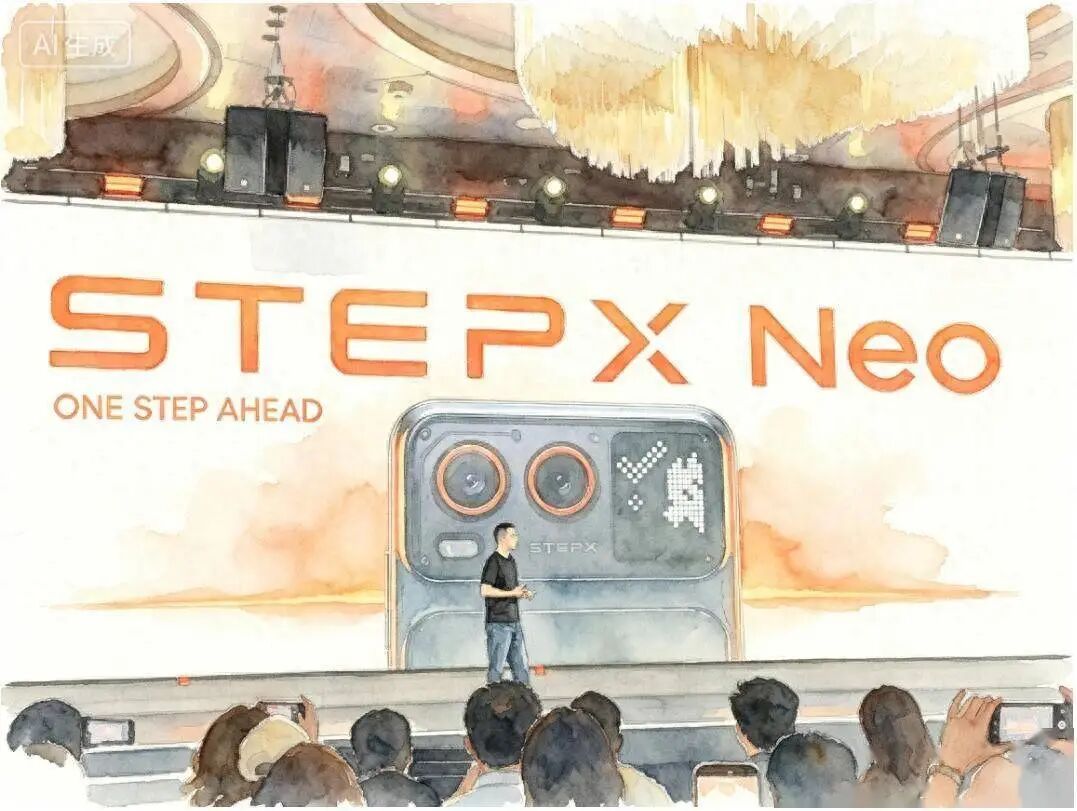
On the evening of July 13th in Shanghai, on the eve of the World Artificial Intelligence Conference, Step AI unveiled three trump cards in one go. They are the original AI terminal brand STEPX, the original agent-based operating system Step AOS, and the world's first original large model-based agent smartphone STEPX Neo.
In 2026, when the AI industry is generally pursuing lightweight solutions and large model companies are laying off employees to survive, this launch event seems extremely out of place. While peers are struggling to integrate large models into various wrapper applications or engaging in price wars over API calls worth a few cents, Step AI has chosen to cross over into the smartphone market—a red ocean with the most complex supply chain management and the highest capital requirements.
This is not just a simple product launch. After the brutal shakeout of the hundred-model battle and computational power arms race, this is a final survival declaration from China's AI large model companies to the capital markets and the entire industry.
The ambition of Step AI's Chairman Yin Qi and CEO Jiang Daxin is to replicate Steve Jobs' Apple legend in the agent era. Only by controlling terminal access and operating systems can AI companies avoid becoming cheap underlying pipelines and seize the maximum commercial profits.
Step's Apple dream represents a tragic yet bold breakthrough for Chinese AI companies unwilling to remain mere water sellers. It reveals the ultimate power rule of the AI era: whoever controls hardware access and operating systems holds the power of life and death over agents. However, the cost of this high-stakes gamble is that Step must simultaneously wage two ecological wars with little chance of victory against smartphone giants and super apps.
Rooting Downwards
To analyze Step's underlying motivation for making smartphones, we must first understand the life-and-death dilemma faced by large model companies. Their decision to engage in the arduous task of making smartphones is not because they excel in hardware but because the business logic of selling interfaces and creating wrapper applications has been mercilessly shattered by reality.
Over the past year, domestic large model API prices have plummeted by over 90%. Revenue from simply selling computational power or interfaces cannot cover the hundreds of millions of dollars in research and development costs for foundational models. Whether it's Kimi or Zhipu Qingyan, all consumer-facing wrapper applications face extremely high customer acquisition costs and very low user retention. AI applications lack true moats and are vulnerable to dimensionality reduction attacks from system-level features of large companies at any time.
A deeper fear lies in being reduced to mere pipelines. If large models remain confined to the cloud, they will inevitably be integrated as underlying capabilities by smartphone manufacturers like Huawei, Xiaomi, and Apple into their own operating systems. By then, AI companies will completely lose pricing power and become cheap backend technology suppliers. When API prices drop to rock bottom, large model companies will suddenly realize that only by putting AI into users' pockets and controlling that screen can they truly generate revenue.
This is the fundamental reason why Step AI is willing to pay any price to root downwards.
Capital patience is also forcing this strategic upgrade. In January 2026, Step AI completed a Series B+ financing round exceeding 5 billion yuan, with participants including industrial investors such as Shanghai Guotou Pioneer Fund, China Life Equity, Pudong Venture Capital, Xuhui Capital, Wuxi Liangxi Fund, Xiamen International Trade, and Huaqin Technology, as well as existing shareholders like Tencent, Qiming, and Wuyuan. This deal set a new record for the highest single financing amount in China's large model sector over the past twelve months.
Just four months later, Step completed a nearly US$2.5 billion Pre-IPO financing round. Combined, Step AI's total financing for the year has exceeded 20 billion yuan.
According to multiple financial media reports in May, Step AI has dismantled its red chip structure and is preparing to submit an IPO application to the Hong Kong Stock Exchange. Hong Kong Investment Management Corporation has also made a strategic equity investment to endorse its Hong Kong listing.
To support a valuation of tens of billions of US dollars on the Hong Kong stock market, a vague AGI vision alone is far from enough. The capital markets need to see a defined commercial closed loop (closed loop). The trinity strategy of models + systems + hardware is Step's most hardcore growth story prepared for the IPO. They aim to prove to investors that Step is not just selling water—it wants to build its own water plant and monopolize the tap.
Ecological Shadow War
For agents to truly function, they must break through data silos and permission barriers between applications. Step AOS attempts to be the barrier breaker, but this directly threatens the core interests of mobile internet giants.
At the July 13th launch event, Step AI announced AI deep collaborations with ecosystem partners such as Ctrip, Alipay, Didi, Meituan, and Baidu. This list is impressive but also hides a hidden agenda.
As of press time, Step has not detailed the specific interface openness levels with these super apps. However, referring to the ten-year ecological competition history of the mobile internet, system-level takeover of core transaction links has always been an absolute no-go zone for giants. Super apps will never easily open core interfaces such as payment links, social relationship chains, or order data to third-party operating systems.
Step AOS claims to execute complex tasks across applications, such as having the built-in personal agent Amoo automatically book flights, hail rides, and arrange itineraries for users. Technically, this often requires simulated clicks or screen reading, which can easily be seen as hacking or traffic hijacking by super apps and lead to bans.
Step's attempt to use an agent operating system to pry open the backdoors of super apps echoes the most irreconcilable wars between smartphone manufacturers and Tencent/Alibaba in the mobile internet era.
It is foreseeable that once STEPX smartphones are truly mass-produced and launched, Step AOS will encounter countless covert battles of interface changes, permission revocations, and even direct bans when calling these national-level applications. The cruelty of this ecological competition will far exceed parameter benchmarking of large models in laboratories.
Hardware Curse
Apple's myth of integrated hardware and software is built on extremely high hardware profit margins, a closed ecosystem, and decades of supply chain dominance. As a pure software and AI company, Step lacks hardware DNA and is bound to face a massive hardware curse.
Making smartphones is an extremely brutal business. It requires enormous capital upfront, complex inventory management, and stringent quality control. Developing AI large models burns money; making smartphones burns lives.
From the July 13th launch event, STEPX Neo is still in the concept-first stage. As 36Kr and other tech media pointed out in post-event comments, this is still a fully outsourced prototype that has not yet entered mass production. Step AI remains tight-lipped about specific hardware configurations, BOM costs, pricing strategies, and release dates.
This concept-first approach can certainly raise market expectations but also exposes Step's caution on the eve of hardware mass production. If it remains just a toy for geeks, it will fail to achieve scale effects and thus cannot generate sufficient data to feed back into large model training.
However, is Step truly unprepared for the hardware quagmire?
Digging into its financing history reveals an astonishing supply chain trump card. Among the investors in Step AI's nearly US$2.5 billion Pre-IPO financing round completed in May, prominent names include Huaqin Technology, Longcheer Technology, OmniVision Group, and ZTE.
Huaqin and Longcheer are the world's two largest smartphone ODM manufacturers, OmniVision is a top-tier image sensor supplier, and ZTE is a telecommunications equipment giant. This means Step AI is not starting from scratch in hardware manufacturing but has directly bound China's top smartphone supply chain into its own community of shared interests (community of shared interests) through capital ties.
This tactic of exchanging equity for supply chain capacity and bargaining power greatly reduces the mortality rate of Step's cross-border smartphone venture. It doesn't need to monitor assembly lines in Dongguan factories personally—Huaqin and Longcheer will go all out to ensure mass production and quality control of STEPX Neo for their own invested ecological niche.
An even more fatal (fatal) external threat is that smartphone giants have woken up. Just as Step unveiled STEPX Neo, ZTE's Nubia brand confirmed that its new AI agent smartphone would make its debut at the World Artificial Intelligence Conference opening on July 17th. Catalyzed by this news, Nubia's parent company's stock price surged 9.38% on July 9th with significantly increased trading volume.
When traditional smartphone giants with mature supply chains, vast channel networks, and abundant cash flows fully embrace agents, Step's survival space as a cross-border intruder will be severely squeezed.
Final Outcome Speculation
At the poker table of the agent era, there is no middle ground. Either become an Apple controlling access points or become an integrated pipeline. Step has chosen the hardest path, and its outcome will provide a highly valuable stress test sample for China's AI industry.
We can speculate three possible endings for Step AI.
The first is a pessimistic outcome. STEPX smartphones become a niche geek brand due to high pricing or poor experience. High hardware R&D and marketing costs drain the company's cash flow. Ultimately, under pressure to redeem debts or from investors, Step is acquired at a low price by traditional smartphone giants like Xiaomi, Oppo, or Vivo and becomes their AI R&D department.
The second is a compromising outcome. After hitting walls with its own hardware, Step resolute (decisively) abandons smartphone manufacturing, white-labels Step AOS, and licenses it to second- and third-tier smartphone manufacturers, IoT device makers, or even smart home companies. Step retreats to its strongest areas—model and system layers—becoming the Android of the AI era and earning stable profits through massive terminal licensing fees and cloud API calls. This may be the most commercially rational retreat.
The third is an optimistic outcome. STEPX Neo becomes an instant hit with its disruptive agent experience, and Step AOS successfully tears open the ecological iron curtain of super apps. Step truly achieves the flywheel effect of models, software, and hardware, becoming the new Apple of the AI era. The probability is extremely low, but if successful, it will give birth to a trillion-dollar great company.
For Step AI, which is about to impact ( impact means " impact the Hong Kong stock market" or "make a push for" in this context) the Hong Kong stock market, how capital markets value a company combining large models with hardware is a huge point of contention. Secondary market tech analysts may argue that hardware business will drag down the gross profit margins of large model companies, making it a negative factor. However, in the eyes of primary market hard tech investors, AI companies controlling physical access points possess true monopoly potential.
Conclusion:
Step AI's high-stakes gamble is deeply imprinted with the personal styles of its core management.
Chairman Yin Qi is a serial entrepreneur with a strong hardware obsession. From Megvii's AI cameras to Qianli Technology's smart cars, and now Step's agent smartphones, Yin has always believed that AI's ultimate value must bloom on terminal devices in the physical world. His joining has injected much-needed hardware manufacturing and supply chain management experience into Step.
CEO Jiang Daxin represents pure software and large model ambitions. From Microsoft Research Asia to founding Step AI, Jiang's team has maintained extremely high technical standards in foundational model R&D. The Step 3.5 Flash model released in February this year, with 196 billion total parameters and extremely fast reasoning speed, demonstrated strong capabilities in code generation and mathematical reasoning scenarios.
Yin's hardware obsession and Jiang's software ambitions constitute the core driving forces of Step AI. Whether this duo can create miracles in the smartphone red ocean surrounded by strong enemies is a suspense (cliffhanger) that the entire tech circle is eagerly awaiting.
Whether STEPX ultimately becomes a groundbreaking new species or a lesson for the capital markets, Step AI's attempt has thoroughly (completely) torn apart the genteel facade of China's AI industry.
It tells everyone that in the brutal jungle on the path to AGI, no one can live a stable life by selling water. To avoid being left behind by the times, one must personally enter the fray and compete for that screen leading to the future.
The old mobile internet pattern (landscape) has solidified, and the new agent war has just begun. Step AI has bet all its chips—now, the roulette wheel is spinning.
-
Why Can''t AutoNavi Maps Excel in Local Services?
-
![]()
Cameras: A New Frontier in Smart Hardware at More Affordable Prices
-
Raising Nearly US$400 Million in Intensive Financing Over Six Months: Can This New Heavy Truck Player Pioneer a New Model for Autonomous Heavy Trucks?
-
![]()
Memory Chip Price Surge Imposes Heavy Burden on Smartphone Market, with Q2 Global Shipments Slumping to 13-Year Low
-
![]()
Tencent’s Acquisition of Manus: No Less Anxious Than Meta
-
![]()
Collective Failure of BBA, Only '56E' Holding On
-
![]()
Step's Apple Dream
-
![]()
The value of AI Coding is quietly shifting from 'whose model is stronger' to 'whose toolchain is denser'.