High-Profile Corporate Feud! Apple Sues OpenAI
 07/15 2026
 546
546
On July 10, Apple initiated legal proceedings by filing a lawsuit in the U.S. District Court for the Northern District of California. The defendants in this case include OpenAI, the OpenAI Foundation, OpenAI Benefit Corporation, and OpenAI's hardware subsidiary ioProducts. The latter was acquired by OpenAI in May 2025, with an estimated valuation of $6.5 billion, approximately $5 billion of which was for the remaining equity. Additionally, two former Apple executives, Tang Tan and Chang Liu, are also named in the lawsuit.

Apple's allegations are grave: it accuses OpenAI of systematically pilfering Apple's trade secrets to bolster its own hardware business.
The 41-page complaint unveils several key details. Tang Tan, the former Vice President of Apple Product Design, is accused of divulging supplier information to OpenAI while still under Apple's employment. After his departure, he allegedly coaxed job candidates into bringing prototype machines, CAD drawings, and supply chain secrets to interviews. Chang Liu, a former Senior Systems Electrical Engineer at Apple, is accused of refusing to return his laptop upon resigning in January 2026, exploiting system vulnerabilities to illegally access Apple's internal network, and downloading engineering files for unreleased products in bulk.
The complaint also underscores that over 400 former Apple employees have now joined OpenAI.
Just 14 months prior, at WWDC 2024, Apple CEO Tim Cook hailed OpenAI CEO Sam Altman as a 'pioneer and market leader' and announced the integration of ChatGPT into the iPhone.
Notably, in this initial collaboration, Apple did not compensate OpenAI with cash but adopted a 'distribution for exposure' model. Under this arrangement, ChatGPT was offered for free on Apple devices, and Apple would earn a commission through the App Store if users subscribed to ChatGPT Pro. OpenAI had hoped to significantly boost its paid user conversion rate through this partnership, but the actual results fell short of expectations.
Now, the two companies have transitioned from 'partners' to 'courtroom adversaries.'
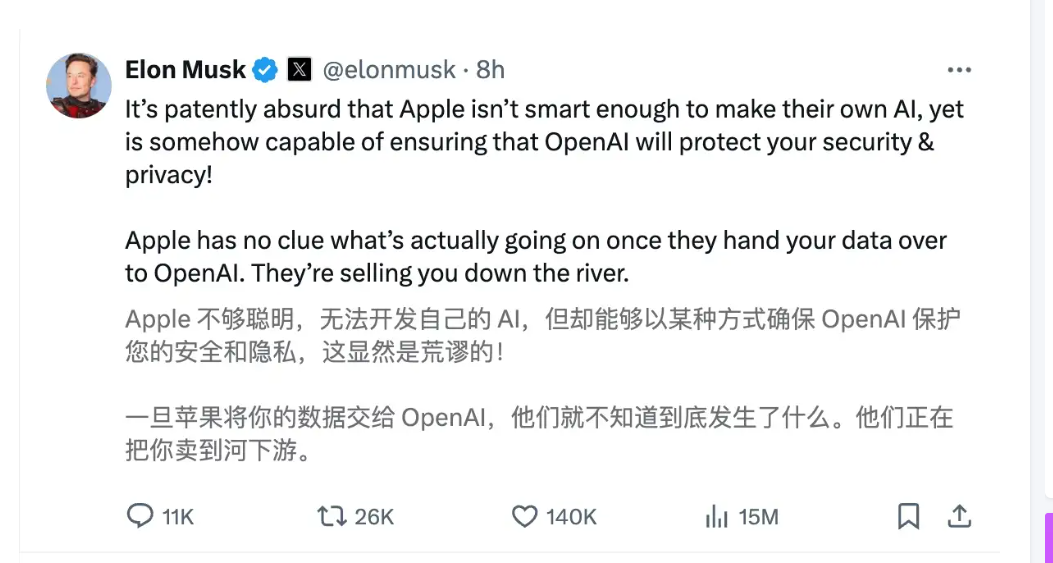
Ironically, during their collaboration, Elon Musk accurately 'predicted' that OpenAI would steal Apple's data.
1. The End of the Cook Era
In my opinion, the primary reason for this legal battle is that Cook's key lieutenants chose to pursue their own paths upon his retirement.
Tang Tan, a 24-year Apple veteran and former Vice President of Product Design, was instrumental in designing major hardware products such as the iPhone, Apple Watch, and AirPods. Apple's complaint alleges that he possessed 'top-level project, supply chain, and manufacturing process secrets.'
After leaving Apple, Tang Tan co-founded io Products, which was later acquired by OpenAI in May 2025 for an estimated valuation of $6.5 billion, including approximately $5 billion for the remaining equity. He subsequently became OpenAI's Chief Hardware Officer.
Apple accuses him of leaking supplier information to OpenAI while still employed and, after his departure, inducing job candidates to bring prototype machines, CAD drawings, and supply chain secrets to interviews. He is also accused of coaching departing employees on how to evade Apple's security reviews.
Chang Liu is another pivotal figure in this saga.
He worked at Apple for eight years as a Senior Systems Electrical Engineer. After resigning in January 2026 to join OpenAI, Apple repeatedly requested that he complete the resignation handover, return equipment, and sign a confidentiality acknowledgment. However, he never responded to these requests.
Apple also accuses him of refusing to return his computer after leaving, exploiting vulnerabilities to illegally access the internal network, downloading engineering files for unreleased products in bulk, and instructing current Apple employees to steal data.
The common thread between these two individuals is that they were both core figures in Apple's hardware ecosystem, both joined OpenAI in a short period, and both have been accused by Apple of stealing secrets.
The crux of the complaint is that OpenAI's hardware business is 'in its infancy' but is built on 'stolen trade secrets.' Apple is demanding that the court order OpenAI to immediately cease infringement, destroy all products using Apple's secrets, and redesign upcoming hardware to ensure it does not contain Apple technology.
This lawsuit is not just about trade secrets; it is also a direct counterattack by Apple against OpenAI's poaching of its employees.
The complaint explicitly states that OpenAI has poached more than 400 Apple employees. For a company renowned for its culture of secrecy, this number is sufficient to trigger its alarm systems.
2. Apple: Early to Rise but Late to the AI Race
The timing of this lawsuit is also delicate. OpenAI is preparing for its initial public offering, and Apple's lawsuit is akin to pouring cold water on OpenAI's credibility at this critical juncture. Additionally, OpenAI's hardware ambitions, combined with Jony Ive's involvement, are forcing the market to reassess who this AI company's true competitors are. Apple's lawsuit is both a counterattack against infringement and a market statement.
The last significant move Steve Jobs made before his death was acquiring Siri. Unfortunately, Cook failed to build on this legacy. Siri was released alongside the iPhone 4S in 2011 and was one of the most advanced personal voice assistants in the industry at the time. However, over the next decade-plus, Siri's evolution lagged far behind the market.
Technologically, Siri has long relied on a 'command-control' architecture rather than a generative AI model based on large language models. This is akin to an athlete who has learned fixed routines—Siri can only answer preset questions and cannot engage in continuous dialogue or open-ended conversations.
Former Apple engineers describe Siri's codebase as 'vast and clunky,' where adding a simple feature might require restructuring the entire database and take up to six weeks; complex updates could even take a year. Under this architecture, Siri struggles to understand context and complete complex tasks like ChatGPT.
In terms of user experience, Siri has long been ridiculed as 'artificially stupid.' The old version of Siri could not handle complex instructions or continuous dialogue, forcing users to simplify their speech deliberately. Its Chinese recognition accuracy was low, it could barely understand dialects, and it often gave irrelevant responses to everyday colloquial commands. Surveys even show that some users wake Siri less than three times a month.
This is not just a technological gap but also a lack of strategic iteration. While Amazon's Alexa, Google's Google Assistant, and domestic voice assistants like Xiaomi's Xiao Ai and Huawei's Xiaoyi continued to evolve, Siri's capabilities seemed stuck at checking the weather, setting alarms, and turning lights on and off.
Why didn't Apple develop its own large language model sooner? The core reason lies in Apple's organizational DNA. Apple has always been a 'product-driven' company, with technological research often serving specific products rather than pursuing breakthroughs in foundational technologies. Model training requires massive computational power, data, and talent investment, areas where Apple has been relatively slow to deploy.
After launching the Apple Intelligence platform, Apple hoped to compensate for its shortcomings by leveraging external large models. However, this created a contradiction: Apple wants Siri to be more intelligent but also does not want to rely too heavily on third-party technology.
At WWDC 2026 in June, Apple introduced 'Siri AI,' claiming that the new version of Siri has moved beyond simple answers to support multi-turn continuous dialogue, context memory, cross-app interaction, and screen awareness. But by this point, more than three years had passed since ChatGPT's debut.
While suing OpenAI, Apple also replaced OpenAI with Google Gemini as the foundation for the new Siri, marking both a technical realignment and a nimble statement.
3. Cook's Final Dance
Apple's financial results for the second quarter of fiscal year 2026 (ending March 28, 2026) appear impressive on the surface.
The company reported revenue of $111.2 billion, up 17% year-over-year, setting a new record for the March quarter. Diluted earnings per share were $2.01, up 22% year-over-year. Operating cash flow exceeded $28 billion.
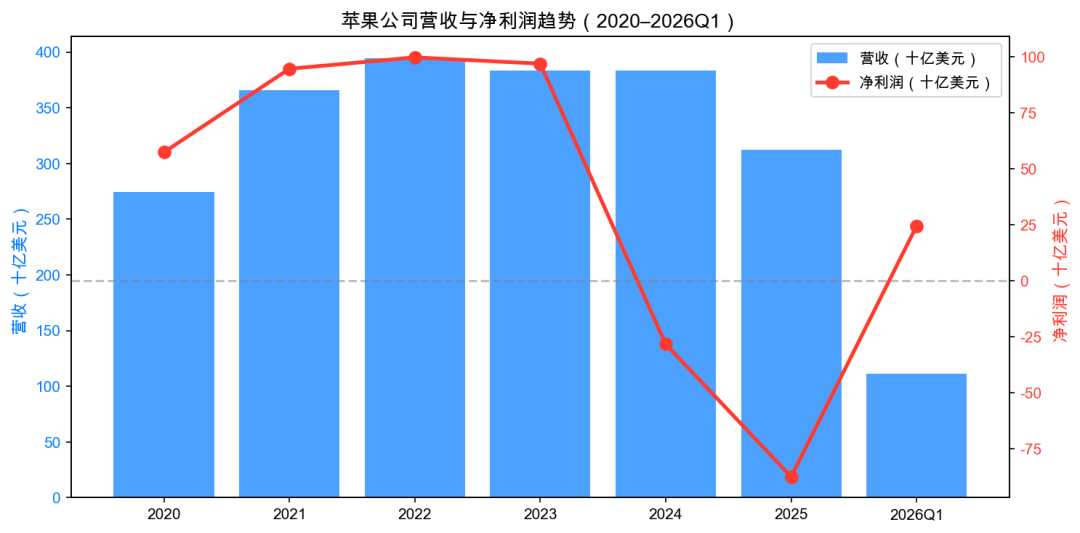
All major business segments achieved double-digit growth. iPhone revenue set a March quarter record; services revenue reached a new all-time high; and product lines like Mac and iPad also performed strongly. The launch of the iPhone 17 series and iPhone 17e drove upgrade demand. The iPad Air and MacBook Neo, powered by the M4 chip, expanded the high-end product lineup.
The sustained growth of the services business is particularly noteworthy. Apple's services revenue now includes App Store commissions, iCloud storage, Apple Music, Apple TV+, Apple Pay, and more, all of which have significantly higher gross margins than hardware. Services revenue's share of total revenue continues to rise, helping Apple maintain stable overall gross margins amid hardware sales fluctuations. However, services growth also depends on the hardware installed base and user engagement—if iPhone sales slow, the services business will face growth pressure.
Geographically, China showed a strong rebound. Revenue in the Chinese market grew 28% year-over-year this quarter, reaching approximately $21 billion, making it one of the brightest spots in the financial results.
-END-
Disclaimer: This article is based on the public company attributes of listed companies and relies primarily on information disclosed by the companies in accordance with their legal obligations (including but not limited to interim announcements, periodic reports, and official interaction platforms) as the core basis for analysis and research. Shiyu Xingkong strives to ensure the fairness of the content and views presented in the article but does not guarantee its accuracy, completeness, or timeliness. The information or opinions expressed in this article do not constitute any investment advice, and Shiyu Xingkong assumes no responsibility for any actions taken based on this article. Copyright Notice: The content of this article is original to Shiyu Xingkong and may not be reproduced without authorization.
-
Why Can''t AutoNavi Maps Excel in Local Services?
-
![]()
Cameras: A New Frontier in Smart Hardware at More Affordable Prices
-
Raising Nearly US$400 Million in Intensive Financing Over Six Months: Can This New Heavy Truck Player Pioneer a New Model for Autonomous Heavy Trucks?
-
![]()
Memory Chip Price Surge Imposes Heavy Burden on Smartphone Market, with Q2 Global Shipments Slumping to 13-Year Low
-
![]()
Tencent’s Acquisition of Manus: No Less Anxious Than Meta
-
![]()
Collective Failure of BBA, Only '56E' Holding On
-
![]()
Step's Apple Dream
-
![]()
The value of AI Coding is quietly shifting from 'whose model is stronger' to 'whose toolchain is denser'.