DeepSeek May Launch IPO as Early as This Year Amid 'Insatiable Demand for Computing Power'
 07/16 2026
 339
339
[HK Stock Value Line] On July 14, foreign media, citing informed sources, reported that DeepSeek has initiated preparations for an initial public offering (IPO), with plans to list on the Chinese mainland. The company may submit its application as early as this year, aiming to complete the listing by 2027. It is understood that DeepSeek is working with accounting firms to finalize its financial reports by the end of December 2026.
This year, leading large-scale AI model companies are stepping up their financing efforts to gain a competitive edge in the market.
01 DeepSeek Steps Up Financing to Secure Computing Power
In early June, DeepSeek reportedly secured over RMB 50 billion in financing, setting a record for the first round of funding among Chinese tech startups.
Prior to this, DeepSeek had relied solely on funding from High-Flyer Quantitative for its research and development. May 2026 marked its first foray into external capital.
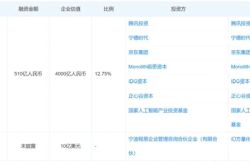
According to Jiemian News, which obtained information from investment institutions, in the first round of financing, Liang Wenfeng personally contributed approximately RMB 20 billion, making him the largest single investor. Tencent invested about RMB 10 billion, while the CATL ecosystem invested around RMB 5 billion. NetEase, JD.com, and IDG Capital each invested about RMB 3 billion, with the China National AI Industry Investment Fund contributing RMB 1 billion.
The Information reported that, except for the National AI Industry Investment Fund, funds from other external investors were channeled into a limited partnership managed by Liang Wenfeng, rather than directly into DeepSeek. These external investors enjoy economic benefits and financial transparency but have no voting rights, and their shares are subject to a five-year lock-up period.
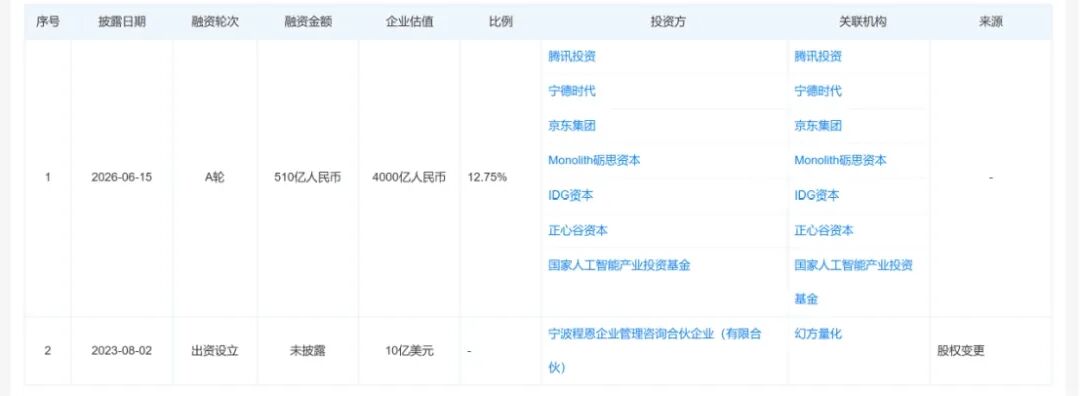
Image sourced from Tianyancha
On the same day, British media reported that DeepSeek had begun preliminary discussions with new investors this week, planning to initiate a new round of financing before the IPO. The pre-investment valuation is approximately USD 71 billion (around RMB 481.39 billion), representing a roughly 37% increase from the valuation during the initial financing round in early June.
The CATL ecosystem's investment of RMB 5 billion makes it the most notable industrial capital in the first round, aside from Tencent.
The dual structure, where external funds are channeled into a limited partnership and the National Fund directly invests in the main company, ensures that while Liang Wenfeng has introduced external capital, legal arrangements guarantee that DeepSeek legally belongs only to Liang Wenfeng and the National Fund. External capital cannot influence the company's direction at shareholder meetings. Such an arrangement is extremely rare in the history of A-shares.
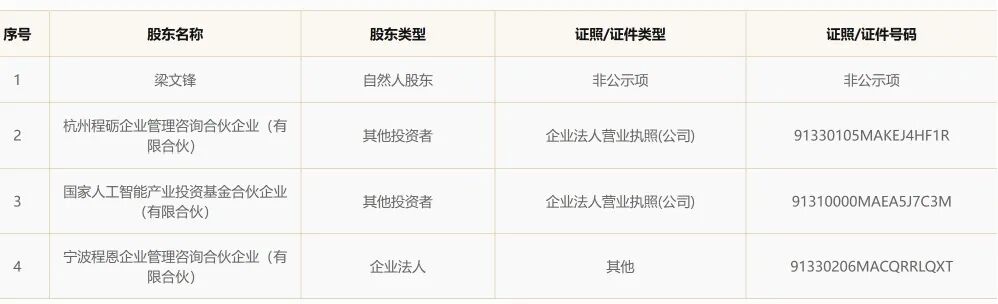
Image sourced from the National Enterprise Information System
Behind this intensive financing lies DeepSeek's insatiable demand for computing power.
According to foreign media reports, the new round of financing will primarily be used in three areas: building its own data centers, procuring more AI chips, and developing next-generation AI systems such as Agents.
Simultaneously, DeepSeek is also developing a proprietary chip dedicated to "AI inference," which refers to the process of using pre-trained models to generate responses to user queries.
The project was initiated about a year ago and is still in its early stages. DeepSeek has already engaged with chip design companies, wafer foundries, and memory suppliers.
Financing, self-developed chips, and data center construction represent DeepSeek's investments in "computing power."
On the "algorithm" front, DeepSeek is also making strategic moves. In a technical article, DeepSeek disclosed that if all tokens were priced according to DeepSeek R1, the theoretical total daily revenue could reach USD 562,027, with a cost-profit margin as high as 545%.
However, DeepSeek also clarified on its official account that actual revenue is far below this theoretical value. With lower pricing for V3, a significant amount of free services, and nighttime discounts, the comprehensive gross profit margin is only about 12%.
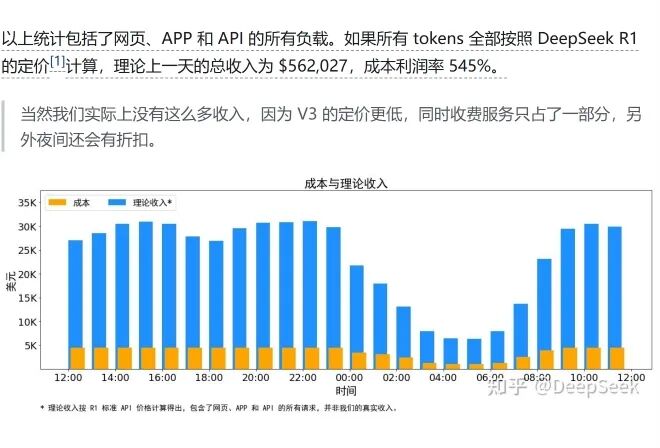 Image sourced from DeepSeek's official Zhihu account article
At the product level, DeepSeek's current core product is the DeepSeek-V4 series, released on April 24, 2026. The series includes two versions: the flagship V4-Pro and the cost-effective V4-Flash.
According to an independent evaluation by the U.S. AI Standards and Innovation Center (CAISI), DeepSeek V4 is the most capable Chinese AI model evaluated by CAISI to date, though it lags about eight months behind the most advanced U.S. models in capability.
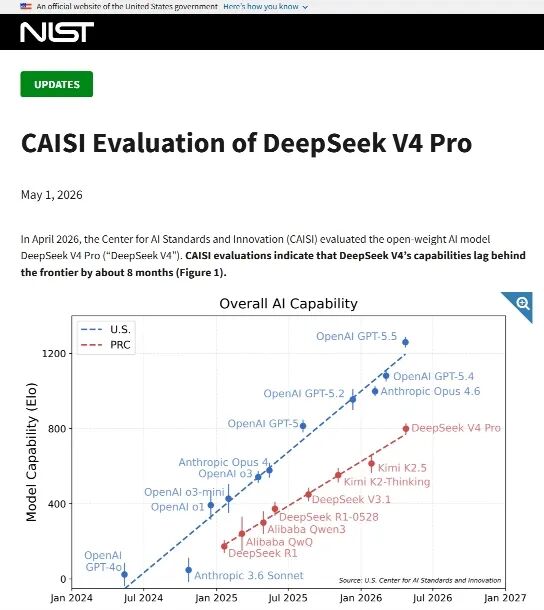
Image sourced from the official website of the U.S. National Institute of Standards and Technology (NIST)
In terms of cost efficiency, compared to the most cost-competitive U.S. reference model (GPT-5.4 mini), DeepSeek V4 offers cost advantages in five out of seven benchmark tests. Moreover, DeepSeek V4 Pro is priced at approximately one-twentieth of GPT-4o.
JPMorgan Chase describes the market landscape as follows: DeepSeek V4-Pro defines the low-cost frontier, Zhipu GLM-5.1 anchors the high-preference end, and MiniMax M2.7 sits in the middle.
When compared to competitors, in the HumanEval code generation test, DeepSeek-V4 Pro scored 90.8%, while GPT-4o scored 90.2%. On the AIME 2026 challenging math problems, V4 Pro achieved a near-perfect score of 99.4%.
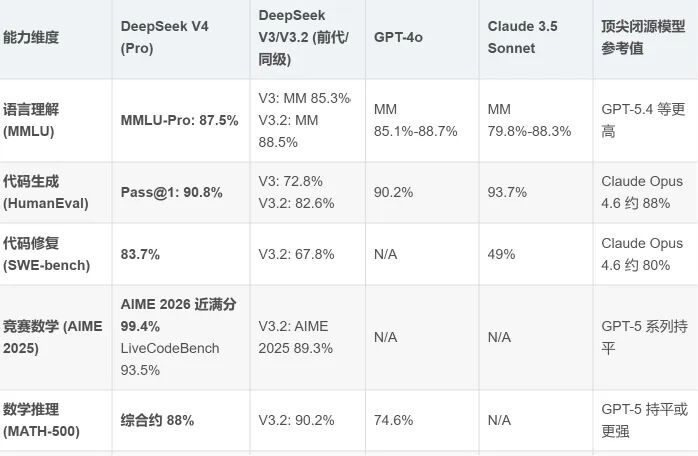
Image sourced from Shen Shan Technology Geek's personal CSDN blog
According to OpenRouter data, DeepSeek-V4-Flash has ranked first in global usage for seven consecutive weeks, with a weekly usage volume of 5.34 trillion tokens. Models under DeepSeek account for 18.5% of global total usage, ranking first globally for six consecutive weeks. From July 6 to 12, the top six models in global usage were all Chinese AI large models, with Chinese large models' weekly usage surpassing that of the U.S. for ten consecutive weeks.
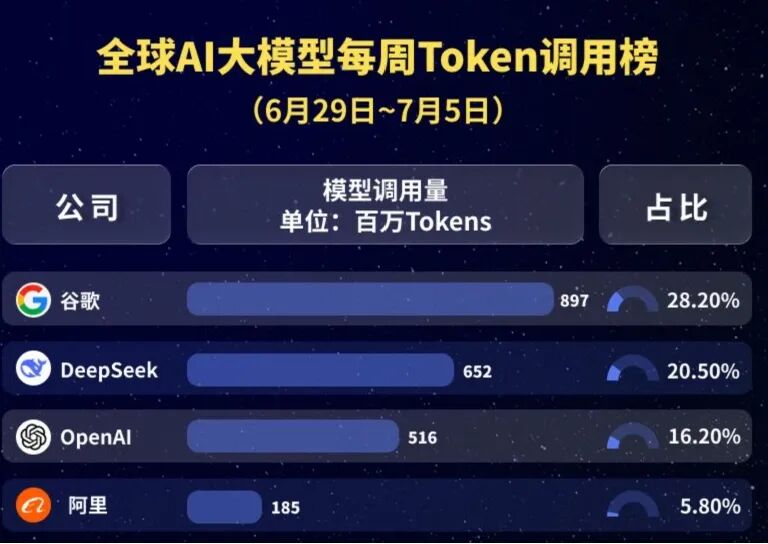
Image sourced from National Business Daily
At the product and market levels, DeepSeek has chosen not to compete with Zhipu and Yuezhi Anmian on price in high-end scenarios. Instead, it has adopted an extreme cost-effectiveness strategy to occupy a large-scale developer ecosystem.
02 Financing Acceleration Competition Begins in the Large Model Sector
DeepSeek is not the only company accelerating its financing efforts. In 2026, almost all leading Chinese AI companies are engaged in a financing arms race.
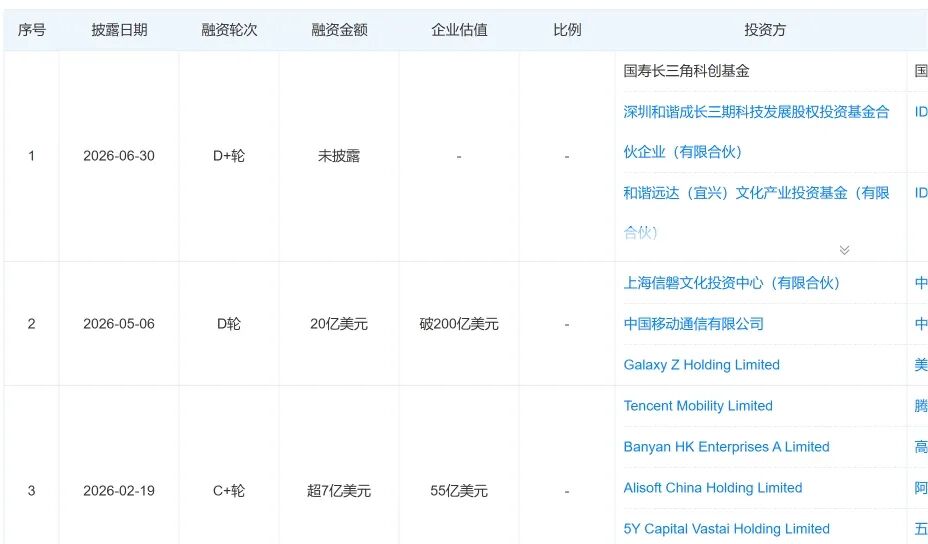
In the large model sector, Yuezhi Anmian (Kimi) completed four rounds of financing within the year, with the latest round amounting to USD 2 billion (approximately RMB 14 billion), pushing its post-investment valuation beyond USD 20 billion (approximately RMB 140 billion) and cumulative financing exceeding RMB 37.6 billion.
Screenshot information sourced from Tianyancha
Jieyue Xingchen completed a Pre-IPO round of financing worth RMB 2.5 billion on May 8. There are also reports that it is set to complete nearly USD 500 million in financing in July, having dismantled its red-chip structure and accelerating its plans for a Hong Kong IPO.
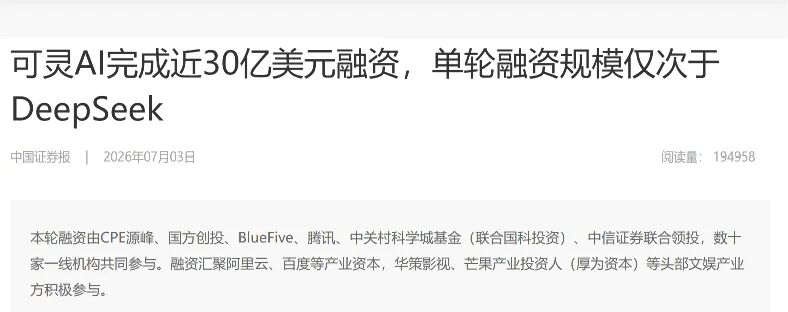
Financing has also spread to niche sectors. Kling AI, a video generation large model under Kuaishou, completed its first round of financing worth nearly USD 3 billion, with a post-investment valuation of USD 18 billion. This round of financing is second only to DeepSeek's initial round in scale, representing the second-largest single-round financing in China's AI sector in recent years. Investors include Tencent, Alibaba Cloud, and Baidu, which invested RMB 1.363 billion, RMB 1.363 billion, and RMB 341 million, respectively.
There are reports that Kuaishou plans to push for its independent IPO in the first quarter of 2027.
Zhipu AI (02513.HK) listed on the Hong Kong Stock Exchange on January 8, 2026, and announced on June 1 its intention to issue A-shares and list on the STAR Market, planning to raise no more than RMB 15 billion. On July 13, it completed the placement of new H-shares, raising approximately HKD 31.4 billion.
Large model companies are accelerating their race.
Source/HK Stock Value Line
-
![]()
Liu Qiangdong Gains Crucial Foothold as Tencent Forms Alliance to Counter ByteDance's Dominance
-
![]()
Physical AI Infrastructure Race: U.S. Firm General Intuition Trains Robots Using Game Footage, Reaches $2.3 Billion Valuation
-
![]()
DeepSeek May Launch IPO as Early as This Year Amid 'Insatiable Demand for Computing Power'
-
![]()
Huawei and Tesla Pioneer the Path! Modular Design Takes Center Stage, Electric Vehicles Bid Adieu to 'Instant Obsolescence'
-
![]()
Expected to Rake in a Staggering 24.4 Billion in the First Half of the Year: What Gives Foxconn Industrial Internet the Competitive Edge?
-
![]()
Tencent Invests 13.6 Billion to Become a 'Minority Shareholder': What Are Its Ambitions with Manus?
-
![]()
Computing Power Extends to Space: Aerospace AI Sparks a New Industrial Era
-
AI's Richest Person Revealed: A Native of Zhanjiang!