Liu Qiangdong Gains Crucial Foothold as Tencent Forms Alliance to Counter ByteDance's Dominance
 07/16 2026
 448
448
 Image Source: Weibo
Introduction
Consumer shopping habits have undergone a radical transformation. Gone are the days when shoppers manually compared prices across various apps while selecting home appliances or gifts. Today, consumers directly consult AI for assistance. AI has evolved from basic question-and-answer interactions to become an all-in-one online shopping guide, seamlessly handling price comparisons, product selection, and order placement in a single, streamlined process.
 Image Source: Yuanbao Official Account
ByteDance's Doubao has already established a closed-loop shopping experience within its app. On July 15, Tencent announced a major collaboration: Yuanbao, its AI shopping platform, is now fully integrated with JD.com's AI agents. Users can now shop directly by entering their needs in the AI chatbox without switching apps. The underlying logic driving the rapid deployment of AI shopping is clear: casual chatting and general information queries alone struggle to retain users. Shopping is a universal, high-frequency necessity and represents the most stable path to commercial monetization. With traditional e-commerce traffic plateauing and customer acquisition costs soaring, conversational AI shopping has emerged as the next critical battleground for internet traffic.
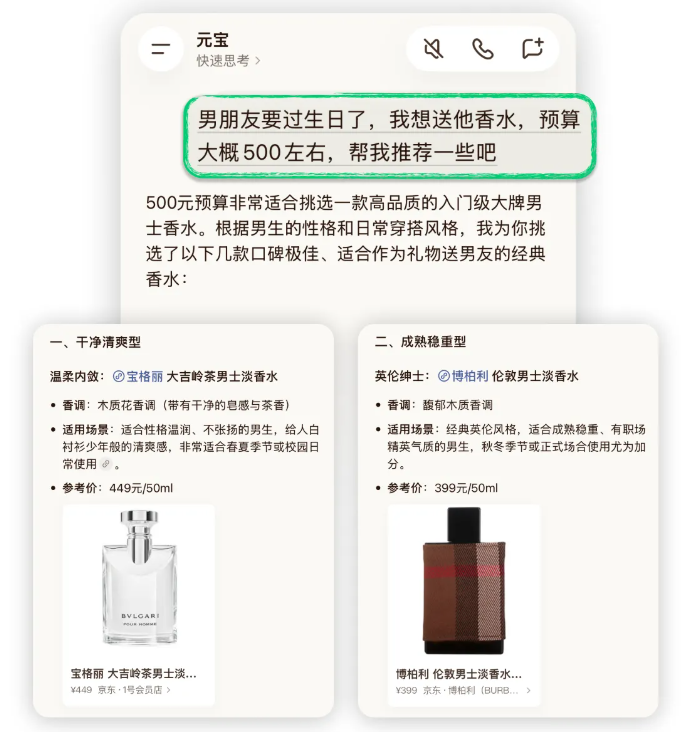 Image Source: Yuanbao Official Account
The deep collaboration between JD.com and Tencent extends far beyond a routine feature update. JD.com boasts nationwide warehousing, distribution, and genuine product after-sales capabilities, while Tencent commands WeChat's billion-user social traffic. These long-standing allies are now joining forces with a core objective: to counterbalance ByteDance's Doubao, officially forming a tripartite competitive landscape in China's AI-driven e-commerce sector.
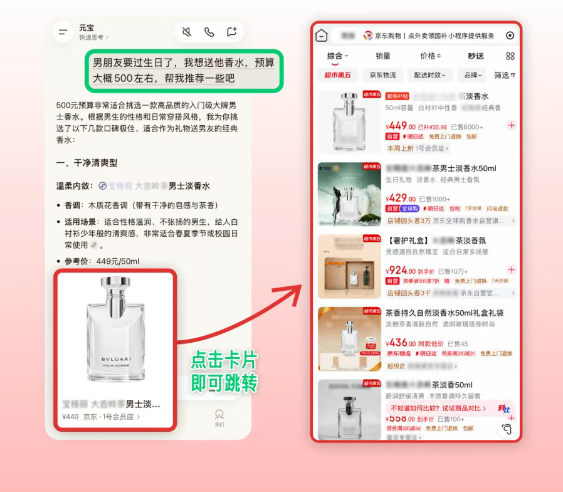
Image Source: JD.com Official Account
I. Diverging Strategic Paths: ByteDance's Closed-Loop Model vs. Tencent's Collaborative Ecosystem
Understanding this collaboration requires distinguishing the fundamentally different strategies of Tencent and ByteDance. Tencent, with WeChat and QQ as its national-level social platforms, possesses a comprehensive traffic, payment, and content infrastructure. It has long adhered to a core strategy of "only connecting traffic, not engaging in heavy asset operations."
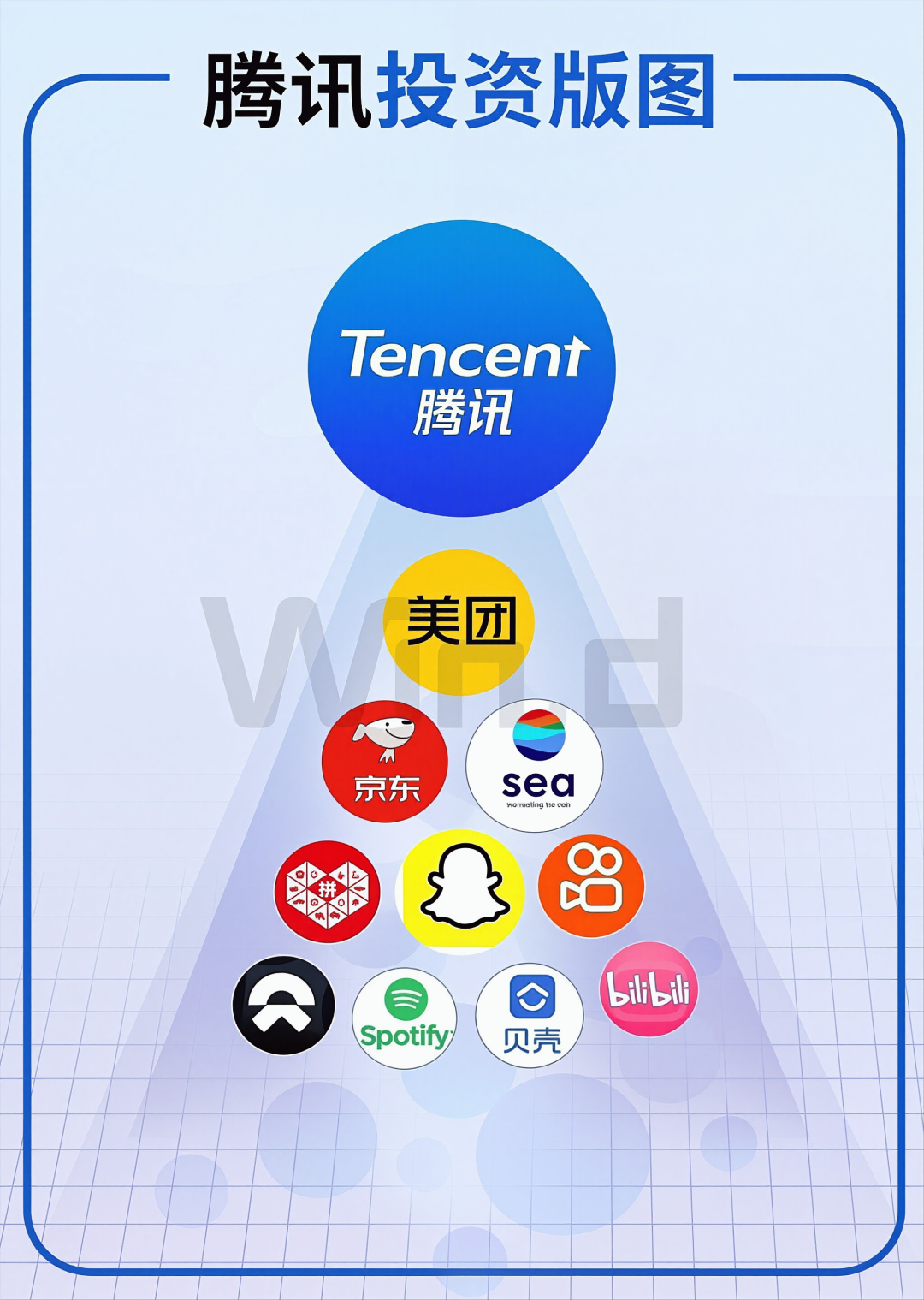
Image Source: Wind Information  Most attendees at Tencent's "Dongxing Banquet" at the 2017 Wuzhen Internet Conference were companies invested in by Tencent. Image Source: Xiaohongshu
Tencent has clearly positioned itself: controlling front-end user entry points while delegating capital-intensive operations like warehousing, logistics, offline operations, and merchant maintenance to industry leaders. This approach has fostered a mature investment ecosystem: retail with JD.com, local services with Meituan, and transportation with Didi. Through capital partnerships, Tencent provides traffic while partners deeply cultivate specific scenarios, creating a win-win situation that avoids the high costs and risks of building a full industrial chain in-house.
In contrast, ByteDance insists on a full-chain, self-developed closed-loop model. Short videos, AI shopping guides, online malls, and local delivery are all built in-house, creating an internal traffic-data-user cycle completely independent of external platforms, from content inspiration and AI consultation to order placement and payment.
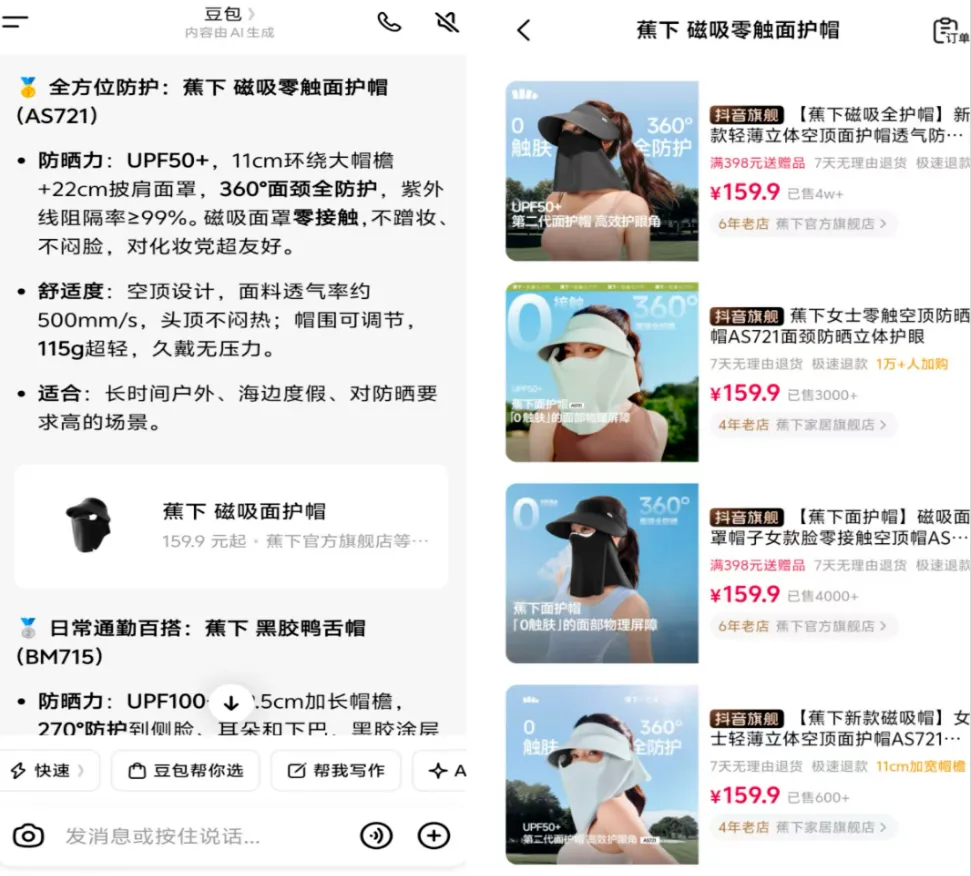
"Doubao Helps You Choose" is deeply integrated with Douyin E-commerce, completing the transaction closed loop.
The AI era has dramatically widened the gap between these two models. Tencent Yuanbao, despite its massive WeChat user base, suffers from a critical weakness: it only has conversational traffic without real-world consumption scenarios. Users typically leave after completing their queries, making user retention and engagement difficult to improve. To activate its traffic and achieve commercialization, filling gaps in e-commerce and local services is the only solution.
JD.com and Meituan, as Tencent's core long-standing allies, have mature fulfillment systems. By simply connecting interfaces, they can rapidly implement comprehensive consumption services without building teams or logistics networks from scratch. This makes them the optimal solution for Yuanbao to address its scenario gaps. Now, Yuanbao's full-category integration with JD.com and gradual connection with Meituan's AI assistant represent the core implementation of Tencent's traffic collaboration strategy in the AI era.
II. Decade-Long Cooperation Evolves: Traditional Traffic Fades, AI Conversations Become the New Frontier
The "Shopping" entry on WeChat's "Discover" page was once JD.com's core source of social traffic. In 2022, the two sides renewed their strategic cooperation, with Tencent providing top-tier traffic positions for continuous user referral and JD.com offering equity stakes, formalizing a decade-long symbiotic traffic model.
In September of the previous year, after ten years of operation, WeChat's primary JD.com entry was discontinued. Combined with Tencent's reduction of stakes in related companies, market speculation arose about cooling cooperation. However, Yuanbao's full integration with JD.com completely dispelled these doubts: the era of static page traffic is over, and AI conversational agents have taken over as the new core traffic entry points.
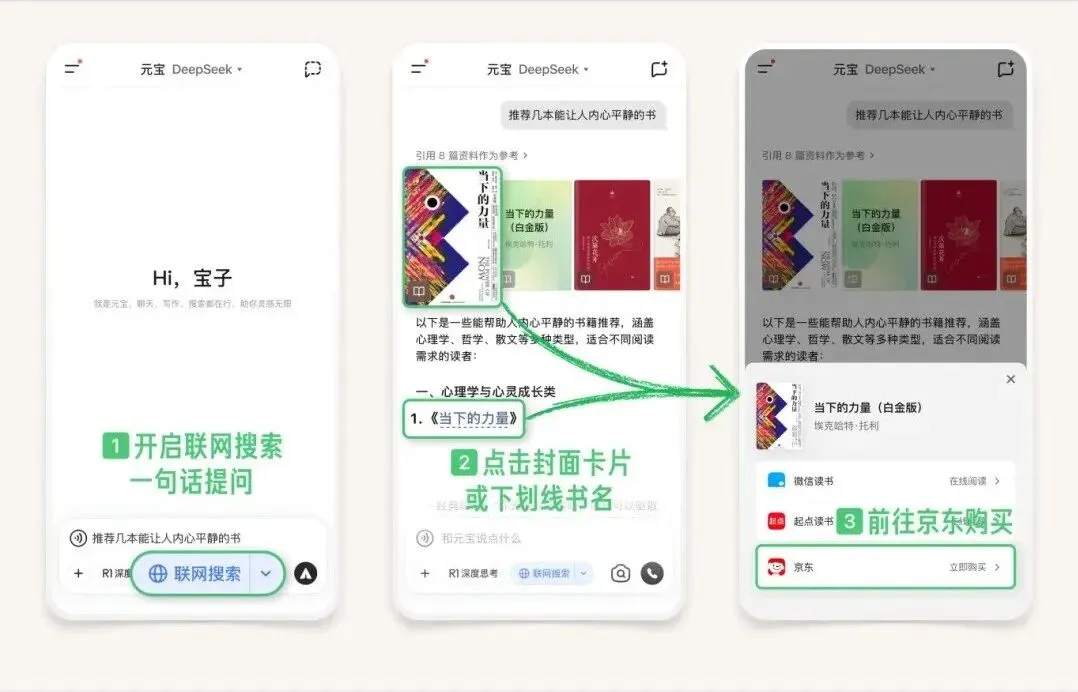
Image Source: Tencent Yuanbao
The cooperation model has undergone a comprehensive upgrade: previously, Tencent provided fixed traffic positions while users actively browsed and selected products. Now, Yuanbao handles users' natural language requests, and JD.com fulfills real orders with its complete supply chain, logistics, and after-sales capabilities. User behavior has shifted from "actively seeking products" to "AI proactively matching needs." Simple traffic exchange has evolved into deep ecological collaboration, aligning with Tencent's long-term strategy of lightweight collaboration.
This cooperation covers digital products, apparel, beauty, and fresh produce, significantly optimizing user experience: users express shopping needs in Yuanbao, AI automatically filters and compares prices, JD.com product cards appear in the chat, and one-click jumps to mini-programs for order placement without app switching. JD.com handles fulfillment and after-sales.
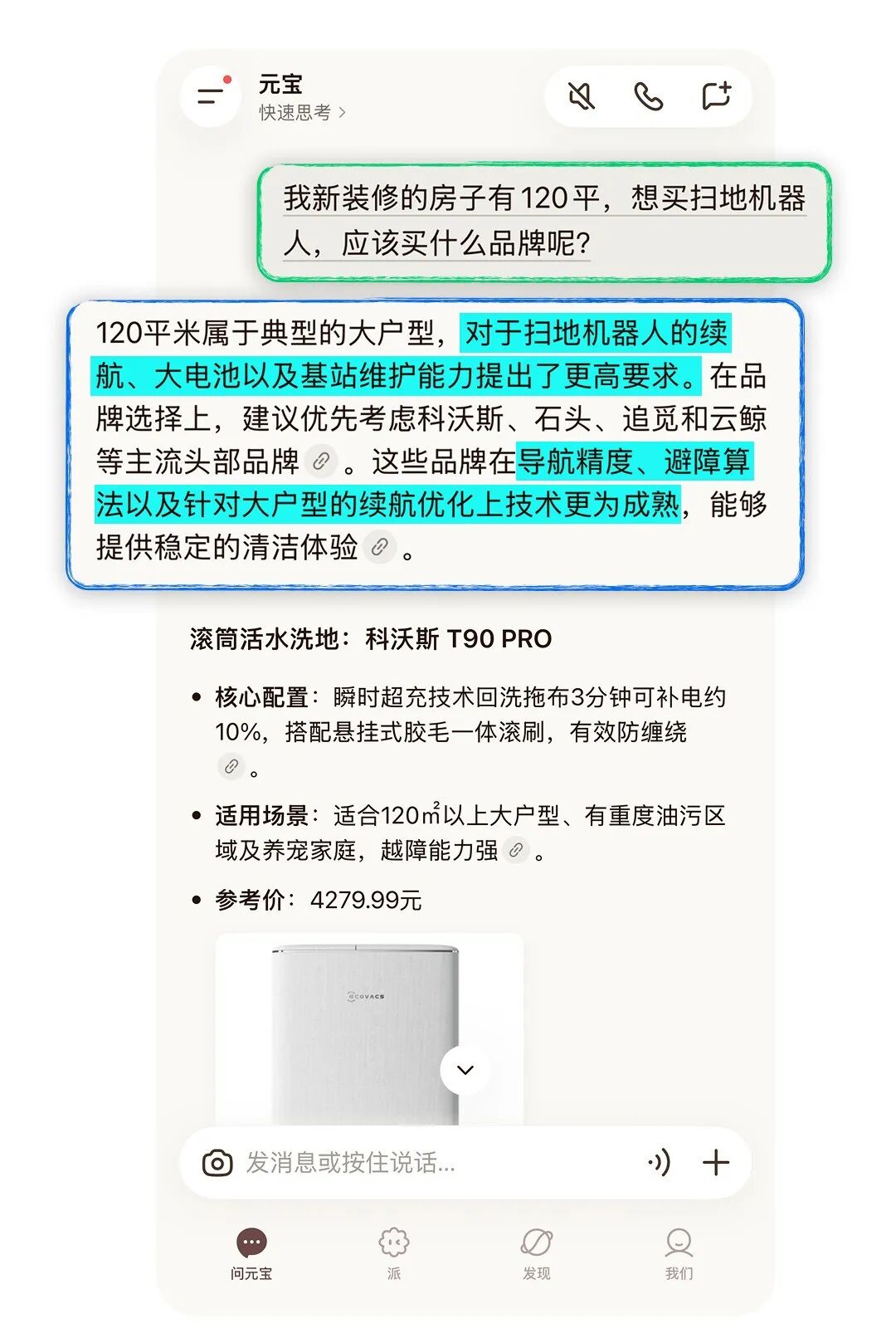 Image Source: Yuanbao Official Account
From early small-scale testing in the book category to now full-category availability, Yuanbao has officially become Tencent's core AI shopping entry point outside WeChat. The platform is also gradually integrating Meituan's AI assistant for local services and connecting with various government service mini-programs, shedding its single Q&A tool identity to upgrade into a comprehensive one-stop AI service platform, solving user retention challenges.
III. Liu Qiangdong Secures AI Entry Point: Four Core Strategic Values Emerge
While most observers focus on improved shopping experiences, this move represents JD.com's critical strategic layout to capture AI-era growth, with four core values reshaping its future growth logic.
First, it fills traffic gaps and secures low-cost, high-precision customer acquisition. After losing stable free social traffic from WeChat's shopping entry, JD.com faced rising customer acquisition costs. Yuanbao's 114 million monthly active users, backed by WeChat's 1.3 billion user ecosystem, bring conversational traffic with inherent purchase intent, achieving conversion rates far exceeding traditional advertising. JD.com gains access to a top-tier AI traffic pool without developing its own large model, opening a new customer acquisition channel beyond its app.
Second, it completes omnichannel layout and builds an industry-wide fulfillment foundation. JD.com has established a cross-device AI agent network, integrating native AI on Huawei, OPPO, Honor, and other phones. This Yuanbao integration achieves full coverage of "phone system AI + third-party national AI," an exclusive advantage Alibaba and ByteDance lack. JD.com transforms from a single e-commerce platform into an AI retail fulfillment service provider for the entire industry, unlocking new growth opportunities.
Third, it counters ByteDance's traffic encirclement and builds an alliance defense line. With 382 million monthly active users, ByteDance Doubao dominates, cultivating user habits of "consulting Doubao before shopping" and continuously diverting JD.com's core customer base. Through Yuanbao, JD.com successfully joins Tencent's anti-ByteDance alliance, capturing AI conversational shopping traffic, breaking ByteDance's exclusive monopoly on shopping guidance, and balancing industry traffic distribution.
Fourth, it reduces app dependency and activates fragmented consumption scenarios. Traditional e-commerce heavily relies on users proactively opening apps, creating high usage barriers. Now, shopping needs are embedded in AI Q&A, product comparisons, and gift planning scenarios. AI proactively meets user needs, expanding consumption boundaries while accumulating massive conversational data to optimize supply chains and recommendation systems, forming a positive supply-demand cycle.
IV. JD.com's Exclusive Edge: Cross-Device AI Network Capturing System-Level Entry Points
In this cooperation, JD.com holds an irreplaceable trump card—the A2A cross-terminal AI agent interconnection system. When users propose shopping needs through native AI on major phone brands, the system directly accesses JD.com's product library, relying on nationwide warehousing, next-day delivery, and doorstep after-sales for fulfillment.
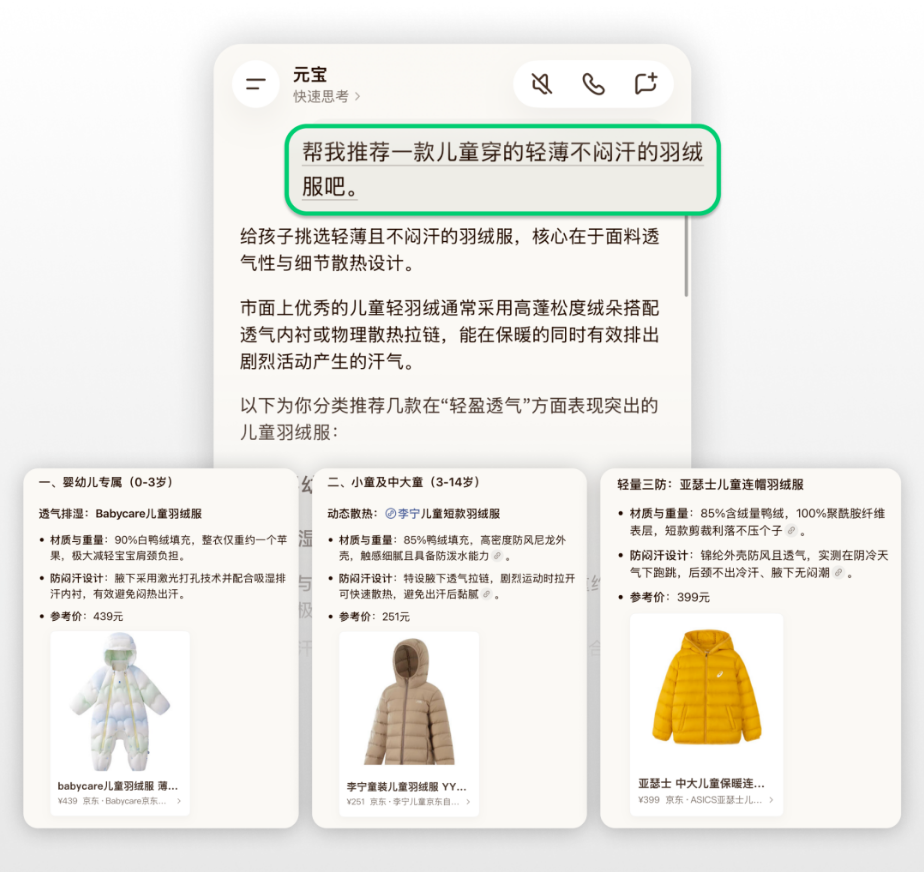
Image Source: Yuanbao Official Account
The industry gap is stark: ByteDance and Alibaba's AI products only operate within their own ecosystems. Only JD.com achieves interoperability among native phone assistants, third-party AI, and Tencent Yuanbao, building a cross-platform, cross-device transaction highway. This frees JD.com from traditional e-commerce's passive traffic waiting, embedding fulfillment capabilities into high-frequency national tools, expanding order sources through Yuanbao's massive traffic, and achieving mutual empowerment.
V. Facing ByteDance's Rapid Rise, 'Allying with Liu Against Douyin' Becomes Inevitable

Tencent's accelerated binding with JD.com primarily responds to ByteDance Doubao's explosive growth. With monthly active users more than triple Yuanbao's, ByteDance has deepened AI shopping since 2025, launching mall links, achieving in-app closed-loop ordering, and establishing independent Doubao order channels with exclusive rates, formally making AI shopping guidance a core monetization track.
Relying on a complete closed loop of short video inspiration, AI shopping guidance, and mall fulfillment, ByteDance enables zero-loss traffic circulation, continuously capturing core links in user shopping decisions. If Yuanbao fails to fill consumption scenarios, Tencent will lose the AI consumption race, with user time, conversions, and revenue all facing downward pressure.
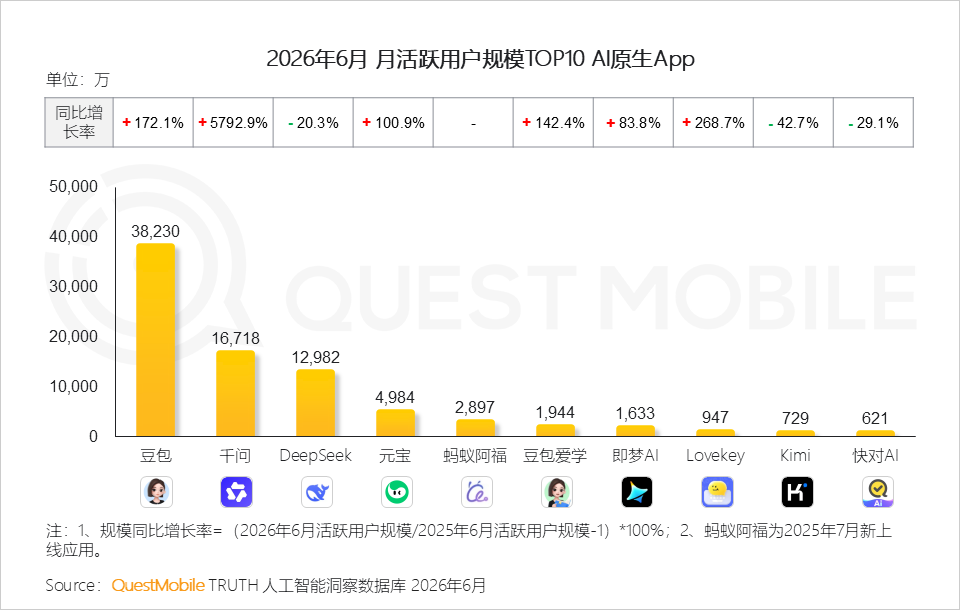
Image Source: QuestMobile
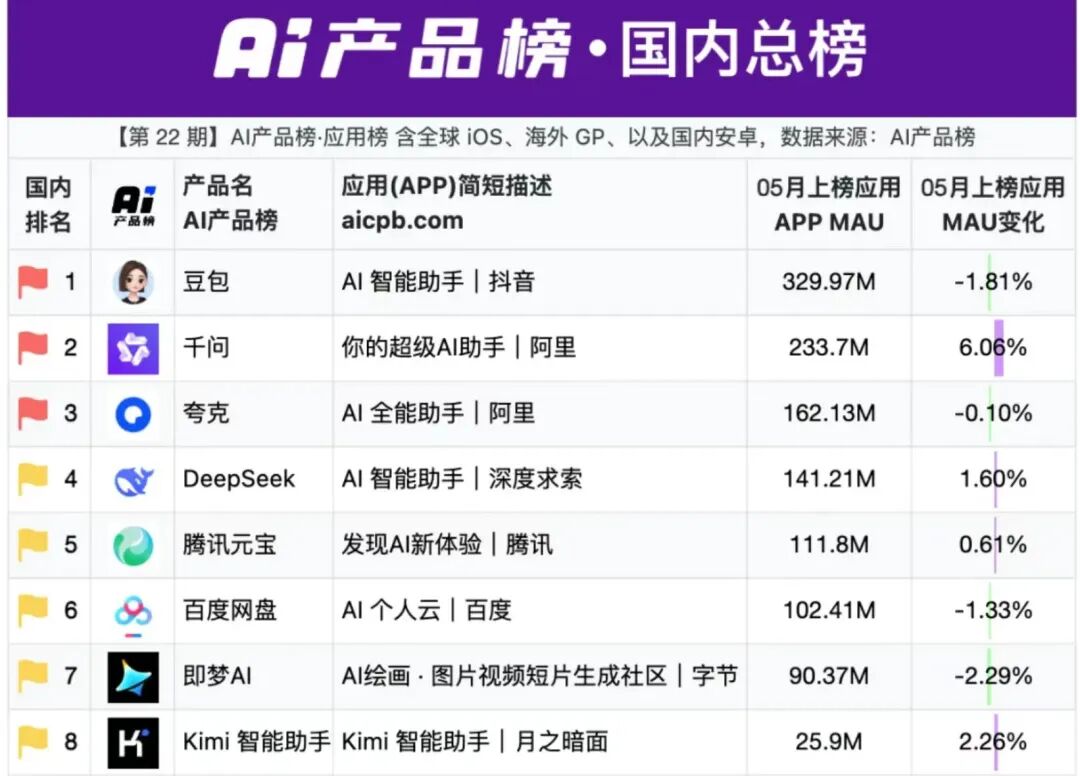 Image Source: Weibo
The alliance offers clear complementary advantages: Tencent controls top-tier social and AI entry points but lacks mature supply chains; JD.com has complete fulfillment and after-sales systems but lacks massive conversational traffic. Leveraging years of capital binding, the two sides counter ByteDance's closed ecosystem, forming a tripartite balance with Alibaba and securing competitive initiative in the AI era.
VI. Hidden Industry Risks: Merchants and Consumers Must Remain Vigilant
While AI shopping closed loops offer convenience, they also pose two major industry risks. First, AI shopping guides lack neutrality—Yuanbao's physical product procurement solely connects to JD.com's inventory without multi-platform price comparison channels, potentially compressing user selection space and sustaining controversies over exclusive partnerships.
Second, merchants risk single-channel dependency. Brands overly reliant on Yuanbao's AI traffic will face extremely concentrated customer sources. Once cooperation policies or traffic support adjust, orders may plummet, threatening operational stability. In the long run, this cooperation won't overturn the e-commerce industry but will clearly segment traffic: essential purchases will flow to AI conversational scenarios, while information and knowledge queries will remain dependent on the entire internet's content, completely differentiating these two types of demand.
VII. The Tripartite AI E-commerce Landscape Takes Shape: Three Tracks with Clear Strengths and Weaknesses
With the Tencent-JD.com-Meituan alliance established, China's AI e-commerce sector has solidified into three distinct camps, each with clearly defined strategies, strengths, and weaknesses.
Alibaba Ecosystem: It boasts a fully independently developed closed-loop system, exercising complete control over AI, e-commerce, and fulfillment processes. This setup offers high scheduling flexibility, yet it is plagued by poor external compatibility, a limited traffic ceiling, and substantial investment costs in heavy assets.
ByteDance Ecosystem: This ecosystem revolves around a traffic-driven closed loop, with Doubao traffic taking the lead. It showcases strong synergy between content inspiration and AI-powered shopping guidance, solidifying its user mindshare and robust monetization capabilities. However, it falls short in having a national logistics network for large items, leading to weaker fulfillment experiences. Moreover, it maintains a closed ecosystem with sustained (chí xù, meaning 'continuous') high investment costs.
Tencent Alliance: Adopting an open collaboration model, it leverages WeChat's comprehensive traffic and partner capabilities to enrich consumption scenarios, enabling swift implementation at a low cost. Coupled with JD.com's underlying advantages in AI entry points, it achieves full coverage of online and offline scenarios. Its only drawback is a slightly lower efficiency in multi-party collaboration compared to self-developed closed-loop platforms.
The current competition in AI-driven e-commerce no longer revolves around computing power but rather centers on AI entry points and commercial fulfillment ecosystems. Tencent's lightweight collaboration model precisely challenges ByteDance and Alibaba's heavy-asset self-development approaches, carving out a distinctive competitive path.
VIII. Conclusion: AI Revolutionizes Shopping Rules, Initiating the Official Entry Point War
Traditional e-commerce platforms vie for app homepages, search boxes, and live-streaming positions. In the AI era, the core competition lies in every daily conversation users engage in. The traffic logic has undergone a complete reversal, shifting from 'users actively seeking products' to 'AI proactively fulfilling demands'. Backend capabilities such as supply chain, logistics, and after-sales service have once again emerged as the core defensive strengths for platforms.
WeChat's decade-long shopping entry has come to a close, with Yuanbao AI dialogue taking the helm. This collaboration represents not just a functional upgrade but also the execution of Tencent's joint venture strategy and a crucial move for JD to solidify its position in AI-driven new traffic and counterbalance ByteDance's advantages.
The future competition in the AI shopping guide sector is set to intensify, with ByteDance, Alibaba, and Tencent engaged in continuous strategic maneuvers. For merchants, the era of reaping benefits from a single channel has come to a complete end. A balanced multi-channel presence and refined operations are imperative for long-term, stable development. The AI-driven transformation of the e-commerce industry has only just begun.
Interactive Topic
1. Would you place orders directly based on AI-recommended products? Among Doubao, Yuanbao, and Qianwen, which shopping experience do you prefer? 2. How should merchants strategize their multi-channel traffic to mitigate risks associated with relying on a single platform?
-
![]()
Liu Qiangdong Gains Crucial Foothold as Tencent Forms Alliance to Counter ByteDance's Dominance
-
![]()
Physical AI Infrastructure Race: U.S. Firm General Intuition Trains Robots Using Game Footage, Reaches $2.3 Billion Valuation
-
![]()
DeepSeek May Launch IPO as Early as This Year Amid 'Insatiable Demand for Computing Power'
-
![]()
Huawei and Tesla Pioneer the Path! Modular Design Takes Center Stage, Electric Vehicles Bid Adieu to 'Instant Obsolescence'
-
![]()
Expected to Rake in a Staggering 24.4 Billion in the First Half of the Year: What Gives Foxconn Industrial Internet the Competitive Edge?
-
![]()
Tencent Invests 13.6 Billion to Become a 'Minority Shareholder': What Are Its Ambitions with Manus?
-
![]()
Computing Power Extends to Space: Aerospace AI Sparks a New Industrial Era
-
AI's Richest Person Revealed: A Native of Zhanjiang!