Ant AI 'Reins in Its Ambition': LingGuang Recedes, Afu Steps into the Spotlight
 07/16 2026
 381
381
Editor: Liu Zhicheng
Reviewer: Xu Xu
Recently, Ant Group has been undergoing significant internal reshuffles, both in terms of personnel and business strategy.
Market sources reveal that Hanluo, the former leader of the 'LingGuang' product, has been reassigned to oversee some aspects of 'Afu,' with LingGuang's core team also being redirected to bolster Afu's functional development.
Concurrently, the LingGuang App has recently upgraded its world model experience, integrating Ant's cutting-edge world model, LingBot-World 2.0. Unlike Afu's pragmatic approach, LingGuang appears to be venturing into more avant-garde territories.
From an outsider's perspective, these changes seem to indicate a strategic contraction in Ant's AI endeavors—shifting from a dual-track strategy of 'full-modal general AI' and 'health vertical model' to a singular focus with Afu at the helm.
Data lends credence to this strategic pivot.
QuestMobile data indicates that in the first quarter of 2026, among AI-native Apps ranked by monthly active users, Doubao, Qianwen, DeepSeek, Yuanbao, and Afu secured the top five spots, while LingGuang failed to crack the top ten.
With Afu now in the limelight, it bears the responsibility of charting Ant's AI course. The onus is on Afu. What can Zhang Junjie, its leader, deliver?
It's time for Ant AI to deliver tangible results.
To grasp Afu's position, one must first understand the current landscape of the AI industry.
The AI battle has transitioned from its most intense phase, marking a milestone for the initial wave of AI achievements to be widely implemented.
The market for general models is taking shape, and video models are rapidly commercializing.
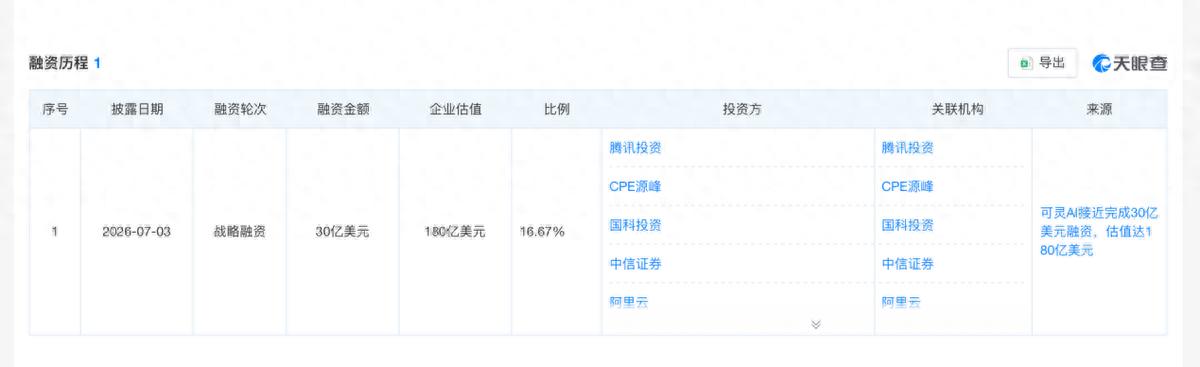
Tianyancha APP data shows that Kuaishou's Kling AI recently secured independent financing with a post-investment valuation of $18 billion; Doubao AI boasts 382 million monthly active users, establishing a dominant lead; Seedance has surpassed Kling in the video generation sector, with its annualized revenue (ARR) reportedly reaching $2 billion.
On the Tencent front, investment in DeepSeek has been made, and the AI assistant 'Xiaowei' has commenced internal testing. Leveraging WeChat's 1.432 billion monthly active users, Tencent's AI has also reached a milestone for accelerated deployment.
These moves collectively signal one thing: the AI strategies of tech giants are beginning to yield results, both in the capital market and business operations, and are gradually coming to the fore.
For Alibaba, this could mean increased competitive pressure in the future.
Firstly, despite significant investments in the Qianwen APP, Alibaba has consistently been overshadowed by Doubao. Secondly, while HappyHorse has emerged in video generation AI, its lack of an ecosystem akin to Douyin or Kuaishou has hindered its commercialization efforts.
Witnessing Kling AI secure independent financing and Seedance's valuation soar, it's evident that Alibaba's AI business lines need to deliver greater outcomes. After all, only with results from this round of AI implementation can there be a 'ticket to the next round' of AI competition.
For Ant Group, with LingGuang shifting towards future exploration, this burden naturally falls on Afu.
The transfer of LingGuang's leadership and the integration of its talent into Afu is not merely the conclusion of a 'horse race' but also signifies that Afu may now shoulder more of the responsibility for implementing Alibaba's AI strategy.
When the pressure mounts, can Afu withstand it? This is a question that Zhang Junjie must ponder deeply.
From Alibaba Group's perspective, although Ant Group operates independently, it has always been a 'pillar' within the Alibaba ecosystem. Whether it's Alipay, the super entrance, or Huabei and Jiebei, the consumer finance giants, they have all been key mainstays among Alibaba Group's diverse business lines.
Therefore, integrating 'health + insurance,' becoming the AI hub for Ant's insurance and health businesses, and transforming low-frequency financial products into high-frequency health services is Afu's top priority.
Afu is currently adept at handling internal business.
For instance, in the insurance sector, Afu directly embeds AI health management services into insurance products. In the broader health strategy, Afu's services already encompass health Q&A, report interpretation, AI registration, medical insurance payment, and medication purchase, seamlessly integrating with Alipay's medical and health channel.

But the question remains: Is internal collaboration sufficient?
Probably not. If Afu is merely an AI connector for Ant Group's business, then it may fall short of Jack Ma's expectations. Ma has personally visited the Ant campus several times and approved the naming of Afu, indicating high hopes.
For Ant Group, Afu is akin to Alipay in the AI era.
Both payment and health are essential vertical fields, both represent potential markets worth trillions, and both have the potential to become super entrances. However, the issue lies in whether Afu, with its current traffic scale, can support Alibaba's entire AI strategy.
In June 2026, according to QuestMobile's ranking of AI applications by monthly active users, Doubao had 380 million, Qianwen had 167 million, and Ant's Afu had only 28.97 million. Although this performance ranks first among vertical models, it is not outstanding.
Within Ant Group, this traffic scale is also far from ideal. After all, Alipay has nearly 1 billion monthly active users. Even if only one-tenth of Alipay's users utilized Afu, Afu's monthly active users would exceed 30 million.
If Afu cannot demonstrate, with concrete results, its ability to become an independent super entrance like Alipay, then will Afu follow the same path as LingGuang in the future? Will Afu's team eventually merge with Qianwen, becoming the medical sector within Qianwen's ecosystem?
This may be the question that Zhang Junjie, as Afu's head, needs to ponder deeply following LingGuang's leadership transfer.
Before Doubao launches its medical offensive, Afu needs to find its own 'QQ Show'
To further advance Alibaba's AI strategy, Ant AI needs to accomplish two things:
1. Achieve scale.
Not to say that Afu needs to match Doubao's traffic scale, but at least grow from 30 million monthly active users to 100 million. After all, for all AI applications, traffic scale itself is a formidable barrier.
Healthcare is a刚性需求 (rigid demand), and Afu does not lack user habits.
Take my own example: I undergo a physical examination every six months and send the report to Afu for interpretation. If there are no issues, I don't bother with a follow-up consultation. For users, this saves time and is highly convenient.
However, the issue lies in the fact that the ultimate traffic scale Afu can achieve may not be that high.
Healthcare is relatively low-frequency; ordinary users may only use it once a week or even once a month. In contrast, applications like Doubao and DeepSeek are indeed used multiple times a day.
What does this imply? In terms of traffic scale, Afu's ceiling may inherently be much lower than Doubao's.
This is somewhat analogous to the GMV ceiling of vertical e-commerce platforms in the e-commerce sector, which is inherently lower than that of comprehensive e-commerce. The traffic ceiling for vertical AI may also be inherently lower than that of general models.
So, the question arises: Could 'Afu,' a vertical App, be supplanted by general AI, just as comprehensive e-commerce replaced vertical e-commerce?
Especially general AI like Doubao, which boasts high daily activity and strong user stickiness.
From a user's perspective, if a single AI application can meet all needs for chatting, working, and learning, users have little incentive to download and retain 'Afu' solely for its health functions.
More critically, ByteDance is continuously laying out in the health sector, improving both online and offline medical infrastructure.
For example, it launched the independent 'Xiaohe AI Doctor' App online, focusing on health consultations and report interpretation. Offline, ByteDance has invested over 20 billion yuan in the medical sector, controlling more than 20 enterprises. Theoretically, ByteDance already possesses the key elements to create a closed loop for 'AI + healthcare.'
If Doubao were to focus on consultations in the future, how should one respond? Perhaps, beyond scale, Afu should find a second path.
This brings us to the second thing Afu needs to do next:
Achieve commercialization.
If the traffic scale of medical AI large models always remains an order of magnitude lower than that of leading general models, can commercialization be achieved first?
I believe it is possible.
Beyond traffic scale, revenue and profit are also formidable barriers.
Moreover, this route is not without successful precedents. A typical example is the video AI generation model sector. Although Kling AI does not have as high monthly active users as Doubao or Qianwen, its advantage lies in achieving commercialization.
Why did Kling AI achieve commercialization before Doubao? The reason may be that helping B-end users reduce costs and increase efficiency generates revenue faster than helping C-end users save time.
Helping B-end users reduce costs and increase efficiency has a more direct payer. For example, in the PC Internet era, the medical industry has always been a core client for search engines. In the AI era, with higher customer acquisition efficiency, the soil for commercialization in the medical industry is theoretically richer and easier to tap into.
Currently, 'Generative Engine Optimization (GEO)' services have emerged in China, where brands can implant information into AI Q&A for a few hundred to a thousand yuan. This also proves from the side that the market has a strong and willing demand to 'be seen in AI.'
The same is true for the AI healthcare sector.
In the healthcare sector, Ant Group does not lack relevant resources and capabilities. Online, it acquired Haodf, theoretically not lacking clients. Offline, Ant Health has connected with 5,000 hospitals and 300,000 registered doctors, building a complete service closed loop from registration and payment to consultations.
With resources and capabilities, the key to Afu's next layout may be how to convert the industry's willingness to pay into Afu's revenue and profit.
Whether this can be achieved depends on whether Afu can find new monetization methods.
After all, selling keywords like in the PC era may face stricter privacy regulations and user trust issues in the AI era.
Finding a more advanced monetization method is the core issue that Afu's commercialization needs to address.
Over the past two years, although commercialization in the video generation sector has progressed rapidly, it is essentially selling Tokens. Selling Tokens is essentially no different from selling ads in the PC Internet era; both are 'selling water' models.
In the PC era, Baidu and major portals earned substantial profits by selling traffic, but what truly disrupted the industry was not search engines but Tencent's social platforms, QQ and WeChat.
When QQ was commercialized, Pony Ma was at a loss and even considered selling QQ until the emergence of QQ Show, which created social currency and thus solved the commercialization problem of social platforms.
Subsequently, the 'selling water' model of Internet commercialization evolved into a 'tax collection' model.
In the AI era, a similar transformation still needs to occur. Whoever finds the new 'tax collection' model first will seize the commercialization initiative.
For Ant Group, if Afu can be the first to find a monetization method in the AI era, even if Doubao charges forward in the medical sector in the future, Afu can still establish its own barriers through commercialization.
This perspective may offer a different understanding of Ant Group's AI business adjustments.
'Reining in its ambition' is to better unleash it.
This may be the underlying strategic logic of Ant Group's adjustments. With LingGuang taking a step back and Afu stepping forward, Ant AI's game has new opportunities.
For Zhang Junjie, what he needs to deliver next is not just an AI application with steadily growing monthly active users but also a performance that validates 'vertical AI can independently run a commercial closed loop.'
This path will not be easy, but as the halftime whistle blows, it's Afu's turn to take the stage for Alibaba's AI.
-
![]()
Personnel Shuffle: Independent Director Mi Xuming Steps Down from OFILM
-
![]()
Net Profit Anticipated to Skyrocket by 103%: What Gives This Optical Company a Competitive Edge?
-
In Just One Year, China Unveils Unicorns Valued at 10 Trillion Yuan!
-
![]()
6 Park Companies Shine at WAIC: How Hong Kong Science Park Bridges AI from Research to Industry
-
![]()
Wang Wenjing’s Third Act: Can Yonyou Reinvent Itself in the AI Era?
-
![]()
Performance Coupe Entry Threshold Reduced to 170,000 Yuan: Assessing the 2027 Exeed ES's Prospects
-
![]()
Battery "Crisis" for 4 Million New Energy Commercial Vehicles
-
【Focus】Fluorinated Photosensitive Polyimide (FPSPI): A High-End Subdivision of PSPI with Great Potential in High-Tech Industries