On the Same Day of WAIC's Opening, Kimi Took the Top Spot
 07/20 2026
 395
395

Copywriting by Chen Cong | Produced by Shi Tianhao Observation On the morning of July 17, 2026, at the Shanghai World Conference Hall, President Xi Jinping attended the opening ceremony of the 2026 World Artificial Intelligence Conference and the High-Level Conference on Global AI Governance, delivering a keynote speech titled "Working Together to Build a Fair and Rational Global AI Governance System."
On the same day, the World Artificial Intelligence Cooperation Organization was established in Shanghai, with a signing ceremony for the agreement held simultaneously. The theme of this year's conference is "Smart Partnerships for a Shared Future," taking place from July 17 to 20 across four venues in three locations: the Expo, Zhangjiang, and West Bund. The exhibition area exceeded 100,000 square meters for the first time, with over 1,100 enterprises showcasing more than 3,000 exhibits. Over 300 AI products made their global debut, accompanied by 140 forums, 1,400 Chinese and foreign guests, and 9 Turing Award and Nobel laureates, making it the largest-scale event to date.
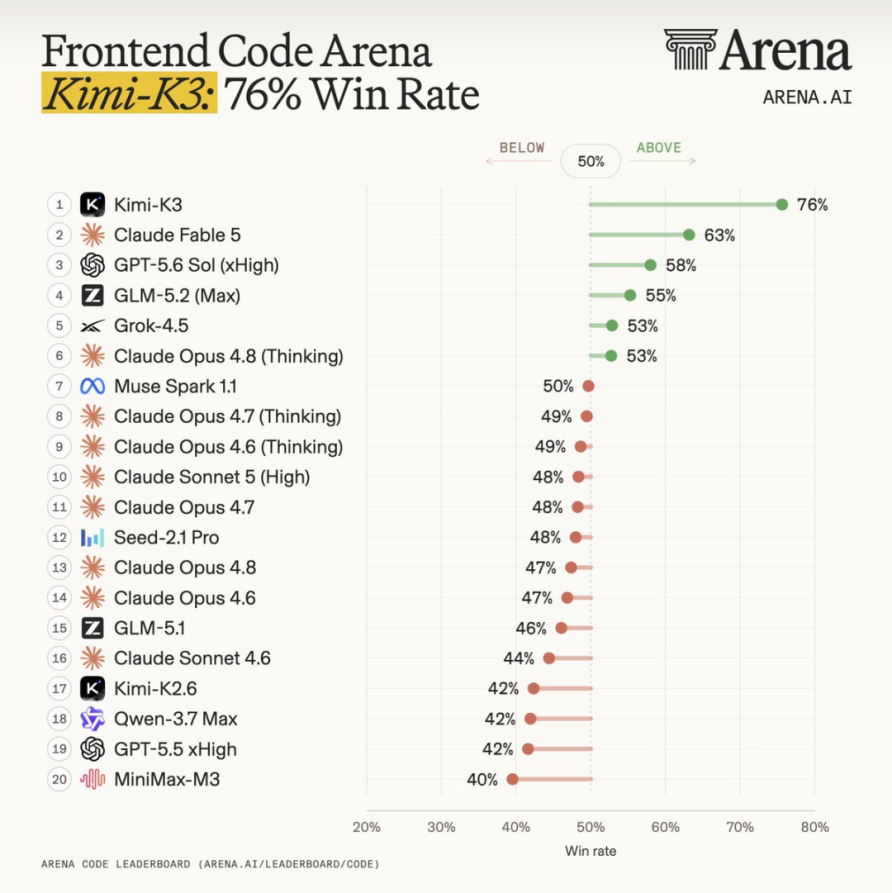 (Image Source: Frontend Code Arena)
In the early hours of the same day, Moonshot AI released Kimi K3. A few hours later, Code Arena, a blind testing platform created by researchers at the University of California, Berkeley, updated its rankings, showing K3 at the top of the front-end programming list with a score of 1,679 and a 76% win rate, surpassing Claude Fable 5 and GPT-5.6 Sol. The spotlight at the conference and the top spot on the rankings coincided in time. The former represents China's national narrative on AI, while the latter reflects the market response to China's AI. Leading this response is a familiar name: Kimi, which has reclaimed its central position.
01 K3's Ascent: The Inevitability of a Developmental Logic
1. Three Years: From 'Do I Have It?' to 'How Much Is It Worth?' Looking back at China's AI progress, the milestones are clear. In 2023, during the 'Hundred-Model War,' companies focused on answering whether they had a model. By 2024, a price war ensued, with the question shifting to how much cheaper their models were. The competitive path was straightforward: offer 80% of the performance at 10% of the price.
In early 2025, DeepSeek rewrote the rules by approaching U.S. frontier models at a significantly lower training cost. By 2026, Zhipu and MiniMax went public on the Hong Kong Stock Exchange, with Zhipu's market value briefly reaching 1 trillion yuan, marking the first round of capital market valuation for China's large models.
In 2025, the scale of China's core AI industry exceeded 1.2 trillion yuan, with an expected growth rate of over 30% in 2026. More important than scale is the path taken. China's AI development follows an 'application-to-model' approach rather than 'model-to-application,' with products designed from day one to meet real business needs. Open-source is its most distinctive feature, with one domestic large model spawning over 170,000 derivative models. A research team in Uganda chose it as the base for a model covering 31 languages.
Statistics from AI aggregation platform OpenRouter show that since February 2026, the proportion of tokens invoked by U.S. companies using Chinese AI models has exceeded 30% weekly, peaking at 46%, compared to an average of just 11% in the previous 12 months and as low as 4.5% in the first half of 2025.
Chinese open-source models cost 60% to 90% less than leading U.S. models. AI startup Lindy switched all its traffic from Claude to DeepSeek in June. Zhipu's GLM 5.2, released in June, scored within 1 percentage point of Opus 4.8 on an agent benchmark test while costing only one-fifth as much. Technical foundations, open-source ecosystems, and the global market converged in July 2026 to produce the same outcome.
2. K3: The Latest Example of This Logic It must be clarified that K3 is not a routine iteration. With 2.8 trillion parameters, it is the world's largest open-source model, supporting 1 million tokens of context and native visual understanding. Its parameter scale is nearly double that of DeepSeek V4.
Architecturally, it employs a combination of KDA and AttnRes, representing a new paradigm designed from scratch, with scalability efficiency about 2.5 times that of K2. Its performance is equally impressive. It scored 42 on the SWE Marathon coding test, higher than GPT-5.6 Sol's 39 and Fable 5's 35. It achieved 91.2 points on the Agent capability test BrowseComp and 91.1 points on the visual understanding OmniDocBench, both ranking first. On the Intelligence Index rankings by third-party agency Artificial Analysis, K3 jumped from 17th to 3rd place.
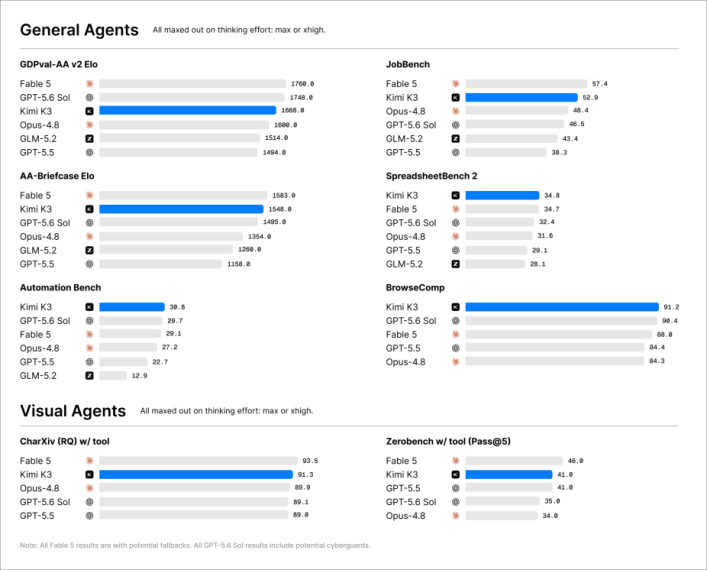 (Image Source: Kimi; Comprehensive evaluation results chart)
Some overseas testers called this the 'DeepSeek 2.0 moment,' as K3 was released just a month and a half after Claude Opus 4.8 and outperformed it overall, directly breaking the long-held belief that Chinese open-source models lagged behind U.S. models by six to eight months.
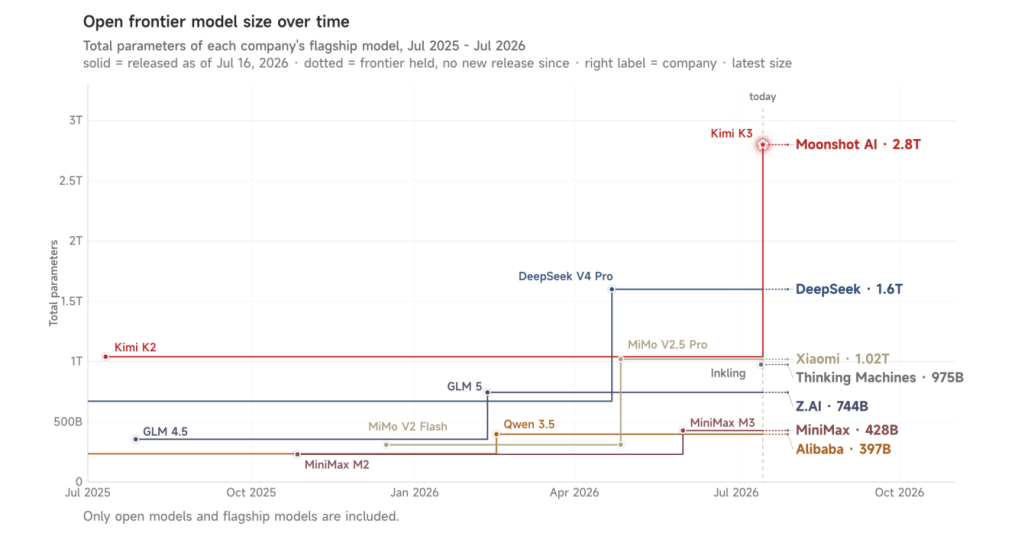 (Image Source: Kimi; Comparison chart of update timelines between Kimi and mainstream domestic and foreign models)
The most noteworthy aspect is pricing. K3's API input price is 20 yuan per million tokens, and the output price is 100 yuan, about five times that of the previous generation K2.5 and the most expensive among mainstream domestic models. However, in U.S. dollars, this translates to $3 for input and $15 for output, only one-third of Fable 5's cost. Leveraging the Mooncake separated inference architecture, the official API achieves over 90% caching in programming scenarios, reducing actual input costs to one-fourth of the standard price.
In the past, domestic models relied on price cuts to gain market share, but this time, Kimi chose to set its value through technology. The capital market responded immediately. On July 17, Zhipu's Hong Kong stock price plummeted by 28.49%, and MiniMax fell by 15.62%. Meanwhile, Moonshot AI's annualized recurring revenue surged from $100 million in February to $200 million in March.
Of course, the company itself acknowledges that while Kimi K3 is generally a highly competitive model, it still lags behind Claude Fable 5 and GPT-5.6 Sol in user experience. However, as Kimi officially stated, when measured against foreign mainstream models using the same standards: 'To achieve the most difficult goals and reach the farthest horizons, one must act with courage, persist with focus, and succeed with strength.' 
A small gap has shifted the pressure back to the domestic front. The closer models get to the frontier, the more demanding they become on infrastructure. Training with 2.8 trillion parameters and reasoning with a million-token context ultimately rely on two things: computing power and storage—China's weakest links in AI. Restrictions on advanced chips and soaring memory prices have not automatically disappeared despite the success at the model level. The higher K3 stands, the more critical it becomes to solidify its foundation. Another name repeatedly associated with K3 is DeepSeek.
Overseas observers refer to this ascent as the 'DeepSeek 2.0 moment,' acknowledging who paved the way. DeepSeek was the first to achieve frontier-level performance through low-cost open-source models, and K3 has now taken this path to the level of pricing power. After K3's rise, the real questions are not about how much stronger models can become but about two things: who will strengthen the foundation and where the pioneers will go next. In July 2026, the capital market provided both answers simultaneously.
02 The Foundation and the Pioneer
1. Changxin Storage: Strengthening the Weakest Link The competition among large models appears to be about algorithms but ultimately hinges on computing power and, further down, storage. Following the surge in demand for AI servers, memory has become as strategic a resource as GPUs. IDC projects that global DRAM market revenue will reach $418.6 billion in 2026, a 177% year-over-year increase.
The day before K3's release, on July 16, Changxin Technology launched its IPO on the STAR Market. Changxin is the only domestic company capable of mass-producing DRAM chips independently, with the proceeds primarily earmarked for wafer fab expansion and HBM (high-bandwidth memory) production for AI computing. HBM3 samples have already been supplied to customers like Huawei, with 12-layer HBM3E slated for mass production in 2027.
Priced at 8.66 yuan per share, the IPO is expected to raise 57.919 billion yuan, making it the largest in Asia and the second-largest on the STAR Market after SMIC. With 9.4288 million effective online subscribers, the final subscription rate was approximately 0.47%, valuing the company at around 579.2 billion yuan post-IPO.
Founded by Zhu Yiming in Hefei in 2016, Changxin entered the then-domestically Blank (nearly nonexistent) storage sector. After accumulating losses exceeding 36.6 billion yuan over a decade, it turned a profit for the first time in 2025. The turnaround was swift, with revenue reaching 50.8 billion yuan in the first quarter of 2026, a 719% year-over-year increase, and net profit hitting 24.762 billion yuan. Its global DRAM market share rose to 7.7%, ranking fourth worldwide.
The adoption rate in Android smartphones has surpassed 30%, and Apple is reportedly testing Changxin's DRAM. For model layers to take center stage, the storage layer must first establish a solid foundation. Changxin's 57.9 billion yuan in funding represents the concrete poured into this foundation.
2. DeepSeek: The Pioneer Enters the Capital Market Among the subscribers to Changxin's IPO was a familiar name: Zhejiang Jiuzhang Asset and Ningbo Fantasy Quantitative, both under Liang Wenfeng, the founder of DeepSeek. They deployed 41 and 153 products, respectively, for offline subscriptions. Liang Wenfeng represents both a decade-long breakthrough in China's semiconductor industry and a company that has showcased China's AI strength to the world. Two highly anticipated trillion-yuan IPOs have now interconnected through a single subscription list. DeepSeek's activities in 2026 have been equally intense.
In April, it released V4; in June, V4.1 entered grayscale testing, adding image and audio processing capabilities. In May, it launched its first funding round since inception, with Liang personally contributing 20 billion yuan. After funding, its valuation rose to 350.8 billion yuan, with Tencent, NetEase, CATL, and others among its shareholders. On June 25, DeepSeek announced hiring plans to at least double the size of all departments.
According to Bloomberg, DeepSeek has begun preparing for a mainland listing, with an application expected as soon as this year. Thus, both paths have succeeded. DeepSeek proved that low costs could approach the frontier, and K3 demonstrated that high pricing could also work. One represents open-source accessibility, the other technological premium—China's large models now have two legs to stand on. Two years ago, the center stage belonged to the most popular applications. A year ago, it belonged solely to DeepSeek. In July 2026, for the first time, the center stage belonged to an ecosystem: at the base layer, Changxin completed capital valuation for hard technology; at the model layer, DeepSeek and Kimi took turns topping the charts; at the national level, even grander steps were taken. On the same day K3 reached the top, the World Artificial Intelligence Cooperation Organization was established in Shanghai.
China announced that over the next five years, it would provide 5,000 AI training slots for developing countries and establish international AI application cooperation centers for ASEAN, the Arab League, the African Union, CELAC, the SCO, and BRICS. The Mazu meteorological early warning system will be implemented in 30 countries. The speech also revealed that the scale of China's smart economy core industry has exceeded 1 trillion yuan.
Becoming a provider of international public goods has thus transitioned from rhetoric to reality. Whether Kimi can hold its center-stage position depends on K3's subsequent market performance. What is certain, however, is that Chinese players at this table are no longer waiting for others to deal the cards—they are now setting up the game themselves.
-
![]()
Personnel Shuffle: Independent Director Mi Xuming Steps Down from OFILM
-
![]()
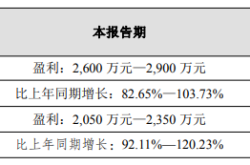
Net Profit Anticipated to Skyrocket by 103%: What Gives This Optical Company a Competitive Edge?
-
In Just One Year, China Unveils Unicorns Valued at 10 Trillion Yuan!
-
![]()
6 Park Companies Shine at WAIC: How Hong Kong Science Park Bridges AI from Research to Industry
-
![]()
Wang Wenjing’s Third Act: Can Yonyou Reinvent Itself in the AI Era?
-
![]()
Performance Coupe Entry Threshold Reduced to 170,000 Yuan: Assessing the 2027 Exeed ES's Prospects
-
![]()
Battery "Crisis" for 4 Million New Energy Commercial Vehicles
-
【Focus】Fluorinated Photosensitive Polyimide (FPSPI): A High-End Subdivision of PSPI with Great Potential in High-Tech Industries