Kimi K3 Tops Global Code Arena: Has the 'DeepSeek 2.0 Moment' Arrived for Chinese Models?
 07/20 2026
 547
547
The 2.8-trillion-parameter open-source model Kimi K3 has claimed the top spot on a leading global frontend code benchmark, outperforming Claude Fable 5 and GPT-5.6 Sol in multiple core capabilities. Chinese large models are moving beyond catch-up to help shape the frontiers of AI technology.

Chinese large models have achieved a critical breakthrough in global AI technology competition. On July 16, Moonshot AI officially released its flagship model Kimi K3. With 2.8 trillion total parameters, it stands as the world's largest open-source model by scale, featuring native visual understanding capabilities and a massive 1-million-Token context window.
Ranked first on Arena.ai's highly credible Frontend Code Arena leaderboard with a score of 1,679, Kimi K3 surpassed Claude Fable 5 (1,631) and GPT-5.6 Sol (1,618), setting a new benchmark record.
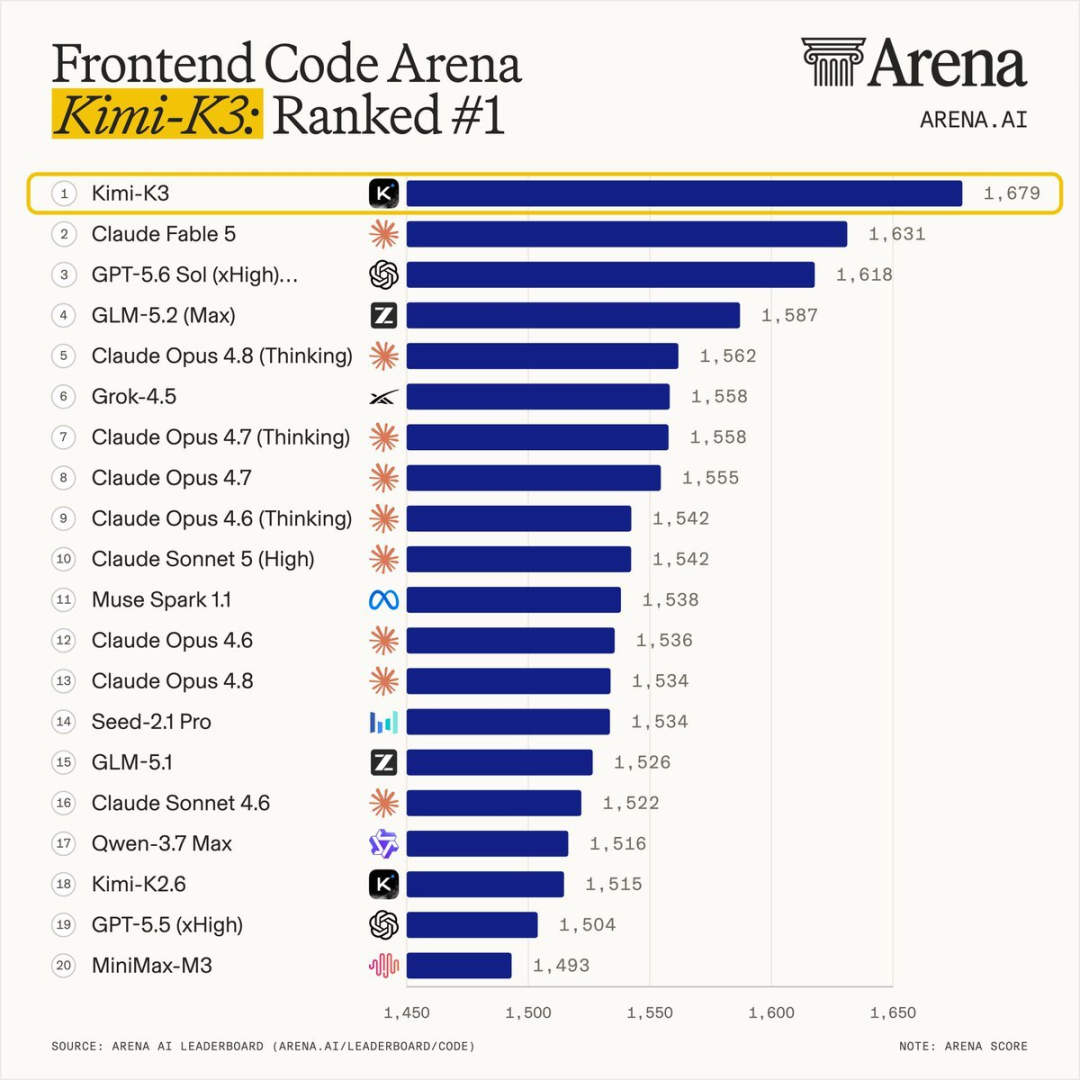
Image: Kimi K3 temporarily ranks first on Arena.ai's Frontend Code Arena with 1,679 points
Source: Arena official leaderboard and official X account
The core value of the Frontend Code Arena leaderboard lies in its real-user anonymous evaluation mechanism, ensuring highly credible results. The platform randomly assigns identical frontend development tasks to two anonymous models, with real users voting after experiencing the generated web pages and applications. Model identities are only revealed after voting concludes.
Evaluation dimensions extend beyond code operability to comprehensively assess visual fidelity, functional completeness, interaction design rationality, and product aesthetic quality. This makes it an authoritative benchmark balancing technical practicality and product implementation effectiveness.
Arena's official data reveals Kimi K3 achieved an average win rate of 76% in head-to-head anonymous frontend model battles, significantly outperforming Claude Fable 5 (63%) and GPT-5.6 Sol (58%).
Across seven evaluation categories, Kimi K3 secured first place in six individual metrics, only ranking second in gaming tasks. Compared to its predecessor Kimi K2.6's 18th-place global ranking, K3 made a 17-position leap in a single upgrade, becoming the first Chinese open-source model to top this global mainstream code arena.
Kimi K3 did not continue the ultra-low-price strategy common among Chinese models. Its pricing aligns with Claude Sonnet 4.6's current standard rates and matches Claude Sonnet 5's post-discount standard pricing.
K3's official API pricing stands at $0.3 per million Tokens for cache-hit inputs, $3 for cache-miss inputs, and $15 for outputs. Domestic prices approximate ¥2, ¥20, and ¥100 respectively. Calculated using the same metrics for non-cached inputs and outputs, both K3 prices are 30% of Claude Fable 5's rates.
According to an Associated Press report citing Bank of America analysts, Kimi K3 became the highest-priced Chinese AI model at launch.
For comparison, GLM-5.2 charges $1.4 and $4.4 per million Tokens for inputs and outputs respectively, while Alibaba Cloud's Qwen3.7-Max is priced at $2.5 and $7.5 in international regions. Compared to Moonshot's previous Kimi K2.7 Code, K3's output price increased from $4 to $15 (3.75x). Moonshot's API pricing has shifted from the low-cost segment of Chinese models to Anthropic's mid-range model price band.
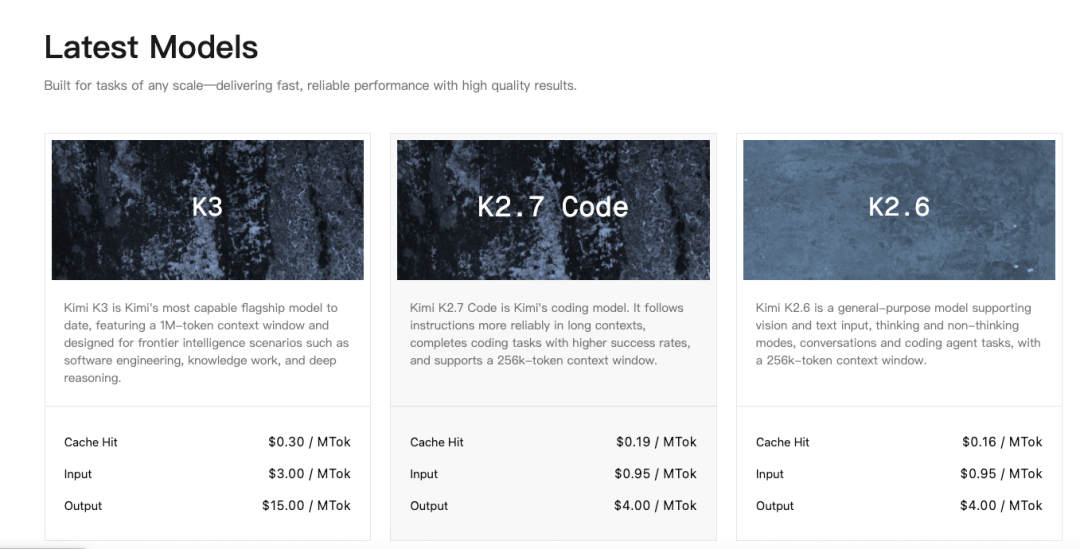
Image: Kimi International API page listing prices for K3, K2.7 Code, and K2.6
Source: Kimi API Platform
Kimi K3's breakthrough has gained global industry recognition, with Tesla CEO Elon Musk commenting "Impressive" under related evaluation posts.
Yang Zhilin, founder of Moonshot AI (Kimi's parent company), received public congratulations from his PhD advisor at Carnegie Mellon University, Ruslan Salakhutdinov, who called this breakthrough a major victory for the open model community.
Notably, Kimi K3 does not dominate overseas top models in all dimensions but has delivered a landmark achievement for Chinese large models in global competition through its open-source nature, differentiated technical advantages, and cost-effective services.

Frontend, Engineering, and Agent Capabilities: What Makes Kimi K3 Strong?
Moonshot AI identifies three core strengths of Kimi K3: long-form coding, frontend and 3D spatial visual reasoning, and agentic execution for complex knowledge work and deep reasoning.
In frontend and 3D spatial visual reasoning, Kimi K3 integrates spatial structure, visual effects, interaction logic, and engineering implementation into a single development cycle.
Official case studies show Kimi K3 completed a 3D simulation of the Long March 10 rocket's launch and recovery, and generated an interactive 3D open-world game featuring procedurally generated forests, wooden villages, snow-capped mountains, and dynamic weather. The model developed the game primarily using Three.js, WebGPU, and GPU Compute in browsers, with rider and horse models generated by external tools.
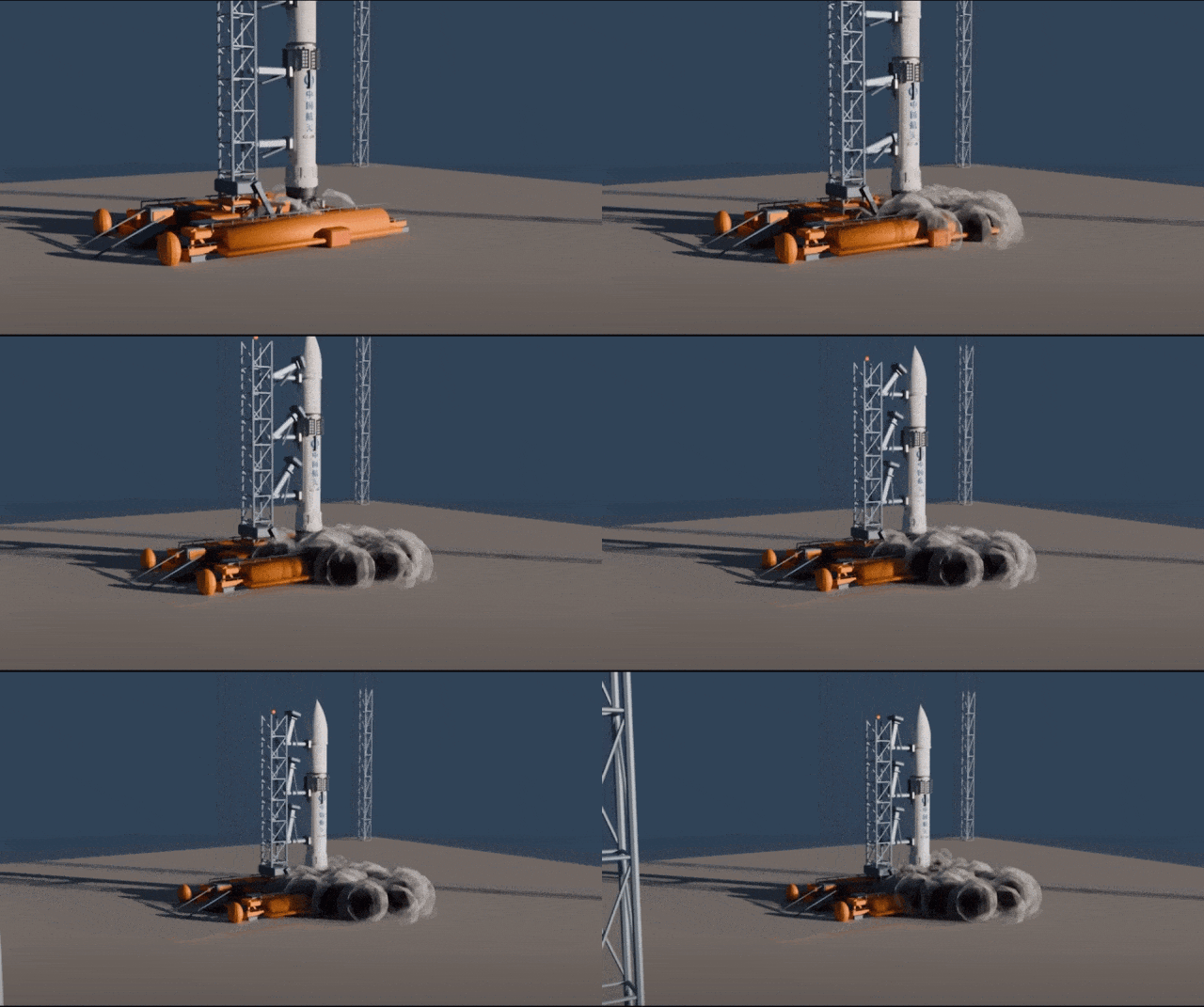
Image: Kimi K3-generated 3D simulation of Long March 10 rocket launch and recovery, demonstrated by Kimi official
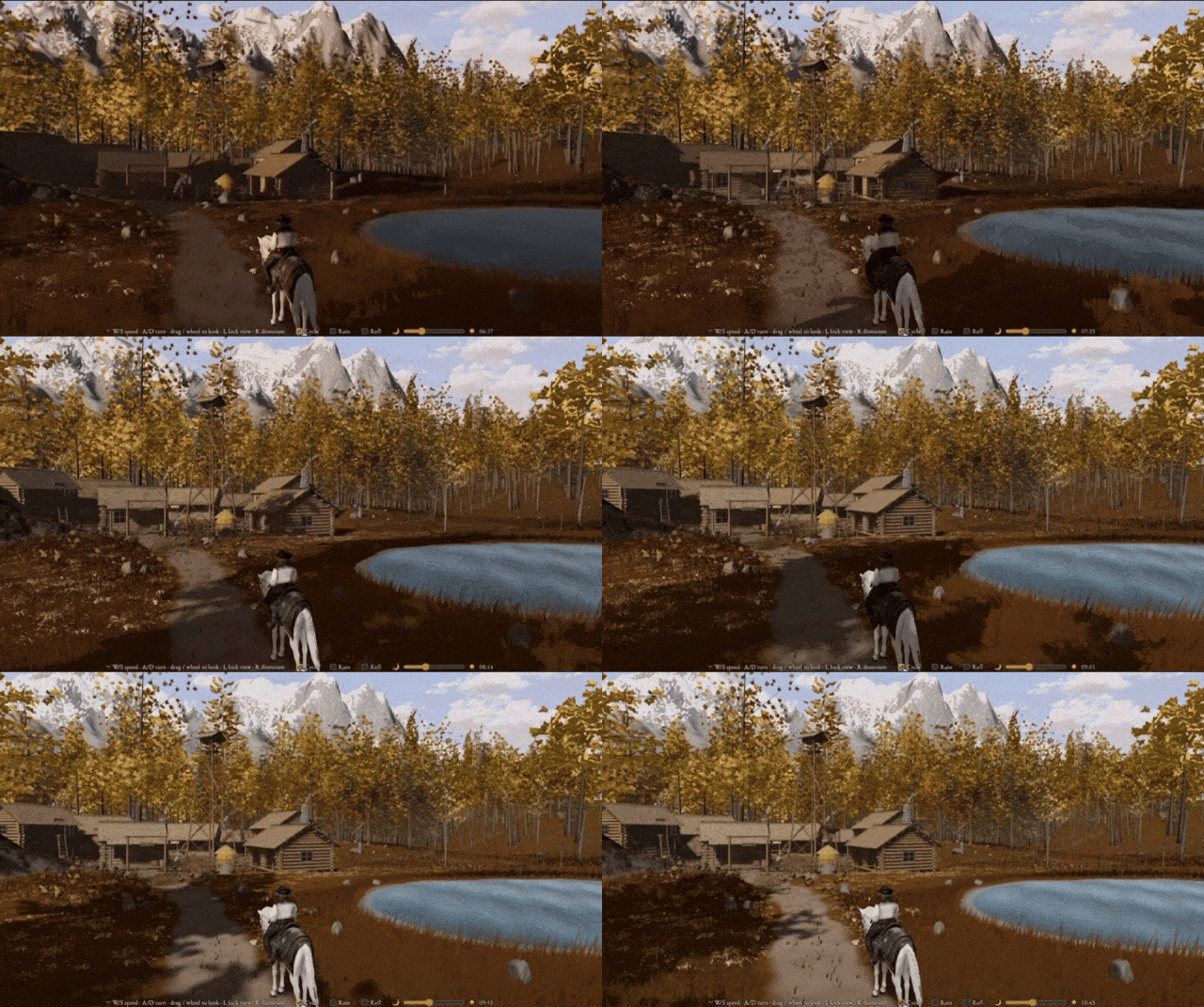
Image: Kimi K3-generated 3D open-world game scene, demonstrated by Kimi official
Moonshot AI calls this capability "vision in the loop": the model not only writes code based on images but also observes runtime results, identifies visual or logical issues through screenshots, and continues refining. Visual feedback thus enters the software development process, suitable for tasks requiring both spatial understanding and engineering implementation like frontend development, gaming, animation, and CAD.
In long-form coding, Kimi K3 can sustain task progression by connecting information retrieval, code writing, testing, and result verification into complete workflows. According to Moonshot AI, K3 reproduced work that typically takes senior researchers 1-2 weeks in about two hours, calculating the "I-Love-Q" universal relations in computational astrophysics.
It read and cross-verified over 20 papers, built numerical calculation pipelines, evaluated 300+ equations of state, identified inconsistencies in published formulas, and ultimately generated 3,000+ lines of Python code along with an interactive HTML dashboard.
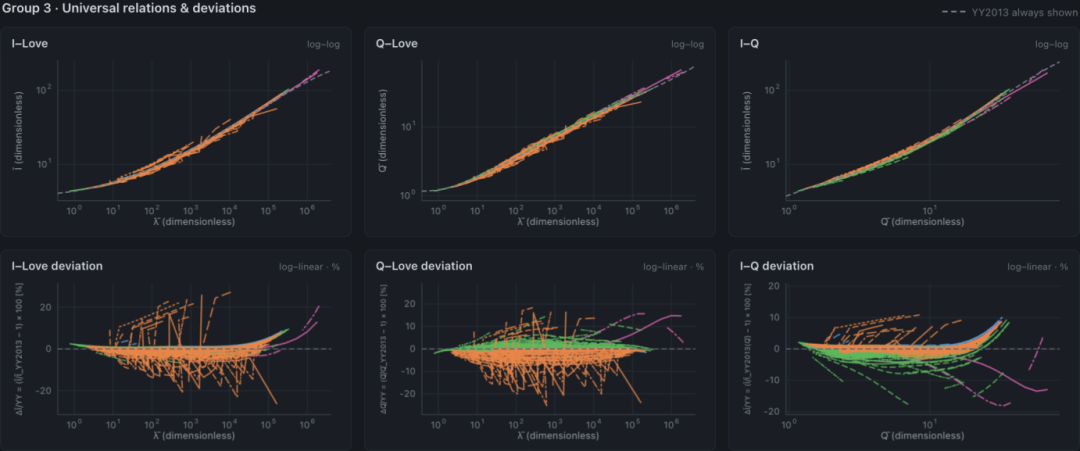
Image: Interactive charts generated by Kimi K3 in the official I–Love–Q scientific programming case, showing I–Love, Q–Love, and I–Q relationships with deviations
Source: Kimi K3 official technical blog and official interactive page
For complex knowledge work, Kimi K3 demonstrated capabilities in sustained information retrieval, tool invocation, data processing, and delivering research outputs.
In an ASIC industry research case, the model underwent 120+ rounds of recursive improvements, executing 2,800+ web searches/scrapings and 1,100+ terminal data extractions while processing over 11,000 pages of materials including 87 quarterly reports and 99 raw PDFs. It ultimately generated an interactive research website covering 42 years of industry history. For fusion energy research, K3 produced a consulting report featuring timelines, tree diagrams, waterfall charts, and Gantt charts.
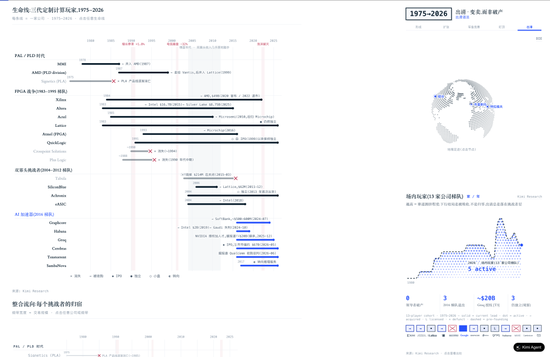
Image: Interactive timeline page generated by Kimi K3 in the official ASIC industry research case
Source: Kimi K3 official technical blog, Kimi Work case
During another 48-hour autonomous operation, the model completed chip design, optimization, and simulation verification using open-source EDA tools. These projects await third-party reproduction after full weight release but already indicate K3's research direction shifting from answering questions to delivering complete work products.

Image: Official demonstration of Kimi K3 completing chip design proof-of-concept in 48 hours; throughput data comes from simulation, not physical chip testing
Source: Kimi K3 official technical blog

Behind 2.8 Trillion Parameters: Three Architectural Innovations Solving Large Model Challenges
Kimi K3 employs a sparse mixture-of-experts (MoE) architecture with 2.8 trillion total parameters and 896 experts, but only activates 16 per Token. Expanding total parameters increases model capacity, while sparse activation controls per-inference costs.
The core architectures supporting this scale include Kimi Delta Attention, Attention Residuals, and Stable LatentMoE.
Kimi Delta Attention (KDA) primarily addresses computational efficiency for long contexts. Traditional full attention's computational load grows rapidly with sequence length. KDA reduces long-sequence processing costs through hybrid linear attention, enabling the model to handle million-Token-scale codebases, research materials, and sustained agent tasks.
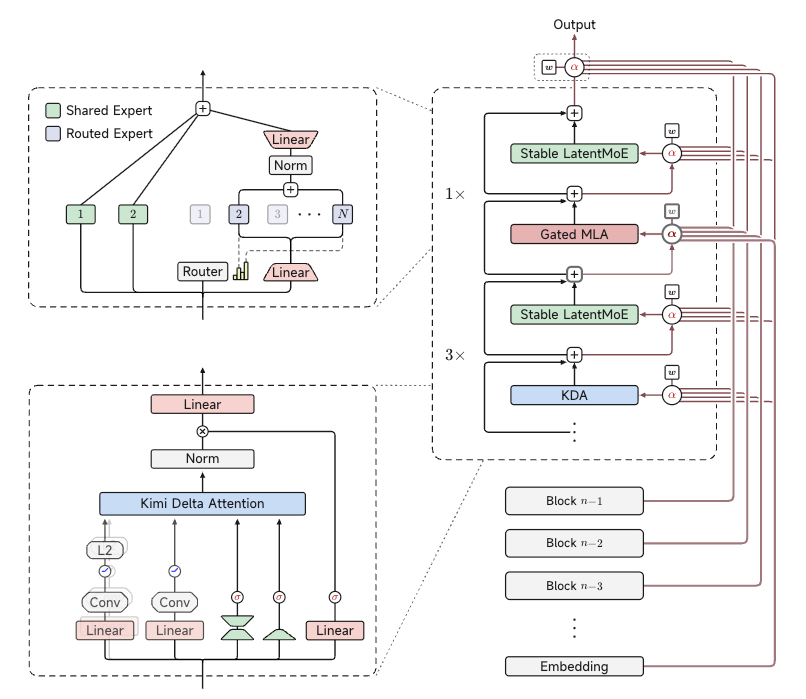
Image: Kimi K3 model architecture diagram featuring KDA, Stable LatentMoE, Gated MLA, and cross-layer AttnRes connections
Source: Kimi K3 official technical blog
Attention Residuals (AttnRes) primarily solves information transfer challenges in ultra-deep models. It allows the model to selectively retrieve representations formed at different depths, preventing important information from being diluted during layer-by-layer propagation. Simply put, KDA enables the model to "see longer," while AttnRes ensures information "transmits deeper."
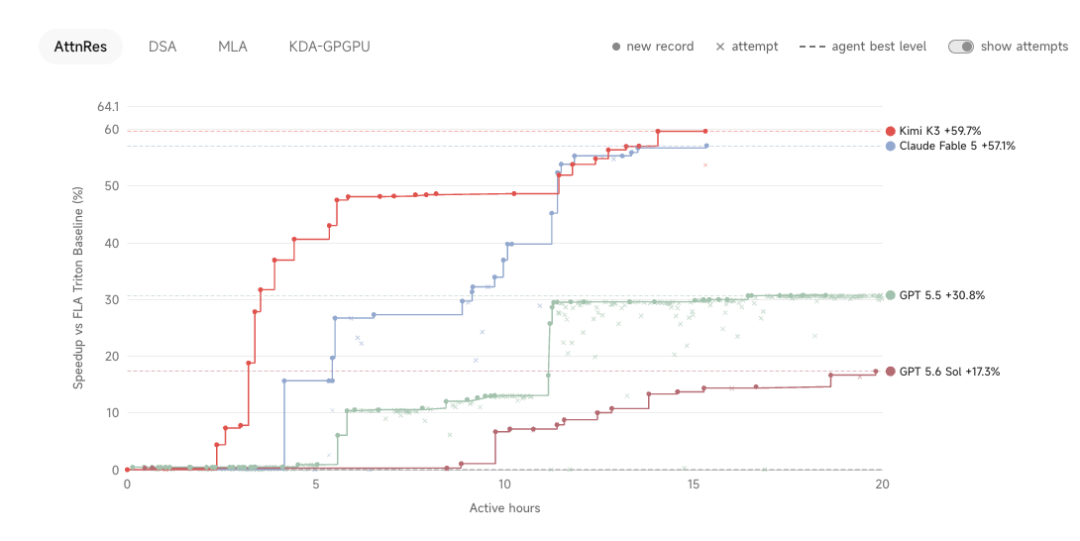
Image: Progress of different models in AttnRes GPU kernel optimization tasks, with vertical axis showing acceleration relative to FLA Triton baseline
Source: Kimi K3 official technical blog
Stable LatentMoE manages routing and collaboration among 896 experts. Combined with expert load balancing, quantization-aware training, and MXFP4 weights with MXFP8 activations, Moonshot AI claims Kimi K3 achieves about 2.5x scaling efficiency compared to Kimi K2.
Despite its sparse and quantized design, Moonshot AI officially recommends deploying Kimi K3 on super-nodes composed of 64+ accelerator cards. It cannot run directly on ordinary personal computers, with its open weights primarily serving cloud providers, research institutions, and large enterprises.
Kimi K3 has scaled the size of open-source models to 2.8 trillion parameters, topping the Frontend Code Arena and outperforming Claude Fable 5 and GPT-5.6 Sol in blind tests with human evaluators. It offers its services at just 30% of the API listing price of Fable 5. The convergence of scale, performance, openness, and cost-effectiveness in a single Chinese model is what makes Kimi K3 truly remarkable.
The so-called 'DeepSeek Moment' may not belong to just one company. Chinese models are transitioning from chasing global frontiers to actively shaping them.
References
Moonshot AI 《Kimi K3: Open Frontier Intelligence》
Kimi API Platform 《Model List》
Kimi API Platform 《Model Inference Pricing Explanation》
Arena.ai 《Code Arena | WebDev》
Official Arena X Account 《Big news: Kimi-K3 by @Kimi_Moonshot is now #1 in the Frontend Code Arena with 1679 pts, surpassing Claude Fable 5》
Official Arena X Account 《Kimi-K3 just topped the Frontend Code Arena with a 76% pairwise win rate》
Anthropic 《Claude Fable 5 and Claude Mythos 5》
Kimi Team 《Kimi Linear: An Expressive, Efficient Attention Architecture》
Kimi Team 《Attention Residuals》
Moonshot AI 《Compact-star I–Love–Q universal relations · interactive atlas (EN)》
Xinhua News 《New Breakthrough: Chinese Enterprise Releases World's Largest Open-Source Model Kimi K3》
Beijing Haidian 《World's First! Haidian-Based Enterprise Releases 3-Trillion-Parameter Open-Source Model Kimi K3》
Associated Press 《Chinese AI model takes US tech industry by surprise with abilities rivaling Claude and ChatGPT》
THE END
Copyright and Disclaimer
1. Content Copyright: Except for publicly available data, policies, and cases cited herein, all content is original. Professional data is sourced from authorized databases and official government websites, with cases compiled from real events.
2. Image Licensing: Some images in this article are proprietary or officially licensed, while others are AI-generated. For any online images with unclear copyright status, ownership remains with the original authors, and any infringement will be removed upon notification.
3. Reprint Guidelines: Unauthorized reproduction is prohibited. Reprints must retain the full source and author attribution.
4. Liability Disclaimer: This article represents the author's observations on business figures and industry commentary based on publicly available information. It is provided for reference only and does not constitute professional advice. Any risks arising from its use are borne by the user. Moonshot AI reserves the final interpretation rights to this article.
-
![]()
Personnel Shuffle: Independent Director Mi Xuming Steps Down from OFILM
-
![]()
Net Profit Anticipated to Skyrocket by 103%: What Gives This Optical Company a Competitive Edge?
-
In Just One Year, China Unveils Unicorns Valued at 10 Trillion Yuan!
-
![]()
6 Park Companies Shine at WAIC: How Hong Kong Science Park Bridges AI from Research to Industry
-
![]()
Wang Wenjing’s Third Act: Can Yonyou Reinvent Itself in the AI Era?
-
![]()
Performance Coupe Entry Threshold Reduced to 170,000 Yuan: Assessing the 2027 Exeed ES's Prospects
-
![]()
Battery "Crisis" for 4 Million New Energy Commercial Vehicles
-
【Focus】Fluorinated Photosensitive Polyimide (FPSPI): A High-End Subdivision of PSPI with Great Potential in High-Tech Industries