Computing Power Infrastructure: Facing an Abrupt Slowdown?
 07/20 2026
 364
364
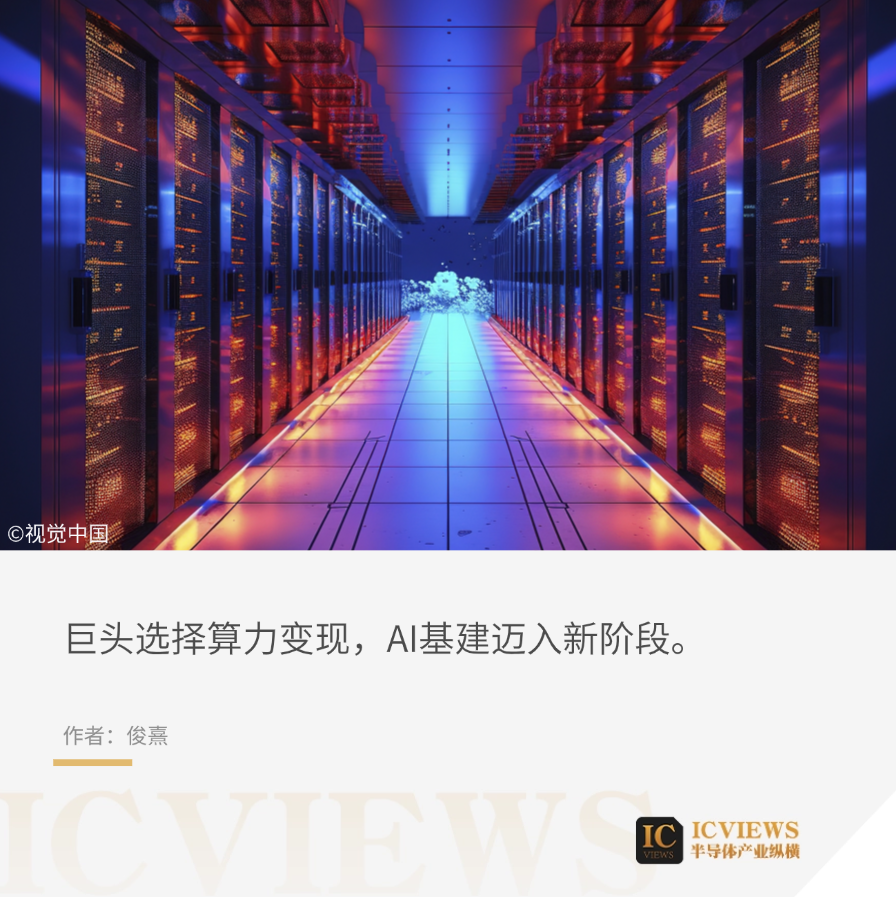
Recently, the global AI infrastructure sector has witnessed abrupt changes. First, Meta announced plans to lease some of its idle AI computing power externally, triggering significant turbulence in the capital markets. Subsequently, SoftBank Group officially established a new company, SB Neo, to aggressively enter the U.S. computing power leasing market. Meanwhile, Blackstone Group, a veteran private equity firm, abruptly halted its planned investment of over $100 billion in the world's largest data center project, while Microsoft abandoned a $3 billion cloud computing power leasing agreement with Oracle due to security concerns.
On one hand, tech giants are entering the 'computing power leasing' business; on the other, multi-billion-dollar infrastructure projects are hitting the brakes. These seemingly contradictory moves have left the market wondering: Is there an oversupply of AI computing power? Is the investment bubble in computing power infrastructure about to burst?
From the perspective of the semiconductor industry, what we are witnessing is not a simple 'oversupply of computing power' but a profound restructuring of the AI industry's development logic. The era of 'wild growth' characterized by at all costs (cost-insensitive expansion) and rapid territory grabbing over the past two years is coming to an end, and the competition for AI infrastructure is comprehensively entering a new phase where 'efficiency is king.'
01 Giants Choosing to Monetize Computing Power?
In July 2026, Meta announced plans to launch a cloud infrastructure business, selling AI computing power and model access rights to external clients. The news sent Meta's stock price surging nearly 9% in a single day, increasing its market value by approximately $127 billion. However, the AI computing power supply chain collectively came under pressure—shares of emerging computing power leasing players like CoreWeave and Nebius plummeted by over 13%, while memory chip giants Micron, SK Hynix, and Samsung Electronics all recorded significant declines.
The market's initial reaction was panic: If even Meta cannot consume its own GPUs, it indicates an oversupply of computing power.
However, this linear thinking overlooks the uniqueness of AI computing power assets and the true intentions of the tech giants. Meta's leasing behavior is essentially an upgrade in asset operational efficiency, not a signal of peak demand.
In 2026, Meta's capital expenditure guidance reached $125 billion to $145 billion, with the vast majority allocated to data centers and GPU procurement. To date, Meta has committed a cumulative $183 billion to AI infrastructure investment. As a company that derives 98% of its revenue from advertising, Meta's annual investment of hundreds of billions of dollars has resulted in a massive computing power cluster, but its open-source Llama model does not generate direct revenue. Monetizing previous-generation or temporarily idle computing resources externally not only directly dilutes depreciation and operational costs but also represents a crucial step in transforming GPU clusters from 'pure cost centers' to 'revenue-generating assets.' Morgan Stanley estimates that if Meta leases 250MW of computing power for a year, it could generate approximately $10 billion in revenue.
This is not unique to Meta. Previously, xAI, led by Elon Musk, successfully leased computing power from its Colossus supercomputing cluster on a massive scale. According to multiple media reports, Anthropic rented the entire capacity of Colossus 1—about 220,000 Nvidia GPUs—paying $1.25 billion per month in rent, with a contract term extending to May 2029, totaling approximately $40 billion. Google also pays $920 million per month to lease bridging computing power to compensate for its own data center construction delays. These two transactions alone generate over $2.1 billion in monthly cash flow for SpaceX. According to institutional calculations, at this monthly rental level, the implied return on investment suggests that all capital expenditures could be recovered in approximately two years.
SoftBank Group's entry further underscores the attractiveness of this sector. On July 2, SoftBank announced the establishment of SB Neo, planning to launch cloud services based on Nvidia's latest GPUs for U.S. enterprises by fiscal year 2027, with a goal of building 10GW of AI data center infrastructure, initially deploying at an 800MW site in Ohio. To support this expansion, SoftBank is securing a $10 billion loan using its OpenAI shares as collateral.
From Meta to xAI to SoftBank, tech giants are becoming 'computing power landlords' not because they no longer need computing power but because, against the backdrop of high computing power capital expenditures, they must seek new paths for return on investment. As Tianfeng Securities points out: 'Meta's foray into AI cloud does not mean an overall oversupply of GPUs. This is not the end of AI capital expenditure transactions but an evolution of business models from purely money-burning infrastructure to chargeable platform assets.'
Notably, Synergy Research data shows that the 2025 revenue of the neocloud (new computing power cloud) market exceeded $25 billion, growing by over 200% year-on-year. Gartner predicts that by 2030, neocloud providers will capture 20% of the AI cloud market. However, McKinsey warns that this business model faces commoditization risks—when GPU supply gradually eases, models relying solely on GPU availability will face margin compression. The entry of hyperscale enterprises like Meta undoubtedly intensifies this competitive pressure.
02 Data Center Construction Hits Bottlenecks While the computing power leasing market heats up, physical data center construction is repeatedly hitting walls of reality.
In early July, QTS, a data center operator under Blackstone Group, officially halted the Digital Gateway project in Virginia. Spanning 2,100 acres with a planned investment exceeding $100 billion, the project aimed to build 37 data center buildings, which would have made it the world's largest data center campus upon completion. However, after five years of local resident resistance, a judicial blow from a state court ruling the zoning approval invalid, and multiple pressures from partners withdrawing first, Blackstone ultimately chose to cut its losses and exit. A few days earlier, Blackstone had sold three mature data center assets in Virginia for $3.5 billion, signaling a clear strategic contraction.
Similarly, in June, computing infrastructure company Crusoe announced a 'pause' on a massive 1.8GW data center project in Wyoming. According to reports, this was due to pressure from its primary client, Google, which raised 'serious concerns' about the project. The project's electricity consumption would have been sufficient to power a medium-sized city.
The collapse of these mega-projects exposes multiple real-world dilemmas underlying the rapid expansion of AI computing power infrastructure.
First is the physical bottleneck of power supply. Data centers are veritable 'electricity hogs.' According to the U.S. Electric Power Research Institute, data centers currently account for 5% of U.S. electricity demand, a figure that could triple by 2035. In Virginia—the region with the highest concentration of data centers globally—this proportion already exceeds 25%. The existing power grid simply cannot match the scale and growth rate of AI infrastructure demand. Morgan Stanley analysis shows that over 60% of data center projects planned for completion by 2027 have not yet commenced construction, with power supply bottlenecks being one of the core reasons. In the first quarter of 2025 alone, the total value of delayed data center projects across the U.S. reached approximately $130 billion.
Second is community resistance and policy tightening. A Gallup poll shows that 70% of Americans oppose building AI data centers near their homes. High energy consumption, noise, water usage, and the resulting rise in living costs frequently obstruct grand AI narratives at the community level. In the first quarter of 2026, opponents hindered or delayed at least 75 data center projects across the U.S. The number of active grassroots opposition groups targeting data centers surged from 396 at the end of 2025 to 833 by March 2026, covering 49 states. In 2025, the number of canceled data center projects quadrupled to 25, with $18 billion in projects blocked and $46 billion delayed.
Additionally, compliance and security requirements have become constraining factors. Microsoft abandoned its $3 billion cloud computing power leasing agreement with Oracle because Oracle lacked the federal security certifications required to manage U.S. government data and was unwilling to undergo large-scale engineering modifications for compliance. This incident demonstrates that, against the backdrop of increasingly abundant computing power supply, security compliance is becoming a hard threshold for computing power transactions.
Power shortages, water scarcity, and permitting delays are replacing 'chip shortages' as the biggest constraints on computing power infrastructure. Blackstone's exit and Crusoe's pause signal that capital's attitude toward AI infrastructure investment is shifting from frenzy to rationality. These bottlenecks will not eliminate computing power demand but will delay its realization—locked-in orders will not disappear, but the landing cycle for new projects will significantly lengthen.
03 Computing Power Supply and Demand: Ushering in a New Landscape
What do the rise of computing power leasing and the slowdown in infrastructure projects mean for the semiconductor supply chain?
First, it must be clarified that high-end AI computing power is not in oversupply. Industry research points out that the current computing power market suffers from 'structural mismatches'—while some low-end general-purpose computing power lacking application scenarios sits idle, the shortage of high-end intelligent computing power supporting large model training remains as high as 40%, with demand outstripping supply.
This assessment is fully corroborated by the financial reports of semiconductor giants. Nvidia's FY2026 revenue reached a record $215.9 billion, up 65% year-on-year, with data center revenue accounting for nearly 90% at $193.7 billion. The latest quarterly report was even more impressive, with data center revenue surging 92% year-on-year. TSMC CEO C.C. Wei explicitly stated in June that global AI chip demand remains strong, and despite efforts to expand production, supply will still fall short of demand for years to come. TSMC's May revenue soared 30% year-on-year, with 2026 capital expenditures projected at $52 billion to $56 billion, internally leaning toward the upper limit. According to the latest reports, AI chip manufacturers like Nvidia still face shortages, with TSMC's advanced node and advanced packaging capacities remaining tight.
In the memory sector, competition for HBM remains fierce. SK Hynix, leveraging its leadership in the HBM market, has surpassed Samsung Electronics in market value to become South Korea's most valuable company. Samsung and SK Hynix have advanced the mass production timeline for next-generation HBM4 to early 2026 to meet surging AI demand.
However, the proliferation of computing power leasing models is indeed reshaping procurement logic in the supply chain. When Meta, xAI, and other giants open their computing power to external clients, they are effectively boosting society's overall computing power utilization. Small and medium-sized AI enterprises no longer need to purchase expensive hardware but instead turn to leasing. An Apollo report notes that GPU prices have surged approximately eightfold since early 2025, making leasing models more attractive to SMEs. This resource-sharing model has, to some extent, slowed the absolute growth rate of total computing power demand, prompting cloud providers to prioritize cost-effectiveness and energy efficiency when procuring hardware.
This is also why AI giants are investing in self-developed chips. On June 24, OpenAI, in collaboration with Broadcom, officially launched Jalapeño, its first self-developed chip optimized for large model inference—designed and produced in just nine months. Meanwhile, Anthropic is negotiating with Samsung for custom AI chip development; Meta's fourth-generation self-developed chip, 'Iris,' is scheduled for mass production in September, aiming to double computing power. Faced with high GPU costs, AI giants are reducing unit inference costs through customized specialized chips, reducing reliance on Nvidia. This trend benefits chip design companies like Broadcom but poses potential long-term threats to Nvidia's market share in inference.
From a broader supply chain perspective, the rise of computing power leasing models is fostering a new mechanism for supply-demand balance. Traditionally, the AI computing power supply chain was linear: chip designers shipped to cloud providers, who either used the computing power internally or resold it to end clients. Today, tech giants are both the largest chip buyers and computing power lessors, a dual identity that significantly boosts the efficiency of computing power resource allocation. For semiconductor equipment manufacturers, this means downstream clients' procurement behaviors will become more rational—no longer panic buying but Refined procurement (precision procurement based on actual utilization and ROI). In the short term, this may slow some order rhythms; but in the long run, a healthier demand structure benefits sustainable growth across the supply chain.
-
![]()
After Three Attempts to List on the Hong Kong Stock Exchange, Has Yonyou Finally Broken Free from Its Painful Transition?
-
![]()
Qianwen Powers Apple’s AI: Alibaba Secures Its ‘Doubao Moment’ with iPhone Integration
-
![]()
JD Marches West, Pinduoduo Ventures East: The Clandestine Struggle for China’s Supply Chain Dominance
-
![]()
GAC Honda Secures 10-Year Contract Renewal: Debunks Merger Rumors, Unites for Market Breakthrough | Mirror Pro
-
![]()
Analysis of BBA Service Reputation Index in the First Half of 2026: Terminal Services Under Pressure
-
Observation of AI Business Models: From Token-Based Payment to Outcome-Based Payment
-
Observations on AI Business Models: From Token-Based Payment to Outcome-Based Payment
-
SpaceX Market Insight: The $1 Trillion 'Fireworks' Fizzle Out, Marking the Start of the Super IPO Gamble