After Three Attempts to List on the Hong Kong Stock Exchange, Has Yonyou Finally Broken Free from Its Painful Transition?
 07/21 2026
 543
543
Yonyou reported a concerning figure in its 2026 semi-annual earnings forecast: "Severance compensation amounts to approximately RMB 170 million, marking a year-on-year increase of RMB 40 million."
Typically, listed companies shy away from disclosing 'layoff' data in their financial reports, as it sends a negative signal to the market. Yonyou's decision to do so is understandable, given the significant proportion of severance compensation compared to its 'profits'.
The semi-annual earnings forecast reveals that the net profit attributable to the parent company's owners, after deducting non-recurring items, is expected to range from a loss of RMB 818 million to a loss of RMB 948 million.
Just one day after the earnings forecast was released, Yonyou submitted its third listing application to the Hong Kong Stock Exchange.
The idea of listing on the Hong Kong Stock Exchange was reignited with the return of Yonyou's founder, Wang Wenjing.
On April 1, 2025, Yonyou's former CEO, Huang Chenhong, stepped down, and founder Wang Wenjing reassumed the CEO position. Merely three weeks later, on April 22, Yonyou submitted its initial application form to the Hong Kong Stock Exchange.
In recent years, Yonyou's ambition has been to narrate a fresh tale to the capital markets: how a traditional software company can transform into a cloud services provider and subsequently evolve into an AI services company.
However, judging by Yonyou's financial data, this transformation has been anything but smooth.
▌1. Transition Losses Still Loom Large
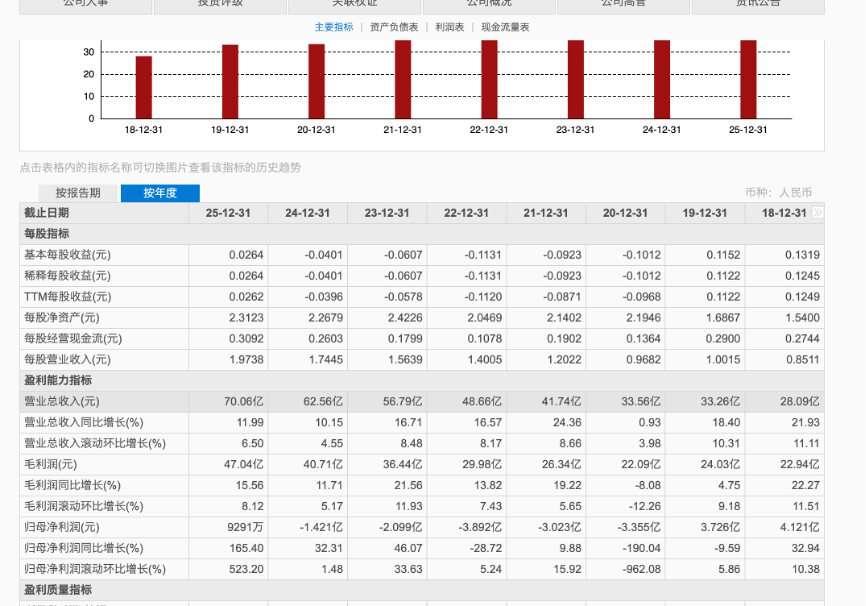
Since 2023, Yonyou has been grappling with losses.
Data from the past few years indicates a significant turning point in Yonyou's financials in 2023, with net profit turning negative and losses ballooning to RMB 2 billion at one juncture.
In terms of revenue, after peaking at RMB 9.796 billion in 2023, Yonyou's revenue declined, with figures for 2024 and 2025 standing at RMB 9.153 billion and RMB 9.182 billion, respectively.
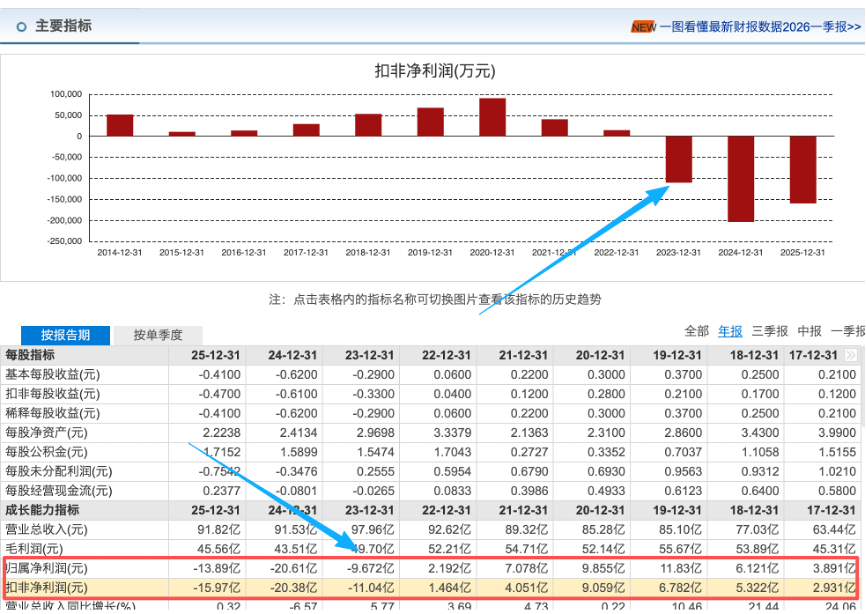
(Yonyou began incurring losses in 2023. Data source: East Money)
From a business perspective, Yonyou's short-term revenue decline is attributed to its cloud strategy transition, with sales models shifting from predominantly one-time licensing fees to subscription-based models, resulting in short-term sales dips.
Yonyou explained in its 2024 financial report that, "A more aggressive promotion of the subscription business model has had a certain impact on short-term overall revenue."
However, Yonyou's latest Hong Kong Stock Exchange prospectus reveals a more complex picture.
The prospectus includes a revenue indicator category, 'Goods/services transferred at a specific point in time,' which plummeted from RMB 4.11 billion in 2023 to RMB 3.35 billion and RMB 2.99 billion in 2024. Conversely, revenue from 'services transferred over time' was RMB 5.34 billion in 2023 and RMB 5.47 billion and RMB 5.88 billion in 2024 and 2025, respectively, without showing proportional or significant growth.
In simpler terms, the orders lost from one-time licensing and buyouts have not been proportionally offset over the coming years.
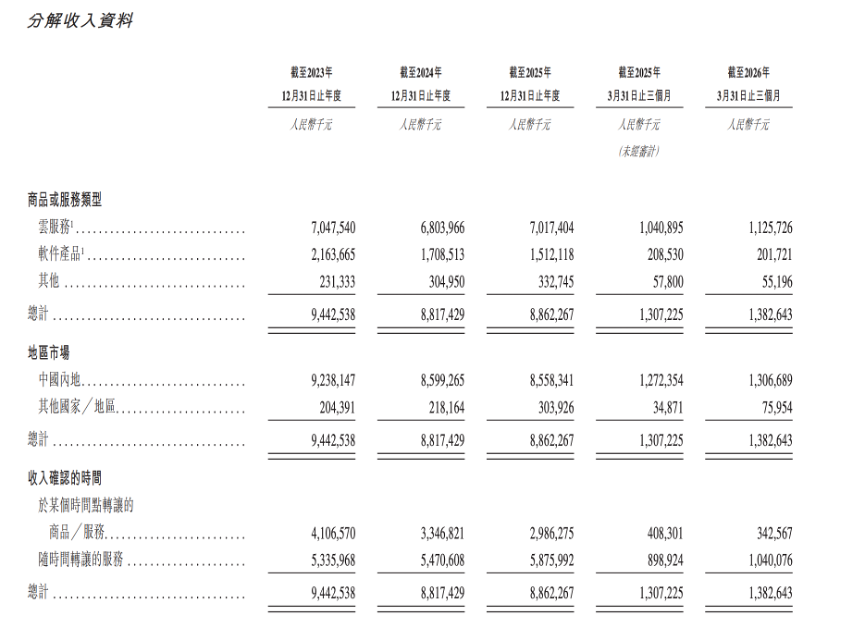
(Yonyou's revenue breakdown by type from 2023 to 2025. Data source: Hong Kong Stock Exchange prospectus)
Meanwhile, issues have arisen with medium and large enterprises, Yonyou's core customer base.
At the end of 2025, Yonyou's accounts receivable balance was RMB 3.359 billion, roughly on par with the RMB 3.348 billion at the end of 2024. However, bad debt provisions surged from RMB 926 million at the end of 2024 to RMB 1.078 billion, with an increase in provisions of nearly RMB 150 million within a year, and the overall provision ratio reached 32.1%.
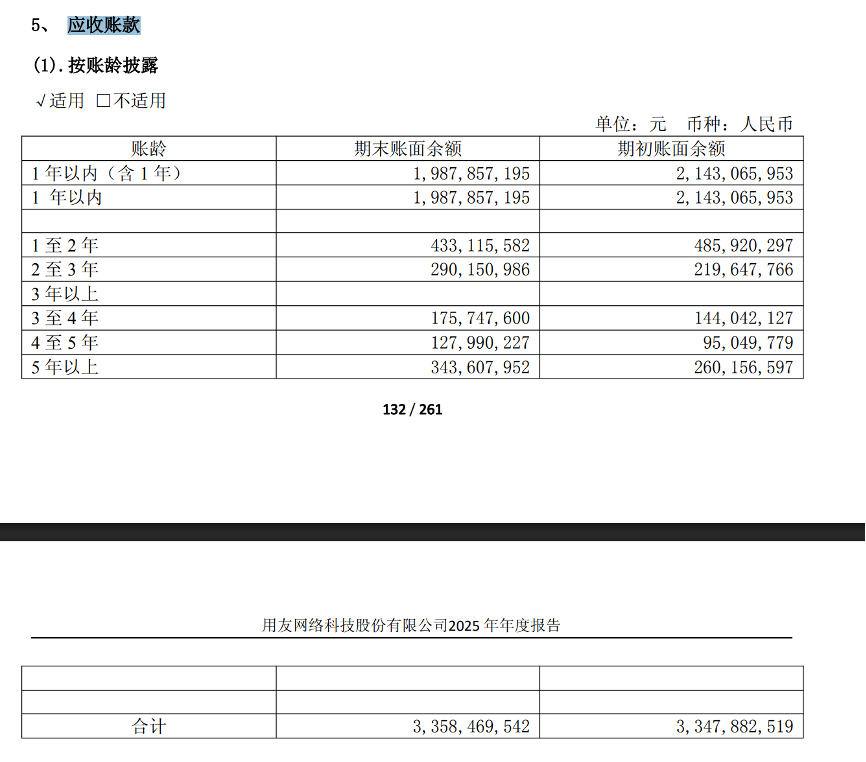
(Yonyou's accounts receivable and aging situation. Data source: 2025 annual report)
Notably, the concentration of the top five debtors in accounts receivable is low (accounting for only about 4% of the total), indicating that the collection issue is not attributable to a single major customer default.
Currently, Yonyou's stock price has plummeted from its peak of RMB 53.57 per share in 2020 to RMB 9 per share, with its market capitalization shrinking from over RMB 170 billion to just RMB 31 billion.
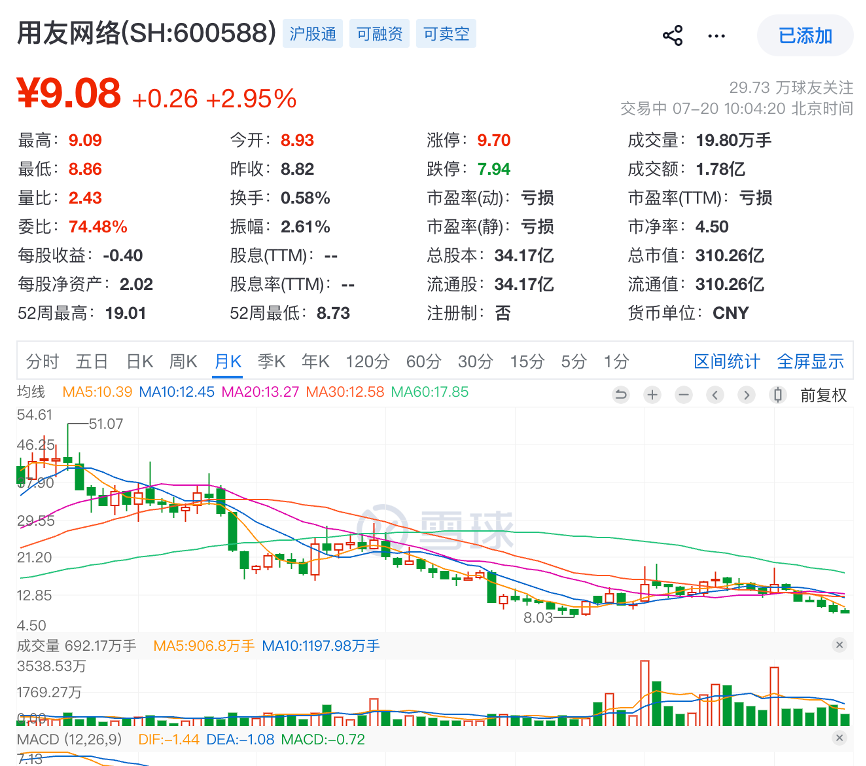
(Yonyou's stock price performance. Data source: Snowball)
In contrast, Kingdee, another leading domestic enterprise services provider, has staged a remarkable turnaround from years of losses, posting a net profit of RMB 93 million in 2025. In 2025, Kingdee's revenue was RMB 7.006 billion, a year-on-year increase of 12.0%, with cloud revenue accounting for 82.5% and subscription revenue growing by 20.9%.
Notably, Kingdee's revenue nearly doubled from RMB 3.356 billion in 2020 to RMB 7 billion in 2025, while Yonyou's revenue grew from RMB 8.528 billion to RMB 9.182 billion, showing relatively modest growth.
Moreover, the gap between Kingdee and Yonyou narrowed from over RMB 5 billion (less than half of Yonyou's revenue) to RMB 2 billion, or 76% of Yonyou's revenue.
(Kingdee's revenue and profit performance over the past eight years. Data source: East Money)
▌2. Leadership Changes Amidst Expanding Losses
Despite continuous adjustments over the past two years, Yonyou has yet to recover from its turmoil.
In January 2019, Wang Wenjing stepped down as CEO of Yonyou Network for the first time to serve exclusively as chairman, with Chen Qiangbing taking over as CEO. However, in January 2021, Wang Wenjing returned and resumed the presidency.
On January 2, 2024, Wang Wenjing resigned as CEO again, with Chen Qiangbing taking the helm.
On January 2, 2025, Chen Qiangbing resigned, and Huang Chenhong, former president of SAP Greater China, stepped in. This tenure was even shorter—just 85 days later, on April 1, 2025, Huang Chenhong resigned, and founder Wang Wenjing reassumed the CEO role.
Examining these three significant leadership changes, in the years before 2019, Yonyou's performance was relatively stable, with revenue steadily increasing and profits maintained at a healthy level.
This was the operational landscape when Wang Wenjing first resigned as CEO. Against this backdrop, his resignation to focus on strategy and long-term planning as chairman was a logical move.
However, when Wang Wenjing returned as CEO in 2021, especially in the two years leading up to it, particularly in 2020, Yonyou's revenue experienced stagnant growth, and profits declined.
During the two years of industry-wide digitalization, Yonyou encountered a brief performance slump, and Wang Wenjing's return was seen as beneficial for capitalizing on opportunities in overall digitalization and domestic alternatives.
This was also the rationale behind Wang Wenjing's subsequent resignation after 2024, as his phased mission had been accomplished.
The situation took a turn in 2024. That year, Yonyou's revenue declined by 6.57% year-on-year to RMB 9.153 billion, and net losses expanded to RMB 2.061 billion, a year-on-year increase of 113%, marking the worst year for Yonyou since its listing.
In 2025, Chen Qiangbing resigned and was replaced by Huang Chenhong, former president of SAP Greater China, who left after three months, and founder Wang Wenjing reassumed the CEO role.
Yonyou's operational performance decline is now entirely unrelated to the 'broader environment,' exposing internal management shortcomings. Meanwhile, Kingdee's growth significantly outpaces Yonyou's, indicating that 'it is not due to an overall industry decline.'
Wang Wenjing acted swiftly upon his return. Just three weeks later, on April 22, Yonyou announced plans to issue H shares for listing on the main board of the Hong Kong Stock Exchange; the formal application was submitted on June 27.
For the Hong Kong listing, Yonyou's stated reason is to further advance its globalization 2.0 strategy, which aligns with Yonyou's overseas ambitions.
However, two critical points must not be overlooked.
First, in the several trading days before April 22, 2025, Yonyou's stock price had already fallen below RMB 15 per share, having evaporated by over 70% from its peak. If it continued to issue additional shares in the A-share market, the cost-effectiveness would be questionable.
Second, Yonyou's cash reserves are rapidly dwindling.
In January 2022, Yonyou raised RMB 5.3 billion through a non-public share offering, swiftly increasing its monetary funds in current assets from RMB 4.6 billion to RMB 8.3 billion. However, by 2024 and 2025, these figures had dwindled to RMB 6.4 billion and RMB 4 billion, respectively. At the current rate of losses and cash consumption, if operating conditions do not improve quickly or new funds are not raised, Yonyou will soon face a liquidity crisis.
At the end of the first quarter of 2026, Yonyou's monetary funds in current assets were RMB 2.5 billion, a significant decrease again (with an additional RMB 1 billion in trading financial assets). Additionally, Yonyou has RMB 4 billion in short-term debt, indicating substantial financial pressure.
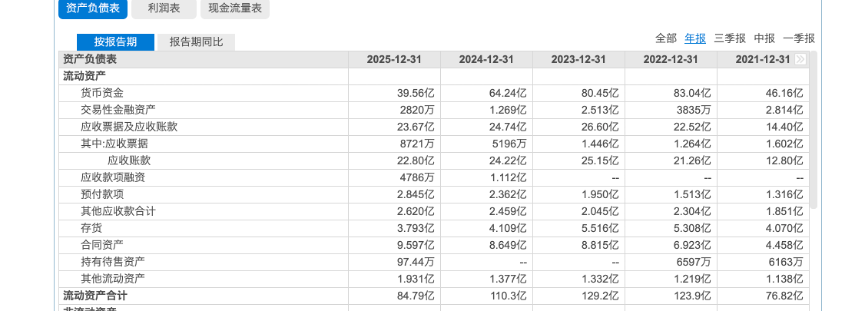
(Yonyou's current assets - monetary funds over the past five years. Data source: East Money)
▌3. A Decade-Long Odyssey: A Software Company's Transition
The crux of Yonyou's new narrative this time revolves around AI.
In its prospectus, Yonyou positions itself as a provider of enterprise digitalization software and intelligent services, leveraging AI, big data, and cloud computing as its core technologies. The intended use of the raised funds is clearly earmarked for the research and development iteration and international expansion of the YonGPT and YonAI platforms.
In 2025, Yonyou incorporated 'AI First' into its corporate strategy for the first time, shifting its annual report wording from 'embracing AI' to 'AI First.'
At the business level, in 2025, Yonyou began tracking AI revenue, with AI-related contract signings amounting to RMB 1.67 billion, and some individual contract signings exceeding RMB 10 million.
To be frank, Yonyou's transition has been arduous, marking the third significant transformation since the company's inception.
Founded in 1988, Yonyou's earliest product was financial and tax software, focusing on financial and tax accounting computerization. By 1998, Yonyou released its first ERP software, U8, fully transitioning towards enterprise resource planning. Since then, Yonyou has been involved in business processes beyond finance and taxation, such as human resources, procurement, and inventory management.
Yonyou's most recent major strategic transition commenced in 2016. Yonyou initiated its 3.0 strategy, fully transitioning towards cloud services and SaaS.
Especially by 2021, when the already resigned Wang Wenjing returned, it was to avoid missing out on opportunities for domestic software alternatives.
Indeed, Yonyou's stock price had been maintained in the single digits since its listing in 2000, reaching a high of over RMB 30 per share in 2015. It then declined, maintaining a range below RMB 20 for several years.
After 2020, driven by opportunities such as the digital transformation of real economy enterprises (physical enterprises), Yonyou Network once boasted a market capitalization of over RMB 170 billion.
Over nearly a decade of cloud strategy transition, the proportion of Yonyou's cloud business has continuously increased, with cloud service business revenue reaching RMB 7.06 billion in 2025, accounting for 77%, and cloud business revenue stabilizing and returning to positive growth.
However, it cannot be ignored that Yonyou is still mired in a painful transition period.
Yonyou's earliest model was ERP sales, recognizing revenue with each software sale; after transitioning to cloud services, customers deploy products on public or private clouds, accompanied by a shift in payment methods from 'buyouts' to annual subscription-based payments, leading to short-term revenue declines.
Additionally, if Yonyou is betting on domestic software alternatives, with large enterprises such as central state-owned enterprises as its core, then Kingdee, which primarily serves small and medium-sized enterprises (SMEs), is accelerating its catch-up with the advantage of having more SME customers.
Data shows that Yonyou has historically served 1.067 million customers, while Kingdee has served 7.4 million, with cloud service revenue accounting for 82.5% and subscription ARR reaching RMB 4.09 billion.
Over the past two years, Kingdee's performance has improved
-
![]()
Personnel Shuffle: Independent Director Mi Xuming Steps Down from OFILM
-
![]()
Net Profit Anticipated to Skyrocket by 103%: What Gives This Optical Company a Competitive Edge?
-
In Just One Year, China Unveils Unicorns Valued at 10 Trillion Yuan!
-
![]()
6 Park Companies Shine at WAIC: How Hong Kong Science Park Bridges AI from Research to Industry
-
![]()
Wang Wenjing’s Third Act: Can Yonyou Reinvent Itself in the AI Era?
-
![]()
Performance Coupe Entry Threshold Reduced to 170,000 Yuan: Assessing the 2027 Exeed ES's Prospects
-
![]()
Battery "Crisis" for 4 Million New Energy Commercial Vehicles
-
【Focus】Fluorinated Photosensitive Polyimide (FPSPI): A High-End Subdivision of PSPI with Great Potential in High-Tech Industries