Analysis of BBA Service Reputation Index in the First Half of 2026: Terminal Services Under Pressure
 07/21 2026
 354
354
Currently, competition in the domestic automotive market continues to intensify, with the penetration rate of new energy vehicles steadily rising and the market space for traditional fuel vehicles shrinking. Against this backdrop, traditional luxury brands like BBA, which rely heavily on fuel vehicle sales, face greater market pressure. This pressure is gradually being transferred to manufacturers and dealerships, further impacting the service experience of end-users. As the automotive market enters a phase of Stock competition (inventory competition), consumer experience and user feedback have become crucial factors in measuring brand competitiveness. This issue will analyze the service issues of BMW, Mercedes-Benz, and Audi based on their reputation index performance in the first half of 2026, combined with owner feedback data. 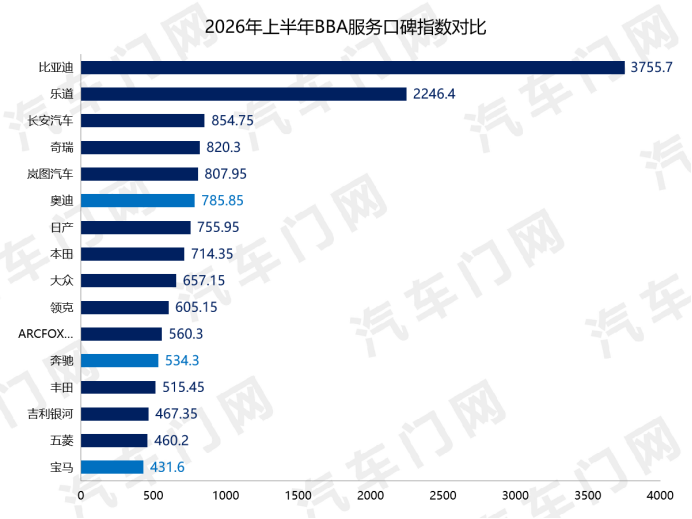
The service reputation index for the first half of 2026 shows that Audi scored 785.85, Mercedes-Benz scored 534.3, and BMW scored 431.6. Among them, BMW's service reputation performed relatively well, while Audi faced greater pressure. Notably, Mercedes-Benz's service reputation index has typically been lower than BMW's and Audi's over the long term. However, in the first half of this year, due to issues with the Mercedes-Benz EQC recall and battery locking, a large number of owners provided concentrated feedback, leading to a significant increase in Mercedes-Benz's service reputation index. Nevertheless, overall, BBA's service reputation remains superior to that of many ordinary brands.
1. Service Issues of the Three Luxury Brands 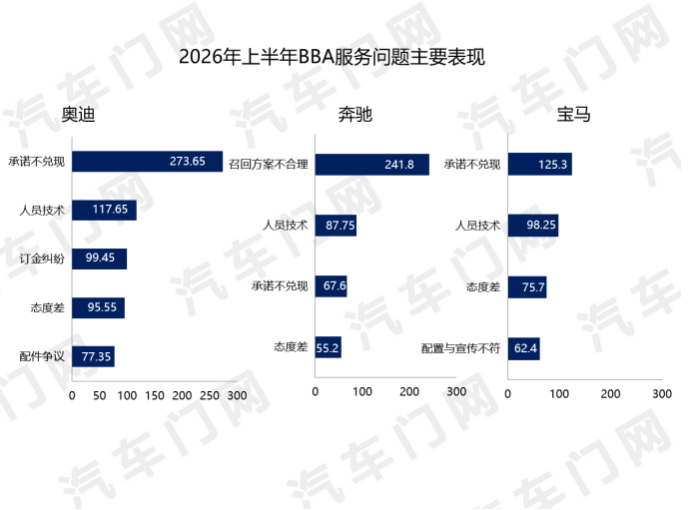
From the perspective of service issues, user feedback for BBA in the first half of 2026 primarily focused on unfulfilled promises, personnel technical issues, and poor attitudes. Against the backdrop of intensifying market competition and rapid penetration of new energy vehicles, traditional luxury brands face significant operational pressures, which are gradually being transferred to dealerships and ultimately reflected in the end-user service experience.
Specifically, "unfulfilled promises" was one of the most concentrated service issues reported by BBA users. Audi's performance in this area was particularly prominent, with a reputation index of 273.65, significantly higher than that of Mercedes-Benz and BMW.
Additionally, Audi faced relatively concentrated issues in personnel technical skills, deposit disputes, and poor attitudes, with a personnel technical issues index of 117.65 and a deposit disputes index of 99.45. In contrast, Mercedes-Benz's overall service issue index was relatively low, but due to the impact of the Mercedes-Benz EQC recall and battery locking issue, "unreasonable recall plan" became its most prominent problem, with a reputation index of 241.8. Concentrated feedback from a large number of owners further elevated Mercedes-Benz's service reputation.
At the same time, issues such as personnel technical skills and unfulfilled promises also received attention from some consumers. BMW primarily faced the issue of "unfulfilled promises," with a reputation index of 125.3. Additionally, service issues such as personnel technical skills and poor attitudes persisted. 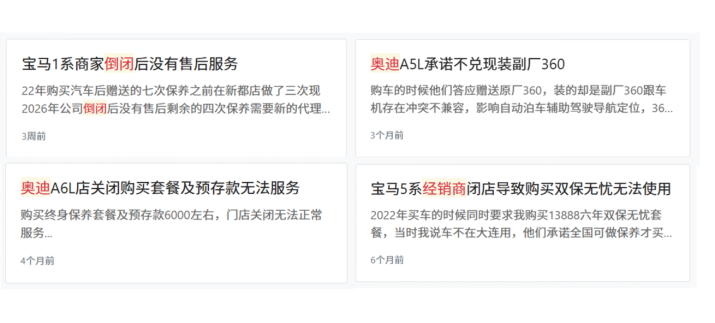
In the first half of this year, multiple owners reported that dealership closures rendered previously purchased after-sales benefits unusable. A BMW owner who spent 9,800 yuan on a lifetime basic maintenance package was unable to redeem it due to store closure. Similarly, a Mercedes-Benz owner who paid 27,000 yuan for a five-year maintenance and extended warranty package found the store closed after just one use. Additionally, issues such as personnel technical skills and deposit disputes were relatively prominent. Some consumers reported that during maintenance, improper operations by staff caused secondary damage to their vehicles.
Problems such as mispainting of car wraps during the repair and painting process of a FAW-Audi A4L, scratches on four wheels due to operational errors during the repair of a FAW-Audi A3, and brake abnormalities after accident repairs on a Brilliance BMW i3 all sparked dissatisfaction among owners. Meanwhile, deposit disputes were also a relatively concentrated issue reported by BBA owners. Some owners who discovered that their purchased vehicles were display models requested cancellations, and although sales had previously promised full refunds, they later reneged. 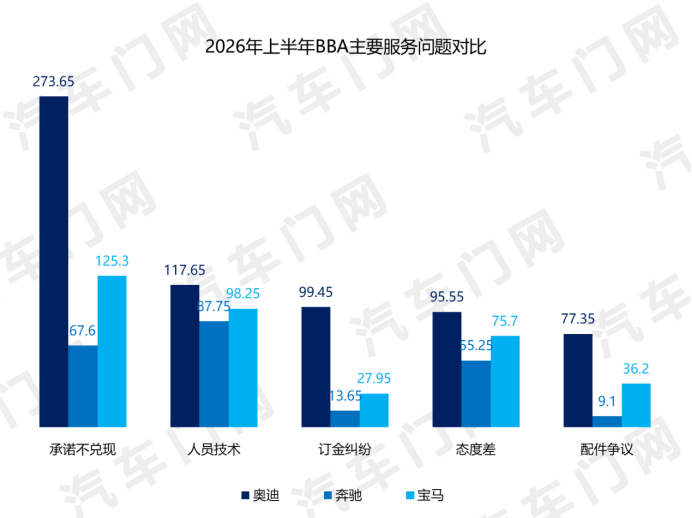
From these issues, it is evident that "unfulfilled promises" is one of the most concentrated service issues reported by BBA owners. In recent years, as the domestic automotive market environment has continued to change and the new energy vehicle market has rapidly developed, BBA brands, which primarily rely on fuel vehicle sales, have come under increasing market pressure.
This pressure has gradually been transferred to dealerships, with slowing sales growth and narrowing profit margins putting some dealerships under operational pressure, leading to store closures and network withdrawals. The operational pressure at the dealership level has further been transmitted to consumers through terminal services, ultimately manifesting as unfulfilled after-sales promises such as maintenance packages and extended warranty benefits, as well as obstacles in refunding vehicle deposits.
2. Service Model Distribution of the Three Luxury Brands 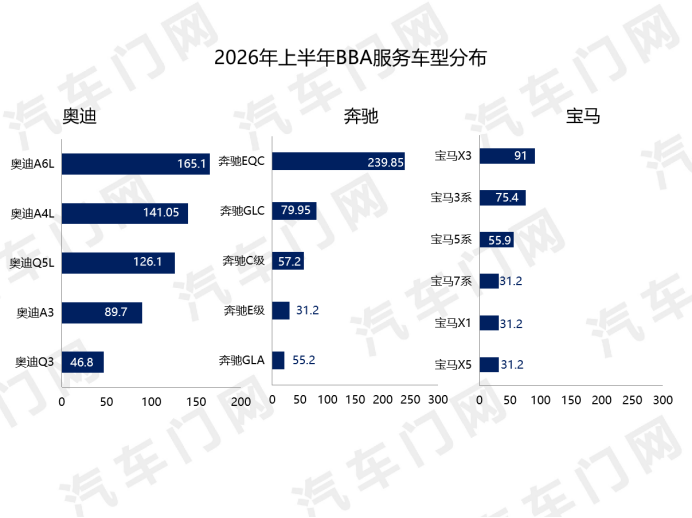
From the perspective of model distribution, service issues for the three brands were primarily concentrated in their respective hot-selling models, mainly due to the high market prevalence and broad user base of these models. Specifically, Audi's service issues were mainly found in models such as the A6L, A4L, and Q5L; Mercedes-Benz's service issues were concentrated in models such as the Mercedes-Benz EQC, GLC, C-Class, and E-Class; and BMW's service issues were primarily found in models such as the BMW X3, 3 Series, and 5 Series.
Additionally, the Mercedes-Benz EQC saw a significant increase in its service reputation index due to concentrated feedback from a large number of owners following the recall and battery locking issue. In comparison, Audi's overall service reputation index performed higher, with service issue indices for major models such as the A6L, A4L, and Q5L all higher than those of BMW and Mercedes-Benz models.
Summary: Overall, in the first half of 2026, service issues became a relatively concentrated area of feedback from BBA users, affecting all three brands to varying degrees. Among them, "unfulfilled promises" and "deposit disputes" were common issues reported by owners, while issues such as personnel technical skills and service attitudes also impacted the terminal experience. From a brand perspective, Audi's service issues were relatively more prominent; BMW and Mercedes-Benz faced fewer service issues. Over the long term, Mercedes-Benz's service issue index has been relatively low, and in most cases, its service reputation has been superior to that of BMW and Audi.
With the rapid development of the new energy vehicle market and the pressure on the fuel vehicle market, the operational pressure faced by BBA is gradually being transferred to the dealership level. Store closures and network withdrawals have further impacted the fulfillment of consumers' after-sales rights and the Car purchase service experience (vehicle purchase service experience). Against the backdrop of intensifying competition in the new energy sector and changing consumer demands, BBA not only needs to accelerate product transformation but also further enhance product quality and service standards to improve the terminal user experience. (Image source: Internet, removed if infringing)
-
![]()
Personnel Shuffle: Independent Director Mi Xuming Steps Down from OFILM
-
![]()
Net Profit Anticipated to Skyrocket by 103%: What Gives This Optical Company a Competitive Edge?
-
In Just One Year, China Unveils Unicorns Valued at 10 Trillion Yuan!
-
![]()
6 Park Companies Shine at WAIC: How Hong Kong Science Park Bridges AI from Research to Industry
-
![]()
Wang Wenjing’s Third Act: Can Yonyou Reinvent Itself in the AI Era?
-
![]()
Performance Coupe Entry Threshold Reduced to 170,000 Yuan: Assessing the 2027 Exeed ES's Prospects
-
![]()
Battery "Crisis" for 4 Million New Energy Commercial Vehicles
-
【Focus】Fluorinated Photosensitive Polyimide (FPSPI): A High-End Subdivision of PSPI with Great Potential in High-Tech Industries