Review of the Token Industry Cycle: The Upstream Peak Has Passed, and the Mid-to-Downstream Sweet Spot Has Arrived
 06/26 2026
 517
517

I recently delved into a research report and gained profound insights, which I would like to share with you briefly today.
This is the research outcome of the Galaxy Securities team led by Wu Yanjing, which organizes the seven major U.S. tech giants along the Token industry chain.

The comprehensive prosperity index for each tier is set to be a weighted combination of three sub-indices: revenue growth rate (40% weight, reflecting demand prosperity), ROIC change (30% weight, reflecting return improvement momentum), and CapEx/D&A change (30% weight, reflecting investment expansion intensity). The results are shown in the figure below:
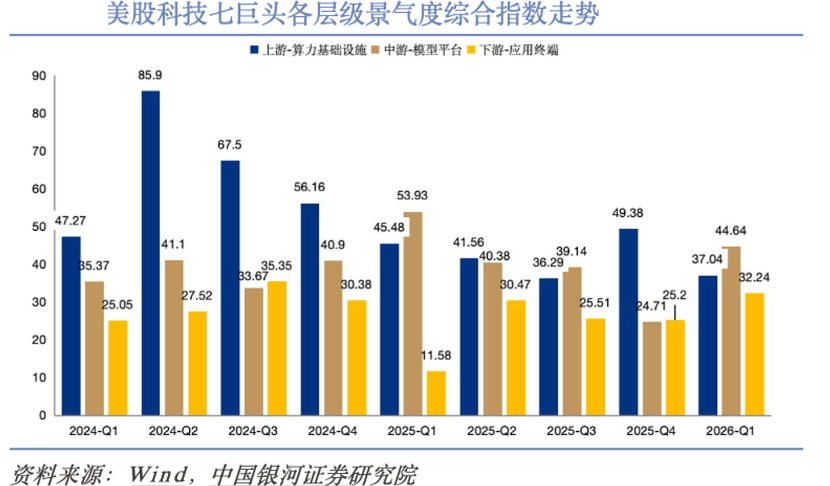
Based on this, the following conclusions can be drawn:
1) From the trend of the comprehensive prosperity index for each tier, the prosperity of the upstream computing power infrastructure tier peaked in the first half of 2024 (with a comprehensive index exceeding 85.9) and then entered a high-level decline, dropping to about 37.04 by 2026Q1.
2) The prosperity of the midstream model platform tier shows a characteristic of initially rising and then stabilizing. The team believes that the midstream cloud computing power tier has gradually transformed from a 'follower beneficiary' of the AI wave to a 'mainstay,' with its prosperity no longer entirely dependent on the supply pull from upstream chips but increasingly driven by downstream AI application demand.
3) The prosperity trend of the downstream application terminal tier is moderate. Unlike the rapid expansion of upstream chips and midstream cloud platforms, the penetration of AI in terminal applications is a gradual process that requires the coordinated advancement of product iteration, user education, and ecosystem construction, rising from 25.05 at the beginning of 2024 to 32.24 by 2026Q1, reflecting the gradual nature of AI application implementation.
More notably, the growth rate scissors gap between the upstream, midstream, and downstream sectors has converged. In the first half of 2024, the upstream growth rate was about 20 times that of the midstream and about 35 times that of the downstream, indicating a significant scissors gap. By 2026Q1, the upstream growth rate (65.47%), midstream (18.73%), and downstream (21.64%) showed that the upstream growth rate was about 3.5 times that of the midstream and 3 times that of the downstream, with a substantial convergence of the gap.
These trends suggest that the investment clock is pointing to the mid-to-downstream sectors: the high prosperity of the upstream has been fully priced in, and the growth rate inflection point has passed, while the mid-to-downstream sectors are in the early stages of a prosperity reversal upward. In the Token economic industry chain, the current best investment sweet spot has shifted from upstream computing power to midstream model platforms and downstream application terminals.
Through the analysis of the seven giants' indicators, the report provides investment strategy recommendations corresponding to the Token industry chain:
Strategically bullish on the downstream: Declining computing power costs + inflection point in revenue growth rate = a Davis Double Play for downstream application profit margins. Focus on application giants with massive user scenarios and the ability to monetize Token consumption.
Tactically allocate to the midstream: Midstream cloud vendors will enjoy the scissors gap dividend of declining procurement costs + cloud service price increases during the downward cycle of computing power prices, with profit margins expected to continue to exceed expectations.
Cautious approach to the upstream: Although the absolute growth rate of the upstream remains high, the decline in ROIC and the implied decline in computing power prices indicate a cyclical inflection point, necessitating vigilance against the risk of valuation declines due to worsening competitive dynamics (AMD/self-developed chips).
Through the rhythm of value transmission between the upstream and downstream, the report also divides the Token economic cycle into four stages:
Stage 1 (2023-2024): Innovation explosion period. Chat GPT triggers the AI singularity moment, and Token demand explodes from zero.
Stage 2 (2025-2026H1): Upstream investment enthusiasm period (current stage), where excess profits induce massive capital expenditures and drive sustained high prosperity of upstream infrastructure supporting products.
Stage 3 (2026H2-2027E): Midstream industry chain integration period. During this stage, as Token production is essentially a high-intellectual-density + high-energy-consumption industry, Token intellectual output per watt and throughput will become the core competitiveness indicators for the midstream. The characteristics of consolidation and elimination will be significant, with small and medium-sized vendors unable to bear high computing power expenditures exiting the market. Midstream cloud service providers (such as AWS, Azure, Alibaba Cloud, etc.) will fully transition to a MaaS usage-based billing system centered on Token consumption, with capital expenditures becoming more rational and self-developed chip substitution rates increasing, significantly narrowing the supply-demand gap.
Stage 4 (2028E+): Downstream application monetization period, where massive capital expenditures in the early stages drive a surge in scenario-side applications, infrastructure transforms into a complete 'Token factory,' and the industry enters a stable return period.
The same can be said for China as for the United States. Recently, the valuations of model-level companies in the midstream of the industry have soared, with market capitalizations skyrocketing and frequently refresh (shua xin, meaning 'refreshing') market perceptions. This can also be seen as an effect of the rotation of the value transmission wheel. Going forward, both the valuations and performance of cloud computing and large model vendors are worth anticipating.
Some friends may still be concerned about the foam (pao mo, meaning 'bubble') in the large model industry and whether high capital expenditures will affect performance. Personally, I believe:
1) Based on U.S. experience, midstream companies in the industry are increasingly gaining pricing power, and the cost burden of inputs will decrease marginally.
2) A large number of companies will fail in the early stages of value transmission, leading to passive industry bubble squeezing and consolidation. Leading cloud computing and model companies will gain higher pricing power, and investments will ultimately translate into returns.
The gears of value rotation have begun to turn. What will happen next? Let's wait and see.
-
![]()
Foreigners Are Amazed: Chinese Electric Vehicle Drive Systems Unveil Innovative 'Poses'
-
![]()
700,000 Brothers and the Future of Robots: Behind JD.com's 'Nirvana Plan'
-
![]()
Zhipu's Trillion-Dollar Valuation: A New Chapter for China's AI
-
![]()
Is Laifen, a 'Dyson Alternative' on the Rise, Now Ensnared by the 'Alternative Curse'?
-
![]()
Beyond Patents: Insta360 and DJI Compete in Retail
-
![]()
Piercing Through Industry Chaos: The Curtain Rises on Compliance for Autonomous Driving
-
![]()
Insta360 vs DJI: A Fiercely Contested Duel Despite Lopsided Market Clout
-
![]()
Sino-US Autonomous Driving Divergence: Overseas Authoritative Index Reveals True Track Gaps