ByteDance’s ToB Restructuring: A Strategic Pivot for AI Dominance
 07/31 2026
 390
390
ByteDance’s ToB (Business-to-Business) division is undergoing a sweeping transformation, signaling a new phase in its AI-driven ambitions.
On July 30, ByteDance released an internal memo detailing a major reorganization of its Feishu, Doubao, and Volcano Engine teams:
First, the Feishu product team will merge with the Doubao team to form a new Doubao product team, led by Doubao head Zhao Qi. Feishu head Xie Xin will report to Zhao Qi.
Second, Feishu’s GTM (Go-to-Market, covering marketing, sales, and customer service) team will integrate with the Volcano Engine team, creating a new ToB GTM unit called the “Creativity Service Platform.” This entity will be led by Volcano Engine head Tan Dai, with Feishu sales head Lin Chan and strategy and marketing head Shi Zhijun both reporting to Tan.
This marks ByteDance’s most significant organizational shift in its ToB sector since establishing six Business Units (BUs) in 2021. Previously, Feishu operated as a BU on par with Douyin, TikTok, and Volcano Engine, with Xie Xin reporting directly to ByteDance CEO Liang Rubo.
At first glance, this appears to be a reshuffling of reporting lines.
However, beneath the surface, a far more strategic maneuver is underway: ByteDance is repositioning Doubao from a consumer-facing chatbot to a B-end AI assistant deeply integrated into enterprise workflows, with Feishu serving as the vital conduit for this transformation.
The internal memo explicitly states the rationale: AI is set to profoundly reshape B-end enterprise productivity and work styles. This integration aims to build superior office and productivity tools and better serve B-end clients.
In essence, under ByteDance’s AI-first strategy, the previously isolated businesses of software sales (Feishu), computing power (Volcano Engine), and model development (Doubao) are being unified into a cohesive force targeting enterprise clients.
As of June 2026, Doubao’s large model has surpassed 180 trillion daily token calls. This surge is driven by enterprise adoption, which has become Doubao’s primary growth engine.
ByteDance is not just competing for market share in large models but for the gateway through which individuals and enterprises access the digital world in the AI era.
At a time when major companies are consolidating their AI ToB operations, this move could be ByteDance’s new ace in the AI ToB race.
ByteDance’s AI ToB Restructuring: Products and Business Stay Distinct
In 2026, the AI industry is pivoting from consumer-centric AI Agents to enterprise productivity tools.
At this year’s World Artificial Intelligence Conference, enterprise-grade Agents emerged as a recurring theme. The focus has shifted from “whether models are capable” to “whether they can scale and deliver commercial value.” “Consumer novelty demand has faded; B-end value is now being validated,” noted Jia Hao, Secretary-General of the Zhongguancun Digital Intelligence AI Industry Alliance.
This C-end to B-end shift aligns precisely with ByteDance’s AI strategy.
At June’s Volcano Engine FORCE conference, ByteDance CEO Liang Rubo stated bluntly: “Scaling AI is ByteDance’s top priority.” The company is “concentrating its efforts on AI, specifically on enhancing model capabilities,” and “Volcano Engine’s MaaS business is becoming ByteDance’s foundational business.”
Against this backdrop, ByteDance’s reorganization can be seen as aligning with its AI ToB strategy—separating product development from commercialization and reorganizing the three previously parallel businesses along “productivity” lines.
The product-level adjustment is clear: Feishu and Doubao product teams merge into a new Doubao product team. This means ByteDance’s future enterprise-facing AI offerings will be primarily shaped by the Doubao team, with Feishu’s capabilities serving as underlying infrastructure embedded in Doubao’s enterprise solutions.
ByteDance clarified that Feishu’s existing products and services will remain unchanged post-integration, with both teams focusing on deepening product synergy in office productivity scenarios.
This is critical. It ensures Feishu, as an enterprise collaboration tool, maintains its functionality, customer base, and user experience despite organizational changes.
In other words, Feishu remains an independent product but must now foster deeper integration between office workflows and AI capabilities within Doubao’s framework.
In fact, this synergy is already underway.
The Doubao Enterprise Edition, developed by the Feishu team, has entered internal testing with select Feishu clients.
Its standout feature is seamless integration with the Feishu ecosystem. Users can access Feishu Docs, multi-dimensional tables, online meetings, group communications, and other office tools without additional setup. It supports intelligent Q&A and content creation based on enterprise knowledge bases, with robust data isolation, permission controls, and security auditing.
In essence, the Doubao Enterprise Edition doesn’t just transplant the Doubao chatbot into enterprise settings but embeds AI capabilities directly into Feishu’s workflows, channeling them into every enterprise office scenario through Feishu’s established infrastructure.
If product integration is a “technology story,” commercial integration is a “business story”—and its strategic value may surpass product synergy.
What was ByteDance’s ToB landscape like before?
Feishu and Volcano Engine operated separate sales teams. Clients with collaboration needs engaged Feishu sales, while those requiring large models or cloud services dealt with Volcano Engine. Under the old structure, adopting the Doubao Enterprise Edition might involve yet another team.
The creation of the Creativity Service Platform consolidates these three touchpoints into one.
For enterprise clients: No need to navigate separate Feishu and Volcano Engine sales teams. A single team now addresses all needs—office collaboration, cloud computing, and AI applications—simultaneously. For ByteDance: Customer acquisition costs, delivery efficiency, and service consistency for ToB business will improve significantly.
A telling statistic: Over 90% of Feishu’s new Q2 clients also purchased AI products.
This highlights the strong link between office collaboration and AI adoption. Once clients use Feishu, they almost inevitably leverage Doubao’s AI capabilities. Since demand-side integration is already complete, failing to align the supply-side sales system would be counterproductive.
This explains ByteDance’s July 2026 action: Product-side fusion (Doubao Enterprise Edition internal testing) is operational, and now commercial-side integration must follow to create a complete closed loop.
Feishu Provides Doubao with the Most Scarce Resource
ByteDance’s strategic shift of AI focus to the B-end has been evident for some time.
Media reports earlier this year revealed that after ByteDance executives visited Anthropic, the company began reallocating AI resources, shifting focus from consumer-oriented products like Doubao to enterprise-oriented solutions.
Thus, this organizational adjustment is the final piece of the puzzle.
The core question: Why Feishu?
The industry recognizes that a chatbot in an app and a truly usable enterprise AI assistant are separated by a wall: “workflow.”
A chatbot lacks an enterprise’s organizational structure, permission systems, document knowledge, and meeting/group chat context. It knows much but not “your company”—who can access what, which document is latest, or a project’s status. These are precisely what Feishu has accumulated over years.
Launched in 2016 and officially released in 2019, Feishu has nearly a decade of history. Its core value isn’t a specific feature but a complete enterprise office ecosystem.
It possesses three scarce enterprise assets:
First, access to real office scenarios, covering documents, spreadsheets, meetings, group chats, knowledge bases, approvals, HR, and projects—nearly all collaboration needs. It’s where employees spend over 8 hours daily.
Second, enterprise organizational structures and permission systems—who can access which documents, departmental data permissions, project roles. This framework is essential for AI to safely and compliantly intervene in enterprise workflows.
Third, enterprise knowledge accumulation—policies, plans, meeting minutes, client data, R&D documents—largely reside in Feishu, fueling enterprise AI to “come alive.”
These capabilities are precisely what Doubao needs to transition from C-end to B-end.
More importantly, Feishu has proven that enterprise demand for AI office tools is rapidly emerging. This means Feishu provides not just scenarios but validated willingness to pay and a customer base. For Doubao to become a B-end AI assistant, Feishu offers the shortest path.
From a broader perspective, this is also the choice of global tech giants.
Google embedded Gemini in Workspace, Microsoft used Copilot to overhaul Office, Tencent integrated AI into WeCom and Tencent Docs, and Alibaba let Tongyi Qianwen cover office scenarios.
Nearly all global leaders have made the same move: abandoning the “super entry point” logic of standalone platforms and embedding AI directly into workflows.
Feishu spent a decade fighting for independence, trying to prove itself China’s Office, Slack, or Notion. But in the AI era, this logic fundamentally shifts—not that office platforms need AI, but that AI needs office platforms as carriers.
Thus, Feishu’s value isn’t diminished but redefined: from a standalone collaboration tool to the critical bridge for Doubao’s enterprise workflow entry, becoming ByteDance’s foundational infrastructure for AI ToB.
The Logic of Enterprise Services in the AI Era Has Changed
ByteDance is using organizational adjustment to align product, commercialization, and infrastructure lines into a unified force. This “top-down design-driven collaboration” approach is rare and decisive among Chinese internet giants.
This adjustment will bring three core changes to ByteDance: strategic prioritization, resource concentration, and commercialization clarity.
Liang Rubo’s statement that “scaling AI is ByteDance’s top priority” is now reflected in the organizational structure. The Doubao product team carries AI ToB product priority, while the Creativity Service Platform carries commercial priority.
Previously siloed Feishu, Doubao, and Volcano Engine teams will now collaborate on product development, customer acquisition, and delivery services. Volcano Engine’s MaaS as foundational business, Doubao as AI hub, and Feishu as enterprise entry point roles are all reinforced.
The commercialization logic is now clear: leveraging Volcano Engine’s validated B-end channels to harness Doubao’s technical momentum, forming a “technology-scenario-commercialization” closed loop.
These changes are supported by clear commercial data.
Based on July’s average consumption, ByteDance’s large model business has reached $4 billion in ARR (Annual Recurring Revenue), exceeding the combined ARR of all other domestic model companies. As of June 2026, Doubao’s large model has surpassed 180 trillion daily token calls.
These figures indicate ByteDance’s large model business has achieved significant commercial scale. The organizational adjustment at this juncture isn’t passive contraction but proactive upgrading—adopting a more efficient organizational form to support its growing business.
Looking across the industry, domestic giants are all integrating AI business lines, with AI office tools as the primary entry point:
Alibaba consolidated three scattered Agent products—QoderWork, Wukong, and MuleRun—into Qianwen Office, led by newly appointed DingTalk CEO Chen Yusen. DingTalk has data and permission assets from over 26 million enterprise organizations, covering nearly 80% of listed companies.
Tencent’s WorkBuddy saw 20.97 million visits in June alone and announced relocating the QClaw product center to Cloud Product Division VI, placing it under the same management as WorkBuddy.
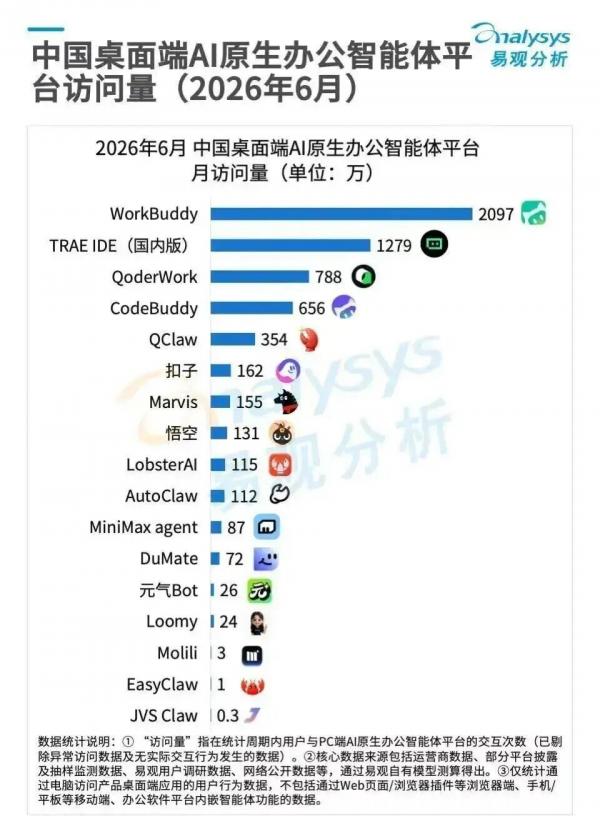
A clear pattern emerges: In the B-end AI race, model capabilities are merely entry tickets. The true competitive edge lies in controlling enterprise organizational structures, permission systems, document knowledge, and business processes—the gateways for AI’s enterprise integration.
This explains why all three companies unsurprisingly pushed office collaboration tools to the forefront: DingTalk, WeCom, and Feishu, the three leading products, have a combined market coverage of 92% according to QuestMobile, covering nearly all domestic enterprise organizations. They hold not just chat interfaces but the “central nervous systems” of enterprise operations.
Feishu’s decade of accumulated office scenarios are ByteDance’s only pathway for “seamless embedding.” Without an enterprise entry point like Feishu, Doubao, no matter how strong, would remain just an API.
More critically, the giants’ AI business integrations signify that enterprise AI competition has evolved beyond single-model or single-software comparisons to full-stack competition encompassing “cloud + model + data + entry point.”
When enterprise clients procure AI, they don’t want fragmented experiences—“models from A, cloud from B, office tools from C.” Whoever can provide a one-stop solution may gain the upper hand in ToB AI competition.
Overall, 2026 is also called the first year of enterprise-grade AI applications. The shift from siloed competition to integration among big tech’s AI ToB businesses indicates a narrowing window of opportunity, with first-mover advantages likely lasting only 3-6 months.
By designating Feishu as the bridge, Doubao as the workstation, and Volcano Engine as the unified outlet, ByteDance is making a significant strategic move with this organizational adjustment. The underlying premise is that the next generation of enterprise software will not rely on human interaction through manual clicks within software interfaces; instead, it will be driven by AI seamlessly operating within workflows.
In this strategic layout, Feishu stands out as ByteDance's most pivotal component.
-
![]()
The 'King of Africa' Tecno Mobile: What Is the Market Hesitating About After Its 'V-shaped' Rebound?
-
![]()
ByteDance Restructures Feishu, What Signals Does It Send?
-
![]()
ByteDance Overhauls Feishu: What Strategic Signals Are Being Sent?
-
![]()
Pay $39 a Month with Apple Upgrade: Apple's New Business, Your Old Wallet
-
![]()
The Open-Source Debate Dividing Silicon Valley
-
![]()
AI Giants Start Borrowing to Fuel Computing Power
-
![]()
China's AI API Call Volume Overtakes U.S.: A Global Turning Point for Domestic Large Models
-
![]()
Meta Painted the Biggest Pie, Invested the Most Money, but Didn't Even Get a Sound