OpenAI's Triple Meltdown: Codex, API, and ChatGPT Collapse Simultaneously—Who Foots the Bill for Agent-Era Downtime?
 07/31 2026
 379
379
On the evening of July 25, OpenAI's API, ChatGPT, and Codex services simultaneously encountered errors, with performance degradation across 31 service components. Full restoration occurred after 1 hour and 51 minutes.
A single outage might be dismissed as trivial—the real issue is OpenAI hasn't operated at full capacity for 17 consecutive days.
A High-Stakes Outage
At 17:17 Beijing Time on July 25, OpenAI's status page flagged 'Investigating' due to elevated error rates across services. By 18:02, 'Monitoring' status indicated mitigation measures took effect, with full recovery announced at 19:08.
The outage impacted 31 service components across three product lines: 12 API components, 15 ChatGPT components, and 4 Codex components. Third-party monitoring recorded the incident's start at 09:17 UTC, aligning precisely with OpenAI's timeline.

User impact was immediate: failed requests, abnormal responses, and interrupted tasks. Codex failures were particularly disruptive—programming Agents executing tasks frequently stalled for tens of minutes, risking project failures for large-scale operations.
17 Days of 'Operating While Impaired'
Viewed through a monthly lens, this incident isn't isolated.
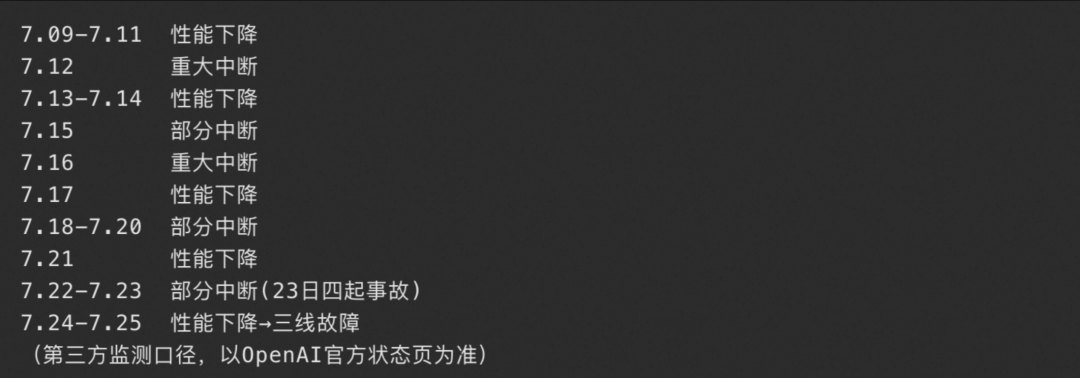
Third-party monitoring platform Bifrost recorded no 'fully normal' days for OpenAI since July 9: two Major Outages on July 12 and 16, with daily fluctuations between Degraded Performance and Partial Outage.
Incidenthub's logs show similar density: On July 23 alone, OpenAI reported four separate incidents affecting ChatGPT error rates and latency; Codex Review errors surfaced on July 24; and the triple collapse occurred on July 25.
Officially silent on causes, plausible explanations include surging summer inference loads compounded by new model/feature rollouts, straining infrastructure. These remain speculative pending official post-mortems.
The Algorithm of Downtime in the Agent Era
Two years ago, ChatGPT outages primarily disrupted chat experiences. The 2026 incident represents a paradigm shift.
APIs now underpin production systems: customer service bots, CI/CD pipelines, automated audits, and Agent workflows. A 111-minute outage halts production lines. The advertising slogan beneath monitoring pages—'OpenAI down? Automatically route requests to healthy alternatives'—signals market demand for multi-model disaster recovery.
For enterprise decision-makers, 17 days of instability elevate a critical metric: SLA. While model capability rankings shift weekly, reliability scores accumulate daily. Capability gaps are measured in percentages; downtime losses are binary—100%.
Two strategic implications emerge: First, multi-cloud, multi-model routing will transition from competitive advantage to enterprise AI architecture standard, with single-vendor dependency risks repriced. Second, each overseas flagship outage creates windows for domestic models to capture spillover demand—provided they can withstand comparable load curves.
OpenAI's engineering team will likely issue a post-mortem within days. However, 17 consecutive days of anomalies demand explanations far more nuanced than 'elevated error rates.'
-
![]()
ByteDance Restructures Feishu, What Signals Does It Send?
-
![]()
ByteDance Overhauls Feishu: What Strategic Signals Are Being Sent?
-
![]()
Pay $39 a Month with Apple Upgrade: Apple's New Business, Your Old Wallet
-
![]()
The Open-Source Debate Dividing Silicon Valley
-
![]()
AI Giants Start Borrowing to Fuel Computing Power
-
![]()
China's AI API Call Volume Overtakes U.S.: A Global Turning Point for Domestic Large Models
-
![]()
Meta Painted the Biggest Pie, Invested the Most Money, but Didn't Even Get a Sound
-
![]()
"AI+" Majors Abound: Are They a Response to a 5-Million Talent Shortage?