Google’s Top Scientists No Longer ‘Call the Shots’
 08/07 2026
 361
361
The Convergence of AI Talent Pathways at Leading Tech Companies
Author | Ding Shan
Editor | Xiaobai
Illustration | AI-Generated
Produced by | Qiangdiao Next
On August 5 (local time), Google unveiled its most significant AI organizational reshuffle since merging Google Brain and DeepMind in 2023. Chief scientist Jeff Dean, after nearly 27 years at Google, left the company alongside Sanjay Ghemawat, Oriol Vinyals, and Quoc Le to co-found Discovery Loop. This new venture, registered as a Delaware public benefit corporation, aims to automate end-to-end experimental cycles in machine learning, science, and engineering through AI. Alphabet has invested as a founding partner and will provide long-term cloud and computing infrastructure support.
On the same day, Demis Hassabis stepped back from day-to-day management of Google DeepMind, becoming department chairman and Alphabet chief scientist while continuing to lead AI-driven pharmaceutical firm Isomorphic Labs. Koray Kavukcuoglu, former DeepMind CTO and Google chief AI architect, was elevated to senior vice president, reporting directly to Sundar Pichai, and now oversees the Gemini model, cutting-edge research, Gemini applications, and developer teams.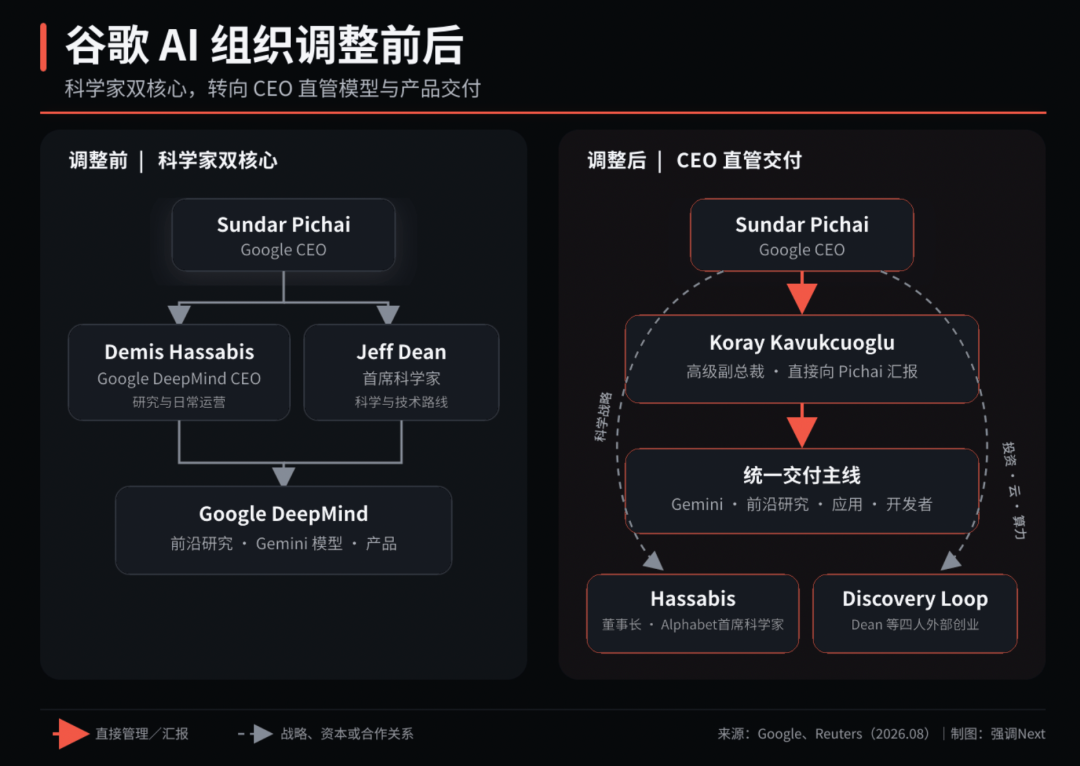
Capital markets reacted negatively, with Alphabet’s Class A shares dropping nearly 5.5% intra-day before closing 4.0% lower. However, this restructuring represents more than a talent drain. The departing quartet brings expertise in large-scale computing systems, foundational models, and inference research. More critically, it signals a power shift: Google is dismantling its scientist-led co-governance model, transforming AI into a CEO-directed business unit focused on model releases and product monetization. This mirrors organizational adjustments at China’s Alibaba, Baidu, and other tech firms, all converging toward similar outcomes.
───
01
Half of Google’s AI Empire Walks Out ■
Jeff Dean, often regarded as Google’s 30th employee, co-developed its search, indexing, and advertising systems with Sanjay Ghemawat. They later designed Google File System, MapReduce, Bigtable, Spanner, and other infrastructure pillars that underpin Google’s global data processing capabilities.
Dean co-founded Google Brain in 2011, pioneering machine learning systems such as DistBelief, TensorFlow, and Pathways. He also championed custom AI acceleration chips at Google. From distributed training frameworks to research organization, he shaped nearly every layer of Google’s modern AI ecosystem.
Ghemawat, one of Google’s few Senior Fellows, served as Dean’s longtime systems partner. Vinyals and Quoc Le complemented the team’s model and inference expertise. Vinyals, co-inventor of the seq2seq model, led technical direction for AlphaStar and Gemini. Le, an early Google Brain core member, contributed to mathematical reasoning projects like AlphaGeometry.
The quartet’s strength lies not in a single breakthrough project but in their ability to simultaneously design models, training systems, computing resource allocation, and experimental workflows. This explains Discovery Loop’s focus on “automated experimental cycles”: enabling systems to propose, implement, run, and evaluate experiments, then iterate based on feedback.
Machine learning experiments inherently involve code, models, and computing resources, making them prime candidates for closed-loop automation before expanding to chip design, drug discovery, and clean energy. While Discovery Loop has not disclosed funding details, valuation, or its ability to overcome real-world laboratory, data quality, and regulatory hurdles, its approach resembles a technological bet backed by the founders’ proven track records. Google loses not just managers but a team capable of bridging algorithms and hyperscale systems.
───
02
Research Institutes Step Back, CEOs Take the Helm ■
In 2023, Pichai merged Google Brain and DeepMind, appointing Hassabis as CEO and Dean as chief scientist to address long-standing research resource fragmentation. Three years later, Google’s challenge shifted from “how to merge research forces” to “who assumes product accountability.” The new structure answers this: Kavukcuoglu, without a CEO title, reports directly to Pichai as senior vice president. Research, models, applications, and commercial interfaces now fall under a unified accountability chain.
Hassabis’s transition is not a typical resignation. He remains involved in model and research strategy and continues as Isomorphic Labs CEO, but Reuters cited Alphabet stating he has few direct subordinates in his new role. Title elevation coincides with reduced operational authority. The 2023 Dean-Hassabis dual-scientist leadership model thus ends, replaced by a Pichai-Kavukcuoglu executive axis. Scientific judgment shifts to the strategic layer, while release schedules, costs, and product adoption fall to professional operational systems. This reflects Google’s response to decade-long lessons: the Transformer architecture originated at Google, yet many core contributors later departed.
While Google advanced foundational research, OpenAI commercialized large models first. As Google invests hundreds of billions in AI infrastructure, technology must swiftly translate into models, traffic, and cloud revenue, making it difficult for research departments to retain full decision-making power. Similar power shifts are occurring at Chinese firms, with increasing frequency.
From March to June 2026, Alibaba established Alibaba Token Hub, upgraded its Tongyi large model division, and merged it with the Future Life Lab into Token Foundry. Model and application teams now report directly to group CEO Wu Yongming. Former Tongyi head Zhou Jingren became group chief scientist, leading the AI Future Research Institute.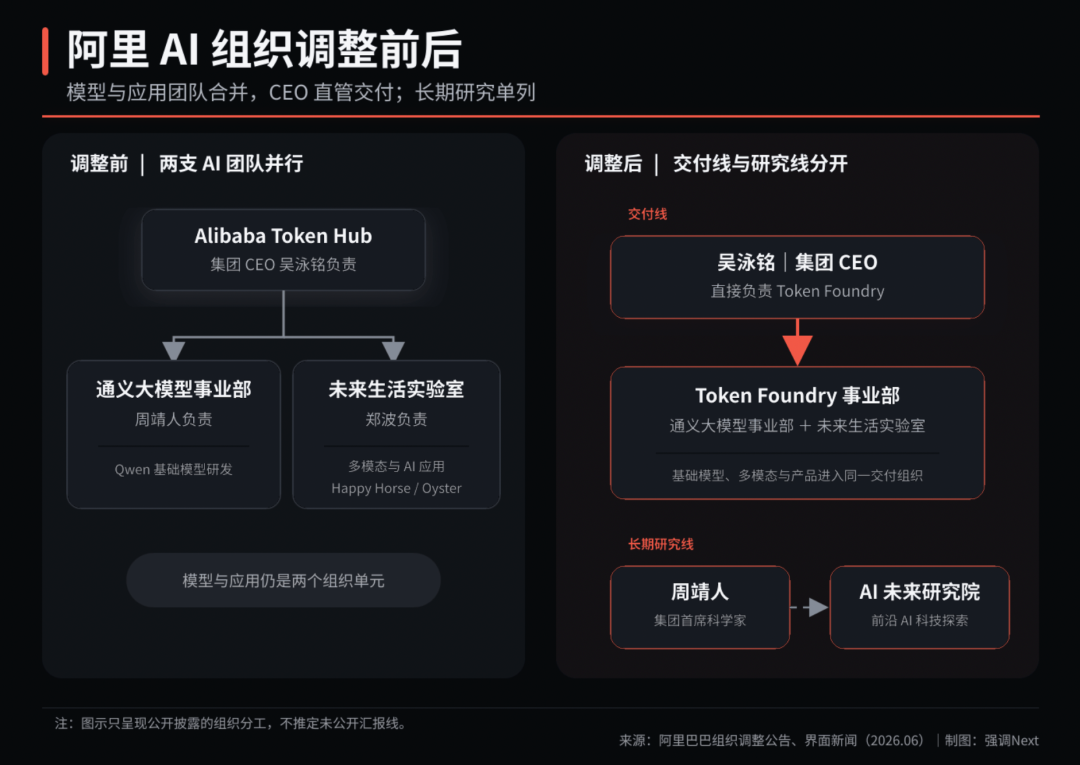
This mirrors Google: long-term research space persists, but model, application, and commercial delivery fall under CEO responsibility. The difference lies in Alibaba’s internal reorganization, while Google also offloads high-risk research to external entities via Discovery Loop and Isomorphic Labs.
Alibaba announced plans to invest at least 380 billion yuan ($53 billion) over three years in cloud and AI infrastructure, requiring model R&D to simultaneously justify reasoning costs, token consumption, cloud revenue, and user access. Baidu’s adjustments are more direct. In November 2025, Baidu established Foundational Model R&D and Applied Model R&D departments, responsible for general-purpose large models and business-specific precision models, respectively, both reporting directly to Robin Li.
Wang Haifeng retained his roles as CTO, Technical Committee chairman, and Baidu Research president, but core large model R&D now flows directly to the CEO via new departments, dispersing permissions previously concentrated in the technology mid-office.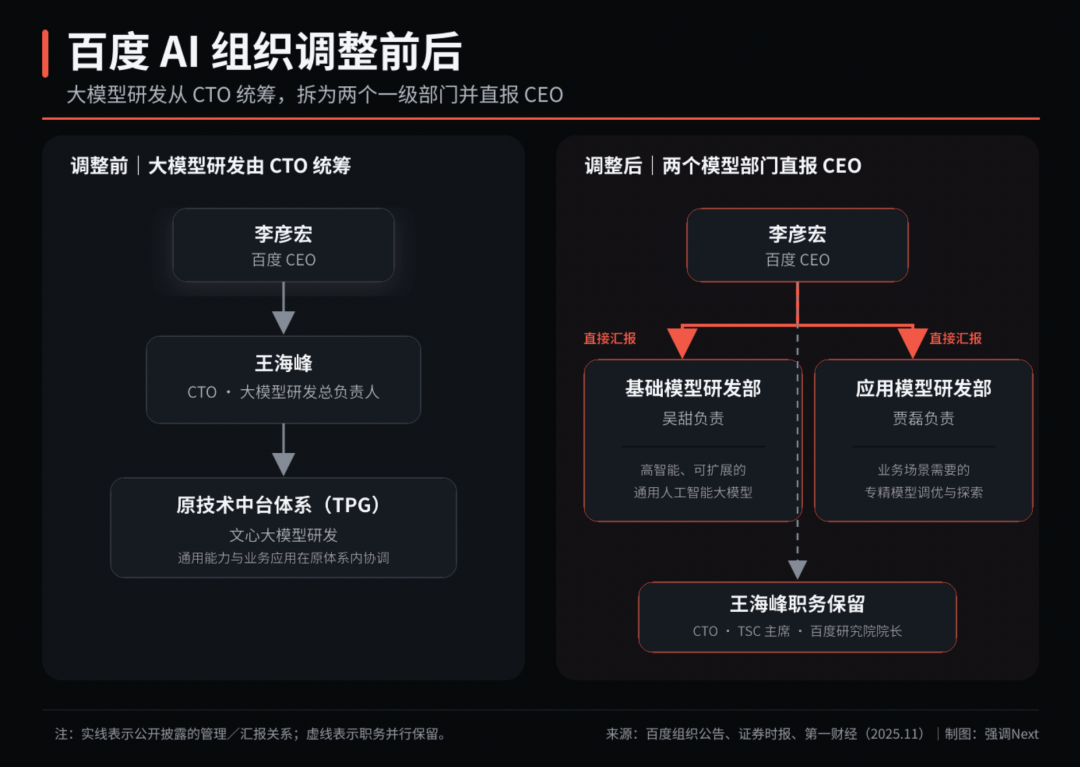
A week before these changes, Baidu reported Q3 2025 AI revenue of approximately 10 billion yuan, up over 50% YoY. However, total revenue fell 7%, with online marketing revenue dropping 18%. AI now shoulders growth responsibilities but cannot yet offset legacy business declines, making coordination speed between foundational models and applications a CEO-level operational issue.
From Google to Alibaba and Baidu, the common trend is that as large models enter a capital-intensive delivery phase, research departments no longer inherently wield end-to-end power over technical roadmaps and product launches. CEOs must align budgets, iteration schedules, product access points, and revenue on a single balance sheet, bringing those capable of timely model-to-product conversion closer to daily operational centers.
───
03
Revenue Grows, But Delivery Pressures Mount ■
Alphabet’s Q2 revenue reached $119.8 billion, up 24% YoY. Google Cloud revenue hit $24.8 billion, up 82% YoY, with operating profit of $8.8 billion—more than triple the prior year. Gemini apps reached 950 million monthly active users, with model APIs processing approximately 220 billion tokens per minute. Commercially, Google AI shows no signs of stalling. However, Gemini 3.5 Pro, initially slated for June release, remained in partner testing as of late July. Pichai acknowledged Google’s need to improve in programming and agentic programming.
Prior to the restructuring, Gemini’s technical co-leads Noam Shazeer and AlphaFold co-creator John Jumper had already departed for OpenAI and Anthropic, respectively. With Dean, Vinyals, and Shazeer—three key Gemini technical leads—now gone, financial pressures are raising delivery demands. Alphabet’s Q2 capital expenditures hit $44.9 billion against operating cash flow of $39.1 billion, resulting in negative free cash flow of $5.9 billion for the quarter.
The company raised its 2026 capital expenditure guidance to $195-205 billion. While Cloud’s backlog reached $514 billion, faster alignment of computing resources, models, and customer demand is essential to justify asset returns. The stock decline reflects not Google’s lost AI capabilities but the compounding uncertainties of flagship model delays, concentrated researcher departures, and rising capital expenditures.
Google’s complete chip, cloud, model, application, and traffic ecosystems establish a floor; sustained delivery of competitive models post-personnel changes will determine its ceiling.
───
04
Releasing Scientists, Retaining Partnerships ■
Discovery Loop’s ties to Google distinguish this departure from typical talent exodus. Alphabet participated in its initial funding round, and Google will provide cloud and computing resources while collaborating on machine learning systems and infrastructure research. Though Google cedes direct management of the quartet, it retains equity stakes, computing revenue streams, research partnerships, and potential technology repatriation. This represents a lighter organizational model: high-risk, long-cycle exploration gains founder equity and greater autonomy outside the company. Alphabet avoids full organizational costs while sharing upside gains. Hassabis’s continued leadership at Isomorphic Labs reflects a similar logic.
The challenge lies in Discovery Loop’s overlapping focus with Google’s existing Co-Scientist and AlphaEvolve initiatives. The quartet’s decision to leave and start a venture suggests the next phase of AI scientific discovery may require not just corporate computing power but also more centralized control, higher equity incentives, and research rhythms unburdened by search, cloud, and application release pressures. This poses a long-term risk to Google: while investments and cloud partnerships can cushion a single amicable departure, they cannot be infinitely replicated. If those best positioned to define next-generation technologies increasingly seek control outside the company, Google’s internal operations may evolve into a machine for scaling mature research rather than a preferred incubator for new directions.
The success of this restructuring hinges on whether Gemini 3.5 Pro can enhance programming capabilities and launch, whether Gemini 4 establishes a stable iteration schedule, whether Google retains its next layer of research leaders, and whether Discovery Loop demonstrates repeatable experimental efficiency gains. Google still possesses the AI industry’s deepest technical assets, and its revenue continues to grow. This talent earthquake alters the old contract of research autonomy: Google reclaims product authority at its core, pushes scientists to the organizational periphery, and reconnects via capital and cloud. This may accelerate Gemini’s progress but could also result in the next Transformer-level breakthrough emerging first in Google’s investment portfolio rather than internally. Data in this article comes from public sources and does not constitute investment advice.
-
![]()
Wang Huiwen, Former Meituan Executive, Achieves 20-Fold ROI, Supports 24 AI Startups
-
![]()
Another AI Computing Power Unicorn Launches IPO! Founded by a Changjiang Scholar
-
![]()
OFILM Holdings Secures Zhongke Daojing, Marking a Significant Leap in the Optical Communication Industry!
-
What Will Be the Next Key Battleground for Large Models After AI Coding?
-
![]()
Leapmotor's Sales Soar, Yet Hidden Concerns Loom
-
![]()
China’s Action Camera Market Soars: 3.12 Million Units Sold in Six Months, DJI Secures 74% Dominance
-
![]()
Zhang Yiming: Strategic Retreat as a Path Forward
-
![]()
Exploring Charging for Some Features of QianWen App: Can It Follow the Path of Doubao?