Wang Huiwen, Former Meituan Executive, Achieves 20-Fold ROI, Supports 24 AI Startups
 08/07 2026
 440
440
Business leaders are riding the AI wave.

Author | Shen Xiao
Click to listen to the podcast version of this article
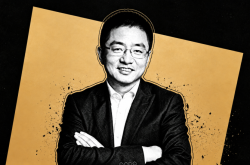
Five years after stepping down, Wang Huiwen has once again become a key figure in the venture capital scene.
But this time, he's not acting as an entrepreneur but as an investor.
According to the official website of Lollapalooza Capital, Wang Huiwen's investment platform, 24 projects have been publicly disclosed so far, spanning various fields such as large language models, AI infrastructure, AI agents, smart hardware, and embodied intelligence. Notable projects include Yuezhian and Manus.
Wang Huiwen, who once left Meituan and failed in his attempt to create a "Chinese version of OpenAI," has found a new path in AI investment.
However, Wang Huiwen is not the only prominent figure in the Chinese business community willing to make significant bets on AI. Chen Tianqiao, a former richest man in China, has allocated $1 billion to establish an incubator. Duan Yongping, known as "China's Warren Buffett," continues to increase his stake in NVIDIA. Zhou Yahui, founder of Kunlun Wanwei, has even set aside his investor identity to personally develop an AI music large model.
From backing star startups to personally developing AI products, why are business leaders flocking (fēnfēn, meaning "one after another" or "in droves") to invest in AI?

24 Projects, Mapping Out the AI Investment Landscape
If Wang Huiwen of the past was the mastermind behind Meituan's business empire, today's Wang Huiwen aims to capture opportunities in the AI industry.
Over the past two years, Wang Huiwen has quietly built an investment network covering the entire AI industry chain through his investment platform, Lollapalooza Capital.
According to the official website, Lollapalooza Capital has publicly disclosed 24 investment projects to date, spanning various fields such as large language models, AI infrastructure, AI agents, smart hardware, and embodied intelligence.
This is not merely chasing hot trends but rather a strategy akin to industrial investment: from model foundations and computing infrastructure to application gateways and end-user devices, Wang Huiwen seeks to position himself at key nodes in the AI industry chain.
Founded in 2025, Lollapalooza Capital is widely referred to externally as the "Wang Huiwen Family Office."
The name originates from the "Lollapalooza effect" proposed by Charlie Munger, referring to the result of multiple factors combining to produce an outcome far exceeding the sum of their individual effects. In the AI era, from breakthroughs in underlying technologies to capital inflows and the explosion of application scenarios, the entire industry chain is forming a new wave of growth opportunities.
Wang Huiwen has bet on large language models. Among them, Yuezhian (Kimi) is one of the most closely watched projects.
In 2025, Yuezhian completed its Series C funding round, with participation from Alibaba, Tencent, and individual investors such as Wang Huiwen, reaching a post-money valuation of approximately $4.3 billion. In July of this year, the company released its new-generation model, Kimi K3, continuing to advance in areas such as programming, intelligent agents, and long-text reasoning.
In Wang Huiwen's view, AI competition does not occur solely at the model level. The stronger the model, the greater the demand for underlying computing power, deployment, and application infrastructure—areas that also hold potential for new industrial opportunities.
Compared to models and infrastructure, AI agents are the layer closest to users and have become one of the most highly capitalized directions in recent years. Among them, Manus is undoubtedly the most representative case in Wang Huiwen's investment portfolio.
In November 2024, Wang Huiwen participated in Manus' second funding round as an individual investor. Other investors in the same round included Sequoia China, Tencent, and ZhenFund, with a post-money valuation of approximately $85 million.
A year later, as the concept of AI agents gained traction, market acquisition offers temporarily pushed Manus' valuation to around $2 billion. Calculated at market valuation, the book value of this investment has grown over 20-fold, making it one of the most notable deals in Wang Huiwen's AI investment portfolio.
Around the agent ecosystem, Lollapalooza Capital has also invested in projects such as AI browser company Citro Labs, voice agent 19Pine, and content generation platform NieTa.
At the same time, Wang Huiwen's investment portfolio extends to AI content, education, and hardware, including AI video generation companies Aishi Technology (Pixverse), Sand AI, CreativeFitting, and XR glasses company Viture.
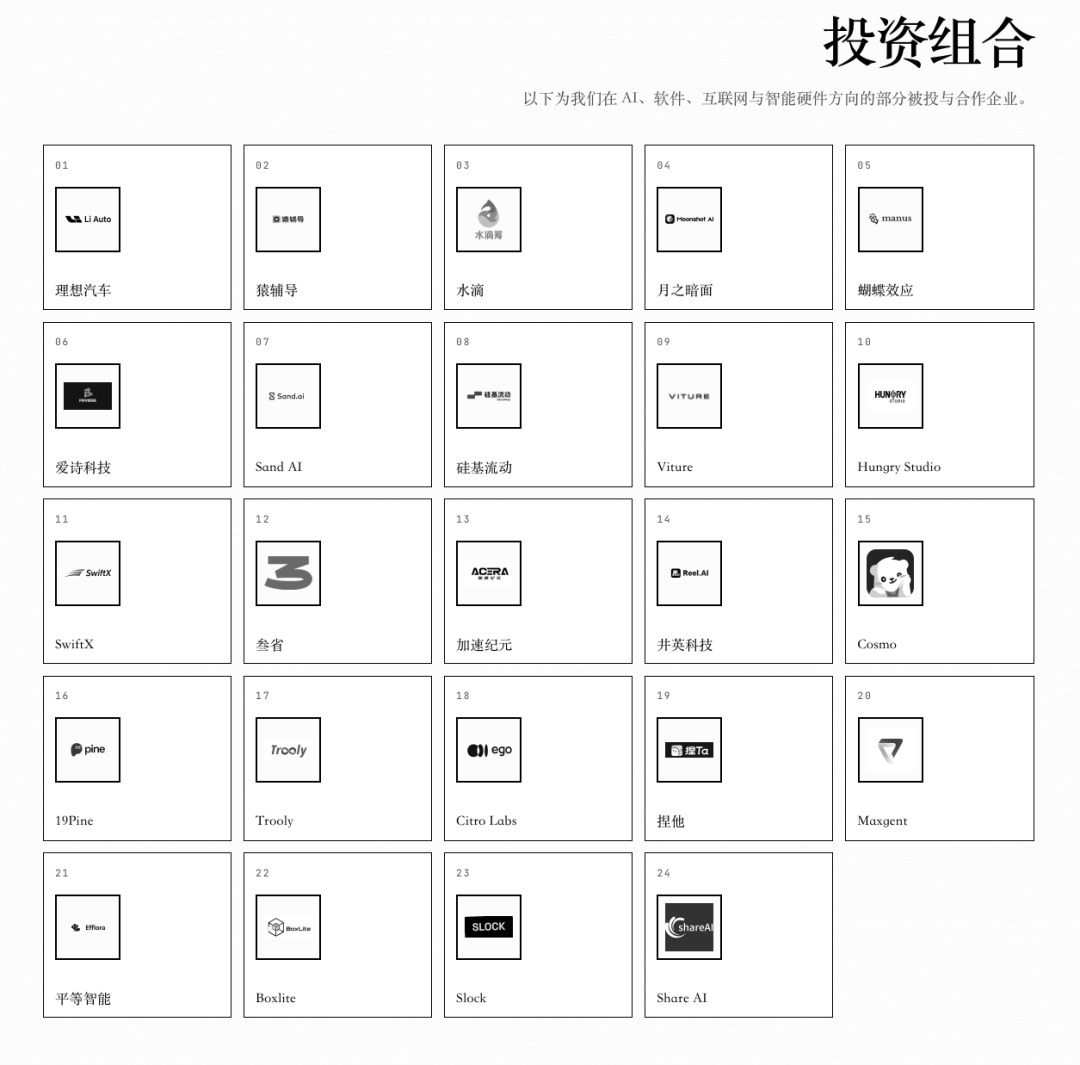
Source: Lollapalooza Capital official website
From the 24 projects Wang Huiwen has invested in, it is evident that he has not simply chased a single AI trend but has instead positioned himself across models, computing power, agents, applications, and hardware.
However, questions arise: How has an internet executive formerly responsible for Meituan's growth been able to form such a comprehensive AI investment portfolio?

AI Entrepreneurial Setback Leads Wang Huiwen to Become an Investor
Wang Huiwen's acumen in the AI investment circle today did not emerge suddenly. Before becoming an investor, he was one of China's most iconic product-focused entrepreneurs in the internet sector.
Wang Huiwen and Wang Xing are among the most representative partnerships in Chinese internet entrepreneurship history. Both graduated from Tsinghua University's Department of Electronic Engineering and were roommates during their university years. In 2005, the two co-founded Xiaonei (later Renren), and in December 2010, Wang Huiwen joined Meituan.
Over the next decade, Wang Huiwen played a pivotal role in driving the development of Meituan's core businesses, including Meituan Waimai (food delivery), local services, and ride-hailing. He was the second most important figure in Meituan's early expansion after Wang Xing, leading to the pair being dubbed the "Two Wangs" by outsiders.
However, after Meituan matured, Wang Huiwen chose to leave.
In December 2020, shortly before Meituan's 10th anniversary, Wang Huiwen, aged 42, announced his retirement. At the time, the public did not know that this internet veteran's next public appearance would be amid the AI wave.
In February 2023, shortly after ChatGPT ignited global interest, Wang Huiwen released a highly influential "AI Hero Post," announcing the establishment of Beijing Guangnian Zhiwai Technology Co., Ltd., with the goal of creating a "Chinese version of OpenAI."
This time, Wang Huiwen was not just an investor but an entrepreneur.
Wang Huiwen invested $50 million in startup capital and designed an attractive talent incentive plan: he would retain a 25% stake, leaving the remaining 75% equity for future core AI talent.
This recruitment letter quickly garnered industry attention and attracted a group of AI professionals from major companies and research institutions. In a short time, Guangnian Zhiwai became one of the most closely watched projects in the "Chinese version of ChatGPT" entrepreneurial wave.
However, this entrepreneurial venture did not unfold as expected. In June 2023, Wang Huiwen temporarily left the company due to health reasons. That same month, Meituan announced the acquisition of Guangnian Zhiwai's assets for approximately 2.065 billion yuan.
Wang Huiwen's dream of a "Chinese version of OpenAI" ended with an unfinished chapter before it could even be tested.
Nevertheless, the story did not end there. In 2024, as his health gradually recovered, Wang Huiwen resumed his involvement in AI-related work and began building his investment platform, Lollapalooza Capital.
To some extent, this represents a continuation of Wang Huiwen's entrepreneurial journey. Previously, he sought an opportunity to build the next-generation AI company; now, he stands on the other side, using his years of accumulated product experience, industry insights, and entrepreneurial resources to identify the next wave of AI entrepreneurs.
From personally developing models to investing in models, applications, and infrastructure, Wang Huiwen has completed his transition from entrepreneur to investor.

Business Leaders Compete for a Foothold in the New AI Sector
Wang Huiwen's chosen path is to use his entrepreneurial experience to identify potential companies for the AI era.
However, in this AI wave, business leaders are entering the fray in various ways. Some choose to become capital providers, betting on future technological winners, while others return to the front lines of entrepreneurship to compete in the next generation of products.
Shanda Group founder and former richest man in China, Chen Tianqiao, is among the more aggressive domestic entrepreneurs betting on AI.
In March of this year, Chen Tianqiao's AI large model, MiroMind, suddenly gained popularity. The model not only predicts outcomes for sports events like F1 but also attempts to play a role in financial market analysis and other scenarios.
In fact, Chen Tianqiao's foray into AI did not happen overnight.
Previously, Chen Tianqiao had a four-hour conversation with Liang Wenfeng, founder of DeepSeek. Although Liang declined Chen's investment offer, the discussion made Chen realize that AI might be initiating a new technological revolution.
Since then, Chen Tianqiao has continued to increase his bets on AI. According to public information, he has invested in over a hundred AI startups and has earmarked $1 billion to establish an AI incubator, aiming to cover models, applications, and infrastructure.
If Chen Tianqiao's approach is to expand his bets through capital, then Duan Yongping has maintained his consistent investment style: waiting for trends to be validated before concentrating his bets.
In 2023, when Duan Yongping first publicly discussed AI, he remained cautious, stating, "It's worth watching, but I don't understand it yet and won't act rashly."
However, as the AI industry rapidly developed, Duan Yongping's attitude began to shift.
In the third quarter of 2025, Duan Yongping began building a position in NVIDIA. By the end of the fourth quarter of the same year, his holdings had increased to 7.237 million shares. In the first quarter of 2026, this figure further rose to 13.844 million shares, a 91.3% increase, with holdings accounting for 12.07% of his portfolio, becoming his third-largest position.
At the same time, Duan Yongping significantly increased his stake in TSMC and invested in companies covering AI computing power, connectivity, and application sectors.
Explaining his increased bets on AI, Duan Yongping stated bluntly, "AI is not just a technological upgrade; it's an industrial revolution-level transformation. This trend is irreversible and cannot be missed."
Compared to Chen Tianqiao and Duan Yongping's capital bets, Kunlun Wanwei founder Zhou Yahui chose a more radical path: transitioning from investor back to entrepreneur.
Zhou Yahui was early known in the venture capital circle as a "unicorn harvester," with investments in high-profile projects such as Inke, Qudian, and Dada. However, as the AI era dawned, Zhou Yahui began to shift his identity.
In June 2023, Kunlun Wanwei acquired Singularity AI for $160 million, teaming up once again with longtime partner Wang Liwei to bet on artificial general intelligence (AGI), launching the large model "Tiangong."
Subsequently, Zhou Yahui turned his attention to AI application deployment. In January 2026, Kunlun Tiangong released the AI music generation model Mureka V8. Zhou Yahui personally promoted it, declaring the goal of creating an "AI version of Spotify" targeting overseas markets, aiming for 100 million daily active users (DAU) and 300-500 million monthly active users (MAU).
The investor once known for "evaluating people and projects" is now personally competing in the AI product arena.
From Wang Huiwen to Chen Tianqiao, from Duan Yongping to Zhou Yahui, these individuals who once defined China's internet and business investment landscape are now re-entering the AI era in different ways.
References:
"Wang Huiwen's Family Office Bets on the AI Landscape: From Large Models to AI Agents," Duozhi;
"Getting Close to Wang Huiwen's 'Family Office': 24 Companies, Five Major Sectors, One Long-Term Bet," Family Office New Intellect;
"Wang Huiwen Declares: I'll Invest 300 Million First," Investment Horizon;
"AI Investors Flock to Wudaokou," ChinaVenture;
"After Alibaba Invests in Kling, It Invests Another 3 Billion in Aishi's Series C," ChinaVenture;
"Wang Huiwen Seeks to Invest in the OpenClaw Sector, Issues Another Hero Post: 'Welcome to Contact Me for Financing,'" QbitAI;
"Chen Tianqiao Invests $1 Billion to Personally Use AI for Financial Market Predictions," Yicai;
"Zhou Yahui Aims to Create an 'AI Version of Spotify': Targeting 100 Million DAU, Unafraid of Big Tech 'Sneak Attacks,'" Tencent Technology;
"Dialogue with Zhou Yahui: Not Competing with ByteDance or Tencent, But Building an 'AI Version of Spotify' Overseas," NetEase Technology.
Click to follow
THE END
Copyright and Disclaimer
1. Content Copyright: Except for quoted public data, policies, and case studies, all content in this article is original. Professional data is sourced from authorized databases and government websites, while cases are compiled from real events.
2. Image Licensing: Within this article, certain images are either proprietary in nature or have been officially licensed for use, while others have been generated by artificial intelligence. For any web-based images where the copyright status is not explicitly clear, the ownership rights are retained by the original creators. Should any instance of copyright infringement be identified, the content in question will be promptly removed upon receipt of notification.
3. Republishing Guidelines: Republishing of this article without prior authorization is strictly prohibited. In the event that republishing is desired, it is mandatory to retain the complete source information and properly attribute the authorship to the original creator.
4. Liability Disclaimer: The observations and industry commentary presented in this article regarding business figures are based solely on publicly accessible information and represent the author's personal perspective. The content provided is intended for reference purposes only and should not be construed as professional advice. Users assume full responsibility for any risks that may arise from the utilization of the information contained herein. Xinzhidongneng reserves the exclusive right to interpret the contents of this article.
-
![]()
Wang Huiwen, Former Meituan Executive, Achieves 20-Fold ROI, Supports 24 AI Startups
-
![]()
Another AI Computing Power Unicorn Launches IPO! Founded by a Changjiang Scholar
-
![]()
OFILM Holdings Secures Zhongke Daojing, Marking a Significant Leap in the Optical Communication Industry!
-
What Will Be the Next Key Battleground for Large Models After AI Coding?
-
![]()
Leapmotor's Sales Soar, Yet Hidden Concerns Loom
-
![]()
China’s Action Camera Market Soars: 3.12 Million Units Sold in Six Months, DJI Secures 74% Dominance
-
![]()
Zhang Yiming: Strategic Retreat as a Path Forward
-
![]()
Exploring Charging for Some Features of QianWen App: Can It Follow the Path of Doubao?