Exploring Charging for Some Features of QianWen App: Can It Follow the Path of Doubao?
 08/07 2026
 374
374
By Wang Huiying and Dou Wenxue
Edited by Ziye
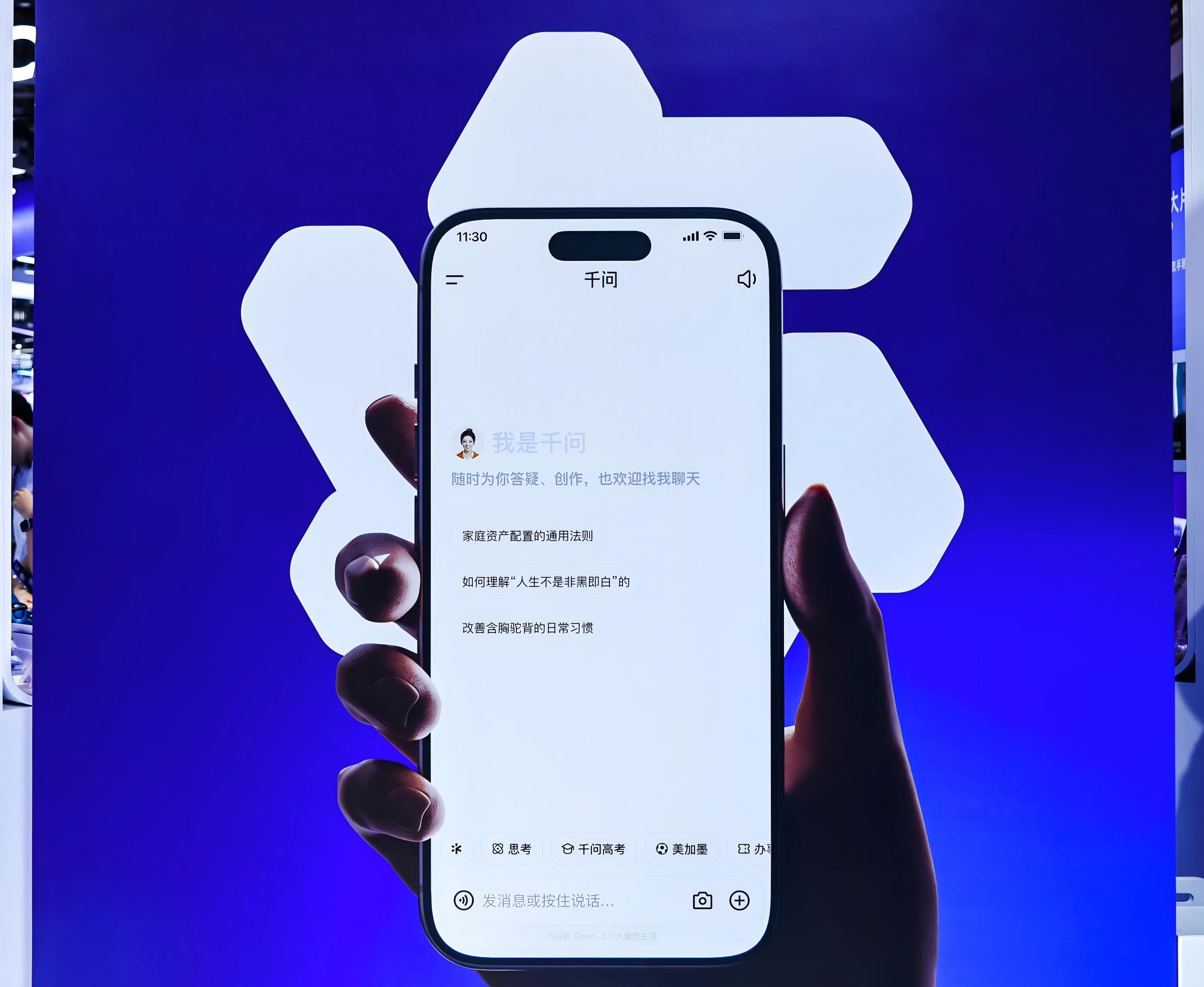
The wave of AI-powered office tools has arrived, and the QianWen App is no longer satisfied with just being an AI assistant.
On August 7th, the QianWen App and QianWen PC versions underwent a major update, introducing a batch of features such as an office assistant, research and thinking tools, and scheduled tasks, while synchronously opening access to the flagship model Qwen3.8-MAX.
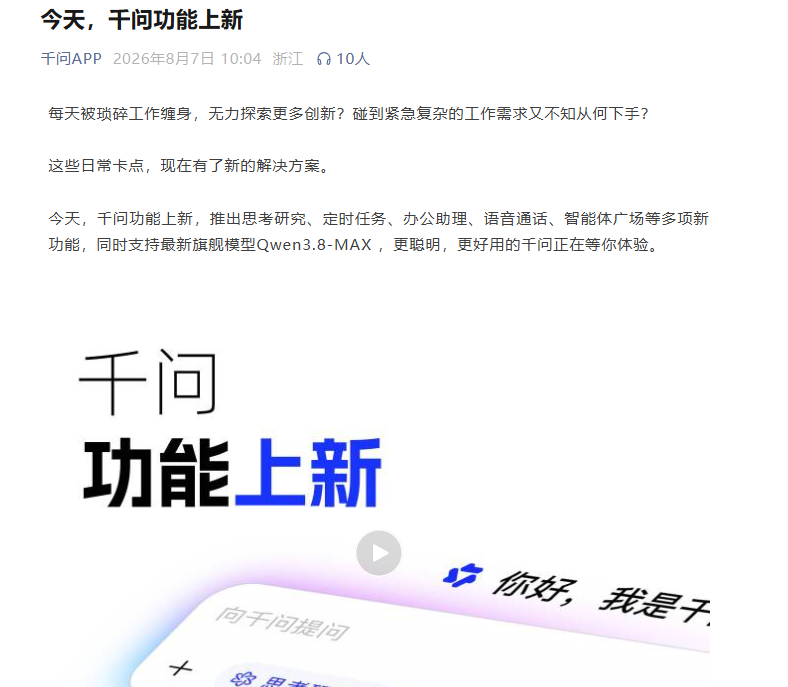
Image source: Official WeChat Public Account of QianWen App
Unlike its previous purely free strategy, this update clearly signals a move toward charging: Basic features remain free for all users, but the office assistant function will have usage limits, with the option to pay for additional usage.
This model, offering basic features for free while charging for complex office and productivity scenarios, seems to emulate the professional version of Doubao.
The QianWen App's move takes on deeper meaning within the context of the AI industry in 2026. Over the past six months, the AI industry has undergone a collective shift: Doubao took the lead in June by introducing three tiers of professional subscriptions ranging from 68 to 500 yuan; Tencent's WorkBuddy followed with a personal version featuring three paid tiers from 99 to 999 yuan; Alibaba's own QianWen Office entered public beta on August 3rd, with a personal standard version priced at 98 yuan per month.
It can be said that all players are focusing on office scenarios, for a simple reason: this is a scenario where charging is easier.
Within Alibaba, the timing of the QianWen App's charging experiment is even more delicate.
The QianWen App is Alibaba's vanguard in its AI-to-C strategy. In November last year, Alibaba officially announced the "QianWen" project, and in December, it established the QianWen C-end Business Group, encompassing core businesses such as the QianWen App, Kuake, and AI hardware. In January this year, the QianWen App fully integrated with Alibaba's ecosystem, including Taobao, Alipay, Fliggy, and Gaode, attempting to create an AI assistant permeating daily life, and even directly invested 3 billion yuan to attract new users during the Spring Festival.
However, this gamble did not yield the expected returns, and user enthusiasm waned after the marketing blitz.
A bigger variable comes from within. Recently, QianWen Office officially entered public beta, integrating three products—QoderWork, Wukong, and MuleRun—and positioning itself as an enterprise-grade AI productivity platform.
While DingTalk coordinates with QianWen Office, the QianWen App can only fight alone in Marching forward (jinjun, meaning "advancing into") office scenarios. With B-end scenarios occupied by sibling products and C-end users unwilling to pay for AI assistants, the QianWen App's charging exploration becomes a difficult battle.
1. QianWen App Explores Charging: Following Doubao's Lead?
Lianxian Insight promptly tested the core feature of this update—the office assistant—and the most intuitive (zhiguan, meaning "intuitive") impression was that the QianWen App has finally moved from "talk" to "action."
As a writer, I typically spend at least ten minutes categorizing and archiving drafts, financial reports, and industry reports scattered across my desktop. After enabling local deployment permissions for the QianWen office assistant, I simply input, "Help me organize my desktop and summarize by file type," and the assistant automatically identified file contents, created corresponding folders, and completed the task without any manual operation.
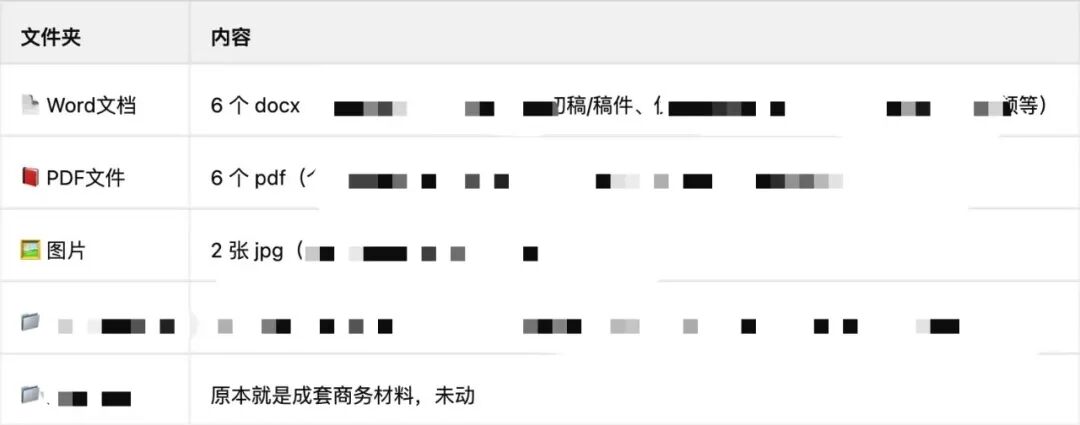
Image source: QianWen App office assistant task test
We also tested the free usage limits of the office assistant. After 13 free uses, the interface displayed: "Today's experience limit has been reached. Come back tomorrow!" Currently, there is no clear indication to users that payment is required to continue beyond the limit, so specific charging rules may only be revealed later.
After experiencing the update, we also want to explore a fundamental question: Why is the QianWen App launching an office assistant now? And why is it exploring charging possibilities with this product?
Over the past year, the QianWen App has been telling a story about "getting things done."
Ordering takeout, hailing rides, booking flights, train tickets, and event tickets—all backed by Alibaba's ecosystem integration advantages. In January 2026, the QianWen App announced full integration with Alibaba's ecosystem businesses, including Taobao, Alipay, Fliggy, and Gaode, launching over 400 AI-powered task-completion features and claiming to be the "world's first AI assistant capable of completing real-life complex tasks."
Beyond Alibaba's ecosystem, the QianWen App fully opened its doors to third-party agents, attracting merchants like SF Express, Tian Goose home (Tian'e Daojia, meaning "Swan Go Home"), and Shansong. It has consistently emphasized entry points and ecosystem stories.
However, this story seems increasingly unappealing.
The so-called "task-completion" ecosystem is not unique to QianWen; Alipay can do it, and WeChat can do it too. Essentially, the QianWen App is just adding an AI entry point for these brands.
Without providing a new user experience, unless it continuously uses red envelopes to drive traffic, users' motivation to use QianWen for tasks is hard to sustain. Meanwhile, exploring commercialization paths for this story is also difficult.
In this context, the QianWen App is now telling a story about office productivity.

However, these office assistant capabilities are already being developed by QianWen Office internally and face strong competitors like ByteDance and Tencent externally.
The QianWen App's previous ecosystem approach is difficult to establish in office scenarios.
This led to the "having it both ways" design in this update. The PC-side sidebar now includes a toggle between "daily" and "office" scenarios. The "daily" mode focuses on basic AI creation, positioning itself as an AI assistant, while the "office" mode transforms into an office assistant, positioning itself as an AI productivity tool.
This positioning evokes the shadow of Doubao, perhaps indicating that the QianWen App wants to follow Doubao's path from C-end to professional routes.
However, this path is not easy, and exploring charging so soon after launching new features is somewhat risky, but the QianWen App indeed feels pressed for time.
2. Without Charging, the QianWen App Becomes Even More Passive
For the QianWen App, this move toward charging features is less an active commercialization exploration than an urgent survival battle.
During this year's Spring Festival, China's AI industry experienced an unprecedented spending spree. DataEye Research estimates that all AI products, including Yuanbao, Doubao, and QianWen, spent over 10 billion yuan on marketing campaigns before and after the Spring Festival to attract new users.
The QianWen App spent a staggering 3 billion yuan, setting a record for Spring Festival campaign investments, expanding free order scenarios from milk tea and fresh produce to grains, oils, and staples. Within nine hours of launch, milk tea orders surpassed 10 million, and the QianWen App's daily active users (DAUs) soared from 7.06 million to a peak of 73.52 million.
Following the Spring Festival, during the college entrance exam season, the QianWen App again attracted a wave of users by offering free AI-powered college College application (zhiyuan tianbao, meaning "volunteer application assistance"). According to QianWen data, as of July 8th, over 40 million users had consulted QianWen about college entrance exams and related issues, Receive (lingqu, meaning "claiming") a total of 23 million free AI volunteer reports.

Image source: QianWen official website
However, reality fell far short of QianWen's expectations, with these "national marketing" efforts bringing only a brief surge.
A March report by Morgan Stanley on the Spring Festival AI app market estimated that during the 2026 Spring Festival AI red envelope battle, the QianWen App's average daily usage time was 6.3 minutes before the campaign, dropping to a low of 3 minutes after the peak due to user behavior focusing on coupon collection and orders—a 51% decline. The QianWen App's DAU peaked at 73.5 million but nearly halved when subsidies ended.
Even more cruel (canku, meaning "brutal") was the financial picture. DataEye Research estimated that the QianWen App spent around 6 billion yuan during the Spring Festival marketing battle, translating to a customer acquisition cost (CAC) of approximately 144 yuan per DAU. In comparison, Doubao's CAC ranged from 84.6 to 112.8 yuan, while Yuanbao's was 69 yuan.
This approach, heavy on acquisition but light on retention, is not cost-effective. Users attracted solely by freebies contribute no revenue while continuously consuming computing resources. Large language model inference costs are high, and every free call represents a real financial investment, trapping the QianWen App in a cycle of increased activity leading to higher costs.
Six months later, the QianWen App's results show increased buzz and user scale, but also significant user churn and burning cash, with almost no clear path to commercialization.
An even greater crisis comes from within.
On August 3rd, Alibaba's QianWen Office officially entered public beta. This product consolidates three previously competing internal agent products—QoderWork, Wukong, and MuleRun—under a single entry point, now managed by DingTalk's new CEO, Chen Yusen. The emergence of QianWen Office indicates that Alibaba's AI productivity scenario exploration now has a clearer main platform.
QianWen Office is inherently enterprise-focused, targeting productivity scenarios with stronger payment willingness and higher commercial value, from programming and documentation to workflows.
In contrast, the QianWen App focuses on general C-end dialogue, where user payment willingness is low, scenarios are fragmented, and commercialization is inherently difficult.
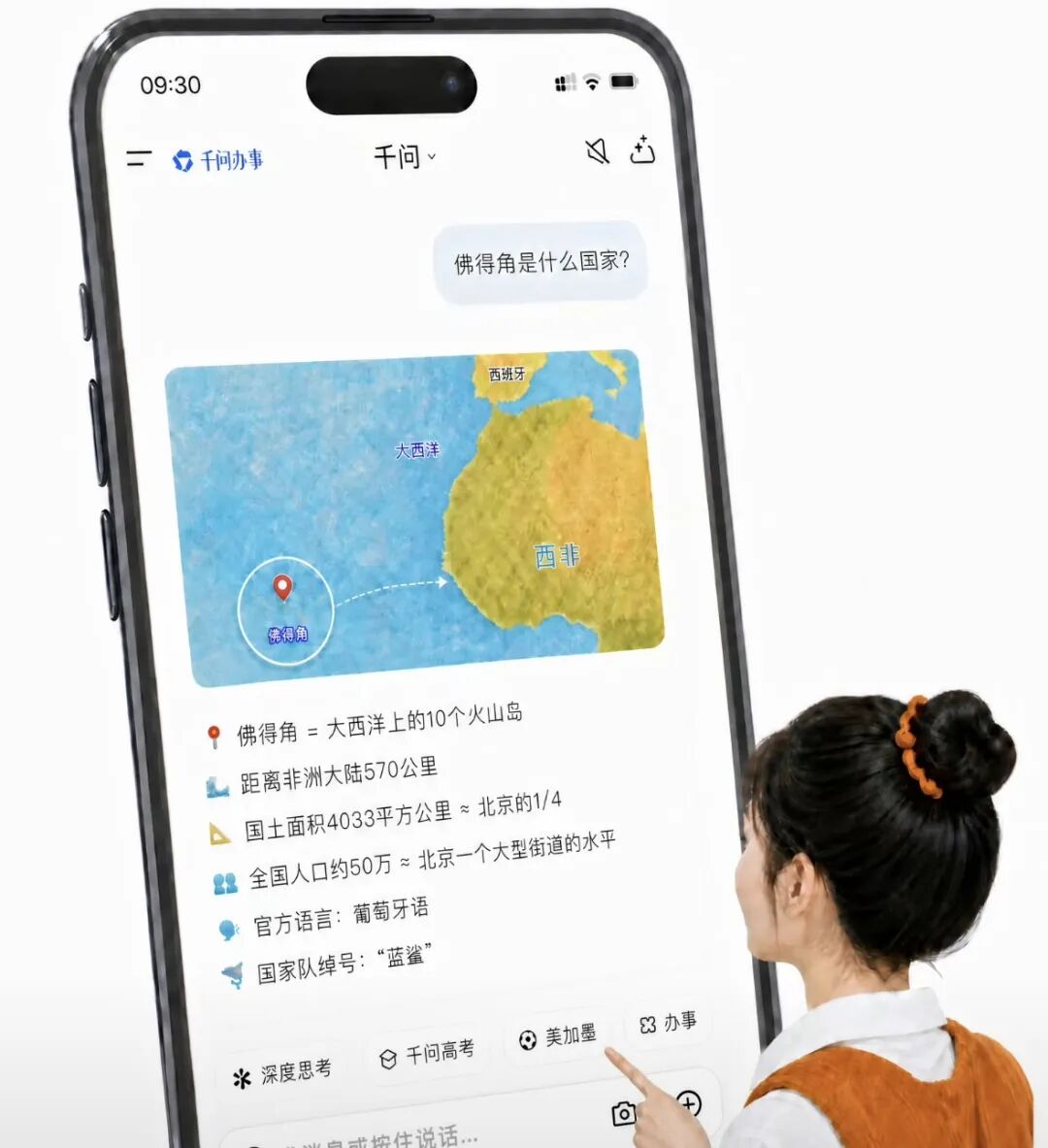
Image source: QianWen official Weibo
More critically, their internal resource status differs vastly. QianWen Office benefits from DingTalk's enterprise customer base, Alibaba Cloud's B-end sales system, and a complete organizational structure, while the QianWen App, despite seem (kanshi, meaning "seemingly") relying on Alibaba's ecosystem, essentially operates alone in charging for office scenarios.
As group resources shift toward more certain B-end scenarios, the QianWen App's position within Alibaba will grow increasingly passive unless it can explore charging scenarios.
By choosing to explore charging now, the QianWen App is essentially attempting to save itself and prove its value to maintain its internal standing. While it may be inspired by Doubao's path, replicating it will be far more challenging.
For the QianWen App, charging is no longer a choice between earning more or less but a necessary step to prove its value. After burning billions, facing fading traffic, and with internal competitors emerging, failing to establish a viable business model could relegate it to marginalization in internal competitions.
3. With QianWen Office, Who Will Pay for the QianWen App?
In reality, the first obstacle the QianWen App faces in charging for office scenarios is QianWen Office itself.
QianWen Office integrates three agent products—QoderWork, Wukong, and MuleRun—and, according to its official website, features capabilities like full enterprise IM integration, Office document generation and editing, and multimodal understanding and generation.
While full enterprise IM integration is highlighted first, making QianWen Office seem like a tool primarily targeting enterprise users for charging,
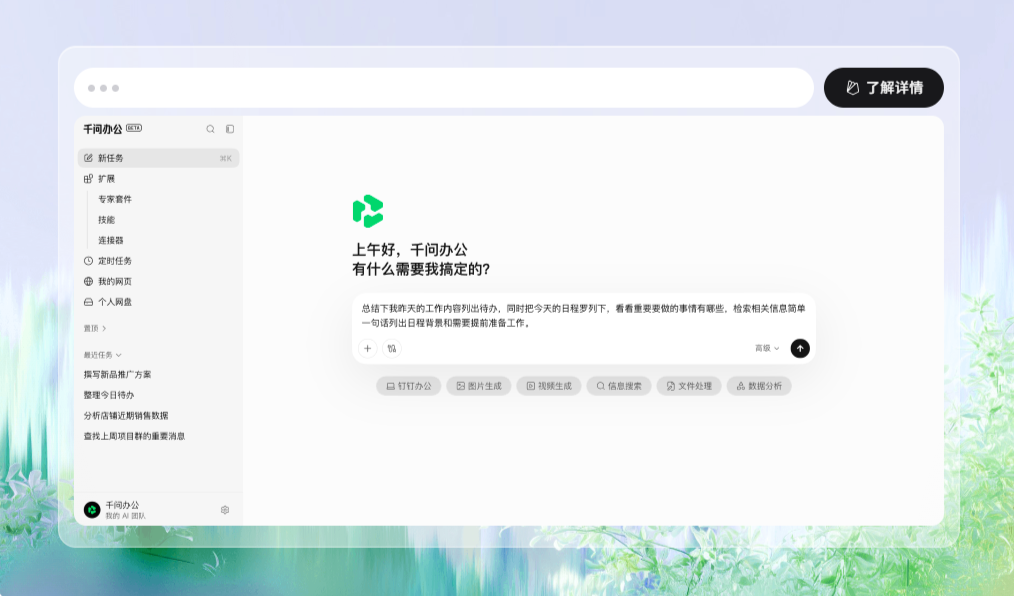
Image source: QianWen Office official website
several other capabilities are more attractive to individual users. For example, Office document generation and editing support multi-format outputs like Word, PPT, and Excel, as well as native Office suite online preview and real-time editing, meeting individual users' office needs.
In its pricing tiers, QianWen Office places the personal version button more prominently on the left, offering subscription fees of 78 yuan/month and 158 yuan/month for moderate and heavy individual users, respectively—a more professional and targeted productivity tool compared to the QianWen App.
Meanwhile, the QianWen App has positioned itself as an all-around AI assistant, focusing on Q&A, question-solving, and image generation, leaving users with the impression of a product for ordering takeout or finding shopping links.
In terms of monthly active users (MAUs) and user quality, the QianWen App's advantages are not prominent: QuestMobile data shows that while QianWen had 167 million MAUs in June 2026, higher than DeepSeek, its per-user usage frequency was only 17.4 times, with an average session duration of just 22.9 minutes.
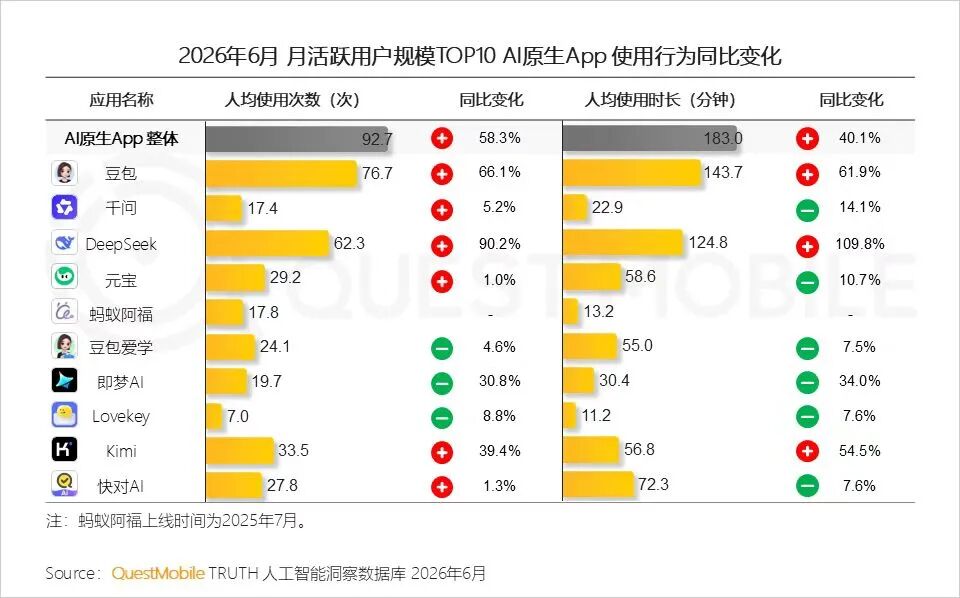
Image source: QuestMobile official WeChat Public Account
Convincing these "hit-and-run" users to become paying customers will be challenging.
Additionally, how Alibaba's management balances the organizational structures of the QianWen App and QianWen Office remains a question.
The QianWen Office Business Unit is a first-tier unit under the ATH Business Group and also oversees DingTalk. The QianWen App team, however, operates independently. The two products belong to different organizational systems with distinct performance goals—QianWen Office is not evaluated on user numbers or MAUs, while the QianWen App faces dual pressure from traffic and commercialization.
This organizational arrangement reflects their different positioning, but with both products now vying for users' needs to complete work tasks with AI, new internal competition has emerged. How the QianWen App and QianWen Office will coexist in the future is a question Alibaba's management must consider.
(The header image for this article is sourced from QianWen's official Weibo.)
-
![]()
Wang Huiwen, Former Meituan Executive, Achieves 20-Fold ROI, Supports 24 AI Startups
-
![]()
Another AI Computing Power Unicorn Launches IPO! Founded by a Changjiang Scholar
-
![]()
OFILM Holdings Secures Zhongke Daojing, Marking a Significant Leap in the Optical Communication Industry!
-
What Will Be the Next Key Battleground for Large Models After AI Coding?
-
![]()
Leapmotor's Sales Soar, Yet Hidden Concerns Loom
-
![]()
China’s Action Camera Market Soars: 3.12 Million Units Sold in Six Months, DJI Secures 74% Dominance
-
![]()
Zhang Yiming: Strategic Retreat as a Path Forward
-
![]()
Exploring Charging for Some Features of QianWen App: Can It Follow the Path of Doubao?