The Debate Between Autonomous Driving VLA and World Models: What Is It Really About?
 08/10 2026
 515
515
As 2026 progresses past its halfway point, the most talked-about topic in the autonomous driving industry is undoubtedly the debate between the two technical routes of VLA and world models.
From the full-scale implementation of end-to-end large models in vehicles in 2025 to the public airing of divergence (disagreements, replaced in context) between the two routes at NVIDIA's GTC Conference in March 2026, and then to discussions on the possibility of integration at CVPR 2026.
The intensity, duration, and scope of influence of this debate have surpassed mere technical differences, becoming a lens through which the entire industry contemplates what the next form of autonomous driving will truly be.
01 Two Types of Intelligence, Two Logics
To understand what this debate is really about, we first need to clarify what VLA and world models can actually do.
VLA, which stands for Vision-Language-Action model, introduces a crucial intermediate layer—language—between visual perception and action execution.
This language is not about making the car speak but using the reasoning capabilities of large language models to make driving decisions.
The workflow of VLA involves first identifying road conditions through visual perception, then analyzing the semantic meaning of the current scene with a language model, and finally outputting corresponding driving actions.
Liu Xianming, head of XPENG's General Intelligence Center, succinctly summarizes that VLA learns how humans would act in this world.
Currently, models like OpenDriveVLA are exploring this approach, generating driving actions through multimodal inputs such as 2D and 3D instance perception, vehicle status, and language instructions.
Official data shows that XPENG's second-generation VLA has reduced decision-making delay to 80 milliseconds. Models equipped with this technology achieved a 97.43% daily VLA activation rate in the first week, a 96.97% monthly active rate, and over 50% of driving miles covered by intelligent driving.
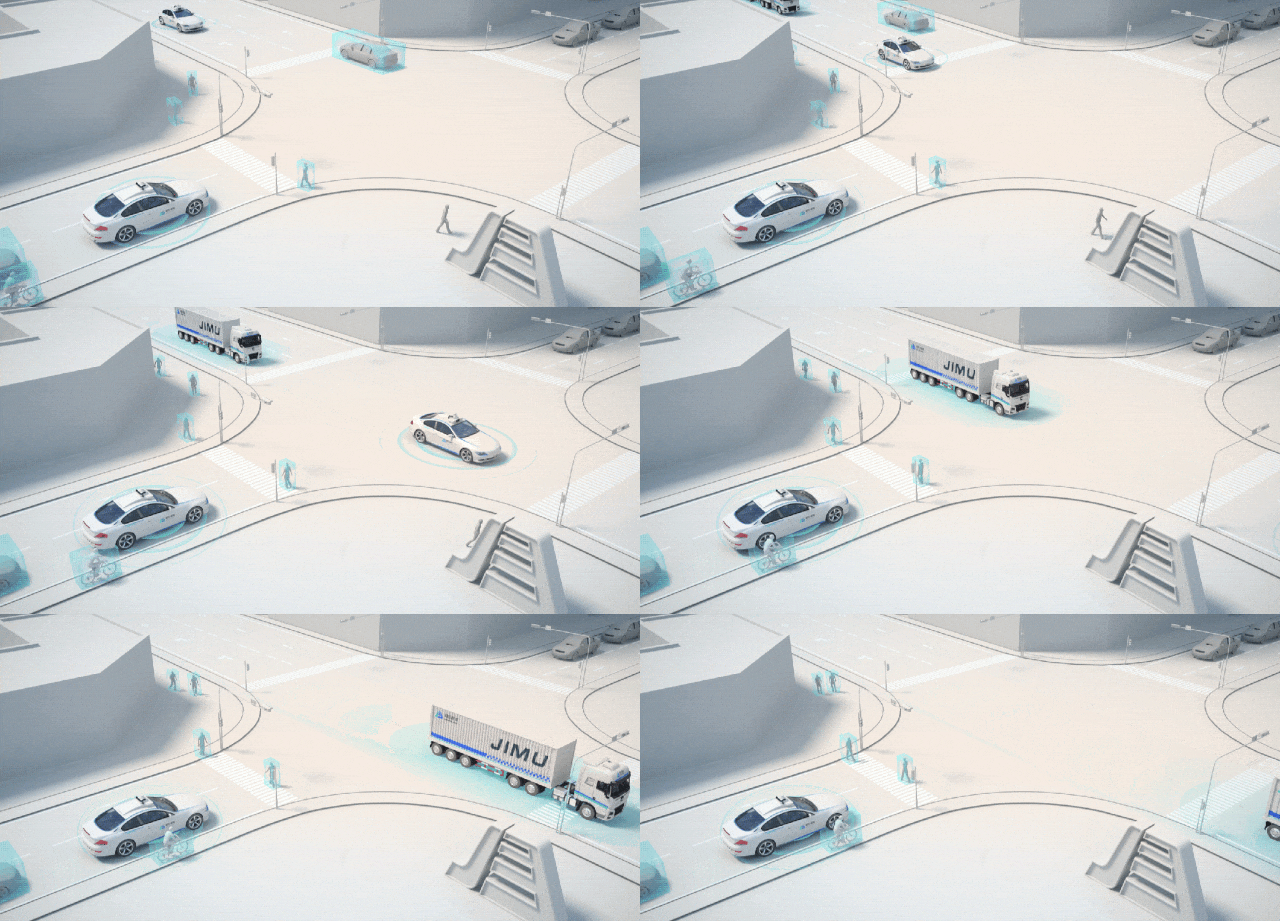
Image Source: Internet
The logic of world models is entirely different; they are not concerned with how humans act but rather with how the world itself changes.
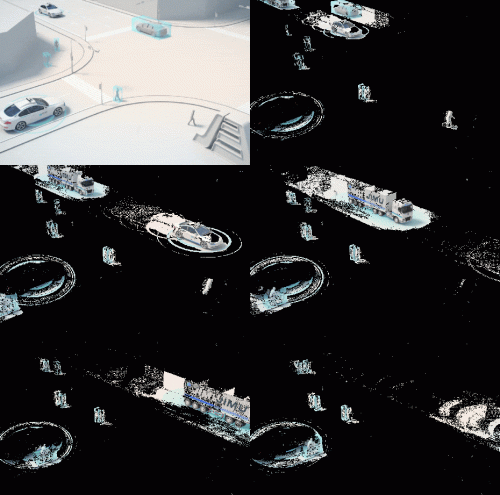
The core capability of world models is prediction—not predicting what the next image will look like but how the physical world will evolve after the vehicle executes a certain action.
For example, if the system sees a bouncing ball by the roadside, the world model will predict, based on an understanding of physical causality, that a child is likely to run out from behind the ball.
Currently, there are many practical cases of world models being implemented in autonomous driving within the industry.
Waymo unveiled its self-developed world model at CVPR 2026, built on Google DeepMind's Genie 3 architecture, capable of predicting the dynamic evolution of road scenes, including the behavioral intentions of other vehicles and pedestrians.
From the tasks these two approaches accomplish in autonomous driving, the fundamental difference lies in how they process the world.
VLA uses the reasoning capabilities of language models to describe the world, while world models directly simulate the physical evolution of the world in a state space. One acts after understanding, and the other acts after predicting.
Jin Yuzhi, CEO of Huawei's Automotive BU, once stated that VLA is a clever but flawed solution, arguing that the approach of distilling cloud-based large models into in-vehicle small models poses significant risks in driving scenarios.
Li Chuanhai, CTO of Geely Automobile Group, and Cao Xudong, CEO of Momenta, have also raised doubts about VLA.
The reason for questioning VLA is that driving is not about reading comprehension; the one-dimensional text tokens of language models cannot accurately describe the three-dimensional physical world.
In other words, VLA understands scene semantics, but semantic understanding and physical causality are two different things. A model can understand the semantics of a pedestrian ahead but does not necessarily truly comprehend the physical law that the pedestrian might cross the road in the next second.
However, the VLA camp has its own perspective. Zhan Kun, head of Li Auto's base model, proposed at GTC 2026 that when vision, language, and actions are unified into a single model, it is no longer just an autonomous driving model but is evolving into a general-purpose agent for the physical world.
02 Taking Sides and Shifting Gears
At the beginning of 2026, the debate between VLA and world models was quite evident.
Huawei is the most steadfast representative of the world model route. When releasing ADS 4 in 2025, Huawei proposed the WEWA world model architecture. By April 2026, with the launch of ADS 5, WEWA had been upgraded to version 2.0, focusing on both cloud and in-vehicle levels.
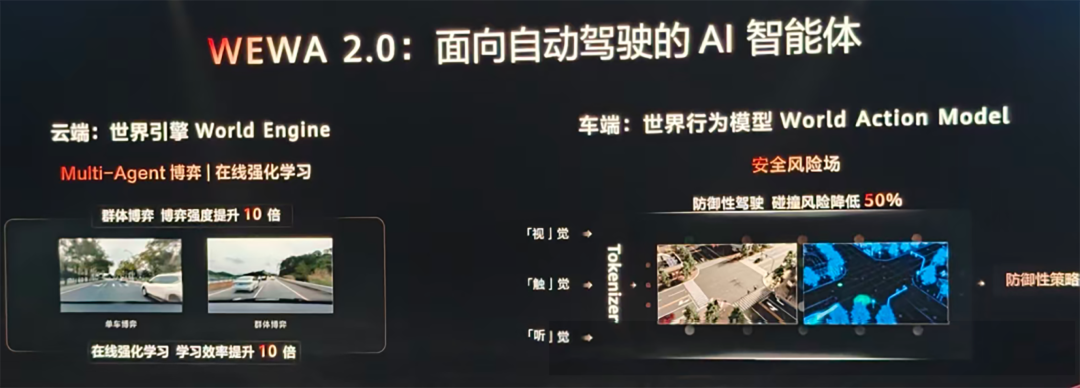
Image Source: Internet
The cloud-based world engine introduces a multi-agent interaction mechanism.
Previously, training was like letting a single driver practice on an empty road; now, it involves hundreds or thousands of AI drivers navigating a virtual environment simultaneously, each with its own behavioral logic, thus increasing training intensity and efficiency tenfold.
The in-vehicle World Behavior Model incorporates Safety Risk Field technology, which assesses risk distribution in real-time from three dimensions—kinetic energy, potential energy, and behavior—generating dynamic risk heatmaps. Huawei claims this can reduce collision risks by 50%.
As of April 2026, Huawei's Qiankun Intelligent Driving has accumulated over 5.8 billion kilometers of assisted driving miles, with cloud computing power reaching 45 EFLOPS.
By June 2026, the cumulative mileage had updated to 12.809 billion kilometers, with deployment exceeding 1.9 million units.
Momenta also released the R7 Reinforcement Learning World Model in April 2026, adopting a three-tier architecture.
The world model pre-training layer compresses physical laws; the simulation layer deduces long-tail scenarios; and the reinforcement learning layer optimizes autonomous decision-making.
Image Source: Internet
Geely also released the WAM World Behavior Model at CES 2026, constructing a unified vehicle brain.
The VLA route has also seen progress. British company Wayve released LINGO-1 in 2023, a VLA model capable of explaining driving behavior in natural language, but it was still an open-loop research system at the time and not truly used for vehicle control.
In April 2024, Wayve introduced LINGO-2, achieving a closed loop from perception to language explanation to action output.
DeepRoute.ai also began layout (laying out, replaced in context) VLA in 2025 and showcased a map-free intelligent driving solution based on VLA at the IAA Motor Show in 2026.
Its CEO, Zhou Guang, explicitly stated that this solution uses a VLA model to replace the semantic understanding function of high-definition maps.
Although Li Auto and XPENG have also publicly declared their commitment to the VLA route, their actual solutions have incorporated capabilities from world models, a point we will elaborate on later.
03 From Either/Or to Both
By mid-2026, the boundaries between VLA and world models began to blur.
At the end of 2025, Tesla's FSD V14 integrated the capabilities of xAI's Grok large model into its navigation and decision-making systems, increasing the model's parameter count by 4.5 to 10 times compared to V13.
Grok does not make the cabin more chatty but adds a layer of language understanding to FSD's decision-making system.
At the same time, Tesla has also utilized patents related to world models to generate training data at the underlying technological level, leading many intelligent driving companies to realize that VLA and world models are not an either/or choice but can be pursued together.
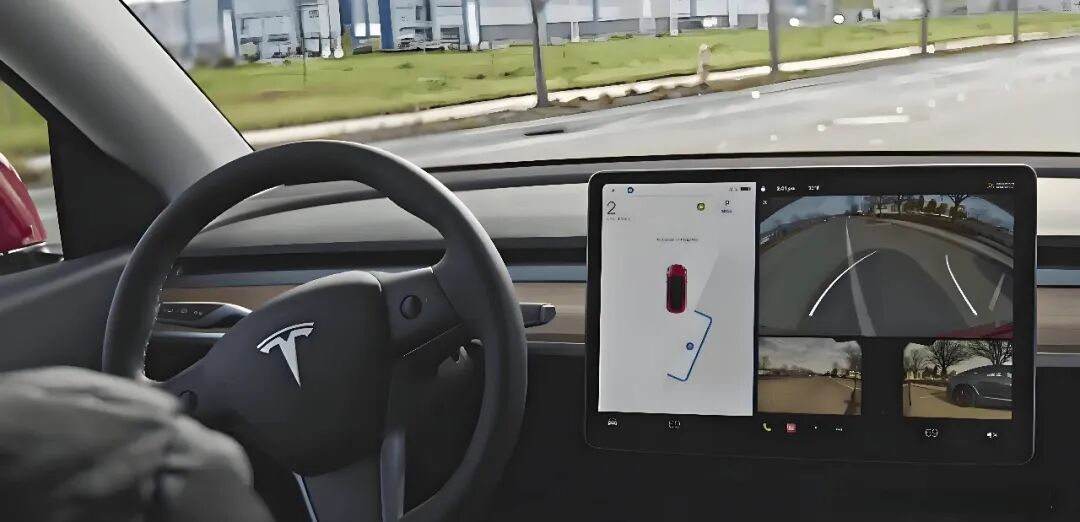
Image Source: Internet
At the inaugural workshop on the deployment of embodied intelligence base models at CVPR 2026, Tesla, Waymo, and XPENG shared the stage, with the core topic (topic, replaced in context) shifting towards the construction of base models.
Shan Jizhang, CEO of Black Sesame Technologies, also proposed at the 2026 High-Level Forum on the Development of Intelligent Electric Vehicles that combining VLA with world models represents the most promising technical route for high-level intelligent driving in the future.
Liu Xianming of XPENG explicitly stated at CVPR 2026 that VLA and world models are not competitive.
In XPENG's base model architecture, the second-generation VLA learns how to act from human driving behavior, while the world model learns how the world will change after an action through predicting future states. Together, they constitute a physical world base model.
XPENG's VLA + world model solution has already demonstrated its effectiveness in practical applications.
In July 2026, the XPENG MONA L03, equipped with the second-generation VLA model, completed localized acceptance testing in Munich, Germany. Without any training on European road test data, it autonomously navigated roundabouts, avoided trams, and managed narrow road meetings.
Officially disclosed, this solution can reduce overseas on-site data collection costs by about 70% and compress the vehicle-specific market adaptation cycle from 18 months to 6 to 8 months.
Li Auto is doing the same. At GTC 2026, Li Auto released MindVLA-o1, which introduces a predictive implicit world model based on the language model's semantic understanding.
The model's training is divided into three stages: first, pre-training implicit world tokens with massive video data; then, continuously deducing world models within the model; and finally, jointly training the world model, multimodal reasoning capabilities, and driving behavior.
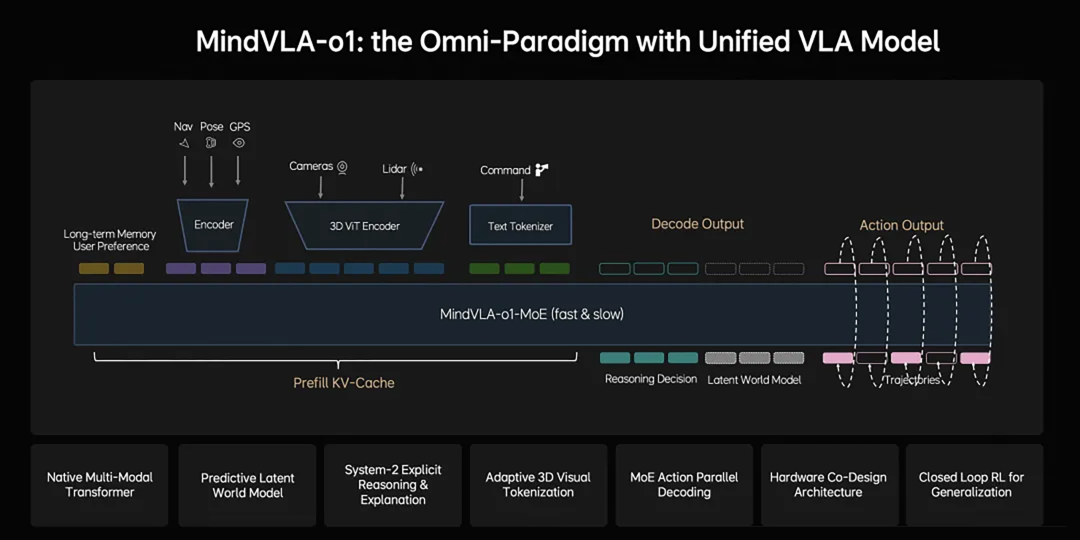
Image Source: Internet
Li Auto also had four papers on world models accepted at CVPR 2026, covering depth estimation, 3D reconstruction, traffic rule cognitive assessment, and safety risk prediction.
The reason for the convergence of VLA and world models is that VLA excels at understanding current semantics but is not good at predicting the future, while world models excel at predicting physical evolution but lack advanced semantic understanding.
Combined, one can be responsible for what to do now, and the other can predict what will happen afterward.
04 Some Observations
Returning to the initial question, what are VLA and world models really debating?
On the surface, the debate is about whether to use language models for reasoning or physical models for prediction in autonomous driving. However, behind these two routes lie two completely different philosophies.
VLA argues that understanding is intelligence. As long as a model can comprehend scenes, understand semantics, and apply common sense, it can make correct driving decisions. This approach views driving as a cognitive problem.
World models, on the other hand, argue that prediction is intelligence. As long as a model can accurately predict how the world will evolve in the next few seconds, it can select the optimal driving strategy. This approach essentially treats driving as a physical problem.
Both assumptions have merit but also flaws.
VLA faces the same issue as large language models: being able to speak human language does not equate to true understanding.
A model can accurately state that there is a pedestrian ahead and that it should slow down, but this output may simply be a pattern recognized from training data, without the model truly understanding what slowing down means.
World models also have problems. No matter how strong their physical prediction capabilities are, they cannot solve value judgment issues.
If a ball rolls out from the roadside, a world model can accurately predict that a child is likely to follow, but what if it is just an empty ball blown by the wind? Should the vehicle brake?
This judgment requires understanding, which is not the strength of world models.
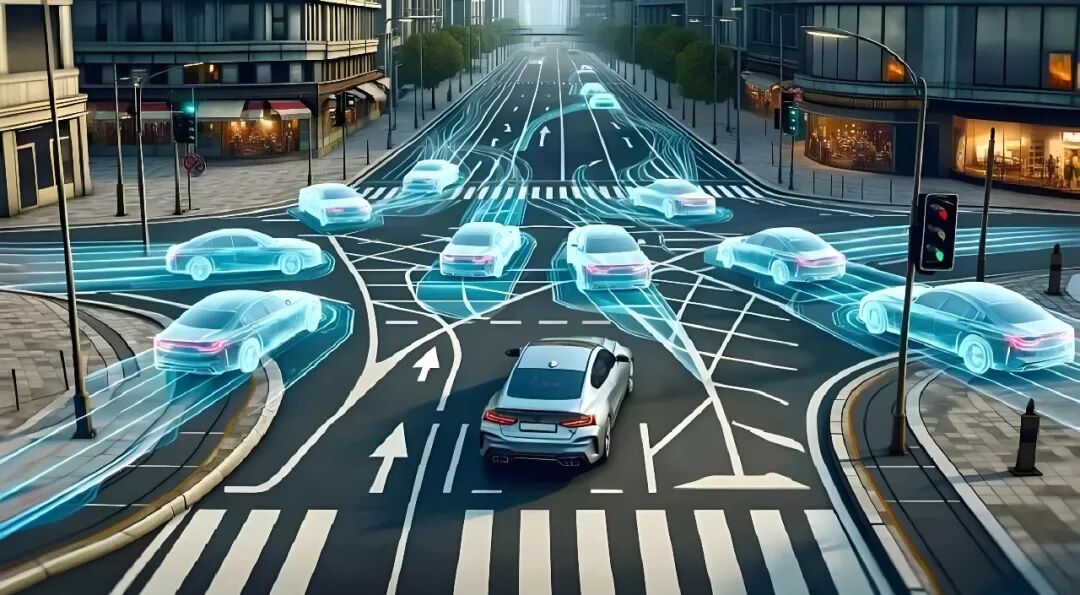
Image Source: Internet
There is also a key issue here: language model tokens and physical world states are essentially two different things.
Text tokens are discrete and have clear semantic boundaries, while the physical world is continuous and high-dimensional. Compressing the continuous world into one-dimensional language tokens for reasoning inevitably leads to information loss.
Conversely, while world models maintain the continuity of physical states, they lack a semantic layer.
Autonomous driving does not operate in a vacuum; it must function under real social rules.
Rules like yielding to pedestrians and giving priority to ambulances are not physical laws but social conventions. A world model without semantic understanding but only physical prediction would appear clumsy in these scenarios.
Therefore, what these two routes are really debating is who has captured the essence of driving intelligence. VLA believes it is understanding, while world models believe it is prediction.
However, in real driving, understanding and prediction are intertwined and inseparable. This is why, by the second half of 2026, integrated solutions were proposed.
Looking back at this debate, winning or losing is not important. Instead, it has helped the autonomous driving industry recognize two things: understanding must be addressed, prediction must also be addressed, and they must be addressed within the same model.
Integration is not a compromise but the only path forward after both routes have reached their limits.
#AutonomousDriving #WorldModels #VLA
-
![]()
BYD's Auto Overseas Expansion Review: 26 Months from 'Catching Up' to 'Advancing'
-
![]()
Are Commercial Rockets Progressing Due to Increased Girth?
-
![]()
From Imitation to Reinforcement: How Far Have End-to-End Large Models Come?
-
![]()
The Debate Between Autonomous Driving VLA and World Models: What Is It Really About?
-
![]()
Sealing the Deal: The Rationale Behind GAC Honda and SAIC-GM’s Early Joint Venture Renewals
-
Third-Party SIM Card Services Discontinued: Strategic Calculations of China Mobile, China Unicom’s Bold Move, and China Telecom’s Tactical Advancement
-
Investigation Launched 3 Days Prior to Listing Meeting! Urgent Withdrawal of RMB 3 Billion Financing Initiative
-
![]()
After Two Years of 'Big Smart,' Smart is Set to Launch Its 'Small Smart'