Are Commercial Rockets Progressing Due to Increased Girth?
 08/10 2026
 537
537
China's commercial rockets are undergoing a notable transformation, collectively "bulking up" in size.
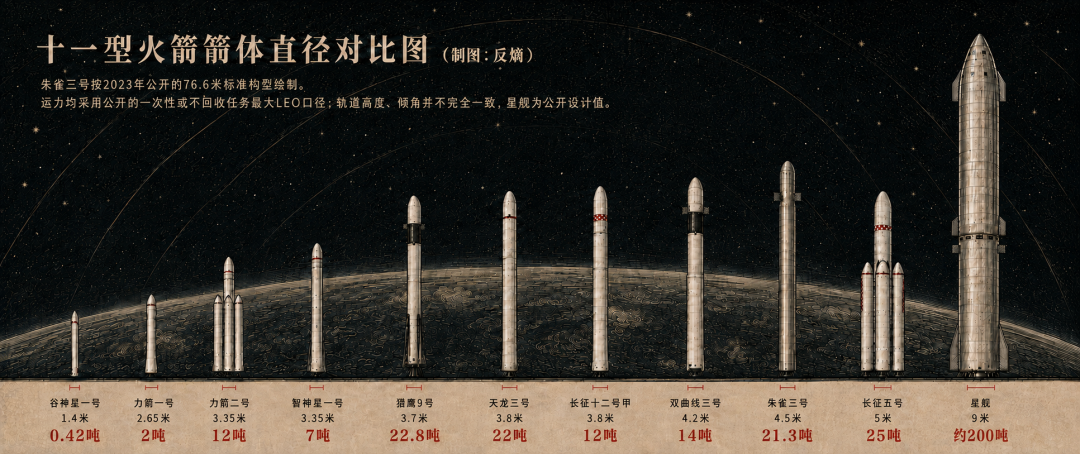
The Ceres-1 rocket boasts a body diameter of approximately 1.4 meters, while the Lijian-1 features a core diameter of 2.65 meters. Among the new generation of liquid rockets, the Lijian-2, Zhishenxing-1, and Xingyun-1 fall into the 3.35-meter category. The Tianlong-3 and Long March 12A extend this to 3.8 meters, the Hyperbola-3 measures 4.2 meters, and the Zhuque-3 further expands to 4.5 meters. However, these size increments also mirror shifts in model types and mission profiles. Early commercial rockets were predominantly small-to-medium solid rockets, whereas today's leaders are medium-to-large liquid rockets tailored for constellation deployment.
The thrust of commercial rocket engines is increasingly clustering around the 100-ton mark, paralleled by a steady increase in body diameter. Greater thrust and bulkier bodies seem to hint at more advanced technology, with diameter particularly reinforcing this impression.
Engine cycles, structural coefficients, and control precision remain hidden within the rocket's design, while body thickness is immediately apparent. It features prominently on official websites and product materials, directly translating into the physical presence of models. What was initially a design outcome dictated by mission requirements, manufacturing capabilities, and transportation constraints has gradually taken on connotations of technological generational shifts.
However, rockets are not mere containers; their capabilities cannot be judged by volume alone.
A diameter of 4.5 meters indeed provides more design space than 3.35 meters, but it also necessitates adjustments to tank tooling, assembly buildings, transportation vehicles, roadways, and launch facilities. If the body becomes just a few dozen centimeters thicker, rail transport may no longer be viable, requiring a switch to road or sea transport.
A larger diameter can accommodate more propellant but also demands bigger factories, more complex transportation, and greater ground infrastructure investment. Only with a sufficient number of launch missions can this system be fully operational, making large diameters advantageous.
01
When discussing rockets, "diameter" can refer to either the core stage or the fairing.
The core stage is the rocket's main body, housing the propellant and engines while bearing the primary flight loads. Its diameter influences tank cross-sections, rocket length-to-diameter ratios, engine clustering, and structural layouts.
The fairing, mounted atop the rocket, primarily accommodates and protects the payload. It determines the usable space for satellites, stacking arrangements, and the placement of adapters and separation mechanisms. A rocket can have a narrower core stage and a wider fairing.
The Lijian-1 has a core diameter of 2.65 meters and can utilize a 3.35-meter fairing. The Lijian-2's general-purpose core stage has a diameter of 3.35 meters, with its maiden flight configuration featuring a 4.2-meter fairing and future heavy configurations potentially using a 5.2-meter fairing. The Zhishenxing-1 also employs a 3.35-meter body and a 4.2-meter fairing.
In promotional materials, the largest number is often the most memorable. A core stage of 3.35 meters and a fairing of 5.2 meters may ultimately be remembered simply as "5-meter class." While these figures are derived from real products, readers may misinterpret which part they refer to.
Expanding the fairing has practical value. Satellite constellation missions are constrained by both mass and volume. A larger fairing improves stacking efficiency for flat-panel satellites, accommodates spacecraft with greater lateral dimensions, and enables more payload combinations for multi-satellite launches.
However, fairings add weight and must withstand aerodynamic loads and separation shocks. If core stage thrust, propellant scale, and structural efficiency do not improve proportionally, increased fairing space does not necessarily translate to an increase in deliverable payload mass.
Thus, when discussing a rocket's "diameter," it is crucial to clarify whether it refers to the core stage or the fairing. A wider fairing makes the rocket appear larger but does not necessarily mean the core stage, propellant scale, or payload capacity have increased proportionally.
02
The appropriate thickness of a rocket depends on its launch requirements and return plans.
Early commercial solid rockets primarily handled small-to-medium satellite launches, technology demonstrations, and rapid constellation replenishment. Their narrower bodies were sufficient for these missions. As low-Earth orbit constellations enter large-scale deployment, single missions now require delivering more satellites, leading to simultaneous expansions in total payload mass and fairing envelope. This has brought medium-to-large liquid rockets to the forefront.
Increasing the core stage diameter allows for greater tank volume without excessively lengthening the rocket. A larger base also facilitates the arrangement of multiple engines, providing space for load-bearing structures, propellant lines, and thermal protection.
Recovery adds extra weight to the overall design. After completing the ascent phase, the first stage must retain propellant for return, deceleration, and landing, along with carrying recovery devices such as grid fins and landing legs. These reduce the payload capacity available for delivering satellites. This is one reason why many reusable medium-to-large rockets opt for larger body diameters. While a large diameter is not strictly necessary for recovery, it provides more design margin for propellant, engines, and recovery systems.
However, diameter only provides design space; the final payload capacity depends on engine performance, structural mass, and overall configuration.
Both the Lijian-2 and Zhishenxing-1 use 3.35-meter-class bodies, with official low-Earth orbit payload capacities of 12 tons and 7 tons, respectively. While their orbital conditions and configurations differ and cannot be directly compared, this demonstrates that identical diameters can yield different payload capacities.
The Falcon 9 has a core diameter of about 3.7 meters, narrower than several new-generation Chinese commercial rockets still under development, yet it has achieved high launch frequencies and first-stage reusability. Its most challenging aspect to replicate lies not in its 3.7-meter diameter but in the manufacturing, launch, recovery, and turnaround system refined through extensive missions.
No matter how large the cross-section, if the structure is too heavy, engine performance insufficient, or mission reliability inadequate, the extra space remains only on the drawing board.
03
Before a rocket takes flight, the impact of its diameter is first felt in factories, roadways, and launch sites.
For a long time, 3.35 meters has been a standard size for Chinese launch vehicles, closely tied to railway transportation limits and the existing technical and infrastructure systems. It is not an aerodynamic ideal, nor an insurmountable physical boundary, but rather a scale around which China's rocket industry has accumulated relatively complete manufacturing, transportation, and launch capabilities.
For the established aerospace industrial system, retaining the 3.35-meter diameter allows some equipment, tooling experience, and transportation capabilities to continue being utilized. Further enlarging the body would incur costs along the entire supply chain.
Transportation is the first issue encountered. According to public reports, the Zhuque-3 Y1, with a diameter of 4.5 meters, was transported by road from Jiaxing, Zhejiang, to Jiuquan, Gansu, covering approximately 4,000 kilometers. Bridge and tunnel clearances, height restrictions, and turning radii had to be calculated in advance, making transportation itself part of the project.
The Long March 5 has a core diameter of 5 meters, making rail transport impractical. The rocket is shipped from its manufacturing base in Tianjin to Qinglan Port in Hainan via a dedicated vessel, then transferred to the Wenchang Space Launch Site. The Long March 5 broke not only tank diameter records but also the constraints of traditional inland manufacturing and land-based transportation on rocket size.
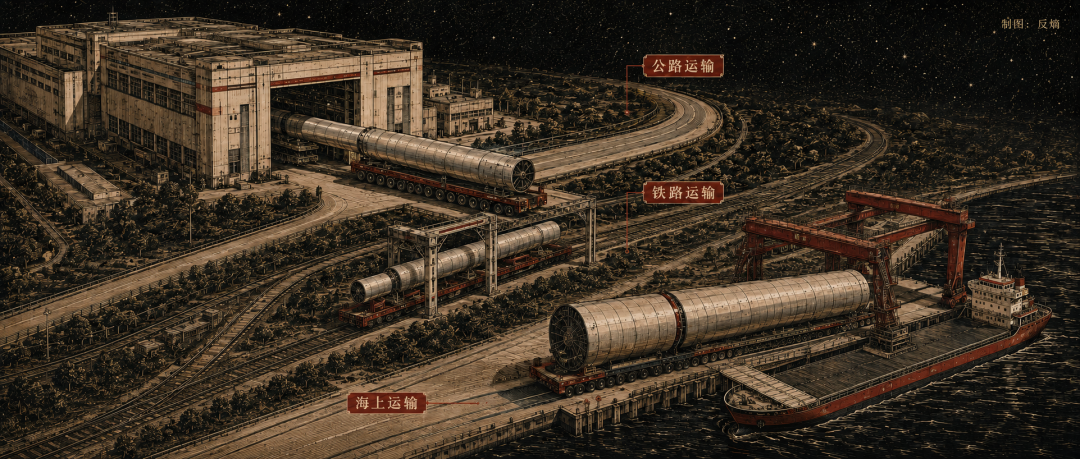
Transportation is just the first limitation. After arriving at the launch site, the rocket's erection equipment, fueling interfaces, and launch pads must be reconfigured for the new body size.
Foreign large rockets also aim to minimize the distance from factory to launch site. The New Glenn features a 7-meter-class fairing, with Blue Origin compressing manufacturing, integration, launch, and refurbishment within about 14 kilometers in Florida. The Starship has a diameter of 9 meters, yet SpaceX has concentrated its manufacturing, integration, and launch operations at Starbase. Once rockets reach a certain size, accommodating roadways becomes increasingly expensive, making shortened transportation distances part of the overall solution.
Expanding tank diameter from 3.35 meters to 4.5 meters may require adjustments to cylinder manufacturing, welding equipment, tooling, non-destructive testing, assembly buildings, and transportation vehicles.
Factories, equipment, transportation systems, and launch facilities must all be funded, built, and maintained by companies.
04
Whether these assets become competitive advantages ultimately depends on their annual usage frequency.
If a 4.5-meter-diameter rocket secures sustained constellation orders and completes multiple stable launches each year, its large payload capacity and volume can be fully utilized, and investments in dedicated factories, transportation systems, and launch facilities can be amortized across more missions.
If it flies only a few times a year, the production lines, roads, and pads built for it will operate at low capacity for extended periods. Before the large payload capacity generates revenue, depreciation, maintenance, and capital costs from the size expansion will already appear in the accounts.
Of course, this does not mean narrower rockets are always more economical. Models designed for rapid small-to-medium satellite launches have no need for 4-meter-class bodies. Reusable rockets intended for large-scale constellation deployment, if too narrow in diameter, might need to increase length, restrict engine layouts, and reduce propellant margins for recovery.
Diameter reflects engineering trade-offs, not technological hierarchy. A 3.35-meter diameter does not signify conservatism, nor does a 4.5-meter diameter automatically equate to advancement. As China's commercial rockets grow thicker, it indicates that single-mission payloads are becoming heavier, and both rockets and ground systems are expanding. Whether larger diameters translate into higher payload capacities, more reliable deliveries, and lower costs will be answered by launch frequencies and order volumes.
Making rockets thicker is just the first step; the challenge lies in keeping them flying consistently, with sufficient payloads each time.
This article is the fourth installment in the "Demystifying Commercial Space" series. Next time, we will continue to investigate: Multiple commercial rocket companies aim for a per-kilogram launch cost of 20,000 yuan. How exactly is this figure calculated?
-
![]()
BYD's Auto Overseas Expansion Review: 26 Months from 'Catching Up' to 'Advancing'
-
![]()
Are Commercial Rockets Progressing Due to Increased Girth?
-
![]()
From Imitation to Reinforcement: How Far Have End-to-End Large Models Come?
-
![]()
The Debate Between Autonomous Driving VLA and World Models: What Is It Really About?
-
![]()
Sealing the Deal: The Rationale Behind GAC Honda and SAIC-GM’s Early Joint Venture Renewals
-
Third-Party SIM Card Services Discontinued: Strategic Calculations of China Mobile, China Unicom’s Bold Move, and China Telecom’s Tactical Advancement
-
Investigation Launched 3 Days Prior to Listing Meeting! Urgent Withdrawal of RMB 3 Billion Financing Initiative
-
![]()
After Two Years of 'Big Smart,' Smart is Set to Launch Its 'Small Smart'