BYD's Auto Overseas Expansion Review: 26 Months from 'Catching Up' to 'Advancing'
 08/10 2026
 553
553
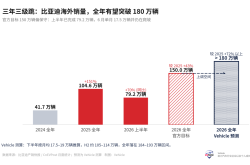
Let's start with three numbers: 417,000, 1.046 million, and 792,000.
These represent BYD's overseas sales for the full years of 2024 and 2025, along with the first half of 2026. While the third figure is the smallest, it reflects BYD's six-month overseas sales performance. Additionally, BYD's overseas sales reached 179,800 units in July, suggesting full-year 2026 sales could hit around 1.8 million, surpassing BYD's revised target of 1.5 million. 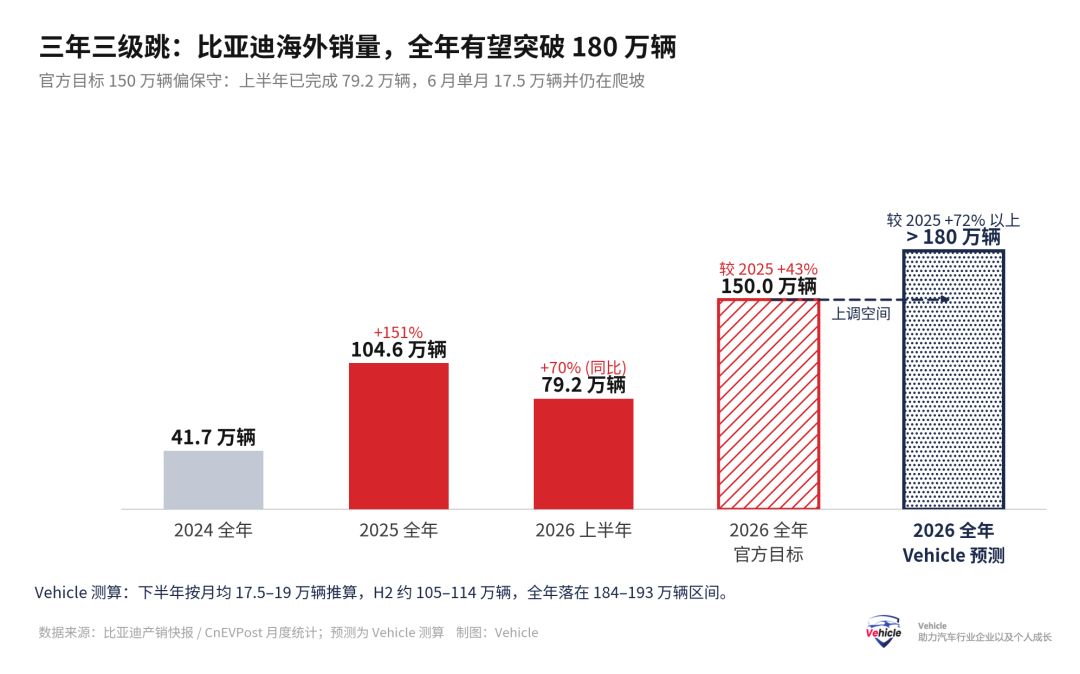
In three years, BYD's annual overseas sales soared from under 420,000 to nearly 1.8 million units, a 3.3-fold increase. This steep growth trajectory is rare in global automotive history and sets a new benchmark for Chinese auto exports.
However, a closer look reveals BYD's overseas expansion was not smooth sailing but involved several rounds of trial and error.
This article analyzes BYD's overseas expansion data and key events to distill actionable lessons for automakers going global, aiming to provide insights and inspiration.
I. Background: Overseas Markets Shift from 'Supplementary' to 'Core'
1|Total Volume: Three-Year Leap
BYD's monthly overseas sales averaged ~35,000 units in 2024, surged to 80,000–130,000 units in H2 2025, and climbed steadily in H1 2026: 100,000 in January, 120,000 in March, 161,000 in May, 175,000 in June, and 179,800 in July, setting a new record. 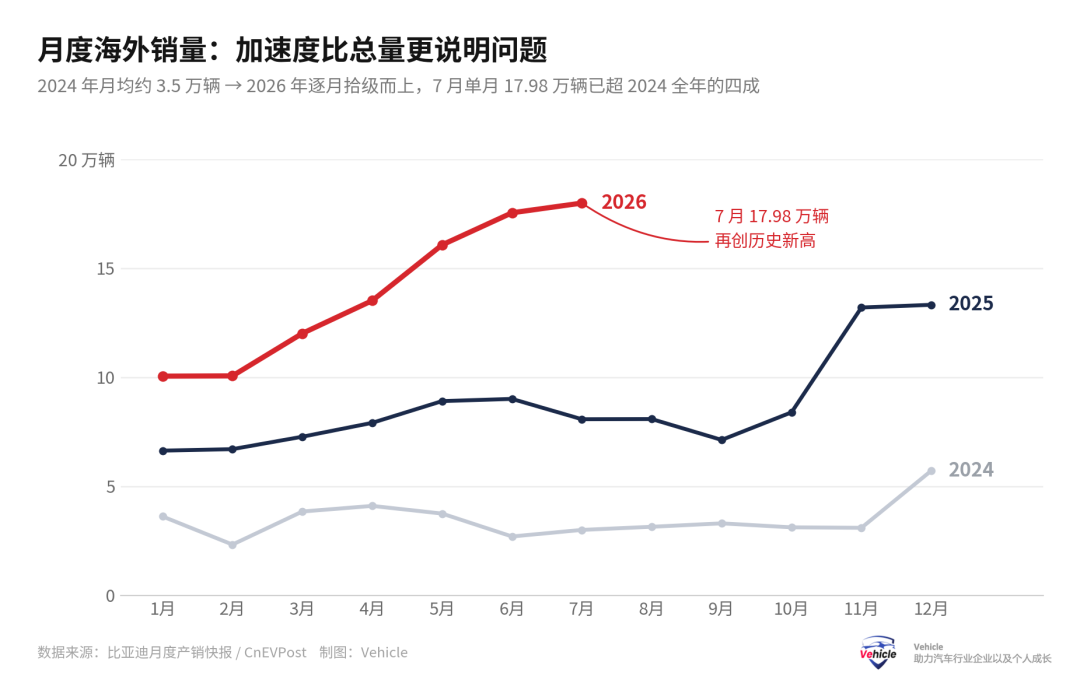
BYD's July 2026 overseas sales (179,800 units) nearly matched half of its total H1 2024 overseas sales.
2|Structural Shift: A Complete Domestic-Overseas Reversal
A deeper analysis reveals BYD's true turning point lies not in overseas growth but in the swap of domestic and overseas sales rankings. 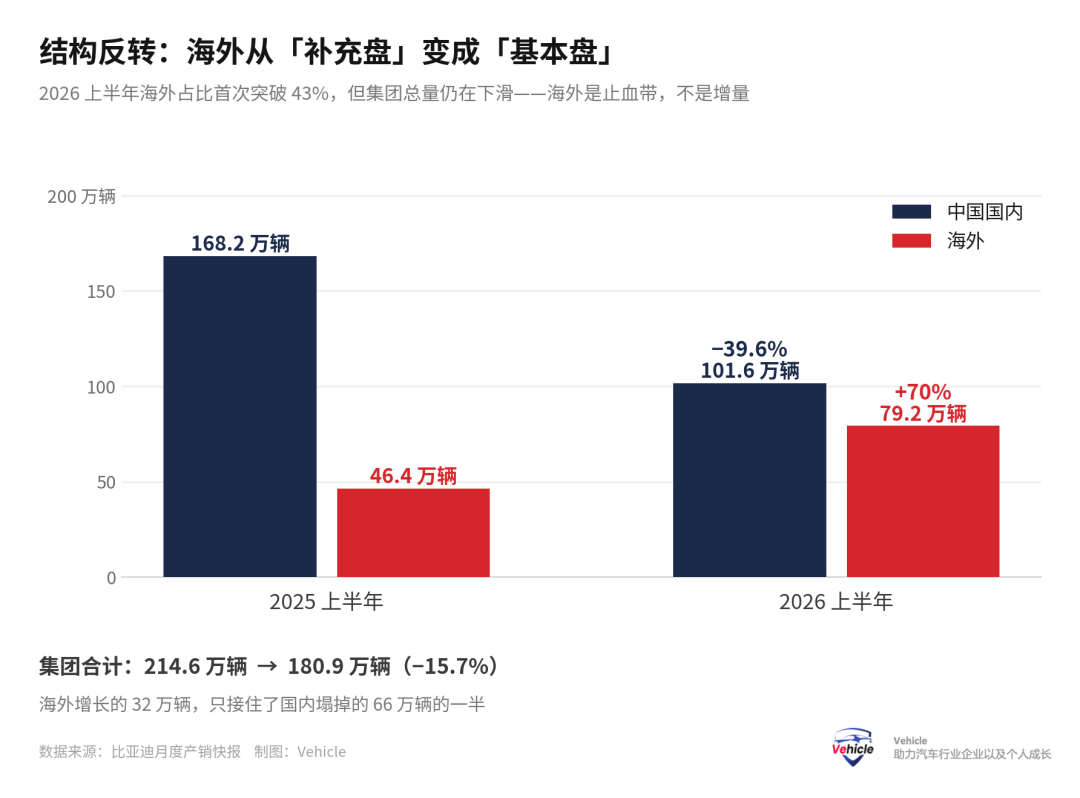
BYD's total sales fell 15.7% YoY in H1 2026, meaning the 320,000-unit overseas gain only offset half of the 660,000-unit domestic decline. Amid domestic price wars and demand fluctuations, BYD's overseas markets shifted from 'icing on the cake' to a 'critical lifeline.'
Overseas sales accounted for ~43% of BYD's total in June and July 2026. Management aims for a 50-50 domestic-overseas split long-term and plans to further increase the overseas share. 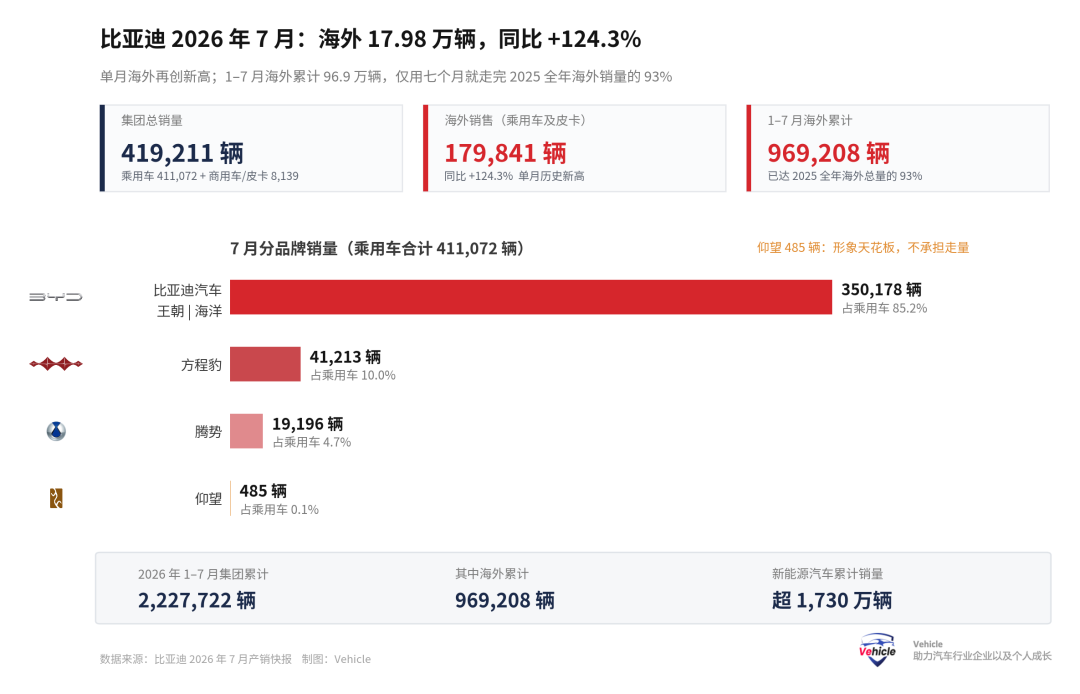
3|Profitability: Overseas Markets Remain the Sole Profit Driver
BYD's Q1 2026 earnings report is key to understanding this expansion: 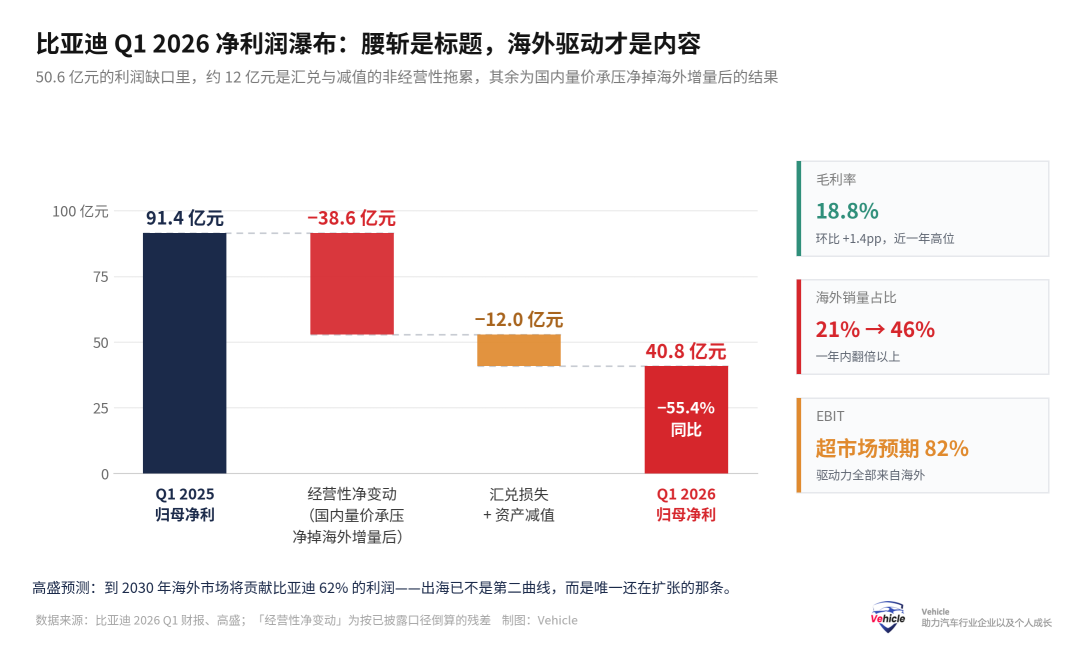
Net profit halved YoY, declining for four consecutive quarters; however, gross margin rebounded QoQ, and EBIT significantly exceeded expectations, driven entirely by overseas performance.
Goldman Sachs predicts overseas markets will contribute 62% of BYD's profit by 2030, making it the most critical second growth engine for the next decade.
The conclusion is clear: Overseas expansion is no longer BYD's 'second growth curve' but its 'only expanding and most profitable segment.'
4|Europe: Breakthrough in the Toughest Market
Among Chinese automakers' overseas markets, Europe offers the highest value but is the hardest to penetrate, featuring the world's most profitable mature market, highest tariff barriers, and a market where BYD previously struggled. 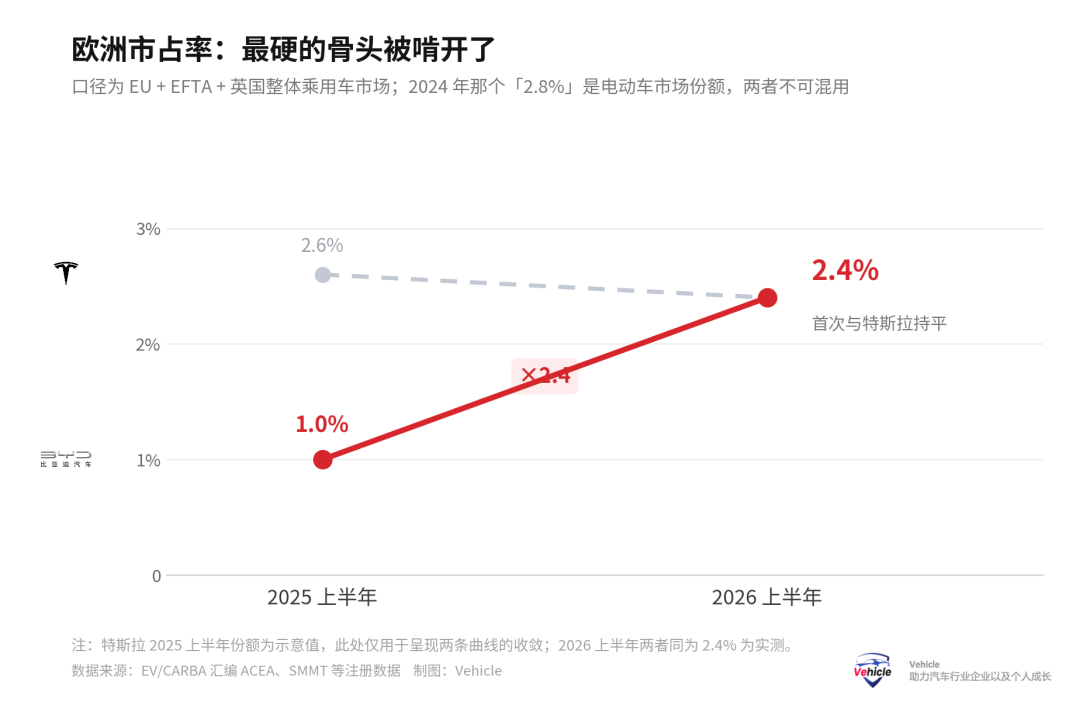
In June 2026, BYD registered 33,624 vehicles across 18 European markets, up 135% YoY and 20.9% MoM. For details, see our earlier article 'H1 2026 EU Auto Market: Manufacturer Sales Rankings.'
Breakdown:
Germany: 6,259 units (+274% YoY), a sixth consecutive monthly record, with H1 sales exceeding 2025's full-year total.
UK: 6,242 units (+36.2% YoY), SMMT data shows this as its best non-plate-change month in the UK.
Switzerland, Czech Republic, Finland: Triple-digit growth in small markets.
Meanwhile, BYD secured a 2,016-square-meter booth at the UK's Goodwood Festival of Speed—the largest in the event's 33-year history—to debut the DENZA Z globally, priced at £142,900 (US$191,800) in the UK.
A Chinese brand launching a US$191,800 performance car at Europe's automotive cultural epicenter, using the largest booth in history—this scene itself signifies 'achievement.'
5|Industry Context: BYD as a Case Study, Not an Outlier
Placing BYD's overseas surge in a broader context: China exported 5.096 million vehicles in H1 2026 (+65.3% YoY), including 1.092 million in July alone (+57% YoY). At this pace, China's annual auto exports could hit 10 million units in 2026, a threshold no country has ever crossed.
However, comparing BYD to global giants Toyota and Volkswagen reveals ample room for growth: 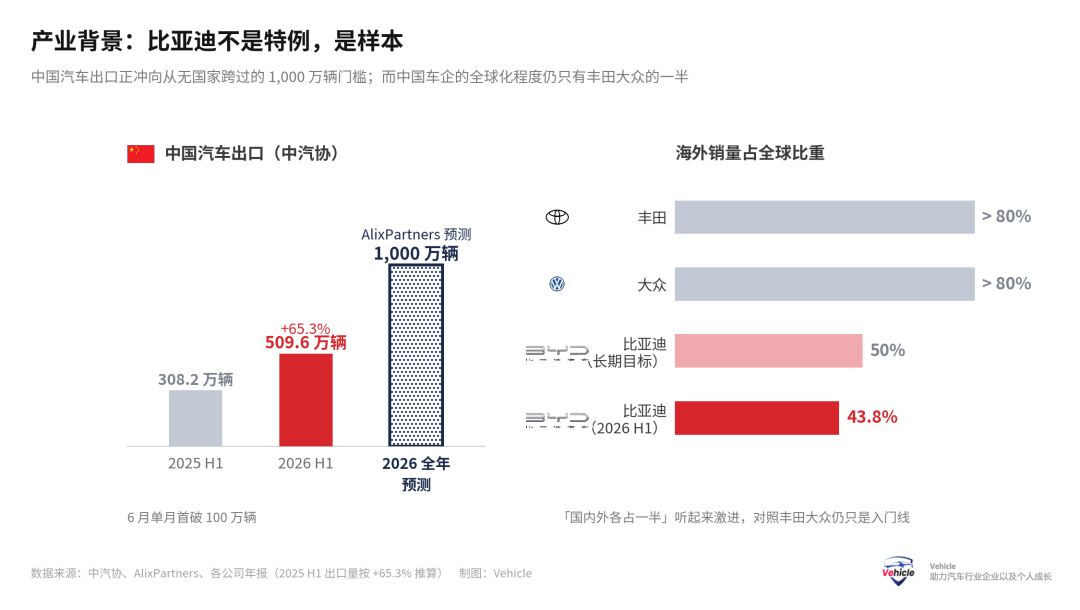
BYD's goal of '50-50 domestic-overseas split' may seem aggressive but pales against Toyota and Volkswagen's 80% overseas sales. Chinese automakers still need to master market strategy, distribution, factories, and charging networks—all of which require time and cannot be accelerated by price wars.
II. Turning Point: This Growth Curve Emerged from Failure
The above outlines BYD's overseas achievements. However, focusing solely on these results would wrongly suggest BYD's expansion was a natural overflow of its domestic success.
The reality is the opposite.
Rewind to 2024: In Germany, BYD sold just 2,900 units (~0.1% market share) despite the market's 2.8 million annual sales. Europe-wide sales barely reached 57,000 units.
By June 2026, BYD sold 6,259 units in Germany alone—more than double its 2024 full-year total. A 20-fold gap in the same market, for the same company, over two years. 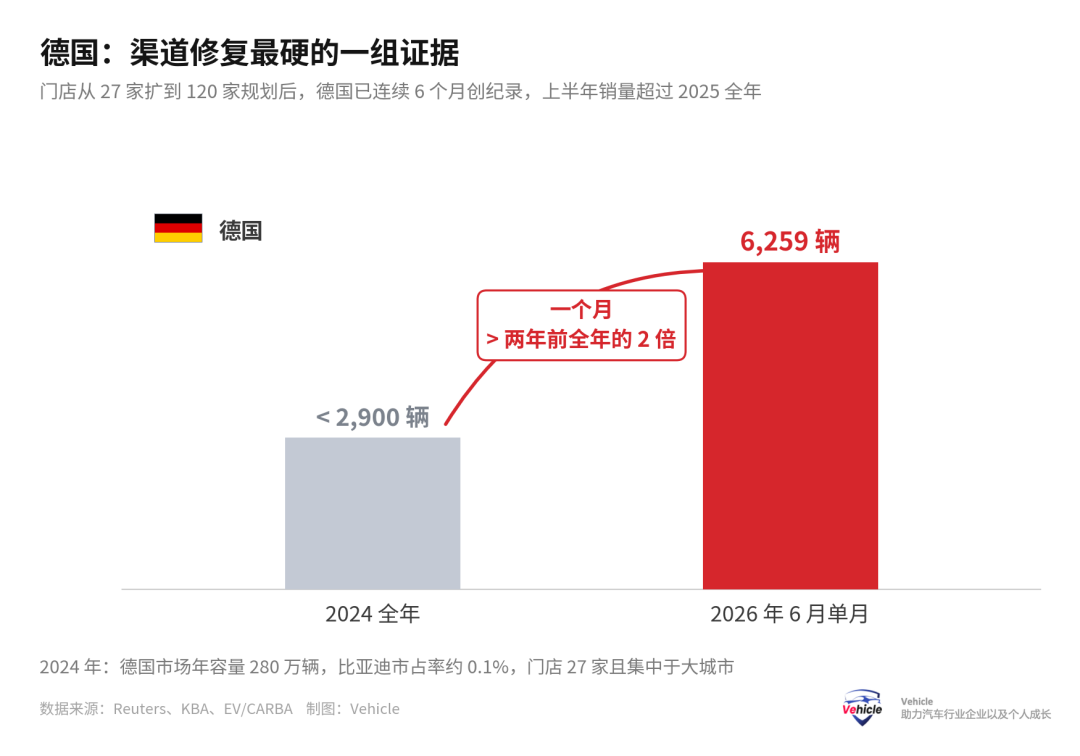
What happened in between?
In April 2025, Reuters interviewed six current and former BYD executives, conducting a rare internal analysis of BYD's overseas expansion. Their listed mistakes—insufficient dealers, no hybrid models, lack of local market experts—were symptoms of a single root cause.
A former executive's quote captures the essence: 'European markets are like frogs in a pan, each jumping in different directions. BYD is just starting to learn this.'
China and the US are unified markets where a single pricing, distribution, and messaging strategy can reach hundreds of millions. BYD transplanted its domestically proven system—which supported a seven-fold sales increase from 2020 to 2024 and made it the world's sixth-largest automaker—to Europe, a region comprising dozens of countries with varying subsidies, climates, and consumer preferences. 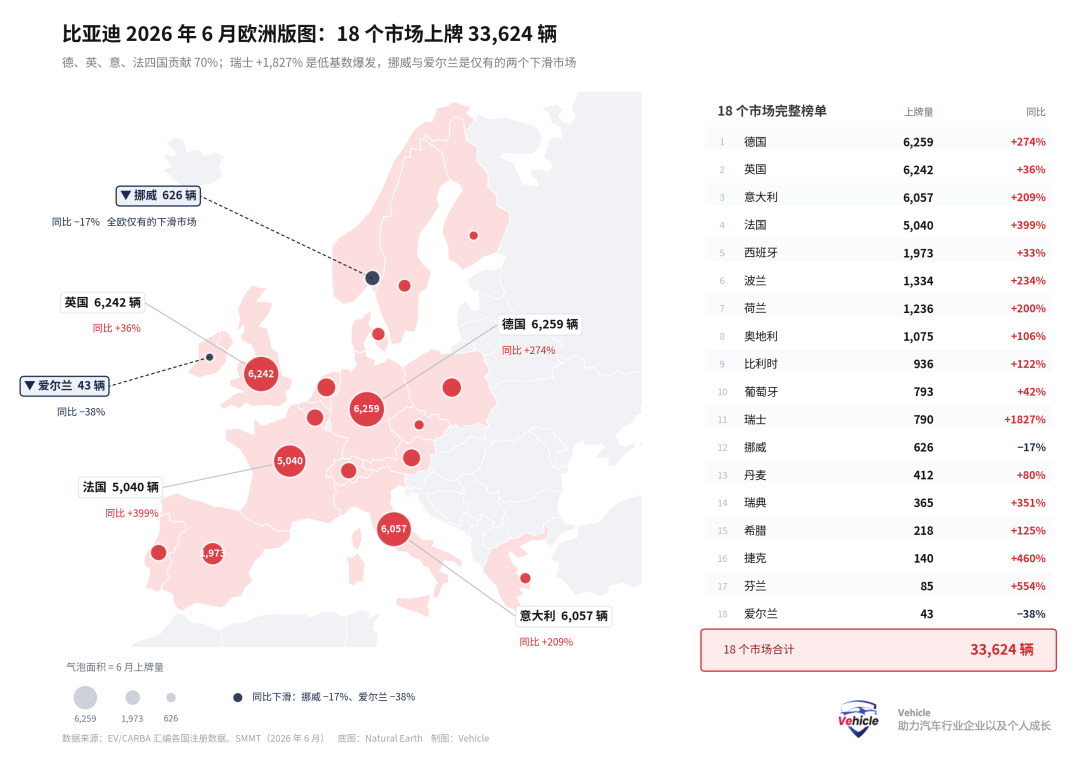
However, Chinese companies' true overseas failure lies not in execution but in mindset. The 26 months from 2025 to 2026 saw BYD's overseas strategy evolve in two phases: the first year 'catching up' on avoidable mistakes; the second year 'advancing' by rebuilding a system tailored for overseas markets.
III. Four Layers of Mistakes
1|Product: Mistaking Technical Routes for Dogma
BYD dominated China's DM-i plug-in hybrid market, driving its domestic sales boom. However, early overseas expansion relied almost exclusively on pure electric vehicles (BEVs).
The turning point came from an outsider: Former FCA executive Alfredo Altavilla, contacted by BYD in June 2024 and appointed European Special Advisor in August, told Wang Chuanfu directly that BEVs remained a hard sell in many European countries.
Altavilla's remarks to Reuters bear repeating:
'He quickly understood and mandated BYD's engineers to offer both BEV and hybrid versions for every new European model. We must educate consumers on green transitions.'
In December 2024, Altavilla declared in Italy that plug-in hybrids would be 'core to BYD's European strategy,' calling the exclusive focus on BEVs 'stupid.'
The key takeaway for Chinese automakers: BYD already possessed the world's best hybrid technology but initially chose not to deploy it overseas. This was not a capability gap but a judgment error—far harder to self-detect because it hid behind 'what we do best.'
2|Distribution: Underestimating the Absolute Threshold of Offline Density
Consider BYD's distribution network: From 2024 to mid-2026, its German dealerships grew from 27 to 120. This expansion wasn't just opening more stores but admitting original planning was off by an order of magnitude. Maria Grazia Davino, recruited to lead Germany, told Reuters bluntly:
'The German market isn't easy. We're still missing the basics here.'
Too few dealerships concentrated in major cities meant abandoning Europe's most profitable suburban and mid-sized city customers while suppressing service reputation and residual values—which directly determine leasing channel pricing, a B2B sales lifeline in Europe.
3|Organization: Local Talent as 'Information Input,' Not 'Execution Layer'
BYD's correction was direct: Poaching executives from Stellantis.
Alfredo Altavilla (ex-FCA) – European Special Advisor, overall strategist
Maria Grazia Davino (ex-Stellantis UK CEO) – Regional GM for Germany, Austria, Switzerland, Poland, Hungary, Czech Republic, Slovakia, and Nordic countries
Alessandro Grosso – Italy
Alberto De Aza – Spain
Stellantis insiders told Reuters: 'These are people we didn't want to lose.'
BYD's product strategy shift originated from these local hires. The true value of localized talent lies not in execution but in bringing invisible Headquarters (headquarters)-level information to the forefront and forcing it into decision-making. The success metric should be 'Did they change headquarters' decisions?' not 'Did they meet KPIs?'
However, this strategy backfired in July 2026: Ford hired Davino as European Sales VP on July 29, effective October 1, reporting directly to European President Jim Baumbick with full responsibility for retail, dealer networks, and distribution. Ford, one of Europe's most declining mainstream automakers, poached the person who grew BYD Germany from 2,900 annual sales to over 6,000 monthly sales.
From Stellantis to BYD to Ford—the same individual completed two job switches in 24 months.
This talent flow indicates two things:
First, BYD's localization strategy for talent recruitment is effective (so effective that it has become a recruitment pool for competitors);
Second, those lured away by high salaries can also be poached by companies offering even higher salaries or stronger platforms. Localization cannot stop at mere "hiring"—it must also involve organizational precipitate (which translates to "institutional knowledge accumulation")—ensuring that local knowledge is transformed into processes, data, and product definition rules, rather than remaining confined to the minds of individuals. This is an issue that BYD has yet to resolve.
BYD's other approach is the localization of political capital: In July 2026, BYD hired Péter Szijjártó, who served as Hungary's Minister of Foreign Affairs for 12 years, as a senior executive in the group, responsible for external relations and new business development, just before the Hungarian factory started production. This move is harder to replicate than poaching sales executives and demonstrates BYD's clear understanding that "the threshold for entering Europe is not just a commercial one." However, since this tactic has just been deployed, its future effectiveness remains to be seen.
4|Communication Layer: Terminology Transportation and Its Opposite
A Negative Example (2024): Sponsoring the 2024 UEFA European Championship in Germany and claiming to be the world's number one manufacturer of "NEVs" (New Energy Vehicles). NEV is an administrative term used in China's policy context but holds no meaning for German consumers. A top-tier sports marketing budget was spent on an unintelligible acronym.
A Positive Example (2026): Just two years later, the marketing approach was entirely different—
Goodwood Festival of Speed: BYD, Denza, and Yangwang occupied a combined 2,016 square meters, making it the largest exhibition booth in the event's 33-year history.
Global Debut of Denza Z: A pure electric performance car available in three versions—Coupe, Convertible, and Racing—with a starting price of £142,900 in the UK.
Launch Ceremony: Unveiled jointly by Executive Vice President Stella Li and former F1 World Champion Jenson Button.
Scene Selection: Goodwood, Cannes Film Festival, Paris Opera.
Football Assets: Secured partnerships with three top European clubs—Manchester City, Inter Milan, and Paris Saint-Germain—within 12 months.
What's the difference? In 2024, BYD was translating Chinese narratives into English; in 2026, it directly entered Europe's cultural vernacular: motorsport culture, film festivals, and opera houses.
Li Yunfei summarized this strategy as a three-step approach: "Be Seen → Be Experienced → Be Recognized," explicitly stating that BYD would not engage in head-on price competition with established luxury brands.
At the same time, he anchored Denza's legitimacy in its joint venture heritage with Mercedes-Benz. This was a clever move: European consumers don't need to understand who "Denza" is—they just need to know it has Mercedes-Benz DNA. By leveraging the existing cognitive assets of the other party, BYD could support its new brand.
4. Efficacy Validation: Data Suggests Corrections Are Effective but Must Be Viewed Layer by Layer
European vehicle registrations (June 2026, 18 markets) show impressive results at first glance. 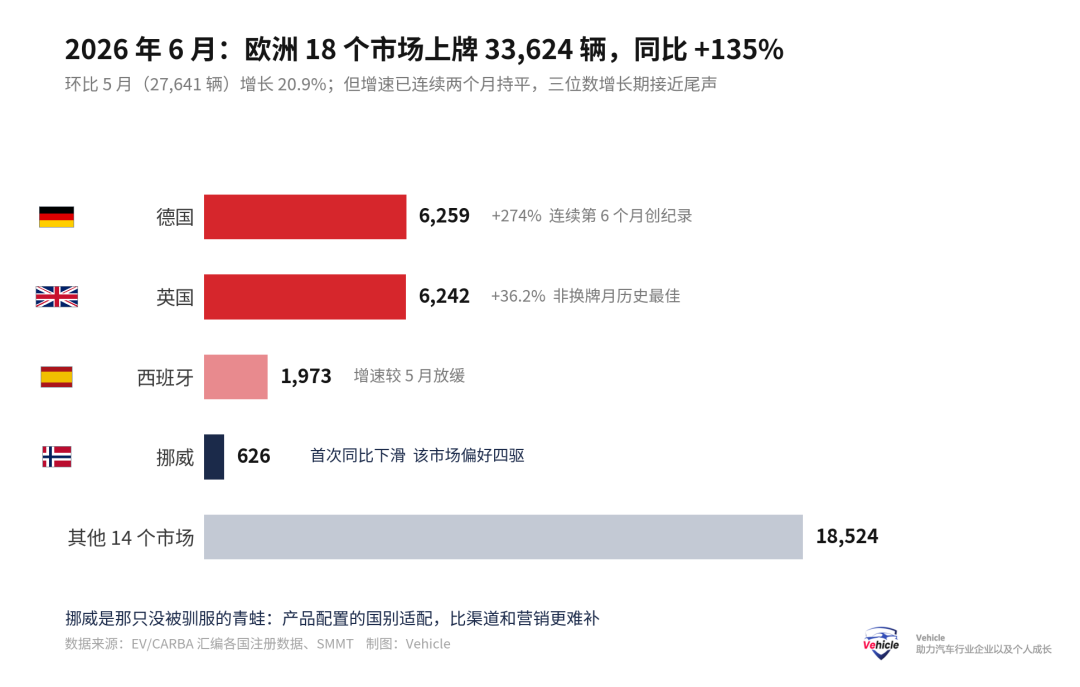
However, a layered analysis of the data reveals both reasons for optimism and concern:
① BYD's 2.4% market share in Europe for H1 2026 represents overall passenger vehicle market share, rising from 1.0% to 2.4%, with Germany seeing an increase from fewer than 2,900 units sold throughout 2024 to 6,259 units in a single month in June 2026—more than double the annual total from two years prior. This is the strongest evidence of BYD's channel repair efforts in Europe.
② Growth is normalizing. June's +135% growth marked "almost flat growth for the second consecutive month," with a noticeable cooling in Spain. The era of triple-digit growth is ending, and the next challenge will be maintaining market share under normal growth conditions.
③ Norway is the untamed frog in the mix. Norway saw BYD's first year-over-year decline in Europe, attributed to the market's preference for four-wheel-drive configurations. The significance of this detail far exceeds the 626 units itself—it proves that the lesson from 2025, "Europe is not a single market," remains relevant in 2026: National-level product configuration adaptations (four-wheel drive, towing capacity, winter range) are more difficult to address than channels and marketing because they require differentiation at the product definition stage.
Tim Albertsen, CEO of leasing giant Ayvens, still holds true today:
"They take this very seriously, but they need to understand that building a position in Europe takes time. Just as European or American automakers coming to China face challenges, what works well for the Chinese in China may not work in Europe."
5. Brand Consolidation in 2026: Structural Reorganization, Not Just Tweaks
BYD began implementing its overseas brand consolidation strategy in early 2026.
The Dynasty and Ocean series were merged into a single BYD brand overseas.
Denza and Fang Cheng Bao (Equation Leopard) were combined for overseas operations.
Yangwang remained independent.
In terms of infrastructure, BYD initiated local production efforts:
Overseas Flash Charging Stations: 6,000 stations to be built by the end of March 2027 (3,000 in Europe, 2,000 in the Americas, 1,000 in Asia-Pacific).
Construction of the Szeged factory in Hungary (land agreement signed in January 2024) is underway, with BYD hoping to start production by the end of this year. A second European factory is under evaluation, with site selection (site selection) ongoing. Various sources indicate that BYD has maintained strong confidentiality, with no leaks so far.
Returning to BYD's strategy of overseas brand consolidation, many wonder why it adopts a multi-brand approach domestically but a single-brand strategy overseas. Isn't this contradictory? In fact, it reflects different market constraints: 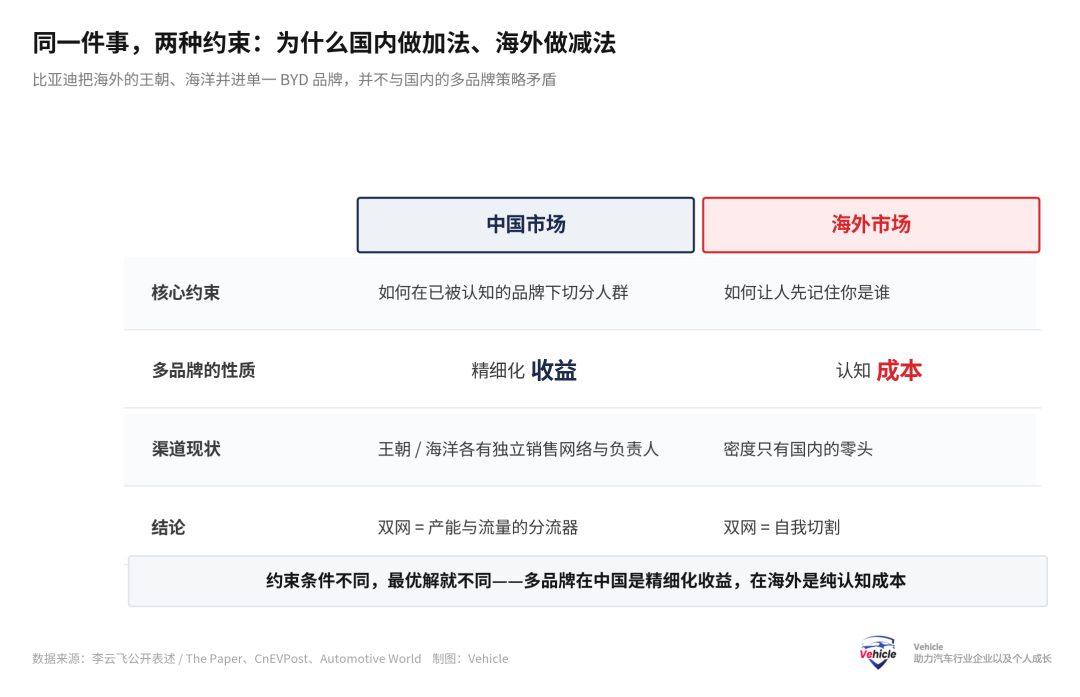
Li Yunfei stated that multiple overseas brands raise "cognitive costs" and dilute channel and marketing resources. A sharper interpretation is that BYD believes the next bottleneck for overseas growth is "brand clarity" rather than "model quantity." For a company that won the Chinese market through model proliferation, this represents a significant shift.
The implicit judgment behind merging Denza and Fang Cheng Bao is that premium and personalized offerings cannot yet support two independent systems overseas. By sharing a common operational base and differentiating through product offerings (Denza targeting European luxury, Fang Cheng Bao targeting off-road/personalization) rather than organizational differences, BYD is making the right resource allocation decision.
The role of Yangwang's independence is not about sales volume but about setting an image ceiling. It prevents the BYD main brand from being pigeonholed as "cheap Chinese electric cars" in Europe. Denza Z's £142,900 pricing in the UK extends this strategy—the price is not about volume but about opening up pricing space for the entire brand matrix. 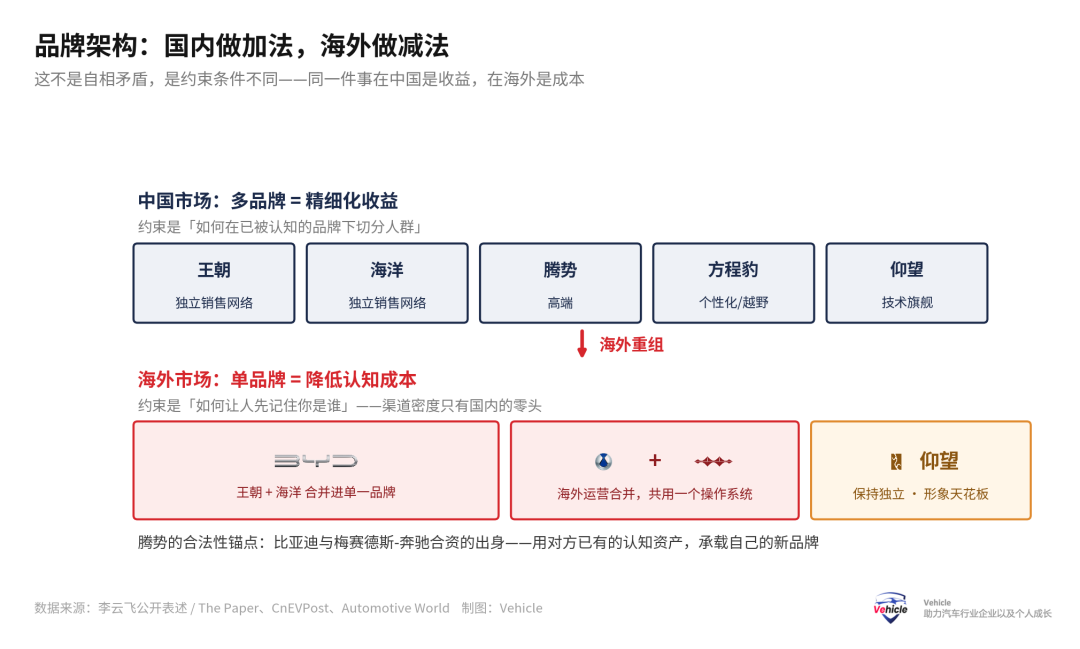
The real deep-water zone lies elsewhere.
In June 2026, reports emerged that BYD plans to make its sub-brands financially self-sufficient, with each brand using the group's R&D, production, and procurement resources on a need-based basis and settling accounts independently.
This represents a shift from a centralized system, where the Automotive Engineering Research Institute uniformly defined products, to a divisional system. Centralization was previously a source of BYD's cost advantage (economies of scale in batteries, hybrid systems, and electric drives), but the trade-off was product homogenization across brands. As overseas scale approaches domestic levels and regional demands diverge (Norway wants four-wheel drive, Germany wants plug-in hybrids, Brazil wants ethanol hybrids), the information-processing capacity of centralization will reach its limit before production capacity does. This reform is essentially an acknowledgment of that reality.
6. Three Unresolved Structural Issues
Is BYD's overseas expansion simply a matter of waiting for time to provide answers? Clearly not. Overseas expansion is a long-term endeavor, and those who try to replicate China's market speed in mature markets like Europe will fail quickly.
While we cannot predict the long-term difficulties of Chinese automakers expanding into Europe, analyzing BYD's overseas efforts reveals three structural issues that remain unresolved in the short term:
1|The plug-in hybrid (PHEV) arbitrage window is closing, and capacity deployment is lagging behind policy changes. 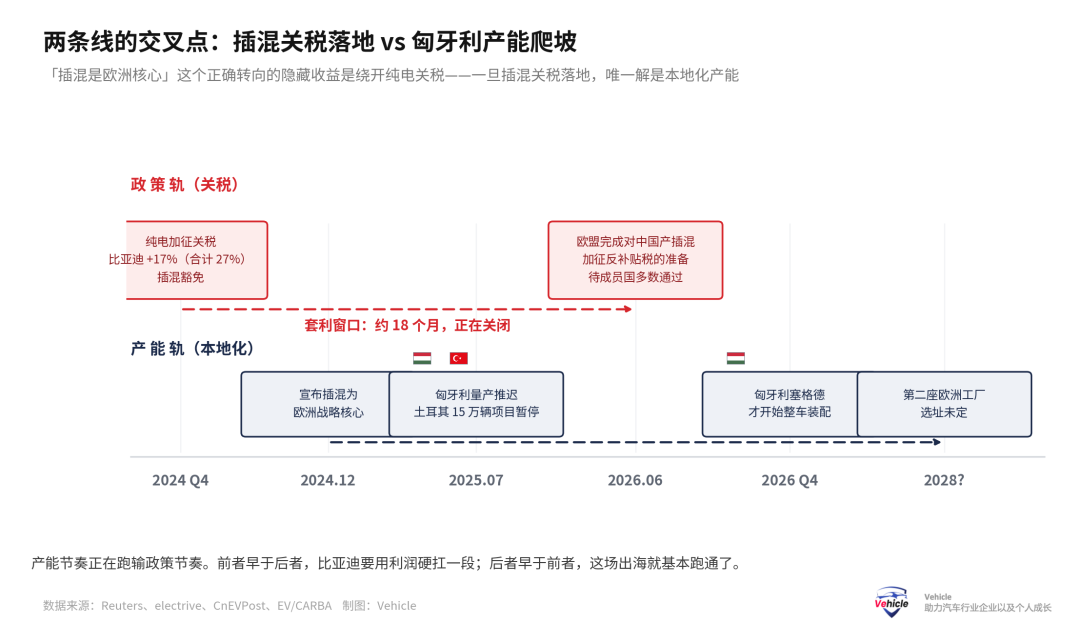
The correct pivot to "PHEVs as Europe's core" in late 2024 offered hidden benefits by sidestepping pure electric vehicle (BEV) tariffs. However, once PHEV tariffs are introduced, this economic foundation will be removed, leaving localization of production capacity as the only solution—and capacity deployment is currently lagging behind policy changes. The location of the second European factory remains undecided, meaning that even if a decision is made now, production capacity would not contribute until after 2028.
This is the biggest single risk today and the key variable for judging BYD's European performance in 2027.
2|6,000 flash charging stations: A channel weapon or a capital black hole?
BYD's plan to build a flash charging network overseas is theoretically sound—eliminating range anxiety with a refueling-like experience, using energy storage for peak-shaving arbitrage to lower operational costs, and creating a barrier difficult for competitors to replicate. The second-generation flash charger peaks at 1,500 kW, 50% higher than the first generation in March 2025; XPENG's 1,040 kW counterpart showcased in Munich in July pales in comparison.
BYD has built 7,018 flash charging stations domestically (covering 325 cities), relying on its massive domestic user base. However, overseas investments are being made before user scale is achieved, with recovery highly dependent on whether the 1.5 million unit target can be met. Such capital expenditures are substantial and compete for the same funds as localization efforts, unless BYD adopts innovative financing or secures local funding support.
3|When overseas expansion shifts from "incremental growth" to a "profit pillar," decision-making rhythms will change.
Returning to the Q1 earnings report: Net profit halved primarily due to domestic price wars and RMB 1.2 billion in non-operating losses, but gross margin recovered quarter-over-quarter, and EBIT exceeded expectations by 82%, driven entirely by overseas operations. Goldman Sachs predicts that overseas markets will contribute 62% of profits by 2030.
This introduces a hidden management risk: When overseas operations are no longer just about incremental growth but about filling profit gaps, management's tolerance for short-term sales volume will plummet. Yet Albertsen's remark that "building a position in Europe takes time" requires precisely the opposite patience.
The arithmetic of the 1.5 million unit target is not difficult—790,000 units in H1 2026 means roughly 710,000 units are needed in H2, and the 180,000 units sold in July alone already exceed the required monthly average. However, this target was raised from 1.04 million units in 2025, and pressure is shifting from the financial side to regional operations. The tension between Urgent to redeem shares (eagerly meeting share targets) and patiently building systems is BYD's biggest internal contradiction over the next 18 months.
7. Methodology for Chinese Automakers Going Global: Eight Lessons
Returning to the broader context of Chinese automakers going global, the era of simply shipping cars overseas and expecting sales is over. With an estimated 10 million units exported this year, the wild west phase of overseas expansion has ended. Drawing on BYD's experiences and lessons, the following eight points can be shared: 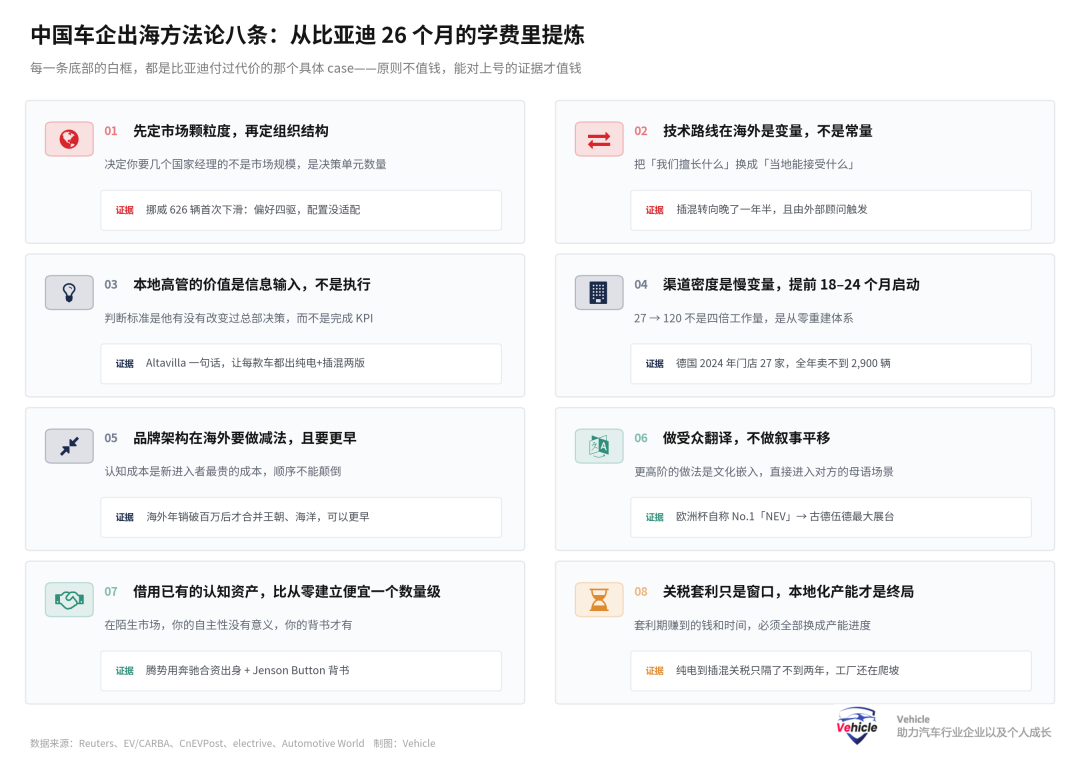
1. Before going global, assess "market granularity" and then define your organizational structure. The number of country managers needed is determined not by market size but by the number of decision-making units. Europe has dozens of decision-making units. Using the wrong granularity will lead to cascading errors in resource allocation. Norway's 626-unit decline is the interest still being paid on this lesson.
2. Technology routes are variables, not constants, overseas. Domestic success routes come with path dependency. Replacing "what we're good at" with "what the local market can accept" requires a local voice who can speak truthfully to the founders—and this role must be in place before entry, not hired after failure. BYD's PHEV pivot was a year and a half late.
3. The value of local executives lies in information input, not just execution—but this must be accompanied by institutional knowledge accumulation. Davino grew Germany's sales from 2,900 units annually to 6,000+ monthly before being poached by Ford. If local knowledge exists only in individuals, it disappears when they leave. Hiring is the first step; transforming individual judgments into processes, data, and product definition rules is the second. Most Chinese automakers have only completed the first step.
4. Channel density is a slow variable and must be built 18–24 months in advance. Expanding from 27 to 120 dealers is not four times the workload—it's rebuilding an entire system from scratch. Insufficient channel coverage suppresses sales, service reputation, and residual values simultaneously and cannot be compensated for with marketing budgets.
5. Brand architecture overseas requires simplification, and the simplification must happen earlier than you think. Cognitive costs are the highest costs for new entrants. Waiting until brands are established before segmenting them reverses the correct order. BYD simplified its brand architecture after exceeding 1 million annual overseas sales but could have done so earlier.
6. Communication must perform "audience translation," not "narrative transplantation"—and the higher-order approach is "cultural embedding." The NEV example teaches that top-tier budgets + untranslated terminology = zero impact. Goodwood's success lies in not translating Chinese stories into English but directly engaging with British motorsport culture. The three-step approach is worth emulating: Be Seen → Be Experienced → Be Recognized, or more poetically, "Start with appearance, fall for talent, stay for character."
7. Leveraging existing cognitive assets is an order of magnitude cheaper than building from scratch. Denza uses its Mercedes-Benz joint venture heritage, Jenson Button, and Goodwood's 33-year racing reputation. Chinese automakers generally underestimate the value of "borrowing momentum" and overemphasize autonomy, but in foreign markets, autonomy means nothing to consumers—your endorsements do.
8. Tariff arbitrage is just a time window; localized production capacity is the endgame. Using PHEVs to bypass BEV tariffs was a clever tactic, but regulators will catch up—it took less than two years to shift from BEVs to PHEVs. The profits and time gained during the arbitrage period must be fully reinvested into capacity deployment progress. BYD's current dilemma is precisely a result of moving too slowly in this area. To judge whether an overseas company truly intends to stay long-term, look at where it invests its arbitrage profits.
Conclusion: The Intersection of Two Lines
What BYD learned in 2025 is that "Europe is not China"—this is market awareness. What BYD learned in 2026 is that "overseas markets are not replicas of the domestic market"—this is organizational awareness. The latter is harder and more decisive in determining whether 1.8 million units can become a sustainable 50/50 split.
The real test does not lie in this year's sales figures, but at the intersection of three lines: the timing of the implementation of tariffs on plug-in hybrids, the speed of capacity ramp-up in Hungary, and the selection of a second factory site in Europe. If the former occurs earlier than the latter, BYD will have to weather a period with reduced profits; if the latter occurs earlier, then this overseas expansion will largely succeed.
For the entire Chinese automotive industry, the value of BYD's 26-month journey lies not in how fast it ran, but in the experience and lessons it accumulated, representing a significant exploration in the history of Chinese automakers going global. The reusable value of these experiences and lessons may surpass the significance of the 1.8 million vehicles that set a new record for Chinese brands going overseas.
Finally, we welcome comments and discussions from all pioneers in the automotive globalization arena, as well as insider information on Chinese automakers going global, to jointly achieve healthy and high-quality global expansion!
References and images* Strictly prohibited from reprinting and excerpting without permission-
-
![]()
BYD's Auto Overseas Expansion Review: 26 Months from 'Catching Up' to 'Advancing'
-
![]()
Are Commercial Rockets Progressing Due to Increased Girth?
-
![]()
From Imitation to Reinforcement: How Far Have End-to-End Large Models Come?
-
![]()
The Debate Between Autonomous Driving VLA and World Models: What Is It Really About?
-
![]()
Sealing the Deal: The Rationale Behind GAC Honda and SAIC-GM’s Early Joint Venture Renewals
-
Third-Party SIM Card Services Discontinued: Strategic Calculations of China Mobile, China Unicom’s Bold Move, and China Telecom’s Tactical Advancement
-
Investigation Launched 3 Days Prior to Listing Meeting! Urgent Withdrawal of RMB 3 Billion Financing Initiative
-
![]()
After Two Years of 'Big Smart,' Smart is Set to Launch Its 'Small Smart'