Kimi's Valuation Rockets to $50 Billion Amidst Frenzy of Secondary Share Sales! Who's Exiting, Who's Buying?
 08/10 2026
 513
513
A gripping drama is unfolding in the capital markets.
On one hand, Kimi has reportedly launched a new pre-IPO funding round with a staggering pre-money valuation of $50 billion (approximately RMB 360 billion). On the other, primary market project groups are witnessing a surge in information about Kimi's secondary shares, Special Purpose Vehicle (SPV) shares, and nominee quotas.
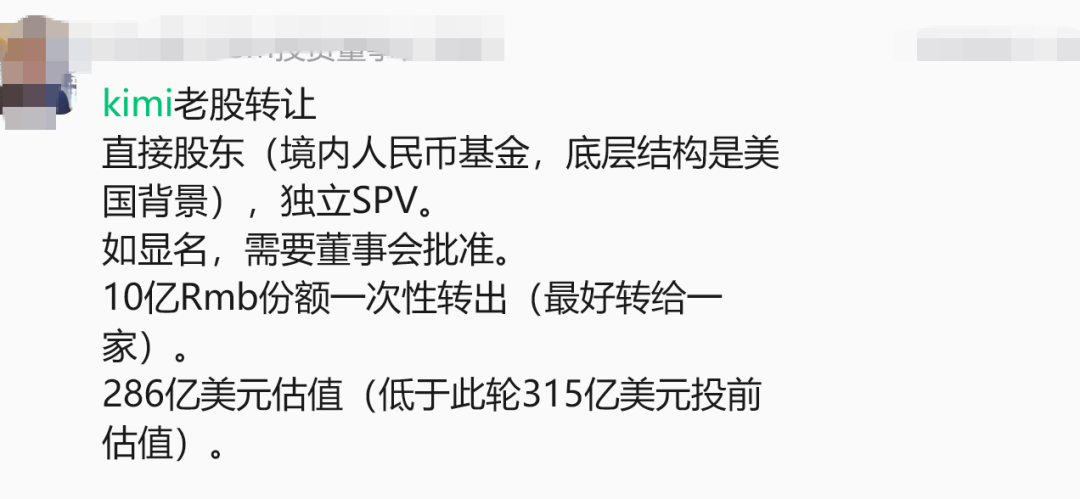
The higher the valuation soars, the more shares are being offloaded.
Is this a sign that early shareholders are losing faith, or are buyers so desperate that they're turning to secondary markets?
Let's get straight to the point: The emergence of secondary shares doesn't necessarily mean a mass exodus of capital. However, when valuations double or even triple within months, and the supply of secondary shares suddenly spikes, it can't be chalked up solely to 'share scarcity.' It signals that Kimi has entered a phase of exuberant value discovery, urgent liquidity realization, and perilous information asymmetry.

Why are investors suddenly willing to bet big at a $50 billion valuation?
According to a report by the "Science and Technology Innovation Board Daily" on August 5, Kimi's Series G funding round has kicked off with a pre-money valuation of $50 billion. Participants must complete their payments by August 15. To be directly listed on the company's shareholder registry, institutional investors must manage assets exceeding $500 million. The company had not yet responded to this funding news at the time of reporting.
This threshold reveals two key points. First, the company is not short of subscription interest and is now being selective about its investors. Second, securing an allocation and actually acquiring equity are two different things.
What's even more striking is the pace of valuation growth. In December 2025, Kimi completed a $500 million Series C funding round at a valuation of approximately $4.3 billion. After multiple funding rounds in early 2026, its valuation rose to $18 billion.
Following a roughly $2 billion funding round in May, the post-money valuation surpassed $20 billion. In July, the Series F funding round exceeded $3.5 billion, with a post-money valuation of approximately $35 billion. By August, the pre-money valuation for the pre-IPO round had soared to $50 billion.
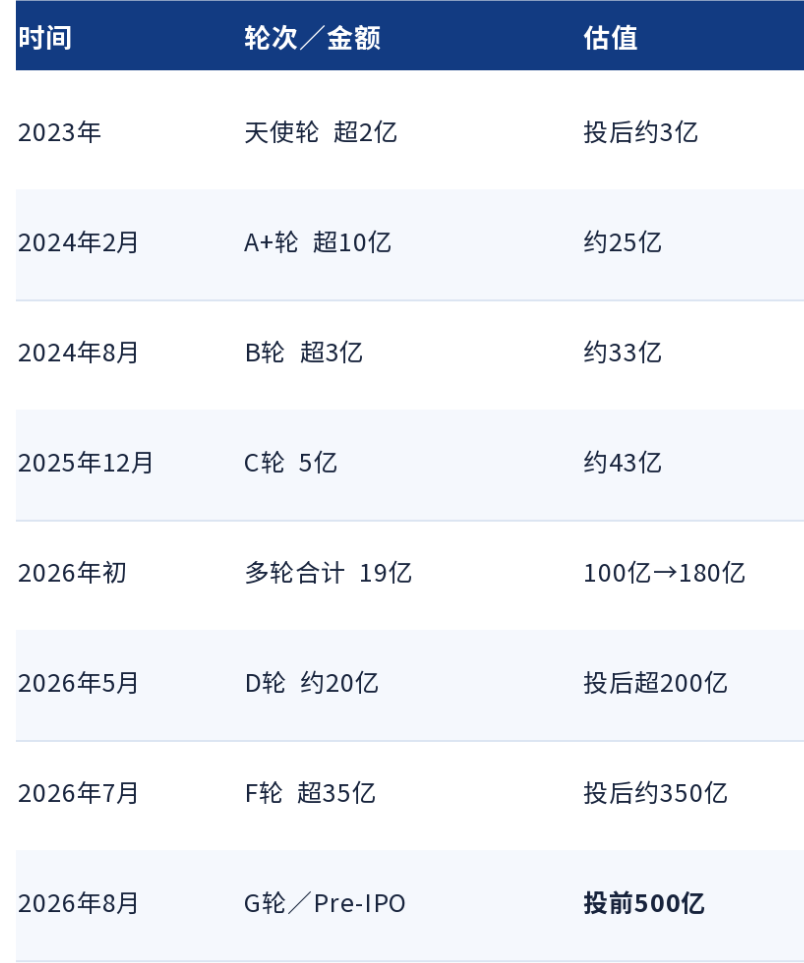
In less than eight months, the valuation has ballooned more than tenfold. Capital is now pricing Kimi not as an ordinary AI application company but as a potential contender to join the global elite of foundational model providers.
The core driver of this valuation re-rating is not just hype but the simultaneous acceleration of model capabilities and revenue growth.
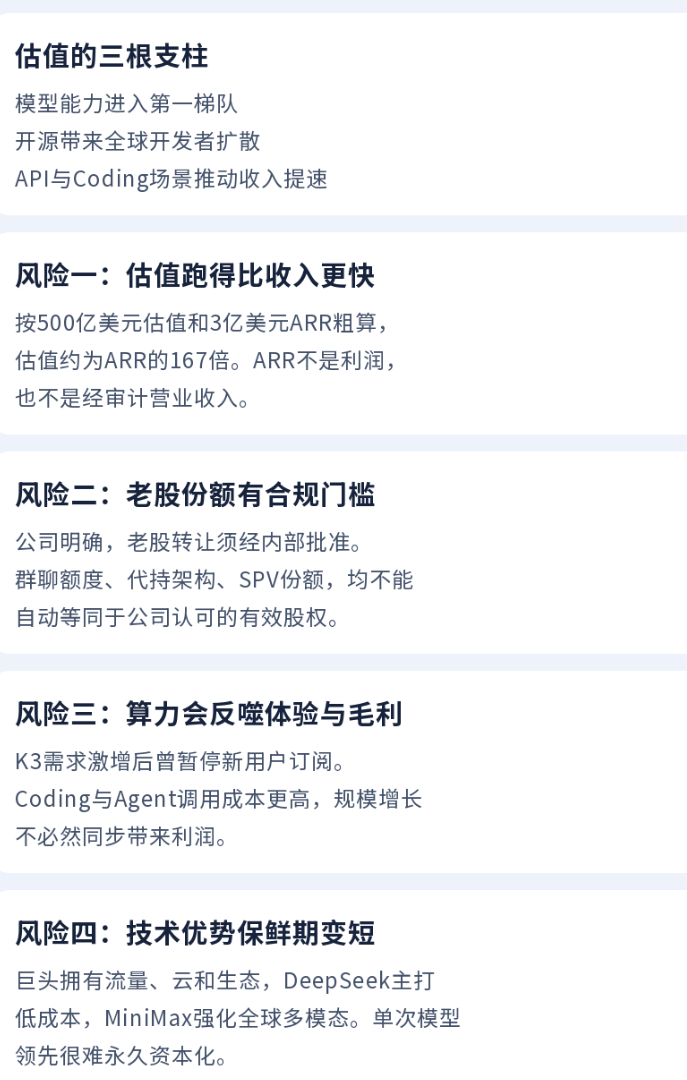
Kimi K3, released in July, boasts a staggering 2.8 trillion total parameters, million-token context windows, and native multimodal capabilities. After going open-source, K3 quickly topped the Hugging Face trending charts. Demand briefly exceeded computational capacity, leading the company to temporarily suspend new consumer subscriptions to prioritize resources for existing paying users.
A commercialization turning point has also emerged. Public reports indicate that Kimi's Annual Recurring Revenue (ARR) surpassed $100 million in March 2026, exceeded $200 million in April, and topped $300 million by mid-June. The head of enterprise business disclosed that APIs account for approximately 70% of revenue, with major clients coming from data platforms and other sectors.
This is far more substantial than relying solely on user traffic narratives. While consumer monthly active users can be amplified through marketing spend, API revenue more closely reflects enterprise clients' willingness to pay for model effectiveness. Kimi's transition from a 'long-text tool' to a platform for coding, agents, and knowledge work has also led the market to price it using logic similar to that applied to overseas foundational model companies.
What does the surge in secondary shares indicate?
The most common market misconception is to interpret secondary share transfers simply as a lack of confidence.
For early-stage funds holding shares for three years and achieving multiple times or even tens of times the paper return, selling a portion to recoup the principal is a standard asset management practice.
"Science and Technology Innovation Board Daily" cited sources from trading institutions stating that a certain state-owned institution, which initially invested $100 million, saw its equity stake's valuation rise to $500 million and may prioritize selling shares equivalent to its principal. This move is essentially risk reduction, not liquidation.
Another reason is the high threshold and tight allocations for new shares. While top-tier institutions can join the shareholder registry, smaller firms must seek entry through fund shares, SPVs, or secondary shares. Sellers want liquidity, buyers fear missing out, and with supply and demand both heating up, projects naturally flood the market.
But a reality check is necessary (project intermediaries, please don't take offense...).
The allocations seen in project groups do not necessarily equate to genuine equity; intermediaries saying "you can get in" does not mean the company will allow it; and "secondary share transfer" does not guarantee full shareholder rights after settlement.
Kimi has previously stated that transfers of its secondary shares, including common stock and incentive equity, must receive internal approval, and unauthorized transactions are invalid. Thus, for many "projects" on the market, the first thing to verify is not valuation but transaction eligibility.
At a minimum, four factors must be scrutinized: who the seller is and whether the underlying shares are genuine; whether the company's articles of association impose preemption rights or transfer restrictions; whether the SPV is multi-layered; and whether the quotation (pricing) is based on the old $30+ billion valuation or the new $50 billion valuation.
The secondary market is not a vending machine. The more popular a project, the more likely information asymmetry is being packaged as scarcity.
How does Kimi compare to its peers in terms of strengths and weaknesses?
Kimi's greatest advantage is that, as a startup, it has simultaneously achieved model capabilities, open-source influence, and API revenue. It does not need to prove traffic first like ByteDance or slowly build a sales force like traditional software companies—model upgrades can directly drive usage volume and pricing changes.
Compared to DeepSeek, Kimi is more aggressive in commercialization and has stronger funding capabilities but still lags in Extreme Low Cost (ultra-low costs) and mass-market recognition.
Compared to MiniMax, Kimi is more distinct in coding, long-context, and knowledge work scenarios, while MiniMax is more mature in overseas revenue, multimodal products, and global consumer applications. Compared to Doubao and Qianwen, Kimi stands out in technical branding but lacks a super app, cloud services, or massive traffic entry points as a foundation.
The most critical shortcoming is the shrinking shelf life of technological leadership. Long-text capabilities were once Kimi's hallmark but are now approaching industry standard. Today, K3 leads, but in a few months, it may face a new wave of model catch-up. A large model company's moat cannot rely solely on leaderboards; it must be a closed loop of models, developers, clients, compute, and products.
Is a $50 billion valuation expensive?
Using the mid-June ARR of over $300 million for a rough calculation, the $50 billion valuation is approximately 167 times ARR—an extremely high multiple.
Of course, ARR is growing rapidly, and revenue may continue to rise after K3's release, causing the static multiple to decline quickly. However, ARR is not audited operating revenue, let alone net profit. The high API proportion has two sides: while enterprise payments are more solid, inference costs, customer concentration, and pricing competition all affect revenue quality.
MiniMax disclosed 2025 revenue of $79 million, up 159% year-over-year, but still operating at a loss. This shows that while large model revenue growth can be rapid, profitability does not follow automatically. Compute costs, R&D investment, and talent incentives all represent real expenses.
Kimi's suspension of new subscriptions is a sweet dilemma but also a stress test. Exploding demand is great, but if compute cannot keep up, customer experience suffers; if high-priced compute is used to prop up operations, gross margins come under pressure. AI companies' commercial miracles must ultimately be proven through unit economics, not just server queues.
The real risk is not that some are selling but that everyone only talks about the next price.
Kimi deserves credit. It has once again proven that, in the fiercely competitive large model arena dominated by tech giants, independent teams can still carve out a niche through technical routes and iteration speed. Model capabilities, revenue growth, global developer attention, and a star-studded shareholder lineup are all genuine assets behind the $50 billion valuation.
But a great company does not mean any price is a bargain, and technological breakthroughs do not equate to commercial victory already achieved.
The increase in secondary shares signals that the capital market is transitioning from "dreaming together" to "some cashing out, others taking the baton." Sellers locking in gains are not shameful, nor are buyers betting on the future blindly. The real danger is when transaction participants stop discussing revenue quality, compute costs, and equity rights and focus solely on how much the stock will rise post-IPO.
Capital can price the future in advance but cannot complete the future's homework.
What Kimi must prove next is not whether it can raise another round but three things: whether rapid growth can be sustained, whether API revenue can translate into healthy gross margins, and whether open-source influence can materialize into global clients and an ecosystem. If these three are achieved, today's secondary share transactions will merely be a prelude to liquidity; if not, $50 billion will become a costly prepayment.
So, when faced with a market full of Kimi secondary shares, the most professional approach is neither to turn bearish at the first sign of selling nor to blindly follow top-tier institutions. First, verify the shares; second, verify the rights; and only then discuss the price. The hotter the project, the more critical it is to enshrine caution in the contract.
-
![]()
Why I'm Not Optimistic About Meituan?
-
![]()
Tencent Goes All In on WorkBuddy: The Battle for AI Office Entry Points Has Just Begun
-
![]()
950 Million Users Fail to Rescue Gemini
-
![]()
Weekly Stock Review | Auto Industry: Profit Margins Thinner Than Factory Work Pay, Thousands of Investors Caught Unawares
-
![]()
Kimi's Valuation Rockets to $50 Billion Amidst Frenzy of Secondary Share Sales! Who's Exiting, Who's Buying?
-
![]()
SAIC-GM Signs 20-Year Contract Extension, Yet Chevrolet Falters at Third Decade’s Dawn
-
![]()
Charging Costs Climb to Parity with Fueling, Will Electricity Prices Reach European Levels?
-
![]()
Tax and Fee Restructuring: The End of 'Special Perks' for Electric Vehicles?