950 Million Users Fail to Rescue Gemini
 08/10 2026
 385
385
The former AI king is quietly bowing out in a different manner. Image source | Internet (Please reach out to us for deletion in case of infringement)
Recently, Silicon Valley has witnessed a silent upheaval.
On August 5, Google's Chief Scientist Jeff Dean posted a lengthy article on the X platform, announcing his departure from the company where he had dedicated 27 years of service.
He was joined in his exit by Sanjay Ghemawat, Oriol Vinyals, and Quoc Le, whose cumulative tenure at Google surpassed 80 years. On the same day, Demis Hassabis, the founder of DeepMind and Nobel laureate in Chemistry, stepped down as CEO, handing over the reins of daily operations.
The day the news broke, Alphabet's stock price plummeted 6% during intraday trading, ultimately closing down about 4%, wiping out approximately $190 billion in market value in a single day.
This was no ordinary personnel shake-up but a formal surrender note from Google AI, marking its transition from the 'lab era' to the 'product warfare era'.
What has garnered even more attention from the entire industry is a report from authoritative research firm SemiAnalysis, stating that Gemini 3.5 Pro has been scrapped and that Gemini has slipped to 8th or 9th place in large model rankings. DeepMind is no longer considered a leading AI lab.
The former AI king is quietly bidding farewell to its position among the world's top 10.

An Unstoppable Defeat
The story unfolds on May 19, 2026.
That day marked Google I/O. CEO Sundar Pichai took the stage, vowing that Gemini 3.5 Pro would be 'launched next month'.
The audience erupted in applause, and Wall Street analysts upgraded their ratings. Everyone believed Google was finally poised to deliver a competitive product.
And then, nothing happened.
It didn't launch in June. It didn't launch in July. By late July, Google's statement had evolved to, 'The model is being tested with partners and will be widely rolled out once ready.' In August, SemiAnalysis directly announced: Gemini 3.5 Pro has been canceled.
Three delays, each more humiliating than the last.
Why couldn't it be launched? According to Semafor, Gemini 3.5 Pro was delayed because its programming capabilities failed to meet internal performance targets. Programming happens to be the primary driver for AI commercialization and monetization.
Some analysts pointed out that Google's AI models were 'about six months behind the cutting edge' in programming capabilities. In an AI iteration cycle measured in months, six months represents a generational gap.
Google's response was to deploy three mid-range Flash models as stopgap replacements. The performance of Gemini 3.6 Flash even fell short of China's leading open-source models and Grok 4.5.
Third-party evaluation agency Artificial Analysis gave it a composite score on par with its predecessor, while developer tests revealed its front-end programming capabilities were inferior to Meta's Muse Spark 1.1.
Flagship model stalled, replacements underperforming. This was the true state of Google AI in 2026.
If product delays could be excused as 'striving for perfection,' ranking data serves as a revealing mirror.
In July 2026, multiple authoritative evaluation agencies updated their global comprehensive rankings of large models, showing that Gemini, Google's most important AI product, had fallen out of the global top 10.
In Artificial Analysis's latest Intelligence Index rankings, none of Google's models ranked in the top 10.
Leading the pack were Anthropic, OpenAI, as well as domestic contenders like Kimi K3 from Moonshot AI and Zhipu GLM-5.2.
Data from AI model evaluation platform Arena.ai showed that Gemini 3.6 Flash ranked 12th with a score of 1537 in the front-end code arena.
Yet in November 2025, when Gemini 3 Pro was released, it topped the LMArena with an Elo score close to 1501.
In one year, it fell from first place to outside the top 10. Such a rapid decline is extremely rare in tech history.
Even more stinging is the comparison. OpenAI's ChatGPT has surpassed 1 billion weekly active users; Anthropic's Claude has seen month-over-month growth in paying users and revenue, with revenue increasing by about 75% since 2026; Claude Code's annualized revenue exceeded $2.5 billion by February 2026, capturing 54% of the market share.
Meanwhile, Google's Gemini app, while reaching 950 million monthly active users, owes much of this figure to forced distribution through Android pre-installations and search portal integrations.
FT Chinese bluntly stated: 'Gemini standalone chatbot still lags behind ChatGPT in popularity.'
950 million users, yet unable to hold onto a top-10 ranking. What does this say? It suggests that the vast majority are merely 'passing by' Gemini passively rather than actively choosing it.

Why Google?
To understand why Google AI has reached this point, we must look beyond products to structure.
First, technological triumph, yet product failure.
In 2017, Google's research team published the paper 'Attention Is All You Need,' introducing the Transformer architecture. This paper became the technological foundation for all subsequent large language models. Without Transformer, there would be no ChatGPT or Claude today.
However, being the pioneer does not guarantee being the harvester.
Google internally had a conversational AI prototype similar to ChatGPT as early as around 2020, but management hesitated to bring it to market due to concerns about disrupting search advertising revenue, as well as worries about the accuracy and accountability of generated content.
Noam Shazeer, one of the eight authors of the Transformer paper, created a chatbot named Meena within Google with conversational abilities close to ChatGPT's later standards. He wanted to release it but was held back by executives citing 'reputational risk.' Frustrated, he left.
Google spent approximately $2.7 billion to 'reverse acquire' Character.AI just to bring Noam Shazeer back. Yet in June 2026, he left again, this time joining OpenAI.
One man, leaving the same company twice. $2.7 billion spent over 22 months.
This incident paints a more precise picture of Google's predicament than any analysis report. It's not about lacking money, talent, or technology. Its problems run deeper—so deep that even $2.7 billion couldn't fix them.
Second, scientists shun battles, and product managers can't win them.
Hassabis is a scientist, not a product manager. He founded DeepMind with the vision of 'solving intelligence and then using intelligence to solve everything,' not 'creating a chatbot better than ChatGPT.'
When discussing how Gemini could compete with ChatGPT, he showed little enthusiasm; but when discussing how AI could cure diseases or crack protein structures, his eyes lit up.
After ChatGPT ignited the market in 2022, the competitive logic of the AI industry shifted entirely. Previously, success was measured by paper citations; now, it's measured by daily active users, retention rates, and paid conversion rates. In this arena, Hassabis's scientific mindset was not an advantage but a liability.
So Google's choice was pragmatic: make Hassabis the Chief Scientist and hand over DeepMind's daily operations to CTO Koray Kavukcuoglu, someone more attuned to engineering implementation.
This marked Google AI's ideological shift: research idealism formally gave way to product pragmatism.
But the problem is, can product managers win just because scientists step aside?
Google's massive organizational structure, complex internal politics, sluggish product decision-making processes, and the insurmountable wall between research and product departments don't disappear just by changing one person.
Conducting AI research at Google, the biggest cost isn't computing power but 'waiting'—waiting for approvals, cross-departmental coordination, and product team scheduling. At Anthropic or OpenAI, an idea can go from inception to experimentation in just days.
The final reason is that internal battles rage while external forces storm the gates.
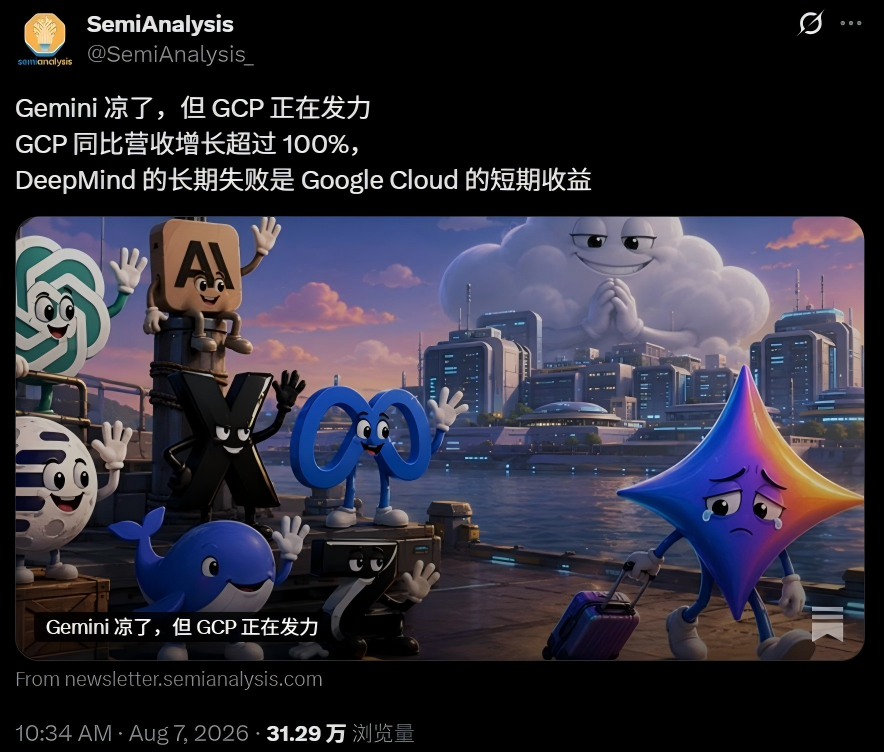
SemiAnalysis's report revealed a more hidden truth: within Google, Gemini and GCP (Google Cloud Platform) have been engaged in a long-term power struggle over computing resource allocation, which ended in GCP's victory.
Simply put, two factions within Google were vying for computing power: one wanted to use TPUs to train better Gemini models, while the other wanted to sell TPUs to external clients to earn cloud service revenue. The latter won.
GCP is now selling TPUs in large quantities to competitors like Anthropic, securing long-term leasing and sales contracts for hundreds of thousands of TPUs over the past nine months.
SemiAnalysis estimates that by the end of 2027, GCP's third-party AI cloud service revenue will exceed $73 billion, with TPU system sales contributing an additional $120 billion. Meanwhile, Gemini's annualized revenue is only about $12 billion.
On one side, $12 billion; on the other, $193 billion. If you were Google's CFO, where would you allocate computing power?
The answer is obvious.
SemiAnalysis bluntly stated: Gemini 3 Pro may represent the peak of Google's model competitiveness, and Google's AI strategy has shifted to 'selling shovels'—selling computing power and infrastructure rather than the models themselves.
This is akin to a shovel merchant during a gold rush who doesn't dig for gold himself but sells shovels to all gold diggers.
From a business perspective, this isn't necessarily a bad move. It might even be a far better one. But it means Google has officially abandoned the quest for dominance in cutting-edge AI models.
Silicon Valley generally believes that Google's formal farewell to the era of 'scientists ruling AI,' shifting from pursuing cutting-edge breakthroughs to focusing on product implementation and commercial revenue, is the core reason for its team collapse.

The Illusion of 950 Million Users
At this point, someone might ask: Doesn't Gemini have 950 million monthly active users? How can it be considered a failure?
This question touches on the core of Google AI's dilemma.
How were those 950 million monthly active users acquired? Largely through Android pre-installations, search portal integrations, and deep integration with Gmail and Workspace.
The vast majority of these users merely encountered Gemini passively while using Google products, rather than actively choosing it as their AI assistant.
Even more fatal is the collapsing user experience.
In May 2026, Google announced adjustments to Gemini's quota algorithm, shifting from 'daily prompt limits' to 'pay-per-computing-power'.
Users reported endless text loops, context loss, language errors in replies, and stricter resource limitations.
Some users said they exhausted a 5-hour quota in about 4 minutes. Developer u/dvrkstar posted on Reddit that Gemini 3.5 deleted 28,745 lines of existing code without authorization in a production environment, affecting 340 files and causing a 33-minute 404 error across the entire production portal.
The free version's experience degraded, while the paid version's computing power shrank. Gemini earned the nickname 'North American Soybean Bag' online—it sounds like an AI but performs like a fool.
When a significant portion of your 950 million users feel 'dumbed down' during use, the larger the number, the more severe the reputational backlash.
So the question arises: Does Google really not know it's falling behind?
Of course, it does. In Q2 2026, Alphabet's capital expenditures reached $44.9 billion, with the full-year guidance raised to $195-205 billion.
The CFO stated during the earnings call that about 60% of that quarter's infrastructure spending went toward AI servers and acknowledged that Google is now 'supply-constrained,' with demand far exceeding its production capacity.
It's spending madly. But the direction of spending isn't chasing OpenAI's model rankings.
Some media analyses point out: Google is waging an 'anchor' strategy, getting a sufficiently usable model into the hands of as many people as possible as quickly as possible.
With 950 million monthly active users, 22 billion API tokens daily, and nearly 90% of Fortune 100 companies already using Gemini Enterprise, Google is using low-cost, fast-moving models like Flash as door openers to get users accustomed to Gemini.
This logic mirrors PayPal's strategy of burning money on subsidies to build its payment network before the dot-com bubble burst.
But this logic has one prerequisite: your model can't be terrible. When your flagship model misses deadlines three times, when your mid-range models can't outperform open-source alternatives, and when your user experience is derided as 'dumbing down,' no amount of money burned or users acquired will cultivate a market for you—it will cultivate one for your competitors.
What is more intriguing is Google's recent series of moves. According to The Information, Google is developing a new server chip with the internal codename 'Frozen v2,' planning to integrate some of the Gemini model's information directly into the hardware.
Once the news broke, Alphabet's stock price rose by 3.7%.
Burning the model into the chip—this approach is very Google. It is leveraging its strongest hardware capabilities to compensate for the shortcomings of its model capabilities.
But the problem is, when your competitors are already a generation ahead of you at the software level, hardware optimization can only help you lose less, not win.

Google will keep on unveiling new models, but their prospects of once again dominating the industry have dwindled to practically nil.
This assertion may seem harsh, but it underscores a reality that is already in motion: Google AI is saying goodbye to its esteemed status as one of the 'global top three.' This is not a mere temporary setback but the culmination of a structural decline that has been unfolding over the past several years.
All eight pioneering authors of the Transformer architecture have now departed from Google; Nobel laureate Hassabis has taken a step back from the forefront; another Nobel laureate, John Jumper, has transitioned to Anthropic; Jeff Dean has exited alongside three key researchers.
The most prominent figures in Google AI over the past decade are vanishing in what can only be described as a near-mass exodus.
These individuals were not lured away by competitors; they chose to leave of their own accord. They are not abandoning a technologically lagging company but rather an organization that stifles the creativity and productivity of top AI researchers.
Brian Mulberry, Chief Market Strategist at Zacks Investment Management, provided a measured yet scathing assessment:
"Google boasts a deep reservoir of talent, but the departure of these four pivotal figures will undoubtedly leave a noticeable void. Reinvigorating the pace of innovation and execution efficiency is never a straightforward task, and the loss of key contributors only exacerbates the situation."
From the Transformer to BERT, from AlphaGo to AlphaFold, Google was once the undisputed titan of AI. However, in the race for generative AI, success is not measured by the volume of research papers or the number of Nobel laureates; it hinges on product iteration speed, organizational execution efficiency, and commercialization prowess.
On these fronts, Google has been significantly outpaced by OpenAI and Anthropic.
Of course, Google remains one of the most valuable corporations globally. Its cloud business is experiencing an impressive 82% growth rate, and its advertising revenue remains steadfast. Even if Gemini falls completely behind its competitors, Google will not crumble.
But 'remaining afloat' and 'reigning as the king of AI' are two vastly different scenarios.
And Gemini, once hailed as the potential 'GPT-4 killer,' has ultimately extinguished Google's own aspirations to dominate the AI landscape.
-
![]()
Why I'm Not Optimistic About Meituan?
-
![]()
Tencent Goes All In on WorkBuddy: The Battle for AI Office Entry Points Has Just Begun
-
![]()
950 Million Users Fail to Rescue Gemini
-
![]()
Weekly Stock Review | Auto Industry: Profit Margins Thinner Than Factory Work Pay, Thousands of Investors Caught Unawares
-
![]()
Kimi's Valuation Rockets to $50 Billion Amidst Frenzy of Secondary Share Sales! Who's Exiting, Who's Buying?
-
![]()
SAIC-GM Signs 20-Year Contract Extension, Yet Chevrolet Falters at Third Decade’s Dawn
-
![]()
Charging Costs Climb to Parity with Fueling, Will Electricity Prices Reach European Levels?
-
![]()
Tax and Fee Restructuring: The End of 'Special Perks' for Electric Vehicles?