OpenAI Delays IPO: Altman Aims for a Higher Valuation
 08/10 2026
 467
467
Is the $1 Trillion Valuation Ambitious or Strategic?
Produced by | Meigang Tanan
Cailian Press has confirmed that OpenAI has officially postponed its IPO from 2026 to 2027, delaying the entire schedule by a year.
In June of this year, OpenAI submitted its S-1 filing to the U.S. SEC. The market initially likened it to SpaceX, dubbing them the "2026 Tech Twin Stars," with high expectations for the IPO ceremony. However, less than two months later, news of the postponement surfaced.
When the announcement was made, many initially wondered, "Is it canceled?"
A closer examination of the financials, however, suggests a different narrative—Altman holds a strong position but simply prefers not to proceed when market conditions are unfavorable.
In my opinion, OpenAI is not retreating; it believes it is currently undervalued.

Is the $1 Trillion Valuation Ambitious or Strategic?
In March 2026, OpenAI secured $122 billion in funding, reaching a post-money valuation of $852 billion, making it the highest-valued global unlisted tech company. Yet, Altman's stance was firm: anything below $1 trillion was unacceptable.
What fuels this confidence?
The revenue growth is remarkable. From $3.7 billion in 2024, it surged to $13.07 billion in 2025, a more than 250% increase. In Q1 2026 alone, revenue reached $5.7 billion, and at this rate, achieving $22 billion for the full year seems feasible. A sixfold increase in three years—this growth is unprecedented.
On the user front, OpenAI is unparalleled. With 900 million weekly active users, GPT is a global AI leader, further strengthened by its deep integration with Microsoft Azure. With these three key assets, Altman is confident in demanding a $1 trillion valuation—because he has the leverage.

The Luxury of Patience
SpaceX's market cap soared to $1.77 trillion on its debut on June 12, with retail investor subscriptions exceeding $100 billion, only to see a subsequent stock price decline. This serves as a cautionary tale for all tech IPOs: retail investor enthusiasm must be rebuilt—patience is crucial.
However, OpenAI's situation is unique. With $122 billion in cash reserves and no immediate cash flow pressure, it has no urgent need to go public. The difference between those who can afford to wait and those who cannot lies here.
Many companies are driven by financial necessity, but OpenAI is pursued by capital. Delaying until 2027 provides a full year to deepen its enterprise market penetration and optimize its cost structure. Having the autonomy to choose its timing is true independence.

Anthropic's Aggression Fuels AI Sector Growth
Anthropic has indeed been aggressive this year. In May 2026, it completed a $65 billion Series H funding round, reaching a post-money valuation of $965 billion. Its annualized recurring revenue skyrocketed from $9 billion at the end of 2025 to approximately $74.1 billion by July 2026, with over 80% of revenue coming from enterprise clients. It is expected to achieve quarterly operating profit for the first time in Q2.
On the surface, it may seem like a competitor is gaining ground, but in reality, it benefits the entire AI sector. Together, the two leaders approach a combined $2 trillion in valuation, with capital markets showing their support: AI large models are the most certain tech trend.
OpenAI board chair Bret Taylor also acknowledges Anthropic's strong performance, admitting that OpenAI needs to "catch up" in the coding market. This healthy competition will only motivate OpenAI to further solidify its enterprise market.
Moreover, Bain & Company data indicates that enterprise AI adoption is still in its early stages, with significant room for cost optimization. The B-side market remains vast, and for players like OpenAI with a large user base and technological reserves, the potential for growth is immense.

Is $1 Trillion Overvalued? Let's Analyze
Altman's $1 trillion valuation request warrants a comparative analysis.
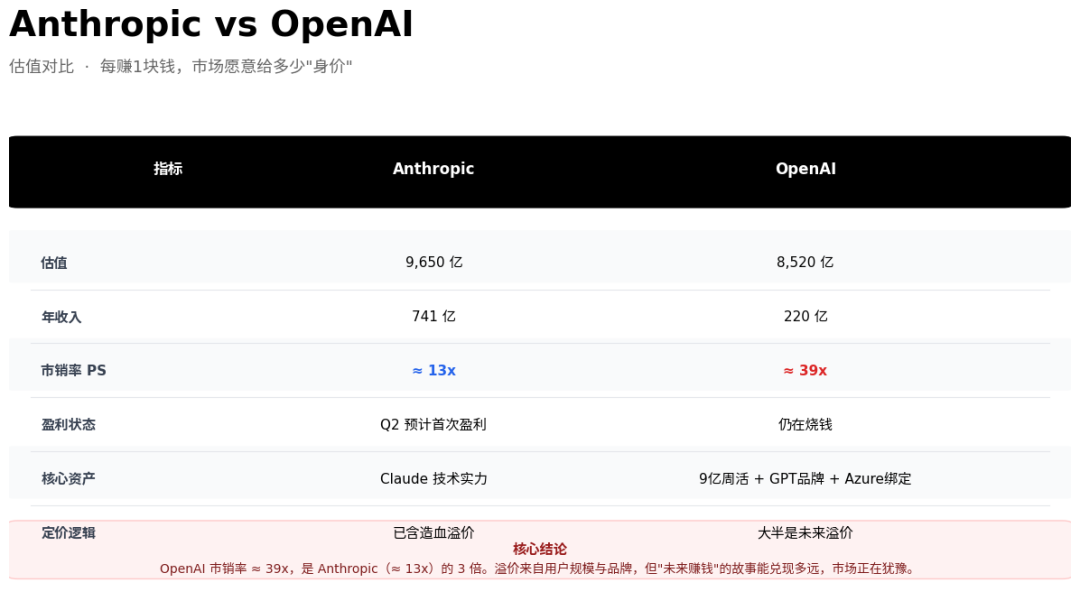
For every dollar Anthropic earns, the market assigns it a 13x valuation, and it is nearing profitability—this 13x includes a premium for "self-sufficiency." For every dollar OpenAI earns, the market assigns it a 39x valuation—nearly triple Anthropic's.
Is 39x excessive? It depends on your perspective.
If you believe in the 900 million weekly active user base, GPT's technological edge, and the potential to further increase its enterprise market share from 60%, then this premium is justified by "future profit potential."
In simpler terms: OpenAI is still investing heavily to capture market share. In Q1 2026, R&D spending reached $8.6 billion, while gross profit was only $2.2 billion—far from covering R&D costs. But this is a common phase for all tech giants—secure market share first, then reap the rewards.
My view: $1 trillion is a ceiling, not a floor. But ceilings are meant to be reached. By delaying until 2027, OpenAI aims to achieve two goals: increase enterprise revenue share and reduce quarterly losses. If successful, the valuation narrative will change entirely.
 Benchmarking: Is This Stock Worth Watching?
When placed in the global tech landscape, OpenAI's true benchmarks should be Amazon and Tesla during their "invest-for-the-future" phases—both were criticized for overvaluation but silenced critics with scale and competitive moats.
Amazon operated at a loss for 20 years before turning profitable; Tesla faced bankruptcy multiple times. But what did they have in common? A vast market opportunity, deep competitive moats, and relentless execution. OpenAI embodies all three.
In the AI large model race, the winner will be the first to commercialize successfully—it's not just about model parameters. With 900 million users, Microsoft's distribution support, and a leader like Altman—delaying a year to consolidate is a strategy to leap forward.
In autumn 2027, when OpenAI stands before the SEC again, the market will ask just one question: When can your cash flow sustain itself?
But don't forget: this company boasts the industry's largest user base, the strongest brand, and the deepest revenue streams. Altman's $1 trillion valuation bet is on buying time.
Is this gamble worth watching?
My stance is clear: I'm staying invested.

Disclaimer: This article is based on publicly available information about listed companies. Meigang Tanan strives for objectivity and fairness in its content and viewpoints but does not guarantee accuracy, completeness, or timeliness. The information or opinions expressed herein do not constitute investment advice, and Meigang Tanan assumes no responsibility for any actions taken based on this article.
-
![]()
Dissecting the Underlying Logic of the 'AI Office Entry Battle': How to Become the Ultimate Winner?
-
![]()
OFILM Issues Urgent Clarification on 'Asset Stripping' Rumors, Denies Channeling Benefits to Related Parties of Actual Controller
-
![]()
Securing 80% of Apple’s Shell Quality Inspection Orders: What Gives Huiyan Technology Its Competitive Edge?
-
![]()
Monthly Sales of 1 Unit: Chevrolet's Failure in China and an Excellent Example of Loss Mitigation for Joint Venture Automakers
-
![]()
The Closing of the $50 Billion Pre-IPO Round Looms: Yuezhi Anmian is Revolutionizing Valuation Logic for China’s Large Language Models
-
![]()
Pork Prices Plummet by 13%, Yet Smartphones and Healthcare Costs Soar: Here's Why Your Wallet Feels the Pinch
-
![]()
Storage Costs Skyrocket! Apple iPhone 18 Pro Sees Nearly 40% Cost Hike: Price Increases Loom
-
Musk's SpaceX to Compete with Top Three U.S. Operators: Wild Dream or Future Disruptor?