Xiaomi's MiMo Stages a Two-Year Comeback to Top Global Inference Volume Rankings
 08/12 2026
 405
405
Author/Vincent
Editor/Jiajia
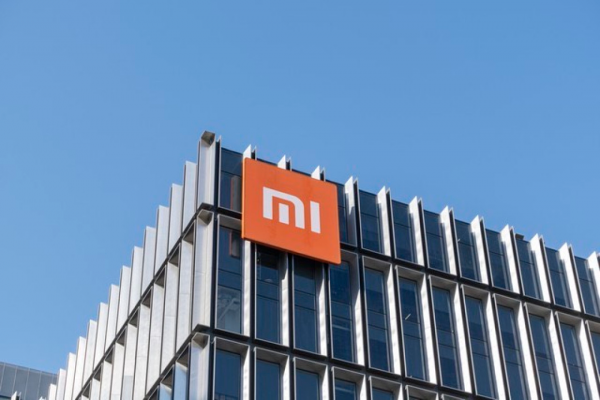
Recently, OpenRouter released data showing that Chinese large models dominate the global top 5 in inference volume, with Xiaomi's MiMo-V2.5 leading at 10.5 trillion Tokens. In response, Xiaomi stated that the users downloading the model are primarily independent developers, startups with three to five members, and numerous small-to-medium-sized vendors focused on AI programming and intelligent agent tool development. The MiMo series models' low inference costs and stable agent operation capabilities precisely meet their needs.
Xiaomi's MiMo has emerged as the darkest horse in the large model race of 2026. However, it is worth noting that compared to mainstream models like Tencent's Hunyuan, Alibaba's Yuanbao, and DeepSeek, Xiaomi's MiMo was initially conceived as a supporting role.
From a supporting role in 2023 to a leading contender today, Xiaomi's comeback in the large model space stems partly from team efforts but more significantly from strategic shifts. After the growth of its new energy vehicle business, Xiaomi's large model elevated from a backup to a core focus, receiving substantial group resources.
【1】A Different AI Large Model
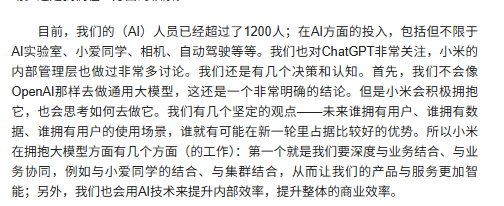
"We won't build a general-purpose large model like OpenAI—that remains a clear conclusion. But Xiaomi will actively embrace it and explore how to approach it."
At the Q1 2023 analyst earnings call, when asked whether Xiaomi would develop large models, Lu Weibing, Xiaomi Group's Partner and President, firmly stated that general-purpose large models were not Xiaomi's primary focus.
 (Source: Sina Finance)
The AI large model industry exploded in 2022. ChatGPT officially launched in November 2022, and by late January 2023, its monthly active users surpassed 100 million.
Gaining 100 million users in two months, ChatGPT became the fastest-growing app, prompting over a dozen internet firms—including Alibaba, Tencent, Huawei, and ByteDance—to announce R&D plans, marking the start of China's "Hundred-Model War."
However, compared to competitors' enthusiasm, Lei Jun remained surprisingly indifferent to the AI large model trend. "Abandoning the main battlefield of large models," Lei Jun recalled, was a unanimous internal decision, with no plans for increased budget allocation.
At the time, Xiaomi faced its own challenges:
On one hand, new energy vehicles acted as a cash drain, consuming at least RMB 30 billion of Xiaomi's cash reserves. With the impending mass production of the Xiaomi SU7, the profitability of the new energy vehicle business remained uncertain.
On the other hand, large model costs were astronomical, with OpenAI's training expenses for a single model reaching the $1 billion mark.
Both new energy vehicles and AI large models represented promising yet high-risk ventures, leaving Xiaomi with insufficient resources and willingness to support the AI large model wave.
This was evident in their product strategy. While giants like Baidu, Tencent, and Alibaba developed standalone AI large model products like ERNIE Bot and Hunyuan, Xiaomi's Core team initially focused on enhancing Xiaomi AI Assistant (Xiao Ai) for hardware products like smartphones and smart speakers through AI technology.
This meant Xiaomi's AI strategy diverged from other internet giants. Within Xiaomi, AI large models were not standalone products but enabling technologies providing intelligent services for Xiaomi's hardware ecosystem, enhancing their appeal.
Thus, while born within the "main sect," Xiaomi's large model team lacked the priority status of "elite disciples" within the group.
【2】Full-Speed Pursuit
A company's success relies on individual effort and historical timing. After nearly two years on the sidelines, Xiaomi's large model team seized its opportunity.
With the Xiaomi SU7 selling 135,000 units in 2024, Lei Jun entered a golden era. The new energy vehicle-driven innovation business generated RMB 32.8 billion in revenue, becoming Xiaomi's third growth engine.
Meanwhile, DeepSeek disrupted the chip-stacking approach to large models, demonstrating that development was shifting from compute hardware to algorithm optimization, significantly reducing costs.
Xiaomi's Core team moved from the periphery to center stage.
Lei Jun stated in a livestream that as Xiaomi's automotive business stabilized, he shifted focus to AI, driven by personal interest and strategic ecosystem development.
Xiaomi announced its entry into the general-purpose AI large model race via a WeChat post: "While 2025 may seem like the late stage of the large model dream, we believe the AGI journey has just begun."
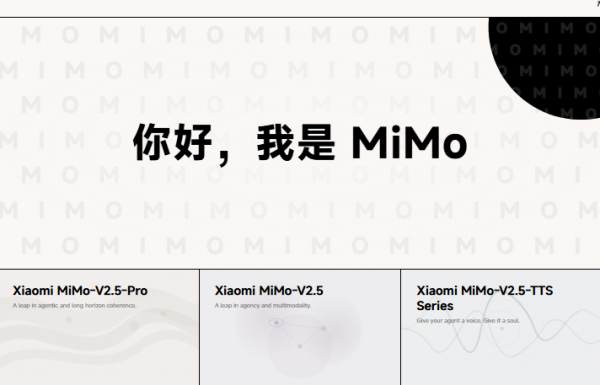
To catch up, Xiaomi invested RMB 7 billion in AI R&D in 2024 and built a 10,000-GPU cluster, aiming to close the gap. In April 2025, it released the lightweight, easy-to-deploy Xiaomi MiMo-70B, hoping to differentiate itself.
(Source: Xiaomi Official Website)
Ideals clashed with reality. Xiaomi lagged behind mainstream models in industry influence and technical capability:
The MiMo-70B had only 7 billion parameters, while same period Llama 4 series models like Scout and Maverick reached 17 billion, with Maverick totaling 400 billion.
This parameter gap limited its applicability. MiMo-70B excelled in benchmark tasks like math problem-solving and code generation but struggled with open-ended conversations, creative writing, image/video processing, and long-document analysis.
MiMo-70B marked Xiaomi's first step into general-purpose models, but China's AI dividends remained controlled by established players.
Frost & Sullivan's *China GenAI Market Insight: Enterprise Large Model Inference Landscape, 2025* report revealed:
In H1 2025, daily inference volume surged 363% to over 10 trillion Tokens, with Alibaba's Tongyi, ByteDance's Doubao, and DeepSeek accounting for 17.7%, 14.1%, and 10.3%, respectively—over 40% combined.
Xiaomi had arrived but still trailed mainstream models. Lei Jun, a believer in "riding the window of opportunity (trend)," seemed to miss the hottest tech trend.
【3】Global Comeback
With capital and risk tolerance, closing the large model gap became Xiaomi's 2025 AI priority. MiMo's strategy shifted:
Previously, Xiaomi emphasized differentiation, favoring "lightweight" and "local deployment" over ever-larger models. While strong in niche benchmarks, this approach lacked market traction.
Post-2025, MiMo pivoted to compete head-on with mainstream models:
It pursued "ultimate inference efficiency and high performance" like others while offering cost-effective solutions amid soaring usage expenses.
This strategic shift fueled MiMo's comeback:
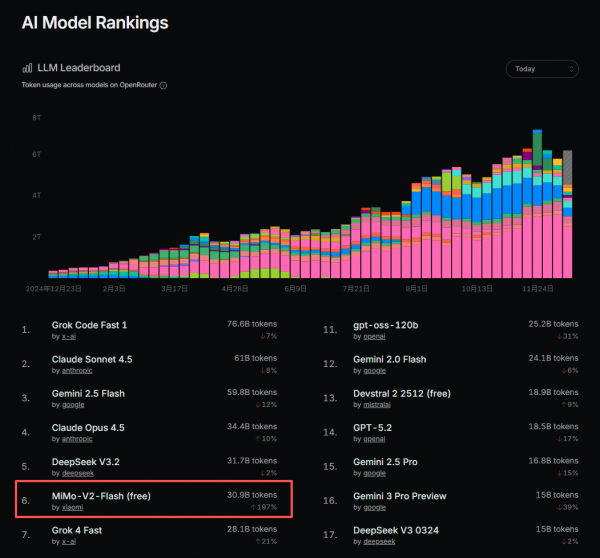
The December 2025 MiMo-V2-Flash, with 309 billion parameters (4x MiMo-70B), matched industry leaders in math, programming, and scientific knowledge, climbing to 6th in global weekly inference volume.
The April 2026 MiMo-V2.5 saw weekly inference volume soar from 1.5 trillion to 10.5 trillion Tokens, with monthly volume hitting 31.20 trillion in July—topping global rankings.
 (Source: Internet)
From MiMo-70B in early 2024 to MiMo-V2-Flash in December 2025 and MiMo-V2.5 in April 2026, Xiaomi transformed from a marginal player to global leader in just two years.
Topping the inference charts is not the finish line. With rivals like DeepSeek, Alibaba Tongyi, and ByteDance Doubao counterattacking, the large model competition enters its second half—where sustained cost reduction, deeper scenario integration, and developer dependency determine winners.
For Xiaomi, its next product must prove MiMo's rise is no fluke but a replicable methodology.
-
The RTX 3060 Makes a Comeback Amid a Mix of Old and New Hardware, Making 2026 the Worst Year for the PC Industry
-
![]()
Zhang Yiming Achieves Jack Ma's 'Dream': Douyin Surpasses 1 Billion Monthly Active Users First!
-
The Complete Decline of Fuel-Powered Vehicles! Only One Model in July's Top 10 Sales
-
![]()
What Are the Three World Models in BYD's HyWorldVLA: Pixel-Level, Latent Space, and Hybrid?
-
Raking in 23.7 Billion Yuan in Just Half a Year! Has Foxconn Industrial Internet Turned a New Leaf?
-
Offline Competition Among Big Companies for Customers: The Battle for Desktop Access with Office Agents
-
![]()
Starting at 3199 yuan, the REDMI K100 series has been launched, making me start to worry for the Xiaomi 18
-
![]()
Xiaomi's MiMo Stages a Two-Year Comeback to Top Global Inference Volume Rankings