Zhang Yiming Achieves Jack Ma's 'Dream': Douyin Surpasses 1 Billion Monthly Active Users First!
 08/12 2026
 418
418
 Image Source: Weibo
The two-decade journey of China's internet hides an ultimate aspiration and comeback saga spanning over a decade. Over ten years ago, Jack Ma envisioned Alibaba building a national platform serving one billion Chinese users across daily life needs. Despite massive investments in e-commerce, payments, and local services, Alibaba never crossed the 1 billion MAU threshold.
 Image Source: Weibo
Unexpectably, this internet dream that haunted Alibaba for over a decade—Jack Ma's 'proud obsession'—was ultimately achieved not by Taobao or Alipay, but by Zhang Yiming's quietly evolving Douyin. In the first half of 2026, QuestMobile's industry report confirmed the legend: Douyin's MAU surged past 1.029 billion, becoming China's second super app after WeChat with over 1 billion users. Taobao, Alipay, and Gaode Maps ranked 3rd, 4th, and 5th, failing to break 1 billion MAU. Amid stagnating growth across major platforms, Douyin added 100 million new users in one year, fulfilling Alibaba's unrealized industry dream.
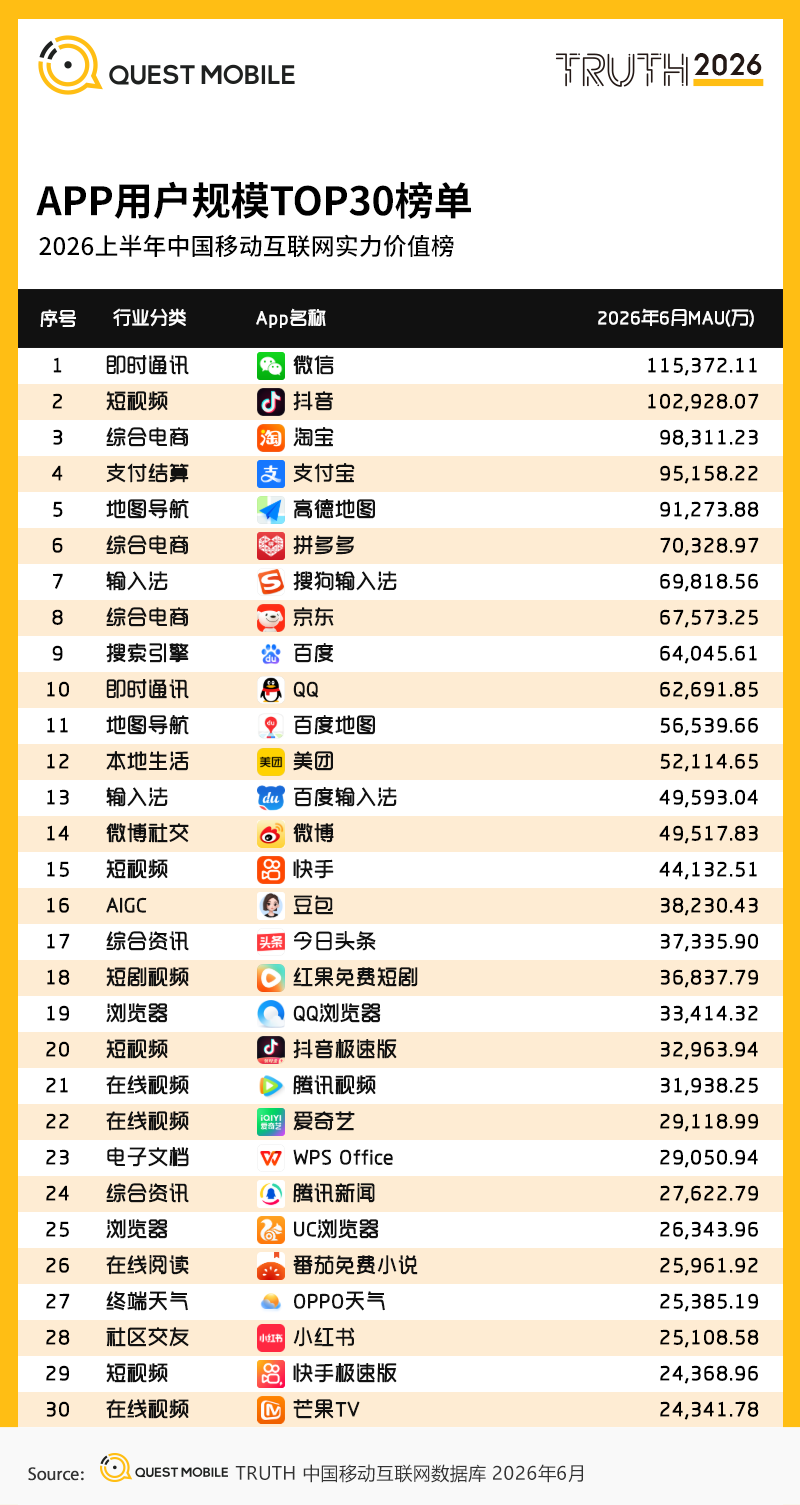
Image Source: QuestMobile (Scrollable image)
01 A 16-Year Obsession: Jack Ma's Billion-User Dream Remains Unfulfilled
The story began in 2010 when China's mobile internet was still nascent with mere hundreds of millions of users. Amid industry uncertainty, Jack Ma declared at an Alibaba internal meeting: Alipay would evolve beyond a payment tool to serve one billion Chinese users. This became Alibaba's unwavering strategic core for the next 16 years.
After Taobao dominated China's e-commerce, Ma doubled down on the vision, demanding Taobao transcend mere transactions to break scenario barriers and reach 1 billion MAU, creating a universal consumption ecosystem. To achieve this, Alibaba launched aggressive food delivery subsidy wars and local services battles, investing hundreds of billions to activate user bases with high-frequency People's wellbeing (people's livelihood) traffic, but failed to breach the 1 billion MAU ceiling.
Despite Taobao and Alipay surpassing 1 billion registered users, their monthly active users remained capped below this milestone. Registered users represent historical data accumulation, while MAU reflects current user dependency—a critical gap Alibaba never bridged. As Alibaba's consumer-focused journey ended with regret, Zhang Yiming's counterattack quietly began.
02 A Decade of Stealthy Evolution: Zhang Yiming's Underdog Triumph
While Alibaba pursued aggressive growth for over a decade, Zhang Yiming led ByteDance in quiet, precise iterations. Few believed in this nascent short-video product, but through four strategic pivots, it outmaneuvered industry giants to disrupt the internet landscape and reach 1 billion MAU.
2016–2018: Algorithm Foundations – Breaking Through Against Incumbents
When Douyin launched in 2016, the industry was already dominated by incumbents. Yingke ruled mobile live streaming as young people's primary entertainment platform, while Kuaishou dominated short videos in lower-tier markets as the 'king of short-form content.' Douyin, a niche trendy short-video tool, struggled between these giants and faced industry-wide skepticism.
Zhang Yiming identified competitors' weaknesses: Yingke lacked sustainable barriers beyond live-streaming hype, while Kuaishou's traditional distribution and inconsistent content quality limited cross-demographic appeal. Douyin differentiated itself by leveraging Toutiao's mature algorithm to build a personalized intelligent recommendation system, offering immersive vertical scrolling and equal traffic distribution to break Head (top player) monopolies and capture young urban users.
Through its algorithmic advantage, Douyin achieved dual reversals within two years: it overtook Yingke to dominate mainstream entertainment attention, pushing the latter into obscurity, and surpassed Kuaishou in user scale and daily active user growth, reshaping the short-video industry and establishing a complete content growth loop.
2019–2021: Mass Market Penetration – Breaking Demographic Barriers
After cementing its position among young users, Douyin shed its niche label and expanded universally. The platform diversified into food, agriculture, knowledge, parenting, and other content verticals while lowering creation barriers to engage ordinary users. Simultaneously, it heavily invested in lower-tier markets, capturing massive traffic overlooked by major platforms to achieve full geographic and age-group penetration. By 2021, Douyin's user base exceeded 600 million, transforming from a trendy tool into a universal content platform among top-tier super apps.
2022–2024: Ecosystem Transformation – Beyond Entertainment to Commercial Hub
As the industry faced growth saturation, Zhang Yiming pivoted from user quantity to scenario depth. Douyin shed its pure entertainment identity, aggressively expanding into live-stream e-commerce, local services, and instant retail, building a complete commercial loop of 'content discovery - live conversion - repurchase retention.' Merchants and brands flocked to the platform, which evolved into a comprehensive ecosystem covering daily life needs. By late 2024, its MAU stabilized above 900 million, just shy of the 1 billion milestone.
2025–2026: Ultimate Breakthrough – AI + Short Dramas Shatter Ceilings
In a saturated market with stagnant growth, Douyin delivered its final blow with a unique strategy. Internally, it invested 1.5 billion RMB to cultivate the short drama sector, using low-barrier, highly bingeable content to engage users across all age groups and lock in usage time. Externally, it leveraged Doubao AI to unlock new user acquisition channels, activating two hidden growth pools: senior citizens and lower-tier markets. Combined with multi-dimensional algorithms for interests, social connections, and local proximity, Douyin activated existing users while Excavate (tapping) new ones, breaching the 1 billion MAU threshold.
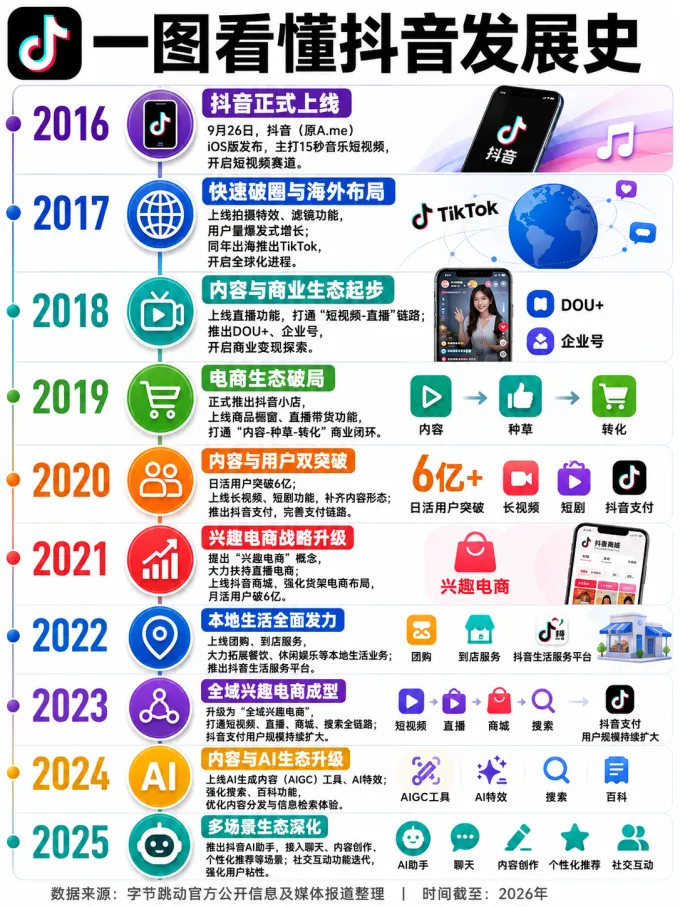
Image Source: Weibo
03 Traffic Secrets in a Saturated Era: The Truth Behind 100 Million New Users
From 2025–2026, as China's internet entered a saturated phase with stagnant growth among top-tier and young users, major platforms faced traffic anxiety. Yet Douyin added 100 million new users by tapping three overlooked blue ocean segments:
First, the massive senior demographic. Douyin's senior MAU exceeds 200 million, with users aged 51+ averaging over 4 hours of daily usage. Unlike fickle young users, seniors demonstrate extreme loyalty and stability, representing the internet's most reliable growth segment.
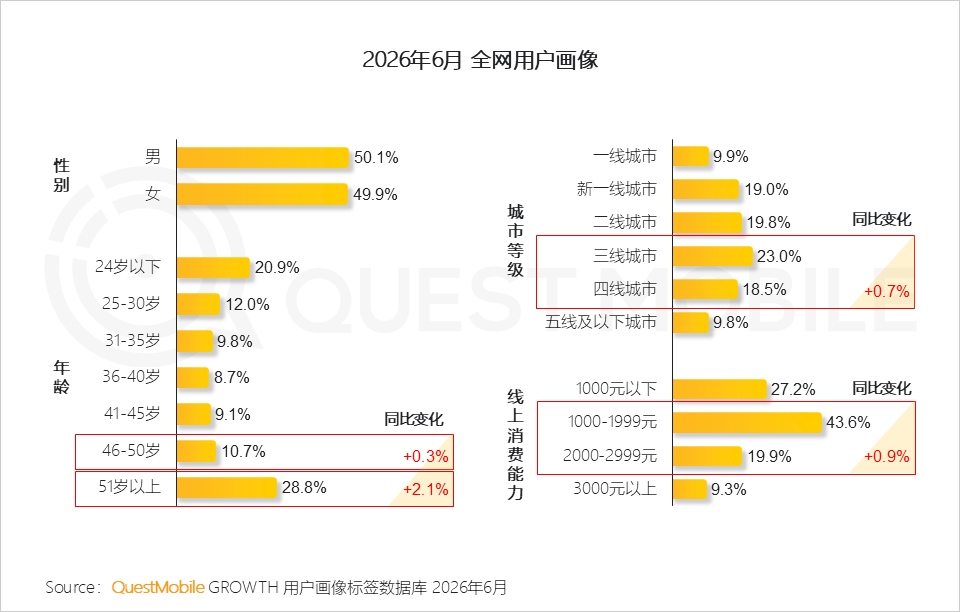
Image Source: QuestMobile
Second, the vast lower-tier markets. Users in third-tier and below cities account for half of Douyin's traffic, with lower-tier MAU surpassing 500 million. These late-adopting internet users, previously disconnected from digital ecosystems, fully entered the online world through short videos and live streaming, becoming Douyin's core user base.
Third, ByteDance's exclusive AI-driven growth. Zero-basis, low-digital-literacy users discovered the internet through Doubao AI and naturally migrated to Douyin. This closed loop of AI acquisition, content retention, and ecosystem engagement created an irreplicable growth formula.
04 The Hard Logic of 1 Billion MAU: Money Can't Buy National Ecosystems
Internet industry axiom: Subsidies can buy 100 million users, but never 1 billion MAU. Short-term incentives only yield fake traffic; only continuously evolving ecosystem value retains 1 billion national users.
Today's Douyin is no longer a mere entertainment tool but a comprehensive platform meeting universal needs. Users open Douyin to watch short dramas, discover music and restaurants, shop online, order food, and access local services—covering all aspects of daily life. Vertical products like Soda Music (Qishui Music) and Red Fruit Short Drama (Hongguo Short Dramas) synergize with the main app to serve diverse user groups comprehensively.
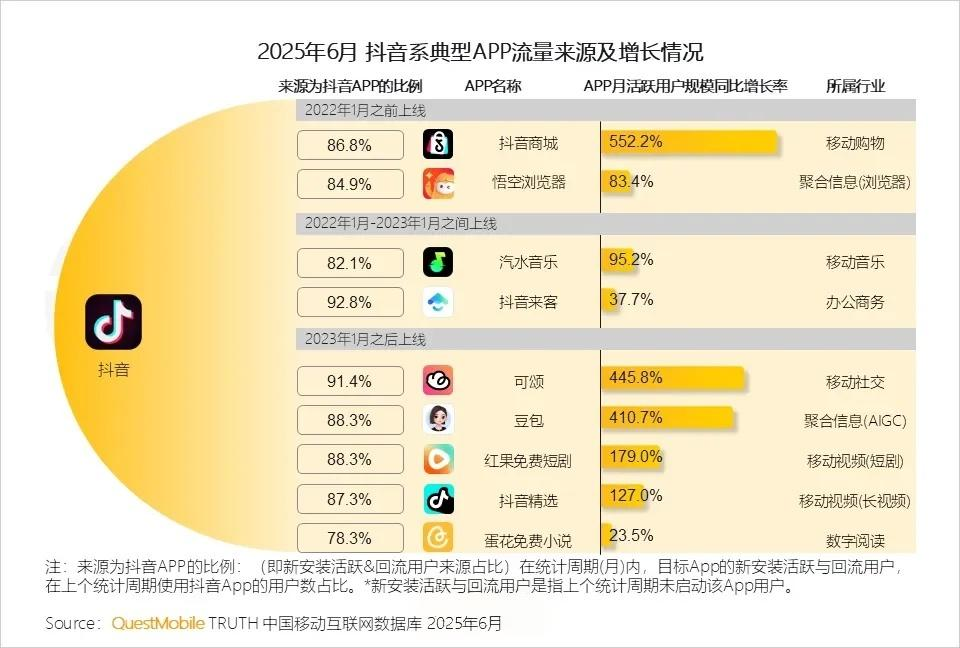
Image Source: QuestMobile
Short dramas represent Douyin's key to universal user activation. Unlike ephemeral short videos, short dramas feature strong binge-worthiness with Rhythm (pacing) suited for fragmented time, appealing to all ages and regions. They transform user behavior from 'casual scrolling' to 'daily anticipation,' locking in retention and time spent while building an irreplaceable content ecosystem barrier. This positions Douyin as the internet's unique dual hub for content and consumption.

Image Source: Douyin Group Short Drama Creator Center
05 Traffic Boom but Tougher Business? Douyin Initiates Industry Reshuffle
After reaching 1 billion MAU, a paradox emerged: While platform traffic expanded, merchants struggled. Organic reach declined, live-stream dwell times dropped, and advertising ROI plummeted. The core issue wasn't shrinking traffic but Douyin's complete Refactoring (restructuring) of traffic allocation rules, ushering in an era of precision-driven market consolidation.
Before 2024, Douyin distributed traffic based on simple interest tags. Merchants could reliably acquire customers through aggressive spending, enabling rapid growth for white-label brands via mass product listings and monetary investments. However, 2025 saw algorithmic upgrades prioritizing social relationships and geographic proximity, shifting traffic allocation from 'money-first' to content quality, retention, and locality.
The era of wealthy brands dominating rankings ended, with low-quality white-label products exiting en masse. Brands focusing on content depth and reputation rose instead. Cosmetics brand Diluowei exemplifies this shift: without aggressive spending or mass listings, it dominated rankings through focused product development, emotionally resonant content, and iterative innovation, proving that in a saturated market, platforms reward content excellence and user retention over capital.
06 The Super App Truth: No Ceilings, Only Resistance to Evolution
Over two decades of China's internet, only WeChat and Douyin have sustained 1 billion MAU. Countless platforms stalled not due to industry limits but corporate complacency and refusal to evolve. The birth of super national apps requires: seizing era opportunities while daring to innovate, relying on systemic momentum rather than luck, upgrading from single tools to comprehensive ecosystems, building barriers through organic user dependency, and achieving universal penetration across all age groups.
07 New Era Begins: Douyin's Golden Age Just Started
Zhang Yiming predicted early on: Depleting old dividends isn't frightening; clinging to inventory (existing markets) and abandoning innovation is. While demographic dividends fade, content, scenarios, AI, and consumption dividends remain inexhaustible. Growth ceilings are excuses for the weak.

Image Source: China Renaissance Capital
After 16 years, Jack Ma's lifelong dream of a 1 billion-user national platform finally materialized through Douyin. The 1.029 billion MAU milestone isn't mere numerical celebration but an ultimate industry transition: In a saturated era, what gets eliminated isn't traffic but players clinging to outdated models. Breaching 1 billion MAU isn't an endpoint but a new beginning—Douyin's golden age of content e-commerce and omnichannel local services has only just commenced.
Interactive Topic: After Douyin surpasses 1 billion MAU, what represents its next true growth frontier—short dramas, AI, or local services? Share your thoughts in the comments.
Disclaimer: This article provides financial commentary on major companies and doesn't constitute investment advice. All corporate data and regulatory events cited come from public information and are for reference only; official sources prevail. Images sourced from the internet; contact us for copyright removal if needed.
-
![]()
Samsung Z Fold 8 Ultra Review: A $2,100 Foldable Flagship—What Justifies the Price?
-
![]()
Rocket Lab: Neutron Launch May Be Postponed. How Can RKLB Compete with SpaceX?
-
![]()
The Wealthiest Individual Critiques E-commerce: 'Championing the People' or 'Falling Prey to Business Theft?'
-
![]()
The 10-Trillion-Parameter Behemoth is Still Elusive, but ByteDance is Leading the Charge with a New Top-Tier Department
-
Who Will Be the Talent for the Commercial Space Industry?
-
![]()
800V High-Voltage Platform Sees Rapid Growth, with Eight of Top 10 SiC Manufacturers Being Domestic
-
![]()
Zhong Shanshan and Wu Xiaobo Don’t Truly ‘Dislike’ E-commerce
-
The RTX 3060 Makes a Comeback Amid a Mix of Old and New Hardware, Making 2026 the Worst Year for the PC Industry