17 Strategies, 1.8 Billion Parcels, 12.5 Billion Yuan: Huizhou, Guangdong, Paves the Way for Autonomous Vehicle and Drone Delivery
 08/12 2026
 437
437
Introduction
On July 23, 2026, the Huizhou Municipal Government Office released a document titled Several Strategies to Foster High-Quality Growth in Huizhou's Postal and Express Delivery Sector (see 'Read the Original' at the end for specifics).
The 17 strategies are all aligned with a singular goal: making express delivery quicker, extending its reach further, and reducing costs.
By 2028, Huizhou aims to reach a delivery volume of 1.8 billion parcels and generate 12.5 billion yuan in business revenue;
By 2035, these targets are projected to double, reaching 4.2 billion parcels and 27.6 billion yuan.
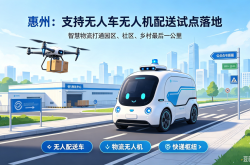
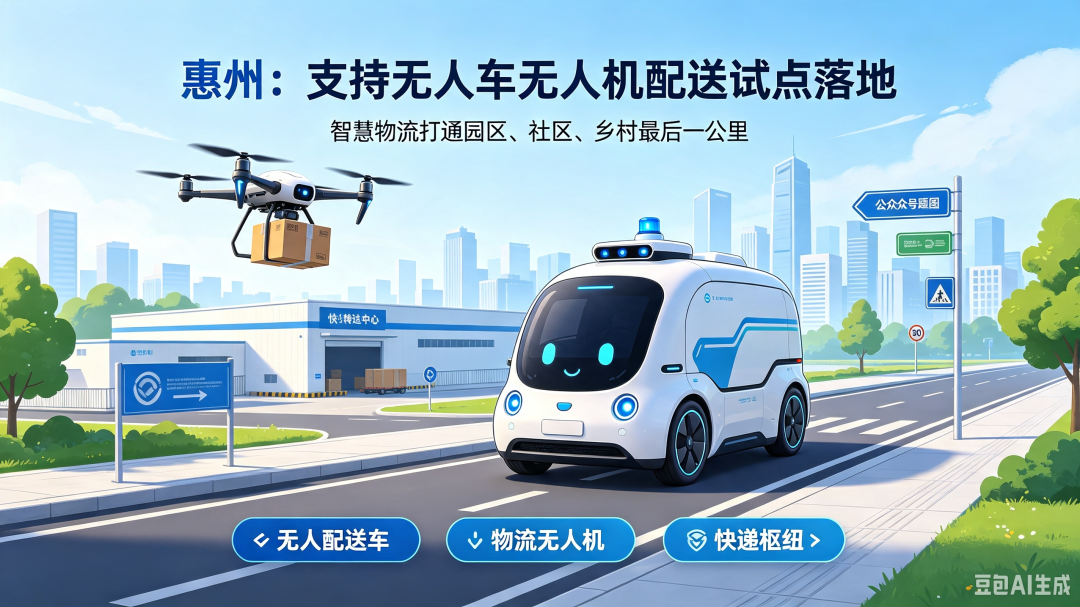
However, what stands out more than these figures is a subtle statement in the document: 'Encourage pilot deployments of autonomous delivery vehicles and drones in well-established industrial parks, residential areas, and rural settings.'
Driverless Vehicle is Coming (WeChat Official Account: Driverless Vehicle is Coming) posits that Huizhou is making a significant move: leveraging autonomous delivery to redefine the efficiency limits of an 'express delivery city'.
(For more information, please refer to: Guangdong Huizhou's Robots at Work: Thousands of Production Lines Active, Autonomous Vehicles Delivering Goods—This Coastal City is Quietly Staging a Comeback)
I. One Document, Three Sets of Figures, One City's 'Express Delivery Dreams'
How rapid is the growth of Huizhou's express delivery industry?
In 2025, the city's postal sector handled a cumulative total of 1.12 billion parcels, with express delivery volume reaching 1.099 billion, marking a year-on-year increase of 27.76%.
Among the top 50 cities in China for express delivery volume, Huizhou ranked 49th.
Yet, Huizhou's aspirations extend well beyond this ranking. The targets of 1.8 billion parcels by 2028 and 4.2 billion by 2035 signify a doubling and then quadrupling of current volumes.
How will this be achieved?
The Strategies outline a roadmap: 17 initiatives spanning six key areas: land use assurances, headquarters economy, last-mile networks, rural delivery, industrial integration, and technological advancements.
The message conveyed by this document is unmistakable: Huizhou is not content with being a mere 'transit point'. It aims to emerge as a pivotal express delivery hub in the eastern Guangdong-Hong Kong-Macao Greater Bay Area.
And autonomous delivery is the 'last-mile' key to unlocking this hub's potential.
II. ZTO's Arrival: One Transfer Hub Revolutionizes a City's Logistics
The first tangible outcome of policy implementation is already visible.
In June 2026, ZTO Express's Guangdong-Hong Kong-Macao Greater Bay Area Huizhou Transfer Hub officially commenced operations in Lilin Town, Zhongkai High-Tech Zone.
This transfer hub, which required an 880 million yuan investment and spans 133 acres, went from groundbreaking to operational in under a year and a half.
Once fully operational, it processes an average of 6 million parcels daily, with peak volumes reaching 7-8 million.
Annual revenue is anticipated to surpass 2 billion yuan at full capacity. The '4,000 parcels per minute' processing rate is redefining logistics efficiency in Huizhou and the eastern Greater Bay Area.
The hub consolidates business from five cities—Shenzhen, Dongguan, Huizhou, Heyuan, and Shanwei—with parcels now distributed directly from Huizhou nationwide.
Previously, parcels from these five cities had to be routed through Dongguan for transfer; now, the route is 'streamlined', reducing national average delivery times by 5-8 hours.
For instance, parcels from Huizhou to the Chaoshan region, which previously required transfer in Dongguan, can now be delivered directly, achieving 'same-day dispatch, next-morning arrival'.
For manufacturing enterprises and e-commerce clients around Zhongkai High-Tech Zone, shipping previously necessitated transporting goods 30-50 kilometers to Dongguan or Shenzhen for transfer; now, the distance to Huizhou is no more than 20 kilometers, significantly slashing logistics costs.
The transfer hub itself is a paragon of intelligence, boasting 20 automated sorting lines with over 99% sorting accuracy, achieving near-complete automation in intermediate transmission and sorting.
III. Autonomous Delivery is Already a Reality in Huizhou
Although the policy is recent, autonomous delivery vehicles are not a new sight in Huizhou.
The S6 series autonomous delivery vehicle, independently developed by Desay SV's 'Chuanxing Zhiyuan' brand, has already established viable business models across various scenarios.
During the 2025 Huizhou Marathon, Chuanxing Zhiyuan autonomous delivery vehicles navigated bustling early-morning roads, precisely delivering boxes of mineral water to various supply points along the route.
In the litchi-producing area of Zhenlong, Huiyang, unmanned vehicles traverse rural roads, delivering fresh litchis directly to express delivery outlets.
Chuanxing Zhiyuan focuses on scenarios such as express delivery, urban distribution, industrial logistics, and agricultural trade distribution, leveraging Desay SV's technological prowess in automotive electronics to accelerate its development.
On May 28, 2026, an autonomous express delivery test vehicle, its yellow hazard lights blinking, drew crowds of onlookers as it traveled along the Xiaojinkou section of Huizhou Avenue. More systematic deployments are also in the pipeline.
On August 10, 2026, the Haijixing·Huizhou Urban Distribution Center, operated by Shenzhen Agricultural Products Group, officially opened its doors. It will deploy a smart logistics fleet of unmanned vehicles and launch a digital procurement and distribution system, constructing a smart logistics network featuring 'direct procurement from origins, centralized distribution, rapid region-wide delivery, and nationwide connectivity'.
Logistics costs are projected to decrease by 25%-30%.
IV. Why Huizhou? A Second-Tier City's Strategic Move in Autonomous Delivery
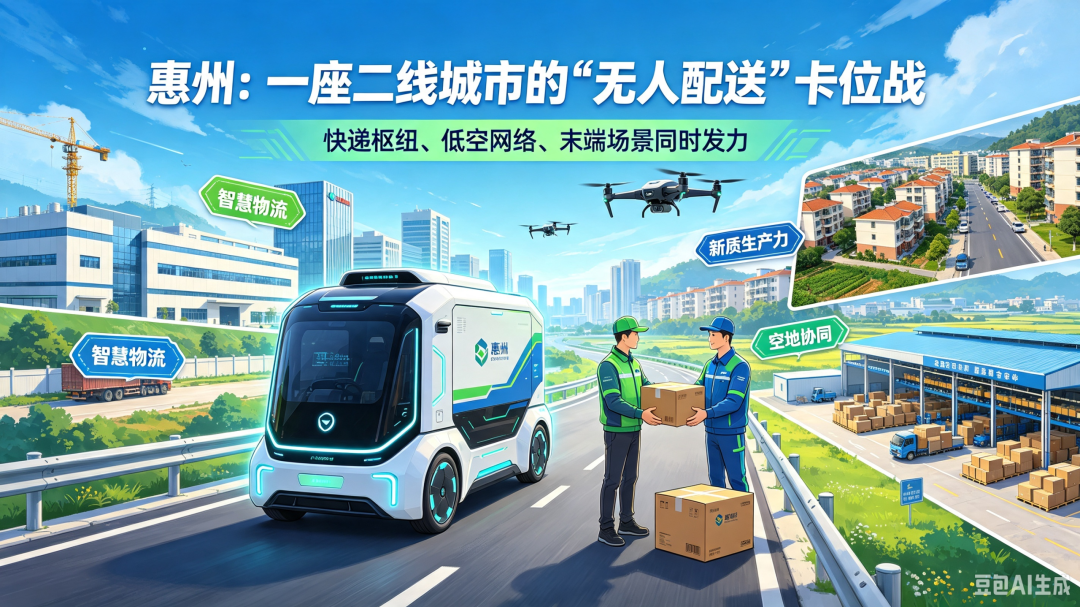
In Guangdong's pilot布局 (layout) for autonomous delivery, Guangzhou and Shenzhen are the focal cities; Huizhou may not be in the top tier, but it has its own strategic approach.
The first advantage lies in its industrial foundation.
Huizhou is constructing a '2+1' modern industrial cluster: electronics and information, petrochemical energy and new materials, and life and health. These sectors generate substantial logistics demand.
The second advantage is its policy arsenal.
In addition to the Strategies, Huizhou has unveiled its first batch of artificial intelligence scenario demand lists and application scenario innovation work lists. The '15th Five-Year Plan' explicitly calls for 'accelerating the application of autonomous driving, autonomous vehicles, and unmanned logistics in urban roads, highways, and other settings'.
The third advantage is the diversity of scenarios.
From urban industrial parks to rural roads, from marathon events to litchi orchards, from agricultural logistics parks to community last-mile delivery—the scenarios are highly varied and rich.
V. The 'Huizhou Model' for Autonomous Delivery: From Policy to Roadways
The Strategies came into effect on July 23, 2026, with a five-year validity period.
By 2028, Huizhou aims to establish a 'postal and express delivery service system with internal and external network connectivity, in-depth urban and rural service coverage, deep industrial integration, and efficient, coordinated governance';
By 2035, it seeks to achieve 'urban-rural coverage, global reach, smart and convenient services, and safe, green operations'.
Autonomous delivery vehicles and drones are pivotal in realizing these objectives.
Nationwide, autonomous delivery is transitioning from 'pilot' to 'standard'.
Huizhou's uniqueness lies in its combination of top-tier policy design, the presence of leading enterprises like ZTO, and local companies like Chuanxing Zhiyuan that have proven business models across diverse scenarios.
With policy, enterprises, and scenarios all aligned, what remains is execution.
In summary, Driverless Vehicle is Coming (WeChat Official Account: Driverless Vehicle is Coming) believes:
One document, one city, and an emerging autonomous delivery network.
When Huizhou's autonomous delivery vehicles transition from 'policy-supported' to a common sight on its streets, this second-tier city's express delivery ambitions will truly have been realized.
References: Media reports from Jin Ri Huizhou Wang, Huizhou Development and Reform Bureau official website, Huizhou Daily, etc.
-
![]()
Voice Input: Opening the AI Gateway?
-
![]()
This Year’s Chengdu Motor Show: A Subdued Affair
-
![]()
Can a Small Car Priced at 63,900 Yuan Help Leapmotor Achieve Its Goal of 60% Overseas Sales?
-
![]()
Behind Two Renewed Agreements: Joint Venture Automakers Choose Long-Term Presence in China's New Energy Sector
-
![]()
Will Zunjie’s Launch of Two L3-Ready MPVs Spell the End of the ‘Price Markup Era’ for Alphard and Its Peers?
-
![]()
17 Strategies, 1.8 Billion Parcels, 12.5 Billion Yuan: Huizhou, Guangdong, Paves the Way for Autonomous Vehicle and Drone Delivery
-
![]()
Manus to Regain Independence, Former Shareholders Including Tencent to Repurchase Shares from Meta for $2 Billion
-
![]()
Starting at 99,900 yuan, the Updated Seal 06 Hits the Market. How Should Family Buyers Decide?