Lenovo is Back in the Spotlight, This Time with Its 'AI for All' Story
 08/18 2026
 386
386
By Dou Wenxue
Edited by Ziye
"AI may have local bubbles, but its widespread adoption has just begun."
On the afternoon of August 13, Yang Yuanqing, Chairman and CEO of Lenovo Group, responded to market doubts about the sustainability of AI demand at the first-quarter FY 2026/27 earnings call with this assessment.
On the same afternoon, Lenovo Group delivered a solid financial report, showcasing strong performance from fundamentals to future prospects.
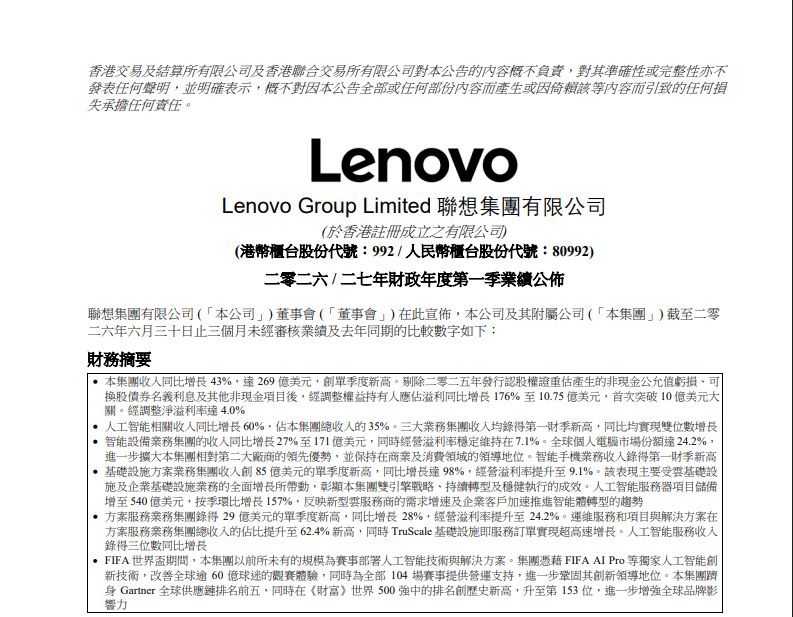
Source: Lenovo Group's Q1 FY 2026/27 Financial Report
In the second quarter of this year, Lenovo achieved revenue of $26.943 billion (approximately RMB 183.4 billion), up 43% year-on-year. All three business groups recorded double-digit growth, and the company's goal of exceeding $100 billion in revenue within two years is expected to be achieved ahead of schedule.
Notably, the performance of AI-related businesses confirmed that AI's widespread adoption has benefited Lenovo.
During the reporting period, Lenovo's AI-related revenue increased by 60% year-on-year. The infrastructure business, which had been consistently losing money, turned a profit. AI server order backlogs surged, nearly securing revenue for the coming period.
Despite reporting a net loss attributable to shareholders of $609 million, after excluding two non-cash items, adjusted net profit increased by 176% year-on-year to $1.075 billion, surpassing $1 billion for the first time. The adjusted net profit margin rose to 4.0%, and the gross profit margin reached 16.5%, up 1.8 percentage points year-on-year.
The capital markets reacted enthusiastically. After the financial report's release, Lenovo's stock price soared, closing up over 20% at HK$34.90 per share.
Since the beginning of the year, Lenovo Group has been undergoing revaluation by the capital markets. Its stock price has surged nearly 300%, with a market value exceeding HK$430 billion, more than tripling from its early-year valuation of just over HK$100 billion.
In fact, over the past five years, Lenovo's market value has hovered between HK$100-120 billion. Its price-to-earnings ratio lingered at 8-10 times, far below the global tech industry average of 35 times. With the AI strategy in place, Lenovo has finally proven itself, achieving a "comeback."
Evidently, the market no longer views Lenovo through the lens of a traditional PC manufacturer. The financial report demonstrates that Lenovo has found its place in the AI era.
However, Lenovo's future is not without challenges.
Overall, Lenovo's role in the AI computing power industry chain remains focused on integration and delivery, with a business model relying on economies of scale to reduce costs. Its debt-to-asset ratio of approximately 88% and a current ratio below 1 increase its liquidity risks.
The market may need to view Lenovo's future rationally.
For a long time, Lenovo has been perceived as a PC hardware company.
This perception is not unfounded. Until the second quarter of this year, over 60% of Lenovo's revenue still came from its Intelligent Devices Group (IDG), which includes PCs, tablets, and smartphones. With the global PC industry entering a stable growth phase and storage chip costs rising, the market's imagination for such businesses has diminished.
Its previous stock price reflected market sentiment, with shares lingering between HK$8-9 for an extended period.
Lenovo's potential truly came to light starting in April this year.
At that time, the company completed its acquisition of Infinidat, a global provider of high-end enterprise storage solutions. Its stock price continued to rise, and by May 22, when Lenovo released its Q4 FY 2025/26 report, it showcased the growth potential of its non-PC businesses, particularly AI infrastructure (ISG) such as AI servers, storage devices, and liquid cooling solutions, which turned a profit during the period, becoming one of the report's highlights.
The company's stock price rose from around HK$11 to HK$26 by mid-July.
While some market voices suggested caution regarding Lenovo's future potential, this financial report reaffirmed that Lenovo is genuinely earning money in the AI sector.
In this quarter, Lenovo achieved revenue of $26.94 billion, up 43% year-on-year, setting a new single-quarter record. Adjusted net profit attributable to shareholders reached $1.075 billion, up 176% year-on-year.
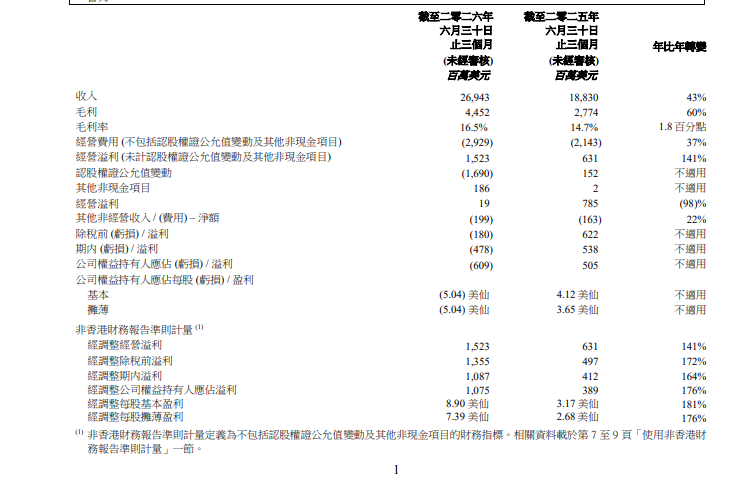
Lenovo's key performance metrics, Source: Lenovo's Q1 FY 2026/27 Financial Report
Within its revenue structure, Lenovo specifically disclosed that AI-related revenue accounted for 35% of total group revenue, increasing by 60% year-on-year to approximately $9.3 billion. This includes PCs and smartphones with NPUs, AI servers, and AI services, corresponding to the company's three main business segments, indicating effective progress in its AI transformation.
Lenovo's overall revenue and net profit performance were driven by its three main businesses.
Lenovo's largest business, the Intelligent Devices Group (IDG), achieved revenue of $17.11 billion this quarter, up 27% year-on-year. Operating profit reached $1.21 billion, with a profit margin of 7.1%, maintaining a stable foundation.
The smallest segment, the Solutions and Services Group (SSG), primarily provides IT operations, project solutions, and services to enterprise clients. Although it generated only $2.88 billion in revenue this quarter, its operating profit reached $700 million, with a profit margin as high as 24.2%.
The fastest improvement overall was seen in the Infrastructure Solutions Group (ISG), which just turned a profit last quarter.
This business generated higher revenue and profit this quarter, with revenue increasing from $5.6 billion last quarter to $8.5 billion this quarter. Operating profit rose from $200 million to $780 million, with the profit margin increasing from 3.6% to 9.1%.
ISG's Exceed expectations growth (better-than-expected growth) is tied to enterprise clients' ongoing demand for AI computing power.
According to Lenovo's report, this growth was primarily driven by nearly doubling revenue year-on-year in both cloud service providers and enterprise and SME infrastructure businesses, with gross profits surging by 1004% and 402% year-on-year, respectively.
Additionally, Lenovo's AI server order backlog reached $54 billion, up 157% quarter-on-quarter, suggesting that ISG's growth may persist for an extended period.
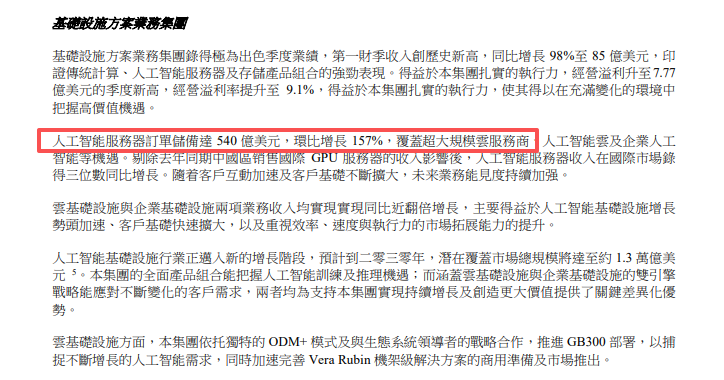
Source: Lenovo's Q1 FY 2026/27 Financial Report
In this financial report, Lenovo's AI-related revenue, ISG business performance, and AI server order backlog all demonstrate that, despite entering the market later, the company has transformed its "All In AI" narrative into tangible results.
Two contrasting data points in this report have sparked widespread discussion.
The company's revenue increased by 43%, and adjusted net profit reached $1.075 billion. However, before adjustments, the company reported a net loss of $609 million, compared to a profit of $505 million year-on-year.
Reported operating profit plummeted from $785 million to $19 million, a 98% decline. Yet, adjusted operating profit reached $1.523 billion, up 141% year-on-year.
On one hand, the company's overall operational performance is improving; on the other, it reported a net loss and a sharp decline in operating profit, creating a typical accounting paradox.
The root cause of this situation lies not in the business fundamentals but in two non-cash items.
The largest item was the $1.69 billion fair value revaluation loss triggered by the surge in Lenovo's stock price this quarter due to warrants issued in January 2025. The second item was $30 million in nominal interest on convertible bonds.
The nearly $1.7 billion gap between Lenovo's adjusted net profit and net loss almost entirely stems from the first non-cash item.
What caused this?
Specifically, Lenovo issued 1.15 billion warrants in January last year at HK$1.43 each, with an initial exercise price of HK$12.31 per share, later adjusted to HK$11.51.
Lenovo's disclosed plan shows that Yang Yuanqing, as the initial warrant subscriber, agreed to purchase 220 million warrants, with an option to purchase up to an additional 330 million if management participation was insufficient. Warrants were also allocated to management investment vehicle Wisdom Summit and external investors.

Lenovo's issued warrants, in short, grant holders the right to purchase Lenovo shares at a predetermined price within a specified future timeframe. Compared to issuing new shares or high-yield bonds, warrants allow for rapid, low-cost capital acquisition to expand businesses and supplement operational cash flow while optimizing the capital structure.
Subsequently, the faster Lenovo's stock price rises, the more valuable this right becomes.
However, under Hong Kong Financial Reporting Standards, the company must recognize this "increased value right" as a fair value loss on derivative financial liabilities, amounting to $1.69 billion this quarter. Combined with the $30 million nominal interest on convertible bonds, this pushed the company from profit to loss.
These warrants expire on January 8, 2028, and Lenovo's management expects non-cash fluctuations from such warrants to persist until the end of FY 2027/28.
From an external perspective, Lenovo's stock price may continue to rise.
Global tech giants are accelerating investments in AI infrastructure. Hyperscale cloud providers like Amazon, Microsoft, Google, and Meta have raised their capital expenditure guidance, with sustained demand for AI servers, data centers, and liquid cooling solutions.
Notably, companies associated with NVIDIA have performed well in terms of both earnings and stock price.

Lenovo and NVIDIA share a close relationship, both publicly and commercially, with numerous joint projects in the pipeline.
For example, in January, Yang Yuanqing and NVIDIA CEO Jensen Huang jointly announced the Gigawatt-scale AI Infrastructure Deployment Plan—Lenovo AI Cloud Superfactory. Yang also predicted that business collaboration with NVIDIA would quadruple in the next 3-4 years. In March, Lenovo became the global launch partner for NVIDIA's Vera Rubin NVL72.
These developments suggest that the gap between Lenovo's reported net profit and adjusted net profit under accounting standards may persist for the next two years, increasing the complexity of interpreting Lenovo's financial reports and its valuation difficulty.
Given the current circumstances, Lenovo may maintain its current advantages for some time.
Its relationship with NVIDIA dates back to the PC era, when Lenovo, as a major PC shipper, served as a carrier and distribution channel for NVIDIA GPUs. NVIDIA's official website lists Cisco, Dell, HP, and Lenovo as initial partners for several new GPUs.
In their superfactory collaboration, NVIDIA provides chips and accelerated computing platforms, while Lenovo handles design, manufacturing, integration, global deployment, and liquid cooling.
While the market may not view Lenovo solely as an NVIDIA contract manufacturer, Jensen Huang explicitly stated when explaining their partnership that Lenovo "is a company capable of mass-integrating autonomous design, manufacturing, and global services."
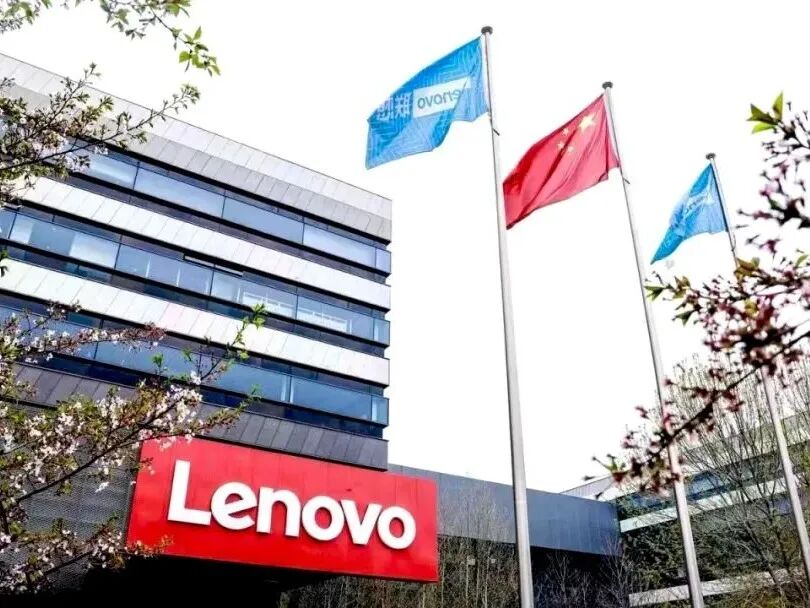
Source: Lenovo Group's official website
In reality, Lenovo's role in the industry chain involves integrating NVIDIA's chips into servers, adding storage, cooling, cabinets, and software debugging to create a deliverable system for cloud service providers and enterprise clients—essentially acting as an "assembler," with GPU technology remaining outside Lenovo's control.
In the AI computing power industry chain, GPUs represent the most profitable segment, with integration and delivery margins far lower than chip sales. While Lenovo's ISG business operating profit margin has seen a significant improvement, the current 9.1% margin reflects a relatively high level in today's supply-constrained market.
Meanwhile, Lenovo's gross profit margin increased by only 10 basis points quarter-on-quarter, meaning its net profit growth this quarter was entirely driven by revenue scale diluting costs, applicable to both intelligent devices and infrastructure services.
If competition in the AI computing power industry chain intensifies, server profit margins may face further pressure.
More concerning is the potential illusion of prosperity in the current AI computing power market.
Currently, AI computing power remains in a classic seller's market, with buyers placing premature or excessive orders due to fear of supply shortages. While Lenovo's surge in AI server order backlogs is impressive, distinguishing between genuine end-user demand and preemptive orders driven by "fear of missing out" is challenging.
This quarter's financial report shows that Lenovo has chosen to double down on this trend. The company's inventory surged again, increasing by $4 billion quarter-on-quarter and $7 billion year-on-year.
This "hoarding" strategy ensures delivery and secures orders but also means that once computing power supply shifts from scarcity to abundance, accumulated inventory and high holding costs will quickly translate into operational pressure.
Additionally, Lenovo's financial structure is not particularly secure during market transitions.
As of late June 2026, Lenovo had total assets of $70.1 billion and total liabilities of $61.9 billion, with a debt-to-asset ratio of approximately 88% and a current ratio of about 0.98.
This indicates that the company's current assets are insufficient to cover current liabilities due within one year. Significant upfront investments in operating expenses and inventory this quarter further increased capital occupation.
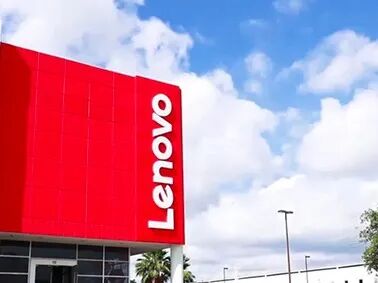
Image source: Lenovo Group's official website
During the upcycle, high leverage amplifies gains, but once AI capital expenditures (Capex) recede, the combination of high inventory and high debt will place the greatest pressure on midstream hardware manufacturers.
It can be said that Lenovo has indeed benefited from the AI boom, but in terms of technological irreplaceability, it has clearly not yet established barriers.
As the computing power market shifts from supply shortage to supply-demand balance, the financial structure characterized by high debt and high inventory will become a variable hanging over its head. For Lenovo, the wave of AI democratization has indeed just begun, but challenges and tests will follow.
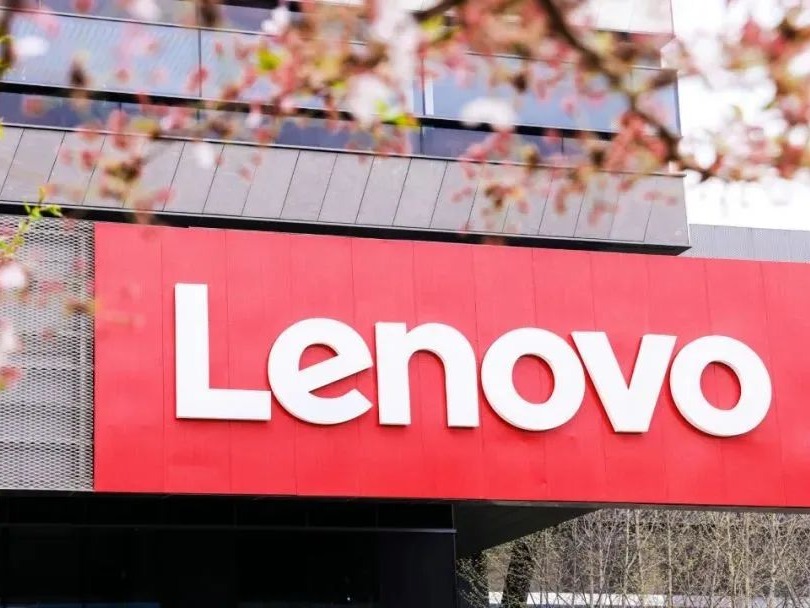
(The header image of this article is sourced from Lenovo's official website.)
-
![]()
FAW, in Its Third Year with a New Chairman, Anticipates Returns on Multi-Billion Yuan Investments
-
![]()
Zhuque-3 Rocket Successfully Recovered: Why This Achievement Bears More Resemblance to SpaceX Than the Long March 10B Mission
-
![]()
Li Shufu Resigns as Chairman of the Board, 'One Geely' Is No Longer Just a Slogan
-
![]()
Challenges in the IPO Journey: What's Holding Honor Back?
-
![]()
XR Business Rockets with 15-Fold Growth! Conant Optics Unveils 2026 Interim Report
-
![]()
Net profit surged by 186%! Accelink Technologies is cashing in on the AI computing power dividend
-
![]()
Trillion-Yuan Chip Project of Domestic Computing Power Behemoth Collapses!
-
![]()
Surging Over 536% Upon Listing! A New Laser Stock Yields Over 500,000 Yuan Per Lot