Key Player Departs MiniMax Following M3 Launch
 08/19 2026
 441
441

Public records indicate that Adao (Miao Yuhang), who headed the Agent Engineering Department at MiniMax, has left the company, as reflected on Feishu. His next professional move remains undisclosed.
However, his profile on X has yet to reflect this change.
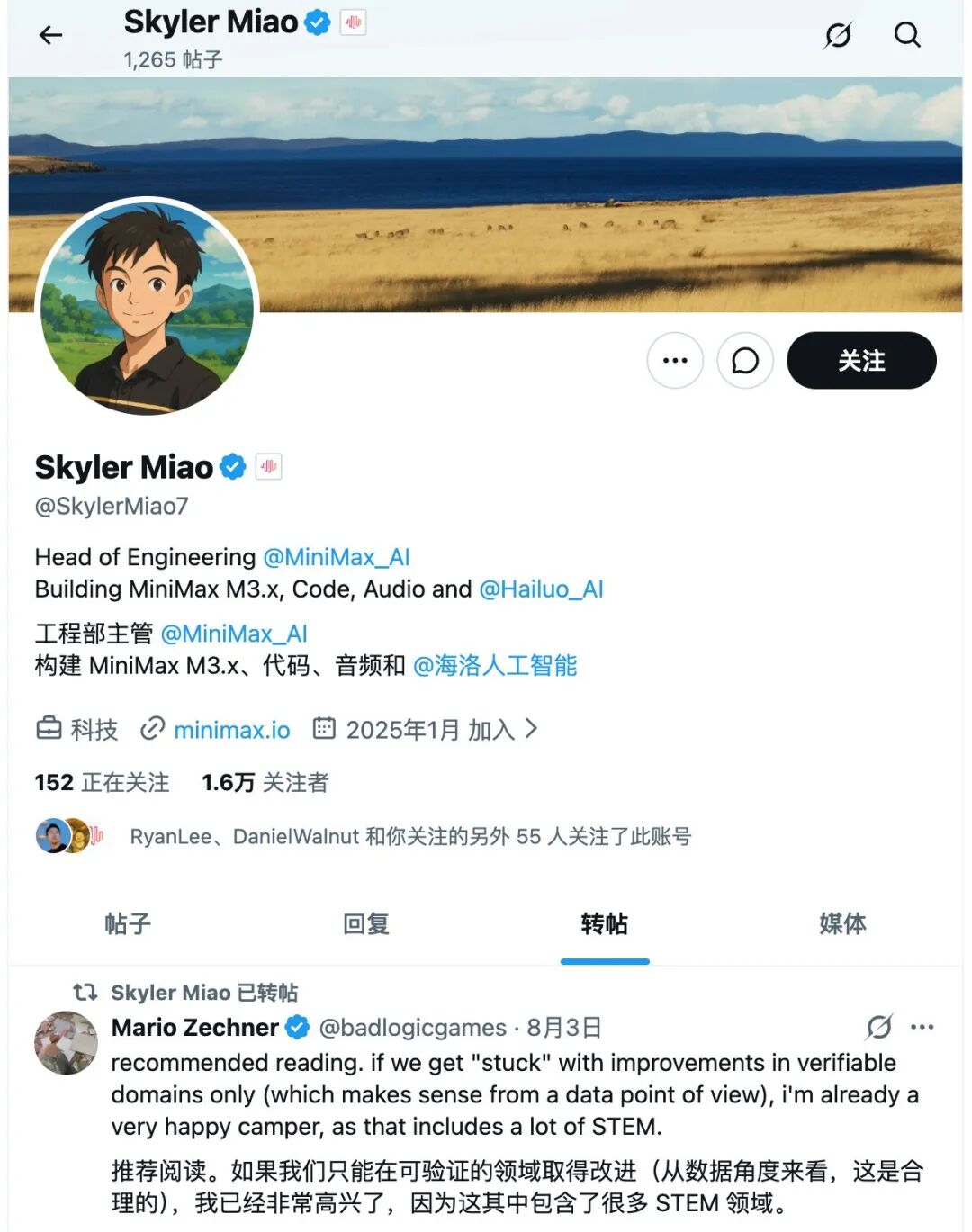
On X, Adao (Skyler Miao) describes himself as the Head of Engineering at MiniMax, overseeing M2.x, Agent, Audio, and Hailuo AI. His most recent post, shared on August 3, delves into AI-related topics.
Previous interactions also chronicle his technical outreach efforts surrounding the M3 launch: previewing MiniMax Sparse Attention, addressing developers' inquiries about sparse attention, confirming the open-sourcing of implementation code, and noting the team's extensive efforts during the M3 rollout.
Prior to joining MiniMax in 2023, Adao held positions at Baidu, Beike, and ByteDance, contributing to model, Agent, and Hailuo AI product development. At MiniMax, he was instrumental in technical dissemination and external communications.
MiniMax's Agent business is evolving from a rapid product development phase to a broader expansion encompassing models, products, infrastructure, and commercialization.
In the past, a skilled engineer could steer the direction, build the product, and elucidate the technology. Now, MiniMax is cultivating systematic organizational capabilities.

MiniMax's Technical Roadmap Communicator
Adao's public persona at MiniMax closely mirrored the company's model roadmap.
Leading up to the M3 release, he showcased the model's contextual, coding, and Agent capabilities. Post-launch, he engaged in user discussions about billing and usage rights.
The M3 launch saw MiniMax transition to a Token-based billing system without adequate prior notice, sparking user backlash. Adao acknowledged the community's dissatisfaction, leading to an apology and compensation plan from MiniMax.
Technical leaders at large model firms now serve as more than just R&D representatives; they engage with developers, users, and the community, explaining product design rationales, capabilities, and the impact of technical changes on user finances.
Adao's X posts reflect a similar approach.
He didn't merely share company announcements but actively participated in M3, MSA, and open-source discussions, answering developers' questions on model architecture, long contexts, and sparse attention. This made him a public face for MiniMax's technical vision.
Adao also expressed bold, personal opinions on the Agent business within the AI sphere.
For instance, in an April public conversation, he expressed a somewhat pessimistic view: general-purpose Agent applications will eventually be absorbed by models, and both Harness and the Agent application layer have a limited lifespan.
Tasks currently requiring Prompt, Skill, Memory, and multi-Agent collaboration may be directly handled by future models. The stronger the model, the less need for external layers. A general-purpose Agent company that merely repackages model capabilities into workflows will struggle to maintain independence.
In an interview, Adao candidly stated that no Agent company currently boasts true barriers. Competitors can replicate industry know-how, vertical scenarios, and customer relationships. The key differentiators are talent, underlying infrastructure, and organizational execution.
His departure adds a new layer of significance to these remarks.
When Adao was involved in Agent 2.0, MiniMax's main challenge was integrating an Agent into workflows. Now, the company faces a more complex system.

Agent Business: From a Four-Person Experiment
MiniMax Agent 2.0 didn't start as a large-scale project.
In a prior conversation with the media outlet Difference, Adao revealed that Agent 2.0 originated from an internal "Agent intern" tool. It first gained traction within R&D, product, GPU Infra, HR, investment, and finance teams before evolving into a user-facing product.
Initially, the desktop version was developed by three students over a month, with the product manager bringing the team size to around four.
This small team tackled a specific challenge: enabling the Agent to transition from web to desktop, directly interacting with local files, browsers, and work environments. Through Expert mode, it combined professional knowledge, workflows, and tools to complete comprehensive tasks.
This was an early strength of MiniMax Agent.
The compact team allowed for rapid feedback between product, model, and engineering. Model enhancements quickly integrated into the Agent; product issues swiftly influenced model training. Internal employees used it first, and the team iterated based on real tasks, shortening the path from requirement research to product launch.
However, the small team model has its limitations.
It relies on a few individuals understanding the model, tools, user scenarios, and engineering systems. The challenge lies not in creating a demo but in transforming the insights of a few into a scalable, collaborative system.
In March, MiniMax unveiled M2.7, highlighting the model's ability to participate in its own iteration and handle complex R&D tasks via Agent Harness, Skills, Memory, and Agent Teams. Officially, M2.7 could manage some internal processes, from problem analysis and code modification to evaluation feedback.
In May, MiniMax introduced Agent Team, enabling multiple Agents to collaborate in parallel, each assuming distinct roles and tasks. The Agent was no longer just a chat window but a dynamic system managing task decomposition, role collaboration, state changes, and execution records.
The June release of M3 further integrated coding, Agent, million-context, and native multimodal capabilities into a single model, accompanied by MiniMax Code. Officially, MiniMax Code is co-trained with M3, optimized for long contexts and complex Agent tasks.
This roadmap has evolved from "creating a useful Agent" to "interlocking models, Agent operating environments, development tools, and user workflows."
Meanwhile, MiniMax continues to diversify its model offerings.
On July 31, the company launched H3, supporting multimodal understanding of text, images, video, and sound, generating up to 15-second, 2K resolution videos, and planning to open-source model weights.
For a large model company, this necessitates simultaneous R&D efforts across language models, video, voice, music, Agent, and open platforms.
In 2025, MiniMax's revenue surged by 158.9% year-on-year to $79 million, with over 70% from international markets. By the end of 2025, the company claimed to have served more than 200 countries and regions.
In July, the company placed 35.6 million new shares and issued HK$6.5 billion in zero-coupon convertible bonds to fund ongoing model R&D and product expansion.
MiniMax is committed to a long-term vision: progressing from full-modal models to Agents, and then to intelligent systems capable of contextual understanding, tool invocation, continuous operation, and self-improvement.
-
![]()
Can L1, the Shargeek AI Glasses That Once Stopped Production Voluntarily, Make a Resurgence? A Firsthand Account
-
![]()
Latest US Consumer Car Purchase Report: Seats and Driving Assistance Top Picks, Auto Parking Makes Debut on List
-
![]()
Chengdu Auto Show Preview: Xiaomi and AITO Take Diverse Approaches, Leaving NIO as the Lone BEV Purist
-
![]()
Is It Worth It for CATL to Acquire Zhongheng Electric for 4.1 Billion?
-
![]()
After 315 Exposed AI Data Manipulation, Someone Finally Unveiled the Inner Workings of the GEO Industry
-
![]()
Cows Vanish from the Grasslands, While Digital Tokens Soar with the Wind
-
Buffett Goes All-In with Billions, Duan Yongping Halves Positions: Who Misjudged Google?
-
![]()
Li Shufu’s Swansong Financial Report: Two Words Capture the Essence – Global Expansion