Cows Vanish from the Grasslands, While Digital Tokens Soar with the Wind
 08/19 2026
 565
565
This is a travelogue.
Here's how it all began: The North China Plain in midsummer is hardly a paradise for primates. Each day, I yearned to bask in the sun, only to be driven back indoors by the scorching heat into the cool embrace of air conditioning. Restless and irritable, I longed for a cooler destination. Then, for reasons unknown, a phrase echoed in my mind: 'One step west of Beijing, and you're in Ulanqab.'
Originally, my vision was simple: to witness the gentle sway of grass revealing cows and sheep, and to savor the cool breeze on the grasslands. While these dreams were realized, my Inner Mongolian adventure unfolded differently than expected. The grasslands were devoid of cows and sheep, and the wind brought not just coolness but also a tidal wave of digital tokens.
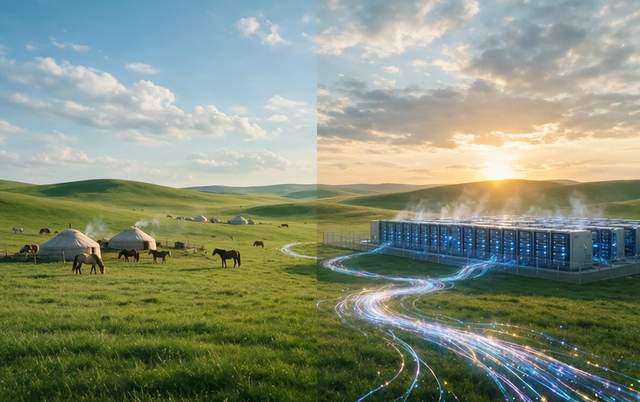
My journey to Ulanqab unveiled a unique narrative of regional development and AI opportunities. At its heart, this tale repeatedly poses a question: How much productivity can be extracted from a fixed expanse of grassland?
I sought to document my travel observations as a testament to the distinctive landscape of intelligent China.

We arrived in Ulanqab in the afternoon. Like all tourists, our first instinct was to seek out a barbecue restaurant, as if only then could we truly honor the stereotypical image of the grasslands in our minds.
At the restaurant, after ordering an array of beef and mutton dishes, we naturally thought to order some yogurt. No particular reason—it just seemed to fit the mold. But the owner stopped us. This elder brother told me there was no need for yogurt or milk here. The so-called grassland milk was all imported from the south, no different from what you could find in any supermarket elsewhere.
'If you don't believe me, just go to the grasslands. Can you spot a single cow?'
Sure enough, in the days that followed on our grassland journey, we saw no cattle or sheep in Ulanqab's grasslands. The only animals were horses for tourists to ride and watch performances on. I inquired how the owner knew so much. He revealed that he had been a dairy farmer before 2008.
'Times were tough back then,' he recalled. First, feed prices soared, followed by milk prices plummeting to rock bottom. Sometimes, it was better to dump the milk than sell it to the dairy stations. Later, the dairy stations stopped accepting milk from small-scale farmers like them, and the government encouraged dairy farmers to leave the grasslands. So, after trying his hand at two businesses, the owner opened a barbecue restaurant in Jining City. Now, his business is thriving.
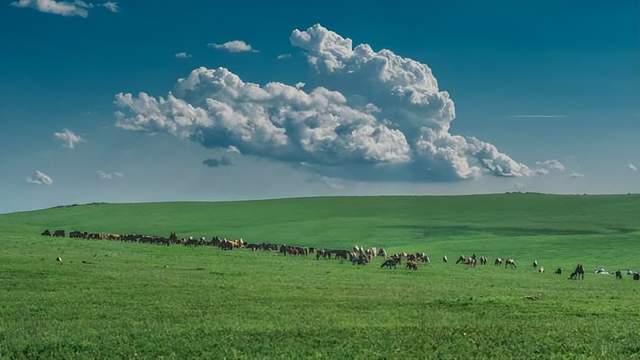
His story mirrors that of countless herders on Ulanqab's grasslands. Typically, each free-range cow requires 1–2 acres of grassland, roughly 600-1,200 square meters. In a good year, the net profit from a high-yielding cow is 3,000-5,000 yuan. While this is a decent income for dairy farmers, if we view the grasslands as a precious, non-renewable ecological resource, such production efficiency remains too low.
After 2010, traditional dairy farming in Inner Mongolia faced a widespread decline. On one hand, imported milk powder and liquid milk prices were extremely low, causing a significant impact on the domestic market. On the other hand, the prices of forage crops like alfalfa and oat grass climbed year after year, imposing significant cost pressures on dairy farmers. Fluctuating raw milk prices left farmers complaining bitterly.
Later, with the rise of giant dairy corporations, the intensification of dairy production became an irreversible trend. The pricing power and standards for raw milk were almost entirely controlled by dairy processing companies. These companies would scramble to hoard milk when supplies were tight and continuously push prices down when supplies were sufficient. Combined with repeatedly changing acquisition conditions and prioritizing their own dairy farms, the situation for small-scale dairy farmers became increasingly harsh.
According to relevant statistics, the population of Holstein cows in Inner Mongolia was 2.384 million in 2011, but by 2017, it had dropped to 1.281 million. Small and medium-sized farmers in Ulanqab were the first to bear the brunt, with many exiting the market during this period.
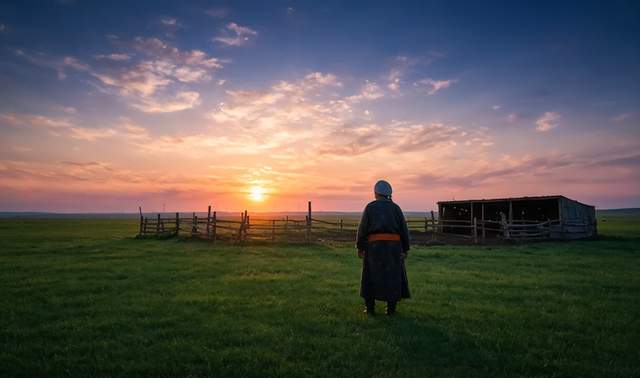
Another irreversible trend was Ulanqab's strict implementation of ecological and environmental protection policies. Natural grasslands fully enforced grazing bans, rest periods, and grass-livestock balance systems. Even if dairy farmers didn't want to leave the industry, they had to switch to confined feeding. Some dairy farms near grasslands and wetlands were even entirely relocated during this period.
Under the combined effects of these factors, traditional animal husbandry, once the core of Ulanqab's GDP, underwent a comprehensive contraction—or rather, was rapidly phased out. Guided by the government, Ulanqab's dairy industry shifted entirely toward areas like yogurt processing. The next question was: What should be done with the vacant grasslands?
Should they be used solely for tourism, or should the economic value of the grasslands be abandoned entirely for the sake of the ecological environment?
Caught between these two difficult choices, Ulanqab found a third path.

Grasslands are vast, but without varying scenery, they can feel a bit monotonous. I used to think this way before visiting grasslands. But Ulanqab's grasslands are different—no matter which direction you drive in, you'll see wind turbines dotting the landscape.
Wind power generation has, to some extent, become an iconic feature of Ulanqab's grasslands. For example, many people on Xiaohongshu share tips on the best angles to photograph the wind turbines. From high vantage points in scenic areas like Huanghuagou, you'll find the area surrounded by wind power matrices.
Wind, this invisible and intangible force, has replaced the grass that once fed cows and sheep, becoming the economic driver of these grasslands.
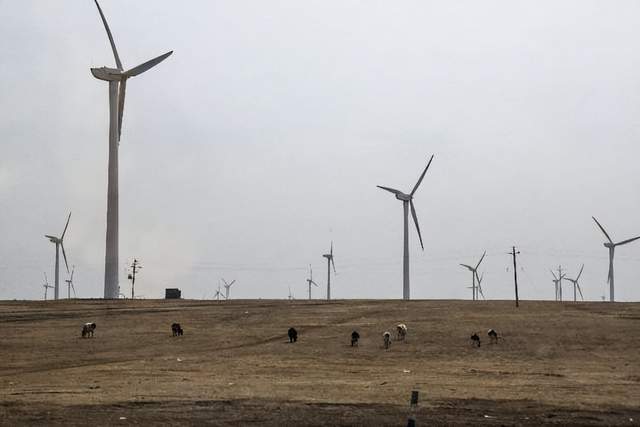
By the end of July 2026, the total installed capacity of new energy in Ulanqab City had surpassed 20.288 million kilowatts, with green power accounting for 67% of the city's total energy mix—ranking among the top prefecture-level cities nationwide. Meanwhile, four integrated projects combining power sources, grids, loads, and storage were approved simultaneously, with a total green power capacity of 1.6 million kilowatts. Once fully built, these projects will generate 4.5 billion kWh of electricity annually.
Against the backdrop of 'dual carbon' goals, Ulanqab seized the opportunity of green power, replacing cows and sheep on the grasslands with wind and solar power. The dairy industry's share of Ulanqab's GDP has significantly decreased and is no longer the pillar industry many associate with grassland regions.
But replacing milk with green power wasn't enough. On one hand, as infrastructure, energy brings less obvious economic benefits. On the other hand, grid-connected sales of green power have long faced numerous challenges. For Ulanqab, the optimal solution was to consume the electricity generated by the wind turbines locally and complete another industrial upgrade within the region. Building on the shift from milk to electricity, the next step was to convert electricity into something even more valuable—computing power.
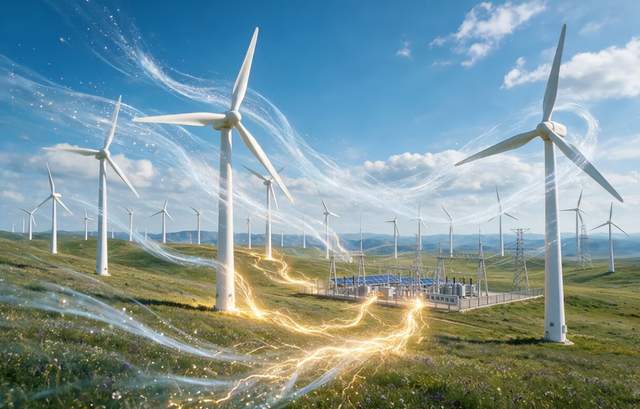
Ulanqab's CICC Data Zero-Carbon Computing Power Base went online in July 2025, becoming China's first computing power park directly supplied by an integrated wind-solar-storage system. In other words, this project can directly convert the green power it generates into computing power within the park. With 300,000 kilowatts of green power and 45,000 kilowatts of energy storage, the park can produce 848 million kWh of self-generated green power annually, with a renewable energy substitution rate of 38.74%. The data center's design PUE is below 1.2, earning it recognition as a 'Typical Case of Computing-Power-Electricity Synergy' by the China Academy of Information and Communications Technology.
Directly supplying local data centers with green power from the grasslands has become a new business model successfully implemented in Ulanqab. Coupled with the rising demand and prices for computing power driven by AI development, Ulanqab's industrial advantages have become increasingly evident.
The grasslands probably never dreamed they'd one day become part of the high-tech landscape.

To be honest, Ulanqab's old town reminds me of many northeastern counties—rustic, kind, but also quite dilapidated. However, a short walk south brings you to the new town, where everything feels entirely different.
Beyond the refreshed urban infrastructure like roads, buildings, and parks, what stands out to those in the tech media industry is the sheer number of tech companies here.
ByteDance, Baidu, Huawei—these companies stand side by side in Ulanqab. One might think they've arrived in Houchangcun, Beijing, or Bantian, Shenzhen. At the same time, the presence of numerous vocational and technical colleges is strongly felt. With banners like 'Master Ascend' and 'Master HarmonyOS,' they showcase the region's focus on talent development.
Relying on its advantageous location for computing-power-electricity synergy, Ulanqab has attracted a large number of high-tech companies to build data centers or settle into local computing power parks. Most of the skyscrapers in the city house these data centers.
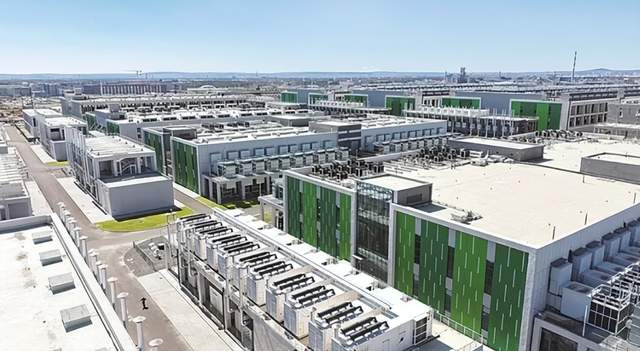
By the first half of 2026, Ulanqab had signed and landed 89 data center projects, with total signed investments exceeding 500 billion yuan. The operational computing power scale reached 165,000 P, with over 90% being intelligent computing power to meet AI demands.
This might not sound intuitive, so let's put it another way: Nearly 9% of all computing power in China comes from Ulanqab.
Paired with dual-circuit high-capacity optical cables directly connecting to Beijing, Ulanqab can even enable an 'R&D in Beijing, computing in Ulanqab' AI collaboration model, maximizing the economic value of AI computing power.
But does this mean the value of the grasslands in the AI era has been fully unlocked? Not yet. At this point, Ulanqab has realized that selling computing power and hosting data centers is still somewhat conservative. Why not use the computing power locally for model training and sell tokens directly?
In 2026, Ulanqab officially issued the 'Three-Year Action Plan for Building the 'Capital of Tokens' (2026–2028),' clearly designating the upgrade of the intelligent computing industry into a new direction for the token economy. The city aims to build a new development pattern synergizing three major industries: 'potatoes, ferroalloys, and tokens.'
'And so, the grasslands remain the same grasslands. Only the cows have disappeared, and the wind now blows up tokens.'

Ulanqab's story fully demonstrates how non-economically developed regions in China can seize intelligent opportunities to achieve industrial transformation.
At first, the grass could only yield milk with unstable prices and serious environmental pollution. Under the combined forces of market and policy, cows were replaced by wind turbines, and the industry's core shifted to green power. Then came relentless industrial upgrading—green power into AI computing power, and AI computing power into tokens. What will Ulanqab develop next? Will it sell intelligent agents directly?
No matter which way the AI wind blows next, it won't escape these grasslands.
Turning milk into tokens represents a highly complex, multi-industry collaborative transformation. The underlying principle is to phase out low-value-added, highly uncertain industries and shift everything toward high-value-added, digitalized, intelligent, and low-carbon industries.
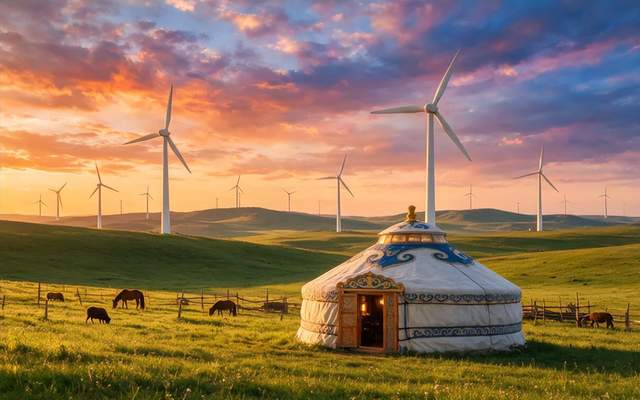
To achieve this goal, all industries in Ulanqab are transforming in synergy. The city's land, electricity, and policy resources are fully tilted toward computing power hubs and new energy bases. Within agriculture, priority is given to developing potatoes, oats, and other crops suited to the grassland ecology that are water-efficient and drought-resistant. Industrial development focuses on integrated power source-grid-load-storage systems, energy storage, and green hydrogen production, forming a new industrial cluster. The service sector emphasizes the integration of grassland cultural tourism with digitalization, locally utilizing the city's advantages in computing power and AI.
-
![]()
Non-Recurring Items-Adjusted Net Profit Soars by 72.59%! Dongtianwei Records 502 Million Yuan in Revenue
-
![]()
Securing 2 Billion Yuan in Financing and Supplying Inno-Light: This Optical Device Company Launches Its IPO!
-
![]()
Farewell to 'Card Stacking': 2026 Marks China's Computing Power Shift to 'Token Value Output' Era
-
![]()
Xiaomi Weathers Storage Price Surge, Q2 2026 Revenue Tops 100 Billion Yuan Again
-
![]()
Geely Bids Farewell to the 'Li Shufu Era': A Historic Power Transition in China's Auto Industry | Auto Circle
-
![]()
Baidu Prepares for Inclusion in Southbound Trading: Wall Street Reassesses the Value of 'AI ETF'
-
![]()
Revenue and Net Profit Dip, GPU Cloud Rockets 283%: Baidu’s AI Strategy Hits Payoff Period
-
![]()
How to Leverage AI Digital Humans for Overseas Live Streaming and Key Precautions