Can General AI Assistants Avoid Repeating the Internet's Mistakes?
 08/19 2026
 457
457

Edited by Sun Jing
AI assistants are now getting serious about monetization.
This summer, leading domestic AI assistants have begun openly discussing charging fees. Qianwen has initiated trials for membership services, while Doubao adopts a dual strategy: launching a professional version to charge users directly and targeting local life services, such as hotels, to earn commissions from completed transactions.
Over the past few years, the rationale behind big tech companies' development of AI assistants has remained consistent: prioritize scaling user numbers first, then figure out how to make money later.
While the industry is still debating who the "Chinese ChatGPT" is, user scale has emerged as almost the primary metric. It appears that whoever first becomes the AI gateway in the phones of hundreds of millions of people will naturally develop a profitable model.
However, GPUs will not indefinitely support big tech companies' long-term narratives. Behind the rapid growth in user scale lies significant computational costs. Under the pressure of enormous infrastructure expenses, even OpenAI, which was once cautious about advertising, has begun testing ads in its free and low-cost subscription plans.
If even the industry leader has bowed to these pressures, there is no reason for domestic big tech companies to continue burning money without a clear monetization strategy. Now that Doubao and Qianwen both boast monthly active users exceeding 100 million, the narrative of "first become a gateway, then think about making money" has entered its second phase: the gateway exists, so what comes next?
From the current landscape, AI assistants, hailed as the next-generation platform gateways, are still, at least in terms of monetization, partially following the old internet path.
01 The Most Valuable Aspect of AI Can't Be Sold Directly
Internet products targeting consumers generally have three business models.
The first is subscriptions, where users pay for enhanced functionality. The second is advertising, where businesses pay for exposure. The third is commissions, where platforms take a cut from merchants' orders after facilitating transactions.
In short, subscriptions sell capabilities, advertising sells placement, and commissions sell results. Each model has its strengths.
However, when these three models are applied to AI product monetization, they can lead platforms in vastly different directions.
Subscriptions demand the highest level of AI capabilities. Users pay monthly for stronger models, higher quotas, and the ability to complete complex tasks. But even ChatGPT, which holds advantages in both model capabilities and user mindshare, still has over 90% of consumers staying on the free tier. After facing this reality, OpenAI shifted its focus to aggressively targeting the B2B market.
The domestic market is no different. Doubao and Qianwen have successively launched tiered membership services, attempting to sell stronger models and higher quotas to heavy users. However, ordinary users will only be motivated to subscribe long-term when free quotas are insufficient and complex tasks are valuable enough.
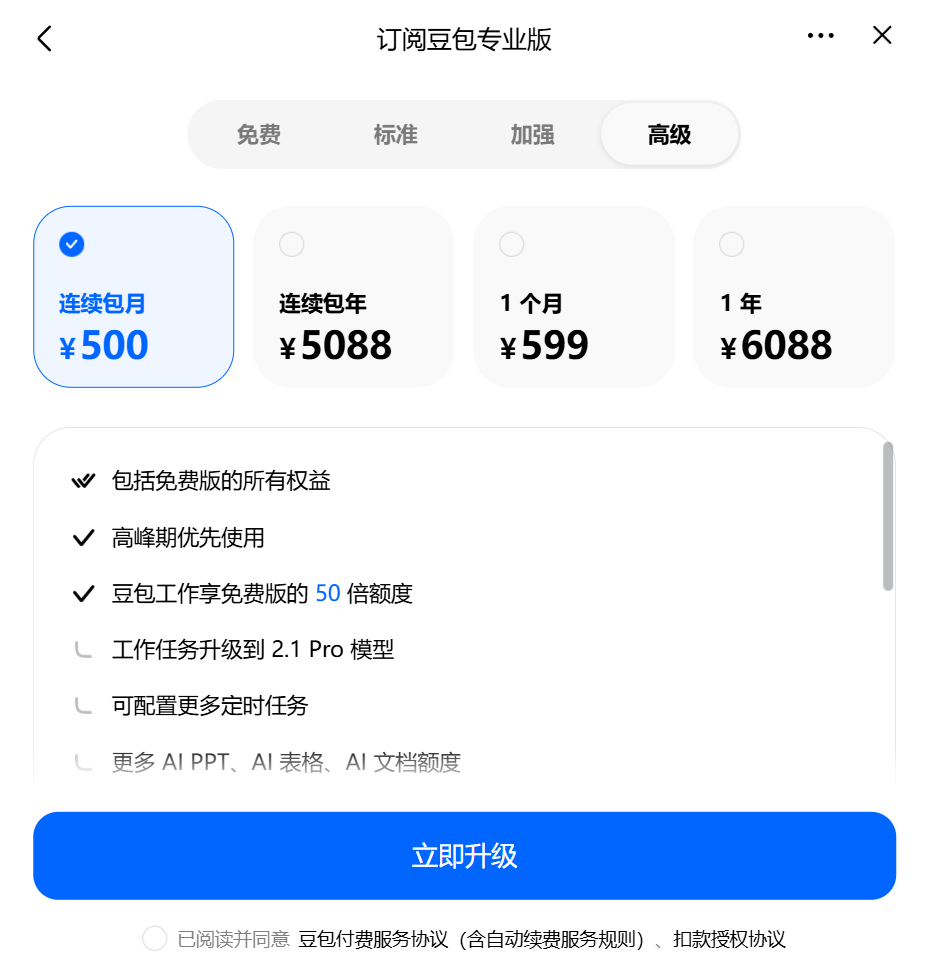
▲ The most expensive tier of Doubao Professional costs 500 RMB/month
At this stage, this approach has not been very effective. According to LatePost, Doubao, with 178 million daily active users, has only a few hundred thousand paying users.
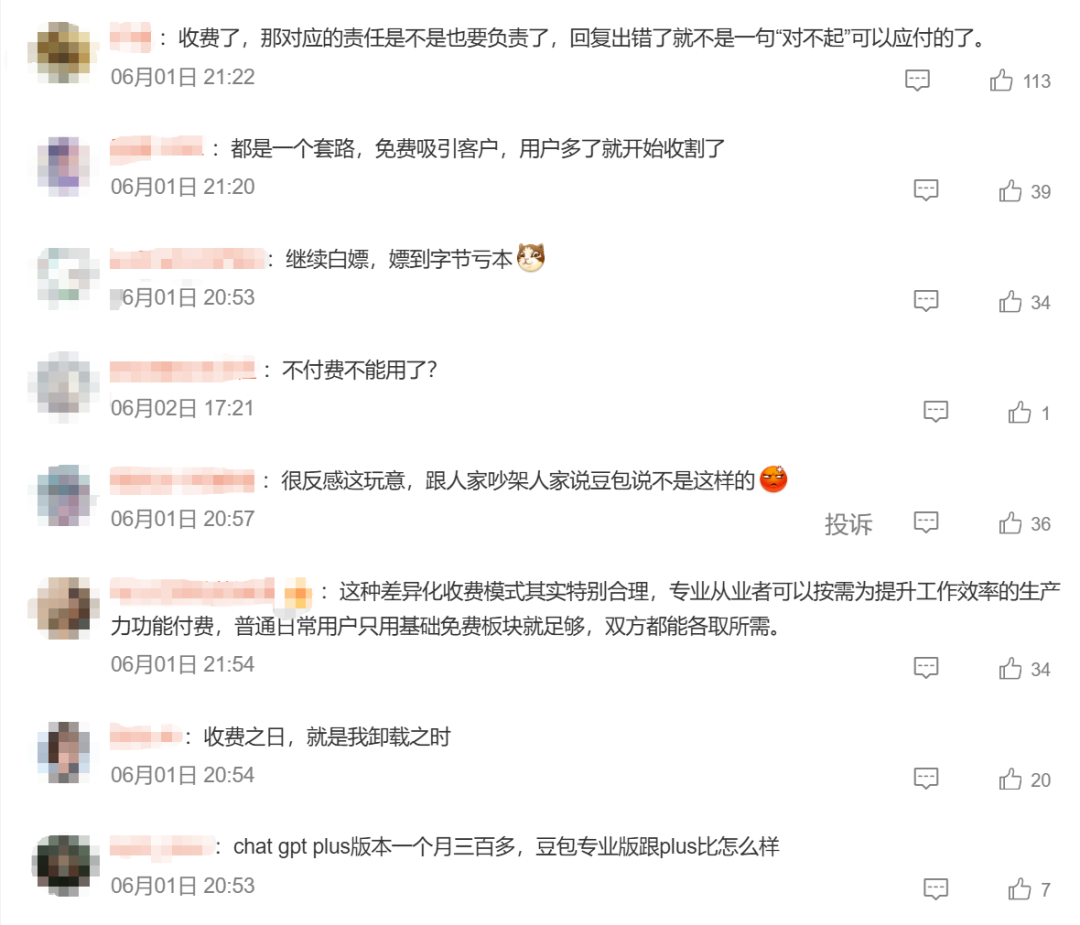
▲ Online discussions under the topic "Doubao Charging" on Weibo
As for AI advertising, at least for now, the model hasn't found a comfortable position. In the search era, a single keyword could generate dozens of links, with a few ads interspersed, leaving users with plenty of search results to compare. AI assistants might only provide three recommendations, and if one of them is a merchant’s ad, it could easily erode user trust.
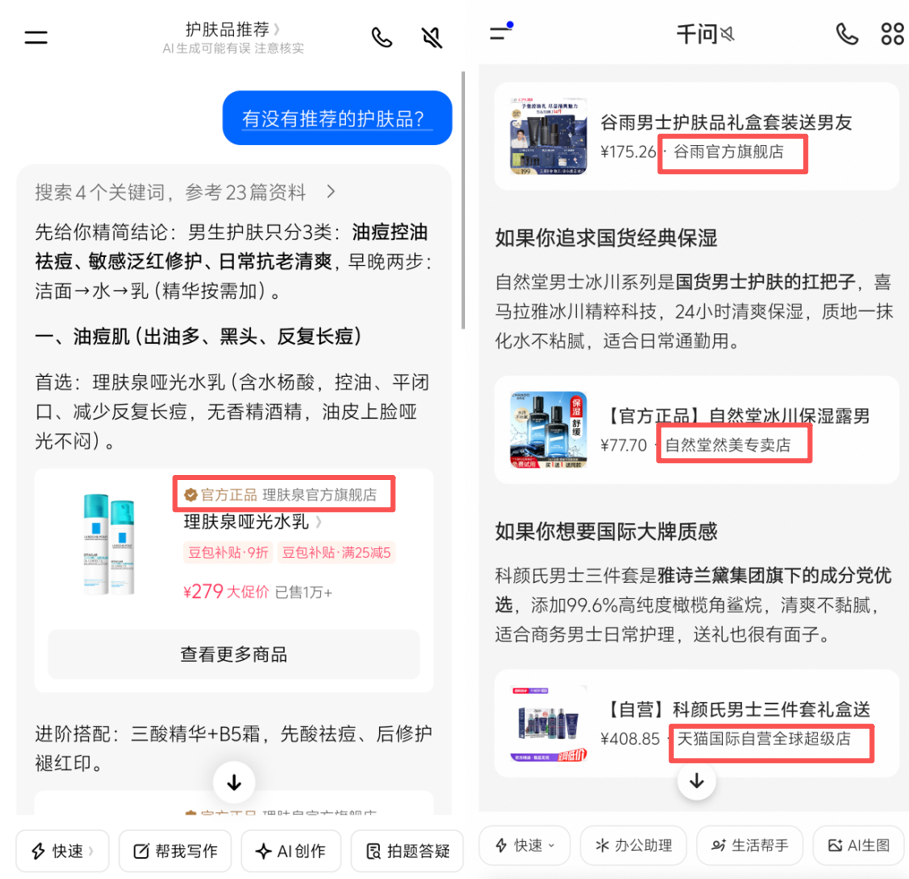
▲ Products recommended by Doubao and Qianwen are available on Douyin Mall and Taobao/Tmall, respectively
This is why leading AI assistants are currently quite restrained with advertising. ChatGPT’s ads deliberately separate commercial content from answers and emphasize that ads won’t affect responses. Perplexity, which experimented with sponsored content earlier, later suspended its advertising business.
This is also the most contradictory aspect of AI assistants: their most valuable asset can’t be freely sold. The closer ads are to the answers, the more likely they are to undermine user trust in the AI assistant.
ByteDance has clearly recognized this. After news spread about earning commissions from hotels, Doubao quickly clarified: currently, its lifestyle services business does not offer paid promotions, and merchants cannot influence hotel recommendations or rankings through payments. They only pay channel service fees after orders are completed.
What Doubao is eager to clarify is precisely the outside association that "AI recommendations equal paid rankings." Under the advertising model, merchants pay for exposure, clicks, or commercial display opportunities. Commissions, on the other hand, do not sell placement in natural recommendations but only charge after a transaction occurs—the third monetization model.
Both involve charging merchants, but the stakeholder relationships are not entirely the same.
The more accurate AI recommendations are, the easier it is for users to make purchases. The more transactions occur, the more likely the platform is to earn higher commissions. At least in this segment of the chain, user experience and platform revenue partially align.
However, in this segment, the merchant supply ecosystem and the data range that AI assistants can cover can also affect the optimality of recommendations.
According to rules announced by Douyin Lifestyle Services at the end of July, local life orders completed through Doubao will be charged as an independent channel. The software service fee for accommodations is 11.4%, plus a 0.6% payment processing fee, totaling approximately 12%. The new policy was originally set to take effect on August 10 but was postponed to August 20 on August 12.
This marks the first time a domestic general AI assistant has separately priced consumer intentions that are understood, filtered, and pushed toward transactions by AI.
For Doubao, earning commissions from transactions could partially cover the enormous computational costs brought by high traffic. For ByteDance’s ecosystem, this approach might have an additional "assist" effect—driving new users and transaction volume to Douyin Lifestyle Services.
A Walmart executive previously revealed to Wired that ChatGPT brings in new customer rates roughly double those from search engines, suspecting this is because ChatGPT’s power users are not typical Walmart customers.
If Doubao’s traffic advantage can continuously translate into transaction volume growth for Douyin Lifestyle Services, theoretically, Douyin Lifestyle Services would form a new gravitational field, attracting more hesitant merchants to join the platform or allocate more resources.
The same logic would apply if future AI assistants like Qianwen adopt a transaction-based commission model.
Of course, whether AI assistants can maintain their commission rates ultimately depends on how much business the channel can bring.
According to the "2026 Mid-Year AI Travel Application Trends Insight Report," 15.2% of surveyed users said they would highly trust AI recommendations and purchase directly, while 66.2% would still verify further after receiving AI suggestions.
02 Just Because AI Assistants Can Recommend Doesn’t Mean They Can Do Business
From an industry development perspective, Doubao is not the first general AI assistant to attempt earning commissions from transactions.
In September 2025, OpenAI launched Instant Checkout in collaboration with Etsy and Shopify. Users could pay directly within ChatGPT after viewing recommendations without leaving the chat window, and merchants would pay OpenAI a commission based on transaction volume. By early 2026, the public fee rate for Shopify merchants was set at 4%.
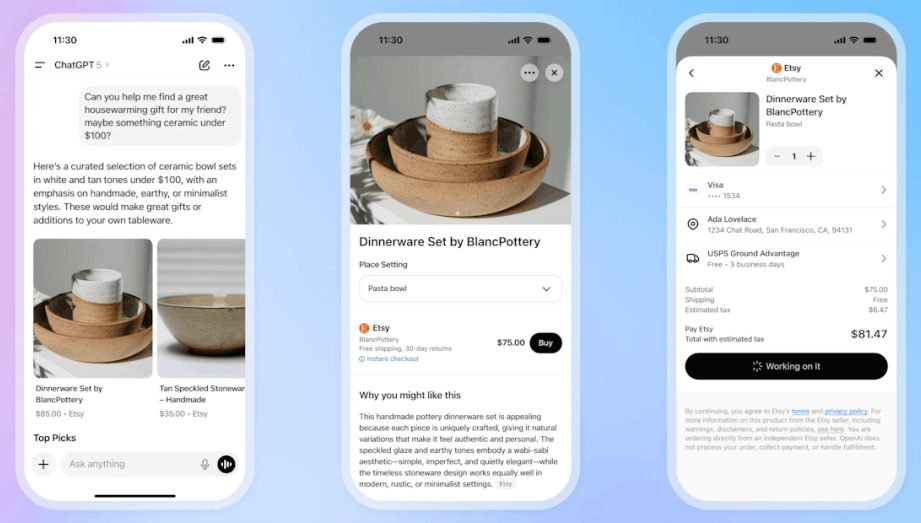
▲ The Instant Checkout interface
But less than six months later, OpenAI hit the brakes. In March 2026, OpenAI announced it would deprioritize in-chat checkout and refocus on product discovery and comparison, leaving checkout more to merchants' own pages and apps. The official reason was that the original model was "not flexible enough."
Because transactions are far more complex than "buy now." Consumers need shopping carts, coupons, loyalty points, and return/exchange services. Merchants also want to retain their payment systems, customer data, and membership relationships. According to Wired, Walmart’s conversion rate for in-ChatGPT checkout was once only about one-third of that for official website products, and users complained about the experience of checking out items individually.
The pitfalls OpenAI encountered are likely unavoidable for domestic AI assistants. To move from "helping you choose" to "helping you buy," AI assistants must still address recommendation quality, data ecosystems, and other issues.
For example, recommendations for local life services like hotels rely heavily on real-time information. Whether rooms are available tonight, how much prices increase on weekends, whether breakfast is included, and how long after booking free cancellation is allowed can all change at any moment. In the lifestyle services category, hotels have relatively high average order values, and consumers rely heavily on guest reviews when making decisions. However, review data is actually an invisible "moat" for OTA platforms, making it difficult for external AI assistants to access.
This points to a deeper issue—the existing internet landscape. Domestic super apps abound, backed by ecosystems from Alibaba, ByteDance, Tencent, and other big tech companies. The same hotel may have different prices, room types, membership benefits, and cancellation policies on Ctrip, Meituan, Fliggy, and Douyin. If AI assistants cannot access real-time supply or review systems from other platforms, even if algorithms strive for objectivity, recommendation results will still have natural limitations.
In other words, general AI assistants are merely a newly embedded layer in the transaction chain. Every AI assistant can claim that its recommendations are unaffected by advertising, but as long as the merchants and services behind them remain "fragmented" across different ecosystems, recommendation completeness depends not just on the model but also on how much supply it can access and the competitiveness of that supply.
From current trends, new collaborations are more likely to emerge domestically. For example, Meituan’s AI Agent "Xiaomei" and JD’s AI Agent have successively integrated with Tencent Yuanbao and WeChat’s AI ecosystem. General AI assistants handle understanding needs and providing traffic entry points, while transaction platforms continue to provide goods and services.
It’s just that, ultimately, general AI may still follow the old internet path. When "middlemen" also have middlemen, merchants can only pay real money for new growth opportunities.
Of course, when only chatting, general AI assistants can require users to verify answer accuracy themselves. But once AI starts facilitating transactions and participating in revenue sharing, the verification cost cannot always be left entirely to users.
Perplexity’s AI shopping feature has exposed such hassles. A journalist once purchased a tube of Walmart toothpaste through the app. The page appeared to complete checkout, and his bank card showed Perplexity as the recipient. Three hours later, he received an email notifying him that Walmart was out of stock and the purchase had failed. The next day, he placed a new order for a different item and waited another eight hours before receiving confirmation of a successful purchase.
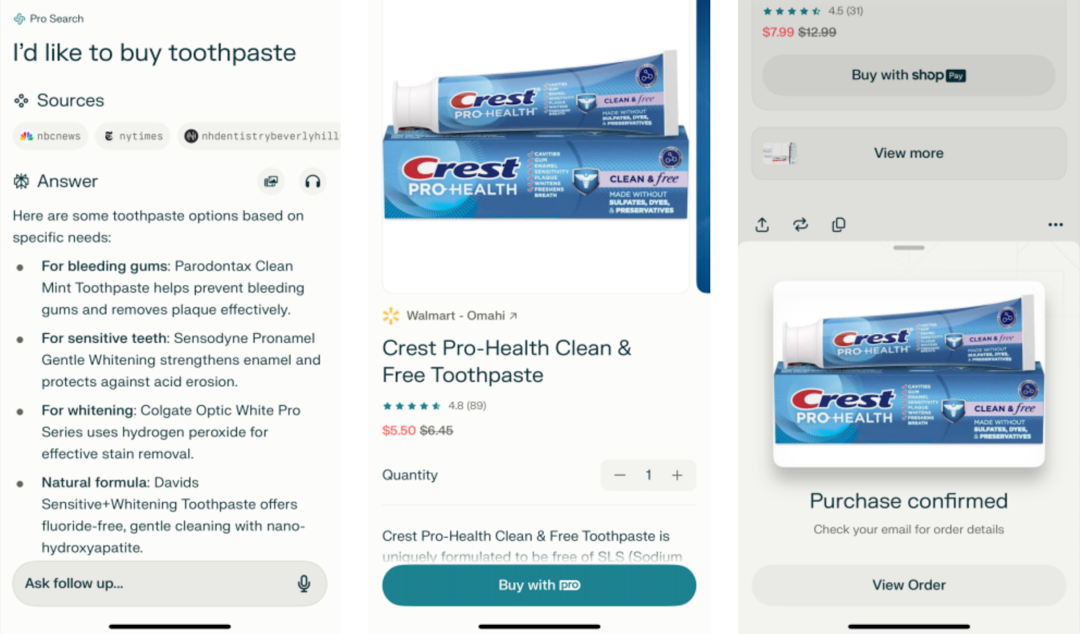
▲ Perplexity’s shopping assistant purchase confirmation process for toothpaste
Source: Perplexity/Maxwell Zeff (screenshot)
The reason is that the product information displayed by Perplexity does not necessarily correspond to real-time inventory. What users complete in the app is not an order instantly confirmed by the merchant but rather an authorization for Perplexity to purchase on their behalf, with the AI agent continuing the process.
Walmart’s self-developed AI assistant, Sparky, has also been criticized for slow response times and frequently providing low-quality replies, leading some consumers to deem it unreliable.
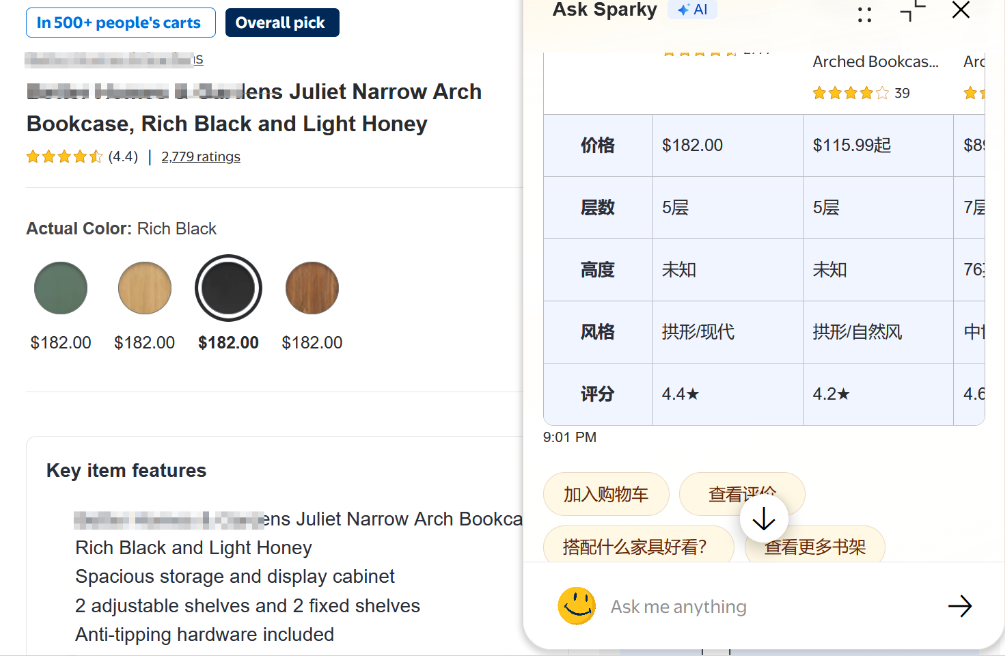
▲ Walmart’s Sparky AI product inquiry page
If the business model of general AI assistants is to move forward, recommendation quality and responsibility must improve. They should even learn from the experiences and lessons of mobile internet platforms, placing responsibility upfront from the moment the business model is established.
-
![]()
Can L1, the Shargeek AI Glasses That Once Stopped Production Voluntarily, Make a Resurgence? A Firsthand Account
-
![]()
Latest US Consumer Car Purchase Report: Seats and Driving Assistance Top Picks, Auto Parking Makes Debut on List
-
![]()
Chengdu Auto Show Preview: Xiaomi and AITO Take Diverse Approaches, Leaving NIO as the Lone BEV Purist
-
![]()
Is It Worth It for CATL to Acquire Zhongheng Electric for 4.1 Billion?
-
![]()
After 315 Exposed AI Data Manipulation, Someone Finally Unveiled the Inner Workings of the GEO Industry
-
![]()
Cows Vanish from the Grasslands, While Digital Tokens Soar with the Wind
-
Buffett Goes All-In with Billions, Duan Yongping Halves Positions: Who Misjudged Google?
-
![]()
Li Shufu’s Swansong Financial Report: Two Words Capture the Essence – Global Expansion