Tencent's Colossal Investment in AI
 08/20 2026
 564
564
Source | Bohu Finance (bohuFN)
Author | Lu Fei
After a relatively restrained spending spree in the first quarter, Tencent unleashed its financial prowess in the second quarter.
Following the close of the market yesterday, Tencent unveiled its Q2 financial results, revealing a staggering jump in capital expenditure to RMB 52.8 billion. This figure represents 26% of its total revenue and far exceeds market expectations of RMB 32.14 billion. When factoring in the RMB 51.4 billion in prepayments for computing power procurement made during the same period, Tencent's total capital expenditure for Q2 soared to RMB 100 billion.
This amount not only sets a new record for Tencent but also marks an unprecedented level within the industry. For comparison, in Q1 of this year, Tencent's capital expenditure was RMB 31.9 billion, a 16% year-over-year increase and already a record high for a single quarter, especially considering that Tencent's total expenditure in this area last year was only RMB 79.2 billion. In contrast, Alibaba and ByteDance's annual AI-related procurement amounts to approximately RMB 120 billion and RMB 160 billion, respectively.
This indicates that Tencent is essentially going all-in on AI.
Previously, we've noted that while Tencent is arguably the internet giant with the strongest fundamentals, its relatively modest investment and progress in AI have hindered the fair reflection of the valuation of its traditional internet businesses in the secondary market. As of the end of June, Tencent's stock price stood at HK$429, down nearly a third from its high of HK$633.7 at the beginning of the year. Despite a rebound from oversold levels in the second half of the year, the sustainability of this recovery remained weak, especially considering that Tencent has allocated significant cash for share buybacks.
This year, Tencent has made notable strides in AI. After officially announcing its AI strategy led by Yao Shunyu at the end of last year, Tencent finally made significant progress. The release of Tencent Hunyuan on July 6 showcased that with a smaller parameter size, it achieved capabilities comparable to larger-parameter models. This demonstrated that under Yao Shunyu's leadership, Tencent has found its path in foundational model R&D. WorkBuddy is at the forefront of AI productivity tools, with several agent products such as WorkBuddy, CodeBuddy, Xiaowei, QClaw, and Marvis already in internal use.
Frankly speaking, achieving this progress in just half a year is commendable for Tencent, but it's clearly not enough to alter external perceptions.
On the one hand, under the weight of massive expenditures, Tencent's free cash flow in Q2 turned negative for the first time since its listing, hitting negative RMB 13.8 billion. This prompted President Martin Lau to specifically explain that the company's AI investments are primarily focused on AI infrastructure. He emphasized that even in the worst-case scenario, these infrastructures could be leased out through Tencent Cloud, and he added, "If returns fall below expectations, we will adjust the scale of our investments."
Nevertheless, the secondary market remained unsettled. Yesterday, at the close of the Hong Kong stock market, Tencent Holdings fell by 4.46%, with its market capitalization at HK$4 trillion (approximately RMB 3.44 trillion), ceding its top spot to Changxin Technology.
On the other hand, as the AI competition intensifies in the second half, the upper limit of model intelligence remains the most critical factor affecting AI business valuations. Zhipu and Kimi have benefited from this, while Minimax has been dragged down. Although ByteDance is also relatively lagging in large language model R&D, recent reports suggest it is preparing to train models with 5 trillion or even 10 trillion parameters. Given the current pace of model iteration and Google's progress in large model R&D, Tencent must unveil a compelling model by the end of the year at the latest.
Can Tencent continue to deliver results in foundational models? Can it maintain or even profit from its leadership in application layers? Can its traditional businesses withstand the pressure of supporting AI investments? These are the questions Tencent needs to answer.
While the secondary market is highly sensitive to Tencent's negative free cash flow, given its current cash-generating ability, Tencent can sustain 2-3 years of large-scale AI investments without issue.
On the one hand, although AI investments have thinned Tencent's free cash flow, with net cash decreasing by 60% compared to the end of March, its cash reserves remain substantial. Financial reports show that as of June, Tencent's cash and cash equivalents stood at RMB 206.93 billion, up 46.7% from the end of 2025.
On the other hand, Tencent's core business remains robust.
Over the past few years, Tencent Games has dominated the market, particularly in strategy and shooting genres. Quest Mobile's semi-annual report on China's mobile gaming industry reveals that Tencent secured the top five spots in the shooting genre, with the monthly active users (MAUs) of Delta Force, ranked first, equaling the sum of the second to fifth-ranked games. Among new mobile games launched this year, the only blockbuster, Roco Kingdom World, is also a Tencent title. In the ranking of heavily active users, six out of the top 10 games are Tencent's, with Honor of Kings leading the pack.
Meanwhile, although the gap in user time share among China's top apps between Tencent and ByteDance has widened further, Tencent has still made progress. In Q2, WeChat had 1.439 billion users, a net increase of 7 million quarter-over-quarter; QQ had 520 million users, a net increase of 4 million quarter-over-quarter. Additionally, the total usage time of WeChat Channels in Q2 increased by over 20% year-over-year.
Under these circumstances, AI is helping Tencent improve the efficiency of its marketing business. In Q2, Tencent's marketing services revenue reached RMB 43.565 billion, a 22% year-over-year increase, approximately 2.7 times the industry average growth rate.
Overall, Tencent's revenue reached RMB 204.785 billion, an 11% year-over-year increase and a 4% quarter-over-quarter increase. Non-IFRS operating profit was RMB 75.636 billion, a 9% year-over-year increase and flat quarter-over-quarter.
Tencent also disclosed a new metric: products like models, Yuanbao, Xiaowei, and WorkBuddy collectively incurred a net loss of RMB 10.5 billion. Excluding the impact of new AI products, Tencent's Non-IFRS operating profit in Q2 increased by 19% year-over-year to RMB 86.1 billion. This means the actual cost of supporting the AI business accounts for only a small portion of Tencent's profits, so spending is not an issue.
Latest data from Cloudflare shows that as AI agents mature, AI-generated robot traffic on the internet has officially surpassed human traffic, accounting for 57.4%, with human traffic dropping to 42.6%. This turning point arrived more than three years earlier than industry expectations.
This signifies that AI has truly reached a point where it could disrupt the mobile internet's business model—by solving practical problems rather than simply engaging in dialogue and Q&A.
At Tencent's AI Industry Conference in June this year, Yao Shunyu stated that models are increasingly adept at transforming complex inputs into outputs, and often, a company's competitive edge lies in whether it possesses the most original inputs.
In other words, model capabilities are sufficient; what matters is having good questions.
This happens to be Tencent's strength, as exemplified by the internal development of WorkBuddy.
As early as 2022, Tencent began investing in AI Coding and released the programming tool CodeBuddy in 2024, which is now used by over 90% of Tencent's engineers.
However, the CodeBuddy team soon realized that while CodeBuddy was designed for programmers, non-programmers would be intimidated by a screen full of code. The next challenge was how to provide ordinary users with an "out-of-the-box" AI workstation.
Thus, Tencent extended CodeBuddy into WorkBuddy—an agent product for users who cannot code. Before its official public beta, over 2,000 non-technical employees were already using it daily. This gave WorkBuddy an AI Native characteristic: simple to operate yet capable of directly manipulating computer files and automating tasks.
Thanks to Tencent's ecosystem, WorkBuddy can easily integrate with products like Tencent Docs, IMA, and Tencent Meeting, allowing it to quickly meet office demands across various scenarios.
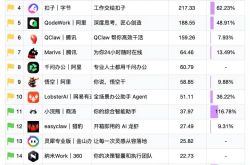
According to an Analysys report, Tencent dominates China's AI office intelligent agent market, with WorkBuddy ranking first in traffic, surpassing the sum of the second and third-ranked products. Second is ByteDance's TRAE IDE (domestic version), and third is Alibaba's QoderWork.
Models, products, scenarios, and ecosystems are interlocking like gears, maximizing Tencent's capabilities.
On the one hand, Tencent is leveraging its rich C-end scenarios to build an agent matrix.
Besides WorkBuddy and CodeBuddy, Tencent also has the WeChat-native AI assistant Xiaowei, QClaw for remote computer control via IM platforms like WeChat, and Marvis, a system-level PC operation agent, covering multiple niche scenarios including office work and social networking.
On the other hand, the massive usage and user feedback generated by agent products provide crucial data for improving model capabilities. Taking WorkBuddy as an example, when users call Hunyuan through WorkBuddy, vast amounts of real-world demands are transformed into data on context, toolchains, and interaction methods, thereby feeding back into model improvements.
This is why, during the earnings call, Chief Strategy Officer James Mitchell emphasized that the current top priority for capital expenditure is training larger and better Hunyuan models in the coming months; the second crucial use is providing inference computing power for models like Hunyuan and DeepSeek, which powers WorkBuddy.
Making money is the least important concern right now.
Currently, external doubts about Tencent stem from the certainty that AI investments will erode profits, while AI outputs remain uncertain. To some extent, these doubts arise from Tencent's competitive disadvantage due to its late start.
In the AI battle among tech giants, cloud is the entry ticket, foundational models are the ceiling, and application gateways are the monetization gates.
Alibaba made significant investments early on, leading in both Qwen models and Alibaba Cloud. Although ByteDance is slightly behind in large language model progress, Doubao is already the top chatbot in China, and its video generation model, Seedance, has become SOTA, forming a closed-loop business. Volcano Engine leverages its own AI demands to achieve both scale and rapid iteration.
Tencent lacks an advantage in cloud, as computing power must prioritize its own model training; foundational models still require time for catch-up and iteration.
Tencent cannot provide better answers to these challenges in the short term, but fortunately, it still has time to catch up.
Reference Sources:
1. Tencent Financial Reports
2. Xinmei: Tencent's AI Flywheel is Spinning
3. Bohu Finance: Is Tencent's AI on the Right Track?
The cover image and accompanying illustrations of the article are owned by their respective copyright holders. If the copyright owners believe that their works are unsuitable for public browsing or should not be used without compensation, please contact us promptly, and our platform will make immediate corrections.
-
![]()
Baidu’s WorkBuddy: Beyond Task Completion, Toward Trusted Automation
-
![]()
Bu Yizhou from Junyuan Capital: The Allure of Commercial Space Investment Transcends Mere Rocket Recovery Success
-
![]()
Avita Seeks Independence from Huawei
-
![]()
Li Shufu 'Steps Down,' Handing Over Reins to 30-Year Geely Veteran An Conghui
-
HONOR Incorporates 'DJI-Inspired' Tech into Smartphones: Hype Surpasses Actual Sales
-
![]()
HUWEI and i16 Pro Are Flying Off the Shelves! The Return of Counterfeit Phones—Are Soaring Memory Prices to Blame?
-
It's Not Too Late to Re-Understand Baidu AI
-
Tencent's Colossal Investment in AI