Sora Exits, Domestic Models Rise: The 'Turning Point' in AI Video Generation
 08/20 2026
 339
339
In March 2026, OpenAI officially bid farewell to Sora. The 'rainy night in Tokyo' that once kept Hollywood awake became a shutdown notice a year and a half later. Meanwhile, Kling surpassed 100 million global users, Wan3.0 entered public beta, Seedance2.5 was launched, and MiniMax H3 went open-source—domestic models didn't just dethrone Sora but built upon its unfinished path, shifting from 'building guns' to 'hitting targets.' The second half of AI video isn't about flashy demos but integration into workflows, invoicing capabilities, and cost reduction.
Original Entropy AI New Tech Team
On March 25, 2026, OpenAI posted 'Goodbye, Sora' on X.
No press conference, no lengthy letter—just a thank-you to user-created works and a shutdown schedule announcement.
This came just 178 days after Sora 2's standalone app went viral, hitting 1 million downloads in five days.
A year prior, the world marveled that 'directors might lose their jobs'; a year later, Silicon Valley retracted video generation from consumer-grade platforms, reallocating budgets to 'world models' and robotics R&D.
This isn't a failure of AI video but the closing argument of the 'stunt era.'

Sora's Exit: Defeated Not by Rivals, But by the 'Cost-Retention-Compliance' Trilemma
Labeling Sora's demise as 'domestic competition winning' is a lazy misinterpretation.
The true causes of Sora's downfall were three simultaneous cuts:
The first cut: cost. Estimates put daily operational costs in the tens of millions of dollars, with monthly compute expenses exceeding $10 million. Free user quotas were slashed from 30 to 6, yet it remained a 'money pit.'
The second cut: retention. December 2025 downloads dropped 32% month-over-month, followed by a 45% decline in January 2026. Thirty-day retention stood at 1%, approaching zero at 60 days—users marveled once but refused subscriptions for blind-box-style outputs.
The third cut: compliance and copyright. Celebrity face-swaps, Disney IP abuse, and tightening regulations worldwide led to Disney's $1 billion funding plan vanishing alongside the terminated partnership.
More fatal was the controllability gap: requests for 'pan left' yielded random screen shakes; demands for 'consistent protagonist faces' resulted in changes every three frames. In professional workflows, such irreproducibility equals zero commercial value.
 ▲Figure/OpenAI's official social media platform
Thus, Sora's epitaph isn't 'defeated by Chinese rivals' but:
Its technical ceiling was high, yet 'deliverability' was distant; demos were dazzling, yet 'reimbursability' was elusive.
OpenAI's shift to robotics and world models admits—the standalone model approach for consumer-grade AI video has stalled.

Domestic Trifecta: Kling Drives Revenue, Alibaba Builds Ecosystem, ByteDance Cuts Costs
In the same quarter as Sora's exit, three distinct domestic paths emerged, united only by a focus on daily active users, annual recurring revenue (ARR), and integration into tools like Photoshop and CapCut—not 60-second demos.
Kling AI: Monetizing the model. Kuaishou's Kling generated RMB 650 million in Q1 2026 (+300% YoY) and RMB 850 million in Q2 (+200% YoY). By June, it had 100 million global users across 224 countries, nearly 50,000 enterprise clients, and ARR nearing $500 million.
Kling 3.0 Omni adopted an All-in-One workflow for text/image/audio/video, with native sync, multi-angle storytelling, and subject consistency—targeting advertising, e-commerce, and brand videos where 'visual quality drives sales.' It proved domestic models don't need to outperform Veo in every metric but must first secure creators' invoice details.
Alibaba: Dual-model strategy. Wan3.0 (Tongyi Wanxiang) launched public beta in August 2026, offering 30-second direct outputs with doc/xls/ppt/pdf inputs. Pricing was set at RMB 0.3/0.6/1.2 per second for 480P/720P/1080P, integrating video generation into office and courseware production. HappyHorse pursued a flagship position, ranking top-tier in Artificial Analysis's visual quality metrics for branded short dramas.
One for shelves, one for leaderboards—Alibaba aimed to close the loop from Qianwen creation to Alibaba Cloud's full-stack solutions.
ByteDance Seedance 2.5: The silent occupancy rate (market share) champion. Launched on July 31, it featured 30-second native outputs, 50 full-modal references, precise local editing, and millisecond timestamp control. Volcano Engine's API followed with price cuts for Seedance 2.0 mini/fast. XCMG, XPeng, and Lingchu Intelligence integrated it into embodied AI and autonomous driving previews.
ByteDance's strategy wasn't 'wow factor' but leveraging Douyin's data and Volcano's compute to slash prices, making it affordable for SMEs and integrable into enterprise workflows.
Summarized in one line:
Kling proved profitability, Alibaba proved ecosystem integration, and ByteDance proved cost-effective industrialization—areas where Sora fell short.

From 'Benchmark Bragging' to 'Monetization Mastery': H3's Open Source—A Democratization and Reshuffle
On July 31, 2026, MiniMax launched H3; on August 3, H3-Base went open-source on Hugging Face.
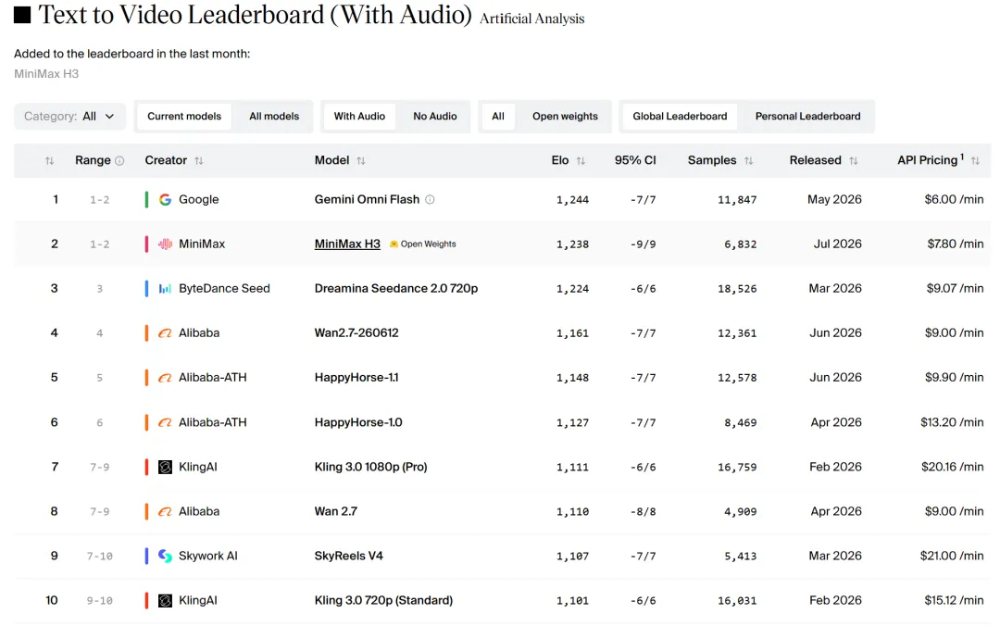
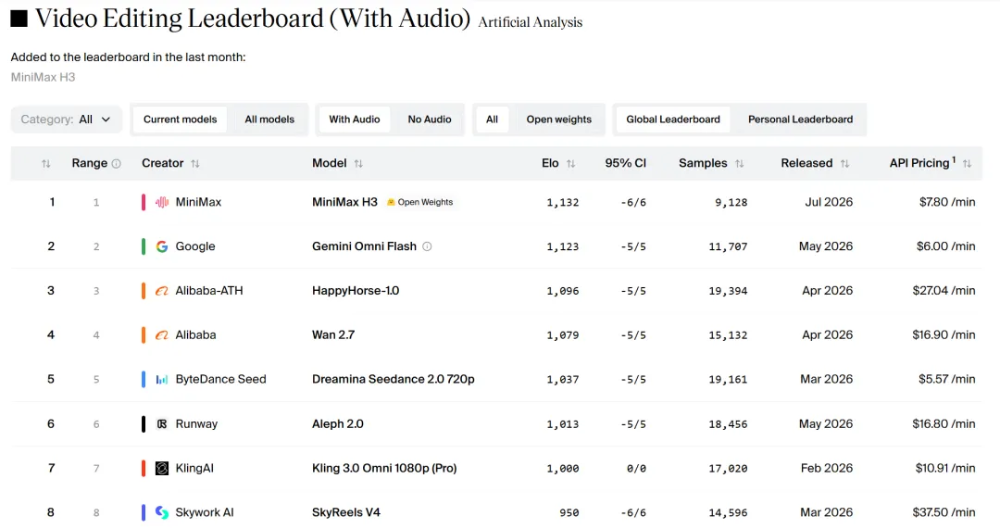
Featuring 2K resolution, 15-second outputs, native stereo sound, and unified text/image/audio/video contexts, it ranked first globally in Artificial Analysis's video editing metrics at one-third the price of flagship rivals ($0.8/second at 2K).
Ascend, Mu Xi (Moore Threads), Moore Threads, vLLM, and ComfyUI adapted it on the same day—was this the 'DeepSeek moment' for domestic video models? Not entirely. DeepSeek democratized language reasoning; H3 democratized localized deployment of industrial-grade video foundations.
 ▲Figure/Iterative AGIBut New Entropy's assessment is colder:
Open-sourcing isn't charity—it's MiniMax's pivot when closed-source API price wars stalled, using community ecosystems to gain entry into enterprise private deployments. SMEs save on inference costs; MiniMax secures an ecosystem niche in the 'domestic video PyTorch moment.'
Zooming out, the 2026 inflection point redefined evaluation criteria:
First half: Compare parameter counts, Benchmarks, and Twitter demo shares.
Second half: Compare integration into CapCut's timeline, Qianwen's doc-to-video conversion, ARR authenticity, and invoice-ready customer support.
A monetizable video requires passing script, storyboard, asset reuse, version control, and compliance watermarking—single-point models solve only the first hurdle.
Domestic vendors' collective strength lies not in 'more realistic frames' but in embedding models into pipelines serving 224 countries, 50,000 enterprises, and Douyin E-Commerce's daily millions of assets—while remaining operational, manageable, and profitable.
On the day Sora exited, OpenAI didn't name Chinese rivals.
It mentioned 'reallocating compute to world models.'
That same week, Kling reported RMB 850 million in revenue in Kuaishou's earnings, Alibaba Cloud published Wan3.0's pricing, ByteDance's Volcano Engine saw rising Seedance 2.5 API calls, and MiniMax H3 topped Hugging Face's trending charts.
While the world argued over 'rifle sights,' Chinese vendors positioned guns on assembly lines, targeting 'short videos, e-commerce detail pages, corporate promos, and industrial previews.'
The 'China Moment' in AI video isn't a slogan.
It's in quarterly revenue growth, API pricing, and the icons permanently docked on creators' desktops.
References:
Volcano Engine's Seedance 2.5 launch (July 31, 2026), Economic Information Daily (August 7, 2026)
Guangming Net/The Paper (March 25, 2026) 'OpenAI Announces Sora Shutdown' (cost/retention data)
Alibaba Cloud's Wan3.0 public beta announcement (August 6, 2026), Artificial Analysis HappyHorse leaderboard
Xinhua Net (March 27, 2026) 'OpenAI to Intensify World Model Research' (Sora's exit and Disney partnership termination)
Kuaishou's Q1/Q2 2026 earnings, China Securities Journal (June 5, 2026) Kling's 2nd-anniversary data (100M users/ARR $500M/Q1 RMB 650M/Q2 RMB 850M)
MiniMax's H3 launch (July 31, 2026)/open-source (August 3, 2028), CNR (August 6, 2026) open-source ecosystem adaptations
- END -
-
![]()
NIO, Huawei, and Li Auto are All Talking About the 'World Model'. Where Are the Differences?
-
![]()
50,000-Yuan Cars Face Sluggish Sales, While Those Priced Over 400,000 Yuan Sell Like Hotcakes—Is Wealth Really on the Rise?
-
![]()
Sora Exits, Domestic Models Rise: The 'Turning Point' in AI Video Generation
-
In-depth: Kimi K3 Unveils the Chaoshan Tech Innovation Cluster, as Traditional Business Group Adopts a New Approach
-
![]()
Anthropic Sprints Towards Largest IPO in History, 'Silicon Valley's First Lady' Emerges
-
![]()
Seedance 2.5 is Here, But Is the Industry Really Ready?
-
![]()
July Sees Penetration Rate Rebound to 34%, Boosting New Energy Sanitation Vehicle Replacement
-
![]()
Certain Automakers Opt Out of This Year’s Chengdu Motor Show Once Again