July Sees Penetration Rate Rebound to 34%, Boosting New Energy Sanitation Vehicle Replacement
 08/20 2026
 327
327
Propelled by the ongoing policies aimed at transforming urban sanitation into a greener model, the electrification of domestic new energy sanitation vehicles is steadily progressing. From January to July 2026, monthly industry sales data, the competitive landscape among enterprises, details on mainstream operational vehicle models, and information on key deployment cities have been released sequentially. These releases comprehensively illustrate the sector's phased development characteristics (this term is retained as it appears to be a specific industry term).
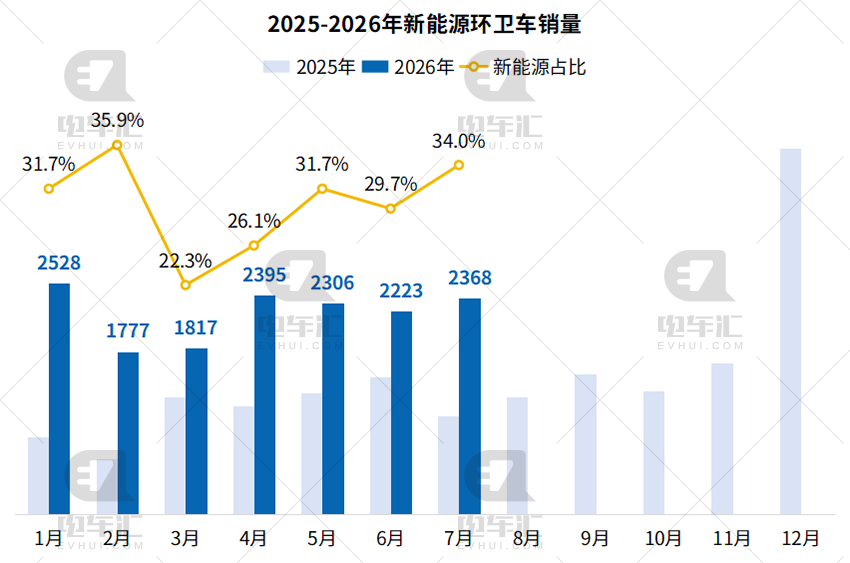
Sales of New Energy Sanitation Vehicles in 2025-2026
Based on terminal sales statistics from Dianchehui, a comparison of new energy sanitation vehicle sales from January to July in 2025 and 2026 reveals that market demand in 2026 has been steadily released. January saw the highest monthly sales for the year, with 2,528 units sold, followed by a dip to 1,777 units in February. From March to June, sales remained stable, ranging between 1,817 and 2,395 units. In July, sales reached 2,368 units, with the penetration rate of new energy vehicles in the overall sanitation vehicle market rebounding to 34%, thus ending the previous two-month decline in penetration. The industry's electrification process is now back on an upward trajectory, with the replacement of fuel-powered sanitation vehicles continuing to gather pace. In the first seven months of this year, the market penetration rate of new energy sanitation vehicles fluctuated between 22.3% and 35.9%, indicating a clear overall trend towards electric replacement in the industry.
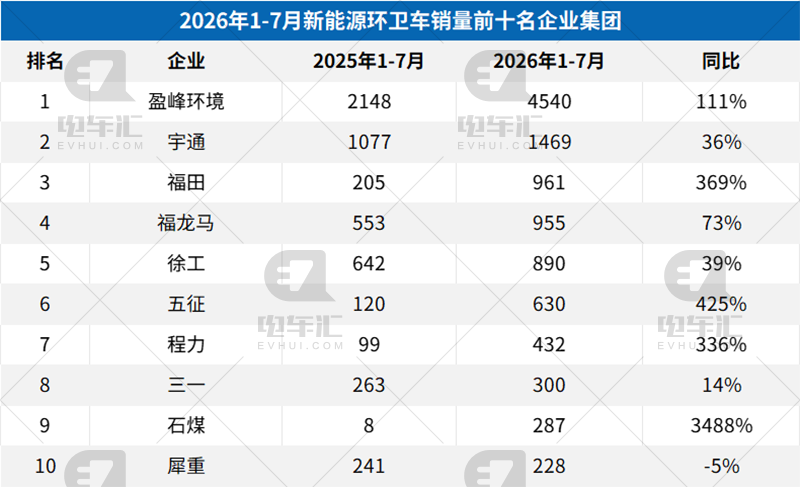
Top 10 Enterprise Groups in New Energy Sanitation Vehicle Sales from January to July 2026
In terms of enterprise competition, the top 10 list for new energy sanitation vehicle sales from January to July 2026 shows significant differentiation. Leading companies have maintained a strong position, while several manufacturers have experienced explosive growth. Yingfeng Environment led the industry with accumulated sales of 4,540 units, up 111% year-on-year. Yutong ranked second with 1,469 units, while Foton and Fulongma reached 961 and 955 units, respectively, ranking third and fourth. In terms of growth, Shimei saw a year-on-year increase of up to 3,488%, while Wuzheng, Chengli, and Foton all exceeded 300% year-on-year growth, demonstrating strong growth potential. Only Xizhong experienced a slight decline in sales, down 5% year-on-year. Traditional equipment leaders have maintained their core markets, while second-tier companies have achieved rapid breakthroughs through the electrification track, making the market competition even more intense.
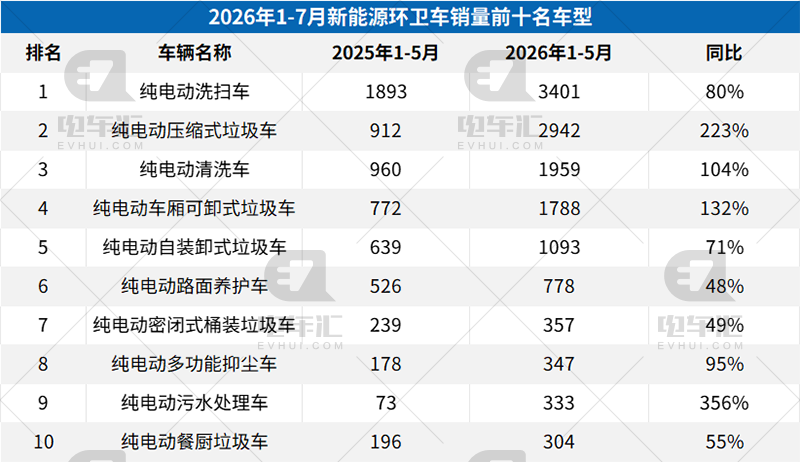
Top 10 Vehicle Models in New Energy Sanitation Vehicle Sales from January to July 2026
In terms of vehicle model structure, pure electric products dominated the top ten categories in sales, covering all operational scenarios in sanitation. Pure electric sweepers accumulated sales of 3,401 units, up 80% year-on-year, representing the highest market demand. Pure electric compressed garbage trucks surged 223% year-on-year, ranking second with 2,942 units. Pure electric sewage treatment vehicles saw a 356% year-on-year increase, showing strong growth momentum, while pure electric detachable container garbage trucks rose 132% year-on-year. The data indicates that road sweeping and waste transfer remain the core scenarios for electrification transformation, with synchronized release of electrification demand in specialized vehicle segments such as sewage treatment and dust suppression.
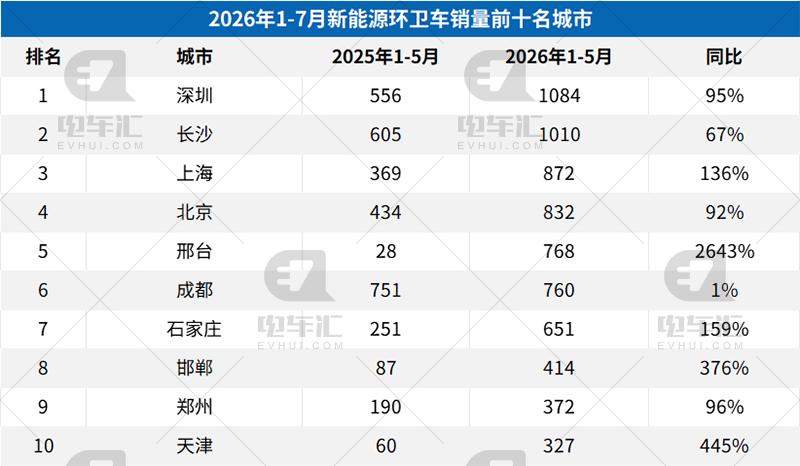
Top 10 Cities in New Energy Sanitation Vehicle Sales from January to July 2026
In terms of regional markets, from January to July 2026, the deployment of new energy sanitation vehicles was concentrated in first-tier and emerging first-tier cities, with multiple northern cities entering a procurement window. Shenzhen, Changsha, Shanghai, and Beijing all exceeded 800 units in cumulative sales, becoming core markets for new energy sanitation equipment. Among them, Xingtai surged 2,643% year-on-year, while Tianjin and Handan saw increases of 445% and 376%, respectively, indicating accelerated electrification updates of sanitation fleets in northern cities. Chengdu's market approached saturation, growing only 1% year-on-year and entering a phase of stock replacement. Overall, first-tier cities continued to increase their procurement efforts, while second-, third-tier, and northern cities gradually released incremental orders, further broadening the market growth potential. Based on comprehensive data, driven by policy incentives and the replacement cycle of aging vehicles, the growth trajectory of the new energy sanitation vehicle sector remains highly certain. Subsequently, as green urban construction initiatives continue to roll out across regions, procurement demand for pure electric sanitation equipment is expected to sustain its release, with industry competition further intensifying around product technology, supporting operations and maintenance, and localized services.
-
![]()
NIO, Huawei, and Li Auto are All Talking About the 'World Model'. Where Are the Differences?
-
![]()
50,000-Yuan Cars Face Sluggish Sales, While Those Priced Over 400,000 Yuan Sell Like Hotcakes—Is Wealth Really on the Rise?
-
![]()
Sora Exits, Domestic Models Rise: The 'Turning Point' in AI Video Generation
-
In-depth: Kimi K3 Unveils the Chaoshan Tech Innovation Cluster, as Traditional Business Group Adopts a New Approach
-
![]()
Anthropic Sprints Towards Largest IPO in History, 'Silicon Valley's First Lady' Emerges
-
![]()
Seedance 2.5 is Here, But Is the Industry Really Ready?
-
![]()
July Sees Penetration Rate Rebound to 34%, Boosting New Energy Sanitation Vehicle Replacement
-
![]()
Certain Automakers Opt Out of This Year’s Chengdu Motor Show Once Again